

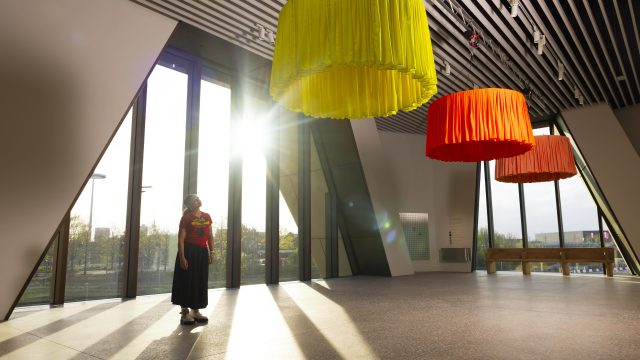
For New Work: Making East London, architect Shahed Saleem has produced I Was Born Here, a series of three hanging fabric pieces, hanging underneath the Torrijos Ceiling at V&A East Storehouse. In this interview, he discusses how his work reflects on histories of movement, and how cultural resilience is carried across time, place and material.
Can you give us a summary of what your practice is about and the questions and ideas that guide your work?
I would describe my practice as interdisciplinary, varying across architectural-scale installations, drawing, writing, and collaborative co-production work.
I am interested in how histories, cultures, and ideas move with people across time and geography. I look at how migrating communities carry their cultures and histories with them as they move across time and place. I like to view time spatially, as a kind of landscape, where ideas change, translate, and shift as people move from one geographical point to another. I’m interested in the fluidity of culture and identity, how the present is a continuously shifting series of historical, cultural, and experiential layers.
How did you come to think of that specific framing via architecture, and what were the main influences that shaped this worldview?
This framing largely stems from my personal experience of growing up within an immigrant household. Within that environment, you are constantly crossing between different cultural and historic spaces, but more importantly, you are navigating entirely different epistemological spaces. You are moving between distinct ways in which the world and its values are fundamentally constructed. This regular transition between epistemological realms is a profound experience of dislocation that one must learn to navigate.
Architecturally, the big turning point for me happened when I noticed the disconnect between the visual registers taught in design school and my own background. In the academy, you learn a specific institutional set of cultural values defining what constitutes “good” design or visual culture. Yet, alongside that, I was witnessing immigrant communities creating an entirely alternative manifestation of beauty and design based on their practical needs and their own aesthetics. I began to see their grassroots aesthetic practice not just as a folk or vernacular design language, but as a vital form of cultural resilience and resistance against the erasure of their histories and lived experiences.
You have produced a new commission for us consisting of three large fabric pieces. Can you provide a description of what these pieces are?
The commission consists of three large, appliqué fabric pieces that are stitched together using materials largely sourced from Queen’s Market on Green Street in East London. Visually, they are bold, vibrant, and highly decorative. This bold aesthetic choice is informed by South Asian visual cultures and histories, and utilizing this language is my way of continuing a creative resistance against the historical erasure of migrant communities. Broadly speaking, the overarching narrative of the work is about immigration control in East London, examining how the state creates and enforces forms of bordering and legislative hostility, and how that is physically felt on local streets, workplaces, and landscapes.
What originally struck you about the historic Torrijos ceiling, and how did its history inform the direction of this project?
I began researching the ceiling’s origins and its historical context. My research quickly took me to the 1490s, specifically 1492—a pivotal moment marked by the fall of Granada and the end of the Muslim presence in Spain. The ceiling originally belonged to a palace owned by Gutiérre de Cárdenas and his wife Teresa, courtiers to the Catholic Monarchs Ferdinand and Isabella.
Looking into this timeline revealed a dark, violent period of Spanish history. Prior to this, the Iberian Peninsula experienced centuries of pluralism and cosmopolitanism, where Muslims, Jews, and Christians coexisted within multicultural states. That pluralistic era was violently dismantled in the 1490s to enforce a homogenous Catholic identity through brutal inquisitions and the forced expulsion of Jews and Muslims.
It took very little effort to see a direct reflection of that dark history in our contemporary climate. There is a terrifying resonance between those 15th-century actions and the rise of highly nationalistic, right-wing, and fascistic tendencies within the contemporary West.
When I finally saw the physical ceiling installed in situ within the storehouse, I had a sudden realization of the sheer scale and historical weight of the space. Spatially, the ceiling has an immense visual and historical impact. I realized that my responding work could not be small or timid; it needed a powerful physical and emotional presence to balance out the space. To successfully coexist with the ceiling, my pieces had to possess enough structural and thematic integrity to step up and meet the mark.
You mentioned sourcing materials from Queen’s Market on Green Street. Can you expand on how East London’s local textile histories shaped this work?
East London is a fluid place defined by shifting layers of migration, labour, shipbuilding, and industrial history. Migrant communities have settled here, worked here, and actively built the very fabric of East London. The textiles for these pieces are sourced from Queens Market and a specific haberdashery stall there that has been trading for some 50 years, run by a family of Indian origin.
This choice was deliberate because textiles have always been a foundational pillar of East London’s productive landscape. Long before South Asian or Bangladeshi communities became heavily involved in the local garment and fabric trades, Jewish immigrant communities dominated the textile industry. And before them, French Huguenots settled in the area as master silk weavers.
For half a century, this particular market stall has provided the buttons, borders, threads, and materials that sustained a plethora of local micro-businesses, tailors, seamstresses, and fabric workers. By using this retail infrastructure to create my artwork, the pieces are tied to the lineage of manufacturing in the area. Furthermore, the exact types of vibrant materials and trimmings available at the market directly dictate and flavour the visual aesthetics of the final tapestries.
We held a workshop session with our Youth Collective. Were there any interesting takeaways from those discussions?
I thoroughly enjoyed engaging with the Youth Collective. It was actually the very first time I presented the concepts of this new work to an outside group, making it an invaluable litmus test. Because the members of the collective are deeply embedded within East London, their feedback offered a crucial sense check on whether the ideas would successfully land with an audience that lives and breathes the culture of the area.
Their reception was incredibly positive and thoughtful, but they also offered highly constructive critique. One of the major takeaways that I am still actively processing came from a suggestion that the artwork should allow viewers to see people within the designs.
Can you talk about how this commission relates to your past artistic output? How much does it represent a completely new creative direction for you?
It represents a shift in a new direction for me, most notably through the physical medium itself. I have never created large-scale fabric pieces before. Spatially, using hanging textiles functions beautifully beneath the Torrijos ceiling because historic medieval palaces traditionally featured grand tapestries on their walls. It explicitly evokes that domestic, historic architectural space.
On a deeper level, textile work has solved a long-standing creative hurdle regarding the scale of my work. Drawing is the absolute core of my practice—it is the foundational DNA from which my architectural installations and projects grow. However, my drawing practice is located in a small sketchbook or page-sized scale. In the past, whenever I attempted to simply “draw bigger” on larger paper, it failed to translate successfully. I learned that you cannot just scale up two-dimensional work by altering its dimensions; it requires a structural translation.
Working with textiles has provided that translation method. While the fabric panels can be read as two-dimensional imagery, they are three-dimensional physical objects. They are physically and mechanically joined together through the application of thread. This allows the work to maintain the intimate sensibility of my sketchbook drawings while scaling up into architectural objects.
You have been a frequent visitor to the Storehouse and have seen our regular visitors. What are your blue-sky expectations for how the audience will receive or interact with this installation?
I think about audience engagement extensively, and I try to design my work to be accessible on a variety of levels. Primarily, I want the pieces to trigger an immediate, instinctive emotional impact. I intentionally utilize vibrant colours, intricate patterns, and bold aesthetics to spark immediate curiosity, interest, and visual joy. On that initial level, I hope the work is stimulating and can be appreciated by anyone—whether it is a young child or a visitor who speaks a completely different language and comes from a different cultural background.
Beyond that initial visual layer, there are deeper tiers of narrative engagement. If a viewer chooses to investigate further, there is an historical and political depth to explore, though anyone can choose to stop pulling that thread whenever they feel they have gotten enough.
If there is a core message I want people to walk away with, it is a sobering sense of “historical precarity”. I want to remind viewers that we are currently existing in a fragile historical moment where the societal stabilities and status quo we rely upon in the Western world are actively being called into question. By tracing our modern state actions directly back to 15th-century Spain, I want to show that we are part of an ongoing historical process. History proves that major systemic shifts can happen rapidly and catastrophically; we must not take our current societal stabilities for granted.
Simultaneously, for the local audience coming from East London, I want them to experience a sense of validation and belonging. By narrating historical moments of the local area and depicting recognisable characters and materials it allows them to see themselves and physically place their own lives within an art historical context.
What has been the most meaningful or creatively challenging experience for you throughout the process of making this work?
The defining challenge has been organising and managing the complex narrative threads without allowing the work to become muddled, overly confused, or reductive. Human histories are incredibly intricate and multi-layered, and people naturally bring highly diverse approaches to interpreting the past. Responsibly and accurately drawing a direct parallel between the creation of 15th-century Spain and contemporary UK border enforcement feels like an ambitious connection to make. The major hurdle was ensuring these historical links were credible so that viewers wouldn’t dismiss the comparisons as spurious or unearned.
I feel that in this work these ideas are carried in its materiality and its craftsmanship. Spending hours physically making an intricate material object lends a weight to, or validates, the underlying idea. I occasionally worry that I am getting bogged down in far too much detail. But then I remember that every thread is doing the heavy lifting of carrying that broader political idea. There is an artistic honesty required at every stage of the making process. You have to constantly ask yourself if you are fully invested in each design decision, or if you are simply taking a creative shortcut to escape a difficult task. I think that if you remain completely committed to the ideas of the work and pour honest, rigorous labour into the craftsmanship, that will ultimately translate into a believable work of art.
Thanks for sharing this – and others in the Making East London series – as it’s helpful and interesting to learn about the artists’ processes and inspirations. This work really grabbed me emotionally and intellectually when I saw it in person. Linking the local, national and global through the themes explained is a brilliant and impactful approach.