R.I.P. Germain is a LA-based multidisciplinary artist born in Luton. His practice examines Black experience, identity and cultural history
For the second iteration of New Work, The Stories of Clothes, Germain draws on his experience of moving from the UK to Los Angeles and becoming more acutely aware of the highly specific meanings attached to clothing in different parts of the city. As a large Black man, he recognises that particular colours, brands or styles could lead others to associate him with a local gang, potentially placing him in danger. Clothing therefore became more than a form of personal expression. It operated as a social code through which identity, affiliation and threat could be read or misread.

Can you briefly describe your practice and the questions or ideas that guide your work?
Unruly fukkry. That’s where my head’s at right now with my practice. I’m really enjoying creating with this mindstate. It’s liberating. I’m not concerned with whether the works I’m making are gallery friendly or institutional…at all. To meet me, think of it like this, there are five questions that I cycle through constantly during the process of making a work. They sort of act like five pendants hung on my chain (practice).
Am I looking back at the line yet?
Fun?
Can I see my heart?
WWLD? (what would Lutz (Bacher) do?)
Is this as weird as I feel?
These questions have become a mantra – they keep me focused, and on the right path. Rigid and fluid.
How did you come to work this way? What are particular moments, influences or experiences that shaped your vision?
Go on YouTube and type in
‘a bag of grime mcs’ – londonAKAgundon
‘Mala – Jah Power Dub’ – beatrixquiddo
‘STREET MONEY’ – Views From Outside
‘Knowledge GOD’ – Raekwon The Chef
‘Mos Def & Talib Kweli What’s Beef’ – Joel Perez
‘Brixton Quincey talks doing Black Magic (Juju) & Shoot out (Part 5) #OFTR’ – LSL FILMS
‘good kid, m.A.A.d city – A Short Film by Kendrick Lamar’ – Kendrick Lamar
‘DIALUP 38253387’ – WHIPLASH
‘Bolaji Badejo ALIEN Screen Test’ – Hubert Daniel
‘Words from Osun’ – Skrilla
In that order. That’ll give you a little bit of insight into where I’ve come from.
Can you describe your commission for V&A East Museum?
wheeloffortune is a horror agent. It is art imitating aspects of my life and riffing off of it. The film consists of a slideshow of polaroids of individual items of clothing as well as configurations of said clothes, that can be and have been used as signals of kinship, as well as acts of war in Los Angeles, depending on where you find yourself in the city, and if you’re Black or Brown. Aesthetic languages from the high end luxury streetwear industry, African American Angeleno gangbanging culture, and crime scene forensics are interwoven to visualise a long period of ponderment from myself about trying to come to terms with being a walking target, being seen as a threat, being considered a threat and being treated as a threat. You might think those last three things are similar, but they are not! The threat of danger is completely different between the three. wheeloffortune is not meant to have answers for the questions I’m posing with it, it is a very much needed act of respite, and a peek through another lens into the absurdities of modern Americana and the constant hum of terror that it manages to impose on the people that live in the US.
How did you begin developing this work? What was your starting point?
A near death experience. It sprouts from there. It’s one of two byproducts of a clarity of thought from a period of reflection.
What was your process like for researching and making this commission?
I wouldn’t even attempt to try to figure out how many hours I spent sourcing the clothes that were used in wheeloffortune. I remember it taking me five months of consistent searching on the internet in secondary clothing marketplaces to find one fitted hat. Every piece of clothing in the film is either something an African American gangbanger in Los Angeles would actually wear to show their affiliation to their gang, or it features a reference and/or symbol that with artistic licence on my part, could be worn by a gang member to show their allegiance to a specific gang. One example of that artistic licence being used would be that the yellow pieces of clothing that feature in the film are meant to result in an outfit that a member of the Main Street Mafia Crips could wear. So, because they wear clothes that typically sport an “M” logo on them of some kind, and the clothes are either blue, yellow or both in colour, such as the Michigan Wolverines fitted cap, I bought a quite rare collaborative hoodie between Palace and McDonalds, and a pair of Evisu Daicock Print #2000 Baggy-Fit Jeans, because they both have a yellow “M” looking logo blasted on them. This attention to detail has been applied to every item of clothing. There is some type of lore attached to all of them, whether that be through the difficulty in me acquiring them and/or the history attached to the item of clothing itself in relation to the fashion world.
I’ll admit I’m still not quite sure as to why I took this approach of blending high end luxury streetwear with the lore, rules and regulations that African American Angeleno gangbangers apply to their dress codes, but it is something I’m actively unpacking. Maybe it was the maximalist in me that’s always trying to eke out some form of additional aesthetic flair in my works, or maybe there’s a messy echo of survivors guilt going on deep in my subconscious that I haven’t acknowledged yet. There is something to be said about how American and Japanese high end luxury streetwear clothing brands have sold a lot of clothes over the past fifteen years that seem to be specifically targeted at gang members, or at least at a customer that recognises the clothing could be interpreted as such and finds that to be an enticing enough reason to buy the pieces of clothing. This by proxy glamorisation of gangbanging culture is extremely problematic for a multitude of reasons that come immediately to me, but I don’t know, I have to sit down and think about this more in my own personal time to reach a more well rounded opinion on this. I don’t mind admitting I’m not all the way there in understanding my works at any given moment. That’s a part of the process of evolving too.
How does this commission connect to your wider body of work, or where your work is heading? Did it help you to explore something new or push your practice in a different direction?
wheeloffortune pushed me out of my comfort zone. I was committing to film, beliefs and ideas that I have a much easier time expressing through sculpture. That’s a more native language to me. A space where I can easily get really loose with it. But, wheeloffortune made me dig deeper…much deeper…into the gut of things. I had to, because this feels very serious to me. It’s been quite hard to figure out a safe way to express messy thoughts on nearly dying violently. I often struggle anyway to accept I’ve totally captured my thoughts and feelings within a work, as there are so many, and often I find them to be in flux. So it’s important to me to feel that it lands, and that I’ve done myself justice. Aside from that though, I definitely want to make more art that blends together both the photographic and sculptural sides of my practice. I feel I can have different conversations with the audience than I have at present. More warped, more turnt. Mixing the two mediums brings out the freak in me.
What do you hope people will take away from encountering the work? Is there a particular way you hope people will engage with or spend time with the work?
Clothes can weigh more than the fabric that they’re made out of. They can mean a lot of things, whether good, bad, dangerous or neutral, depending on the city or neighbourhood you find yourself in, and who you are as a person. Clothes can also be speaking for you, or, to other people, in ways that may have passed you by, so invest in learning local languages! There’s art pronouncing itself in the most extreme and absurd ways through culture, be open to recognising that.
In saying that though, I never tend to focus my mind towards predicting how people will respond to one of my works, as I feel like that would be wishing away a lot of the fun that comes with that. I don’t know, and that’s how I like it. This feeling of mystery is a comfort blanket for me now, as it’s a reliable way to tell myself that I’m creating from a space that sits outside of my comfort zone. And in this context, the ability for me to anticipate means I’ve done something wrong, or at the very least, I haven’t stretched as much as I could, which then means I’ve begun to embrace stagnation. Which to me is artistic death. You know, Nas once said “but it’s always forward I’m movin’, never backwards, stupid, here’s another classic”. I live by that. It says it all there. The work is but one half of the equation, the audience is the other half, and I don’t want to be in control of everything.
If someone were encountering your practice for the first time through this commission, what would you want them to take away?
An impression that I have a commitment to truth, and an unfettered willingness to wade in the mess.
What has been the most meaningful or challenging experience about making this work?
Making wheeloffortune has forced me to acknowledge that I have a close proximity to death whilst living in Los Angeles. Being a young Black male means that depending on where I find myself standing in the city, I am in genuine danger of being murdered over the clothes I’m wearing – or better yet, being murdered over the perceived expression of disrespect that my clothes are emitting, whether I’m conscious of it or not. At points it’s been hard for me to reconcile that the city I live in is trying to kill me, and because of that, I’ve had to take breaks from making the film. My life has become what I used to see on TV. It’s all been a bit dizzying. But I believe in the whole conversation, and going through the process to facilitate it happening.
New Work: The Stories of Clothes
14 November 2026 – 20 June 2027
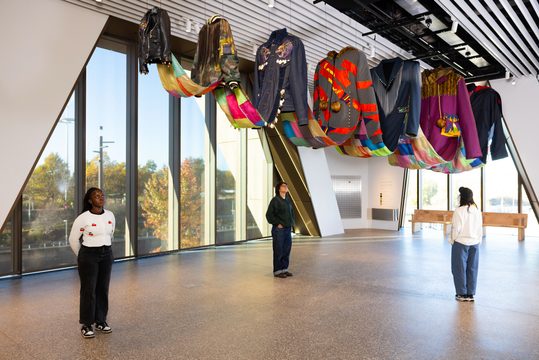
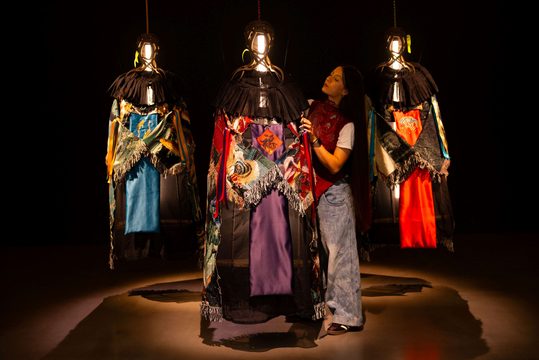
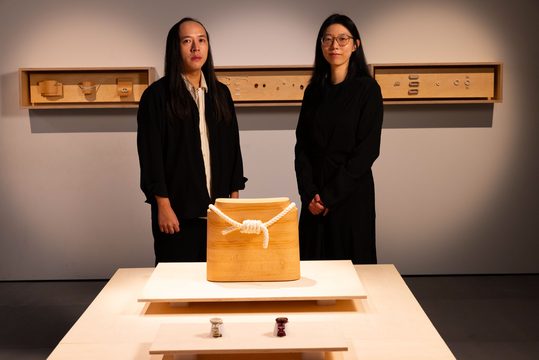
New Work is V&A East’s creative commissions programme. Twice a year, artists create new work in response to a shared theme, exploring how art and design intersect with everyday life across V&A East Museum and V&A East Storehouse. Following the first theme, Making East London, which reflected on the area’s past and possible futures, the second iteration, The Stories of Clothes, explores the storytelling power of clothing through installations, film, displays and events.