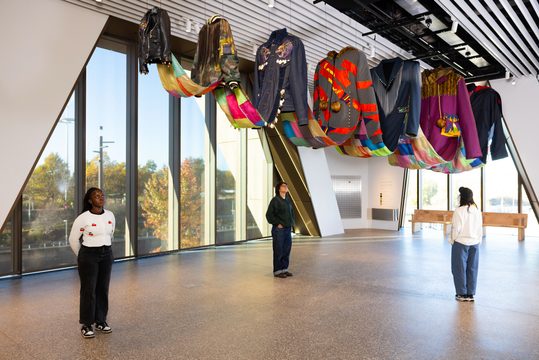
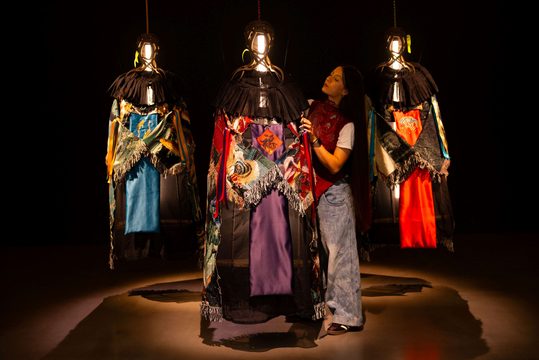
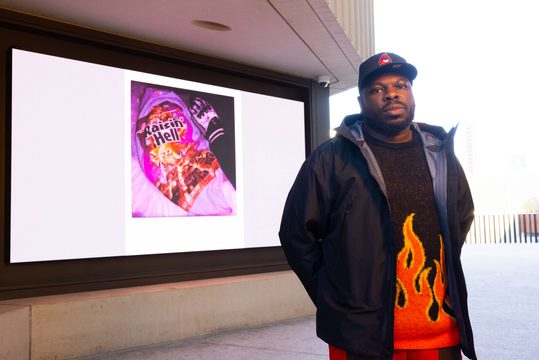
Industrial Designers Jimin Jeon and Adam Huxley Khng have been working together since they met in Tokyo in 2019. The duo were selected as inaugural Design Trust Fellows in 2025. They have been researching garment fasteners within the V&A’s collection as well as in Hong Kong and China.
Here Adam and Jimin share with us their research journey and how they developed their final commissioned installation on display in Gallery 1 of V&A East Storehouse: Motions and Notions of Fastening.

Can you describe the research you conducted as part of the Design Trust Fellowship?
Adam: Our research focused on garment fastenings and the recurring gestures and forms associated with them. We became interested in the actions and principles that have accompanied fastening technologies from prehistory to the present day, and the ways those forms have evolved through continuous refinement and adaptation.
We started with the idea that fastenings are much more than functional mechanisms or decorative details. They fundamentally shape the architecture and construction of clothing. Drawing on our background in industrial design, we became interested in understanding how fastenings have been conceived, developed and manufactured over time, and how they might continue to evolve in the future.
Jimin: One idea that became particularly important to us was what we described as an investigative process. When you encounter a museum object, you are often given information such as its materials, dimensions or date, but there is so much that remains unknown. You don’t necessarily know how it was used, how it felt to handle, or what role it played in everyday life. That absence of information becomes productive. It invites speculation and reflection.
Adam: As designers, we usually make objects. During this project, we began using design in reverse: as a way of reading objects rather than producing them. That shift became central to our research.
Jimin: The ability to handle objects during our research time at the V&A East Storehouse was incredibly important. For example, when we examined a jade belt hook, the catalogue could tell us what it was and roughly when it was made, but it couldn’t communicate the experience of holding it. The moment you pick it up, you feel its weight. You notice the temperature of the jade. You hear the subtle sound made when the pieces connect. Those qualities don’t exist in photographs or catalogue records. They can only be understood through direct experience. That kind of encounter became one of the most valuable parts of the project.
How did the opportunity to research in Hong Kong, China and the Greater Bay Area influence your practice?
Adam: The trip gave us a much broader understanding of production. We weren’t just interested in individual products; we wanted to understand the entire journey of an object, from manufacture and distribution through to sale and use. One of the most striking experiences was visiting manufacturing centres where huge quantities of fastenings are produced. You start to see how a seemingly small component can have enormous significance within a local economy and a much wider global network.
Jimin: Meeting people was equally important. There was a remarkable sense of immediacy and openness. Someone would say, “Do you want to see this?” and suddenly you were being introduced to another manufacturer or another part of the production process. Trust and personal connections played a significant role in how knowledge and expertise moved through the industry.
Adam: When we began the project, we expected to discover dramatic technological change. We found that, of course. But what surprised us was how much had remained the same. Many of the fundamental principles of fastening have changed very little over thousands of years. What has changed are the methods of production, the contexts in which objects operate, and the networks through which they circulate. That continuity between past and present became one of the most important discoveries of the project.
How did you approach classifying the garment fasteners you were researching?
Jimin: Instead of categorising fastenings according to their appearance or historical period, we started classifying them according to action and movement. Gradually, three primary categories emerged.
The first was piercing: materials joined through penetration, such as pins, brooches or other forms that hold materials together by passing through them.
The second was tensioning, which includes actions such as tying, lacing, binding and pulling.
The third was holding, which includes buttons, clasps, clamps, toggles and other mechanisms that rely on containment or mechanical engagement.
Adam: These categories are broad, but they helped us recognise connections between objects that might otherwise seem unrelated
That classification system feels like such an important outcome of the research. It seems like a perfect point from which to move into the commission itself. Could you describe the project you have developed for V&A East Storehouse?
Adam: The project is called Motions and Notions of Fastening. It consists of a series of objects that translate garment fastenings into different contexts. Through changes in scale, material and assembly, we’re exploring the actions and principles behind fastening rather than simply reproducing historical examples. Alongside the finished pieces, we present elements of the research process itself. That includes study models, collected fastenings, prototypes and a series of sculptural investigations into the three primary actions we identified: piercing, tensioning and holding.
How did the theme The Stories of Clothes inform the project?
Adam: It shaped the project in two important ways. The first relates to the idea that fastenings are everyday interactions. Almost everyone has experience of buttoning a shirt, tying a lace or fastening a clasp. These are mundane actions, but they’re also deeply embedded in daily life. Looking closely at those interactions opens up broader questions about material culture, production, trade and technological development.
The second emerged through our engagement with the collection itself. We often encountered fastenings that had become detached from their original garments or contexts. They existed as isolated objects, separated from the stories that once surrounded them. That made us think about how objects are interpreted when their histories become fragmented or incomplete.
Jimin: Design became a way of investigating possible narratives. We weren’t only asking what an object was; we were asking how it might have been used, what kind of life it might have had, and what relationships it might have formed part of.
You’ve looked at hundreds of objects during the course of this project. Could you highlight a few that were particularly influential?
Jimin: One example would be a group of ceramic buttons made by Lucie Rie. Seeing them in person was very different from viewing them online. The gestures involved in pressing and shaping the material seemed embedded within the object itself. Handling them made us think not only about manufacture but also about use; how somebody would hold them, fasten them and interact with them over time.

Another important object was a silk drawstring bag. It helped us realise that not all fastenings are separate components made from hard materials. Sometimes the fastening is integrated into the textile itself. The cord, the loops and the fabric work together as a single system.
Adam: A third important reference was a clock in a bag designed by Daniel Weil. We’d known the object for years, but we had never considered it in relation to fastening. Looking at it through the lens of our research revealed surprising connections. The way hard materials intersected with soft materials echoed the same principles of piercing and holding that we’d identified in historical garment fastenings.

Jimin: We were also fascinated by a Japanese container held together by its own structure. The object effectively fastened itself. That challenged our assumptions because many fastenings depend upon something else: a button requires fabric, for example. This object was self-contained. Its weight and construction created its own fastening mechanism.

Adam: And finally there was a jade belt hook. In some ways it was very familiar. Mechanically, it’s still recognisable today. But seeing it in person revealed details that photographs couldn’t convey. The weight, the sound of the material, the curvature designed to sit against the body: all of those things became visible only through direct encounter. One thing we repeatedly found ourselves doing was looking at the backs of objects rather than the fronts. The reverse side often reveals more about how something functions and how it relates to the body.

What has the making process of this commission been like? How did it differ from your usual work?
Adam: It has been very different from many of our commercial projects. A lot of our usual work involves creating products for manufacturers, clients or start-ups. Those projects are often directed towards production, distribution and sale. This commission has a different purpose. It’s about communication, reflection and sharing ideas.
Jimin: What’s been particularly refreshing is that the project isn’t driven by a problem-solving framework. In conventional design, you’re often given a problem and asked to create a solution. Here, there isn’t really a problem that needs solving. Instead, we’re exploring possibilities. The objects are speculative in that sense. They’re not saying, “this is the answer.” They’re asking what might happen if we looked at fastenings differently, or if we extended certain principles into new contexts.
How has your Design Trust Fellowship pushed your work in a new direction?
Adam: This was our first opportunity to work directly with a museum collection in such a sustained way. One of the most significant things it changed was our relationship to historical objects. So much contemporary design is focused on the future. We often speculate about things that don’t yet exist. Working with the collection reminded us that there is an enormous amount to learn from objects that already exist. There is knowledge embedded in historical artefacts that can still inform contemporary thinking. The collection became a resource not only for understanding the past but also for imagining new possibilities.
What Do You Hope Visitors Take Away From the Project?
Jimin: There’s a quote by the architect Juhani Pallasmaa that describes the door handle as the handshake of a building. We think fastenings operate in a similar way. A button, clasp or buckle is often the first point of contact between a person and a garment. It’s a small thing, but it’s where interaction begins. If people leave the exhibition looking at those everyday interactions differently, then I think we’ve achieved something important.
Curious to start researching at V&A East Storehouse yourself?
You can use Order-an-Object and begin your own research into our collections. It’s free and available 7 days a week, even during our evening openings on Thursdays and Saturdays. With over 340,000 objects to choose from, find out how to choose your first objects to have some 1:1 time with here Order an Object · V&A
The Design Trust Fellowship at V&A East was supported by Design Trust Hong Kong.
New Work: The Stories of Clothes
14 November 2026 – 20 June 2027
New Work is V&A East’s creative commissions programme. Twice a year, artists create new work in response to a shared theme, exploring how art and design intersect with everyday life across V&A East Museum and V&A East Storehouse. Following the first theme, Making East London, which reflected on the area’s past and possible futures, the second iteration, The Stories of Clothes, explores the storytelling power of clothing through installations, film, displays and events.