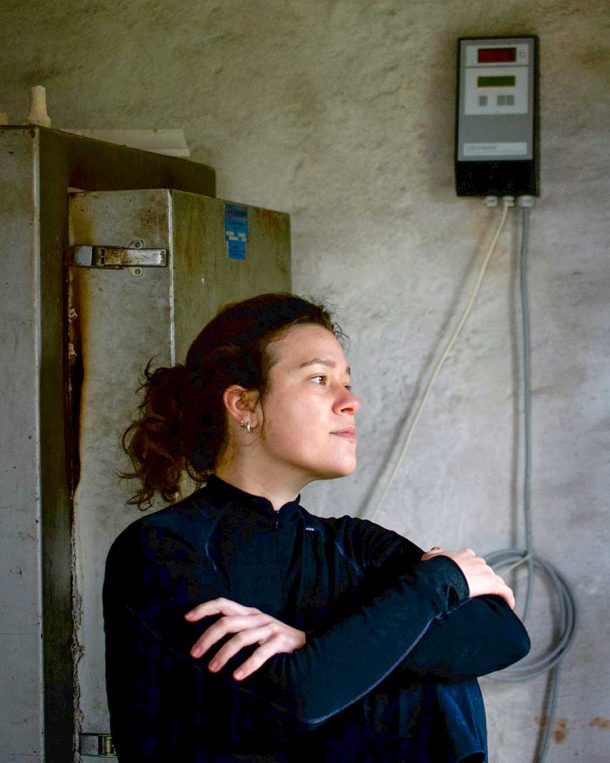
My name is Aya Simone Schmidt, and I am a ceramic artist. I have just concluded my residency with the V&A Wedgwood Collection and the Danish Arts Foundation where I set out to examine the relationship between art and gender within the V&A Wedgwood Collection Archive.
My aim was to investigate how decorative motifs on Wedgwood Jasperware between 1759 and 1795 were shaped by artists of different genders, with particular attention given to the work of female designers. Rather than framing these practices as oppositional, the research sought to understand them as part of an ongoing dialogue in which artistic expression both reflects and shapes identity, social values and cultural narratives.
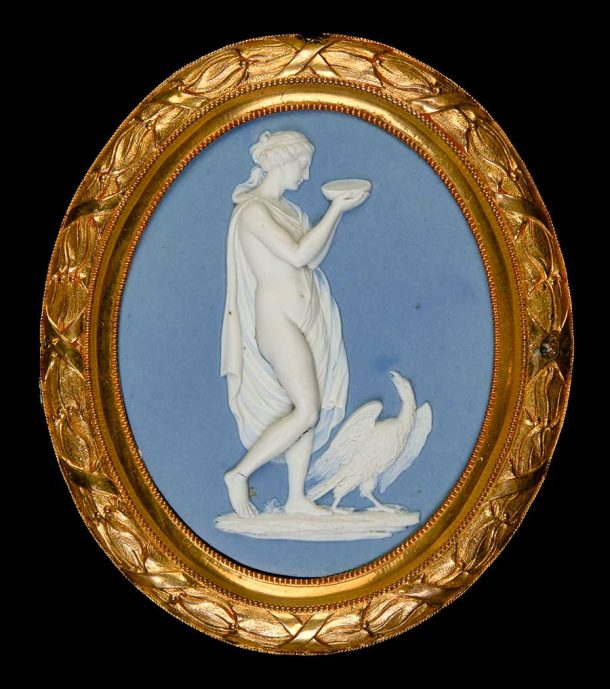
As the research unfolded, my attention was increasingly drawn to the stories depicted on Wedgwood cameos and reliefs. These objects revealed themselves as carriers of myths, allegories and symbolic narratives. Gradually, the focus moved towards narratives that centre on femininity.
Many of the scenes encountered in the archive reminded me of fairy tales from my childhood. This recognition opened a line of enquiry that connected classical mythology with folktales that came centuries later. The decoration on Wedgwood ware is an excellent example of a visual language that continually depicted and reimagined ancient myths and thus made them relevant to new audiences. A key motivation of the research became the mapping of how these narratives developed historically and geographically, how they reappear across cultures while adapting to new contexts and how they might offer potential for contemporary artistic interpretation.

This engagement with myth and folklore led to a deeper awareness of female artists and designers within Wedgwood history whose work drew directly from these sources. Of particular importance was Daisy Makeig-Jones, whose approach to image-making proved highly influential. Her practice of borrowing visual elements from a range of artistic sources and assembling them into imagined worlds reflects the nature of folk tales themselves, which are constantly reshaped by those who tell them. Her work demonstrates how personal interest and narrative freedom can generate richly layered visual languages.

This residency culminated in a body of ceramic work that offers a contemporary interpretation of Wedgwood techniques and the lesser-known narratives encountered in the archive.

I sought to create new motifs that establish a dialogue between past and present. This was achieved by incorporating traditional techniques used to decorate Wedgwood Jasperware, specifically that of sprigging, which is a technique where you press clay into shallow intricate plaster moulds to create reliefs that can then be applied to another clay surface. I made my plaster moulds by simply casting straight onto sculpted clay, rather than the traditional method of casting the plaster over wax, rubber or silicone shapes. This process retained more of the gestural nature of clay, that you get when you work directly with your hands to manipulate the material. Something which is a prevailing characteristic in my practice.

The works focus on the lesser-known story of the Birth of Hebe, discovered whilst transcribing a catalogue outlining the stories behind some of the Wedgwood cameos. In this story Hera, goddess of marriage, women and childbirth, becomes pregnant with Hebe after eating lettuce from the garden of Flora. Flora being the goddess of flowers, spring and fertility. I was drawn to this version as it centred on women helping one another and female autonomy. It also imbued the mundane plant lettuce, with importance and with the symbolism of motherhood and fertility in women.

The use of an oval format for my final piece references the shape of Wedgwood’s cameos, while the floral elements are moulded after sketches and watercolours found in the archive pattern books.
This project demonstrates how archival research can inform contemporary ceramic practice by connecting material history, myth and feminine symbolism. Through engagement with Wedgwood’s processes and narratives, the work establishes a dialogue between historical sources and present-day interpretation, showing how lesser-known stories can be reactivated through making.
Prickly Milk is on display in the Welcome Space of the V&A Wedgwood Collection from February to June 2026.