This is one of three blogs written by students on the module Curation and Heritage at University of Liverpool, led by Dr Marion Leonard. The students were asked to write responses to the objects included in Lost Music Venues, a display curated by Harriet Reed in the Theatre and Performance Galleries (30 May 2026 – 30 October 2027). Featuring around 50 ‘lost’ performance spaces from the 1980s to 2010s, Lost Music Venues celebrates music venues as centres of creativity, shining a light on both their cultural contribution and the challenges they face as a sector.
In this blog, student Zanna Shah writes about the photography of Gregory Nolan, who captured the indie scene in London in the 2000s.
There is a moment at a music venue just before everything begins. The air feels heavy, crowd pressing forward, and stage lights flicker. Before the first note even lands, a flash cuts through the darkness. Not from a phone, but from a camera. Long before concerts became seas of raised smartphones and instant uploads, gig photography was already deciding what would be remembered. Capturing a photograph at a gig in the 1990s or early 2000s was not automatic. Every picture that survived, did so because someone made a deliberate decision to press the shutter at that exact moment.
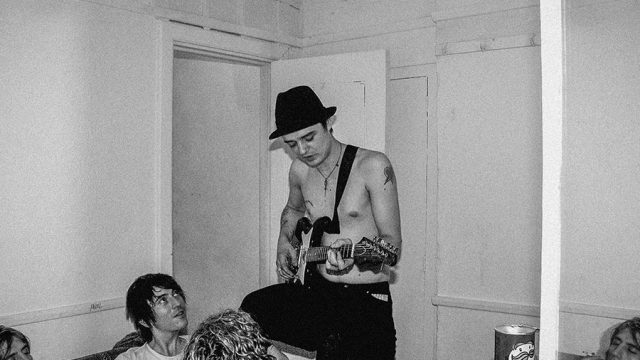
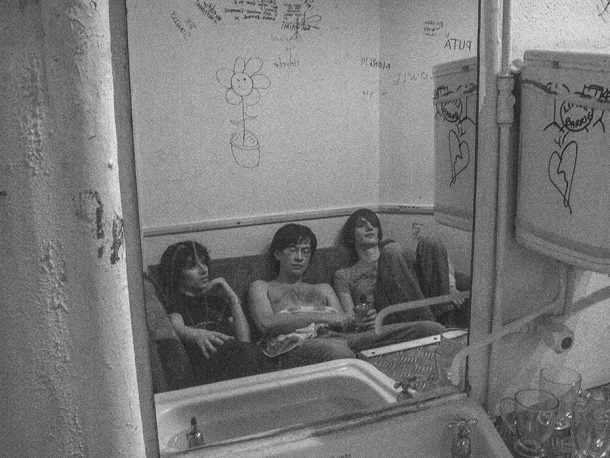
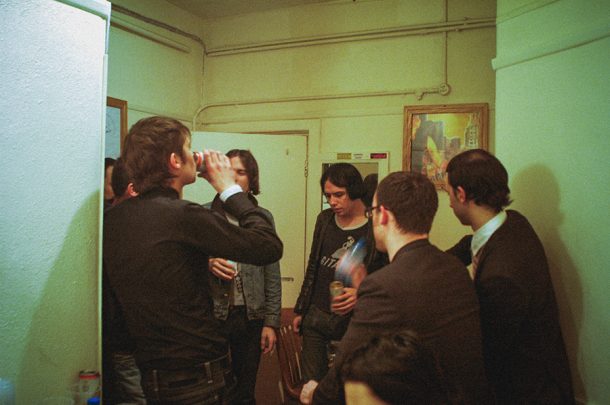
Two backstage photographs by Gregory Nolan of Maximo Park and Bloc Party before their performances show how these unglamorous spaces. They’re cramped, unpolished, and shot in available light. The environments are makeshift, and the subjects are visibly unguarded. They capture something that promotional images and press shots never show, which is what it actually looked like behind the stage door of a small British venue in this era.
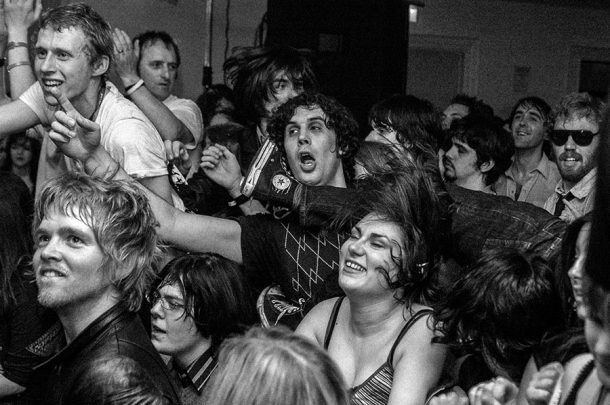
The live shots by Nolan are equally striking for different reasons. A crowd photograph from a Paddingtons gig captures bodies pressing forwards, faces turned towards the stage, the shared intensity of a room that is fully present in the moment. Kid Harpoon performing to a small audience shows the same intensity from the perspective of the stage. This is what sets these photographs apart from the documentation that exists in 2026. A gig photographed by a single professional photographer in 2004 looks entirely different from the same event captured by 400 audience members on smartphones.
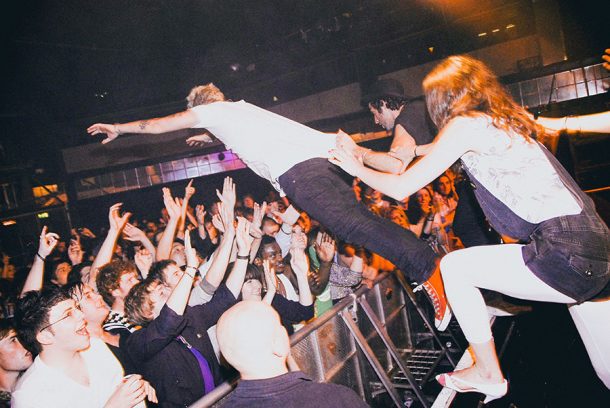
The gig photographers represented in this display, made a choice, professionally, deliberately and with the equipment designed for the job. What they produced was not documentation in the way we use the word today. It was something closer to interpretation.
An image of Florence Welch performing in a small venue before her career broke through, or Laura Marling at The Flowerpot, now carry a weight that was entirely unavailable at the time. The same is true of the photograph of young Chris Martin performing at a Radio 1 gig at the Square, a small music venue in Harlow, Essex, in May 2000. Nobody in those rooms knew what those artists were about to become. The photographs can be revisited as evidence of ‘where it all began’, reinforcing a narrative of authenticity that continues to shape how music culture understands success. The small venue becomes symbolic, marking origin, credibility and struggle and through photography, these performances are transformed into origin stories, moments that appear to define an artist’s identity long after.


This is also where nostalgia enters the picture, not only for those who were present. Younger audiences form genuine emotional connections to such gig images, drawn to scenes that happened before they were even born. Why does a grainy photograph of a crowded venue feel more immediate, or desirable, than a high-definition video captured today? Perhaps because of its imperfection or because the photograph suggests something just out of reach.
But perhaps also partly because the venues themselves no longer exist. Madame Jojo’s, a nightclub home to queer nightlife and launching emerging music, and Buffalo Bar, which supported independent artists, are venues photographed long before their loss. They were specific cultural addresses, shaped by the communities that filled them and the photographs taken inside reflect that belonging. They now function as visual evidence that certain nights in those rooms happened, provoking a longing for the music, the spaces, the communities, and the way of experiencing live performance that the images preserve.


The photographs in Lost Music Venues belong to a moment just before everything became endlessly documented. They are a product of when images were fewer, more deliberate and perhaps more powerful. Since then, gig photography has changed beyond recognition, with professional photographers still working in the pit, with their equipment and technique, however, around them, is a room full of people documenting it themselves, with every angle, every moment covered.
If the value of these pre-digital images lies partly in their scarcity, what is to happen when scarcity disappears and everyone is capturing moments, instead of living in them. Looking at these images now, it is hard not to wonder whether the constraints of that era were also its gifts. Whether something was lost not only when the venues closed, but when the cameras in the crowd multiplied.