This is one of three blogs written by students on the module Curation and Heritage at University of Liverpool, led by Dr Marion Leonard. The students were asked to write responses to the objects included in Lost Music Venues, a display curated by Harriet Reed in the Theatre and Performance Galleries (30 May 2026 – 30 October 2027). Featuring around 50 ‘lost’ performance spaces from the 1980s to 2010s, Lost Music Venues celebrates music venues as centres of creativity, shining a light on both their cultural contribution and the challenges they face as a sector.
In this blog, student Lola Warne writes about the ephemera which depicts the backstage and touring lifestyle.
What really happens behind a stage door? Backstage is not defined by spectacle, but by routine. Time in a green room or dressing room is spent waiting, preparing, and repeating. Set lists are memorised, lyrics rehearsed and small details revised again and again. Yet even within this routine, there is an unmistakeable energy. The possibility of the audience’s reaction, the pressure of a new song, the build-up to the first track and the relief of the final one. These spaces become environments of shared anticipation, where performers move between preparation and brief moments of release.
Looking across the Lost Music Venues display, these tensions become visible. The objects associated with touring expose the hidden practices that sustain live performance. They point towards environments shaped by organisation, repetition and creative work. At the same time, they offer fans a closer look into the lives of performers and the preparation behind the performance.
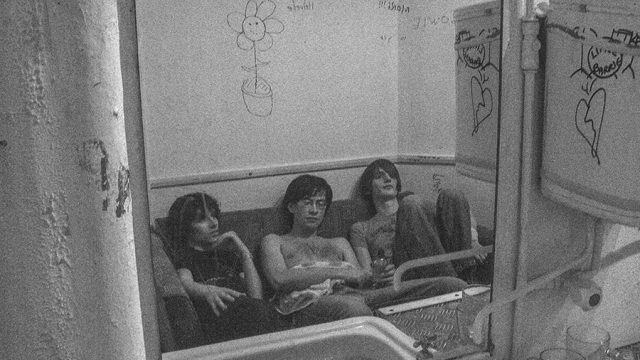
For example, in a photograph by Gregory Nolan of musician Pete Doherty, he is pictured playing a guitar backstage, prompting questions about whether it captures rehearsal, experimentation or simply someone passing time. In contrast, others appear less engaged, seated and waiting, reinforcing the repetition that shapes touring life. What emerges from these images is a constant tension, where the boundary between preparation and creativity begins to blur.

The photograph of the backstage bar at the Rainbow theatre offers a different perspective. Here, the space appears more animated, functioning as a social environment as much as a practical one. There is a sense of temporary escape for the performers, a place where crew, support acts and headliners can gather briefly away from the crowd, finding a moment of privacy before returning to the stage. It offers a glimpse into the social world of live music, revealing the practicalities and social relationships that define touring life.

Beyond the spaces themselves, the objects used within them reveal how structured live music can be. Set lists for the The Who and Blur reveal the organisation underpinning performance. At first glance, they appear to be simple records of songs. However, their purpose is far more deliberate. The art of the set list lies in careful arrangement, shaping pacing, anticipating transitions and guiding audience experience. From the 1970s to the 1990s and beyond, the ritual of selecting, ordering and refining a set list remains central to live music today.


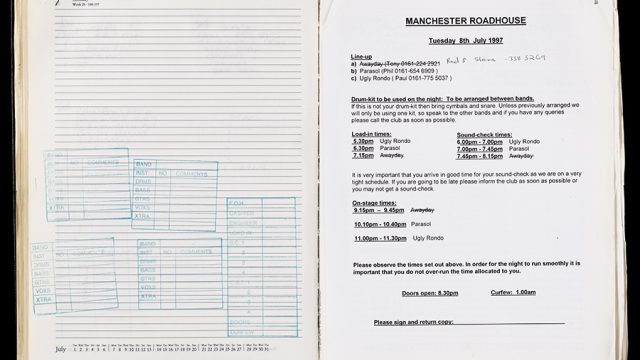
Beyond the performance itself, other objects within this collection reveal the infrastructure sustaining touring life. A guest list for Supergrass and a booking sheet for Barfly, Camden demonstrate the level of organisation required to coordinate live music. Materials such as these document schedules and access, revealing that touring depends upon far more than moving from one stage to another. It relies upon coordination between artists, promoters and venues.


These objects do more than expose the structured realities of touring life; they invite speculation, curiosity, and emotional connection.
A handwritten lyric sheet by Noel Gallagher (LMV45) reveals how creativity can also emerge within these environments. This object suggests that songwriting is not confined to moments of isolation but can develop within the routines of touring life. Written amidst schedules, constant travel and repetition, such lyrics point towards a creative process shaped by pressure, constraint and movement. Touring can become a productive condition where creativity is embedded within labour itself. The demands of performance, the repetition of set lists and the endless transitions between venues may all contribute to new forms of inspiration. A set list, candid photograph or handwritten lyric reduces the distance between artist and audience, uncovering details that would otherwise remain unseen.

These artefacts reveal the hidden routines and structures that make live performance possible. The desire to experience backstage life may never disappear. It promises access to something hidden, exclusive and seemingly more ‘real’ than the performance itself. Yet perhaps the reality is more compelling than the myth. What happens beyond the stage is not a world of spontaneity, but the mechanisms that allow it to exist: preparation, coordination and creative outbursts carried out within spaces that are rarely seen.