The National Art Library is home to many beautifully-bound books, but also to some of the tools that were used to decorate them. Over the past few months, I have been working to catalogue these binding tools so they can be discoverable both online and viewed in our reading rooms. All of the tools we have were used for gold tooling, which involves heating up the metal face of the tool and using gold leaf to press a pattern onto leather.
I have catalogued 171 binding tools, mainly belonging to three binders: Sarah Prideaux, Charles Ricketts and Sybil Pye. The tools themselves are beautiful objects but the binders are equally interesting. I find myself especially drawn to the life and work of women binders, and Sarah Prideaux was a particularly influential figure among them. We have 35 tools that belonged to Prideaux, signed and donated by her to the National Art Library between 1911 and 1917.
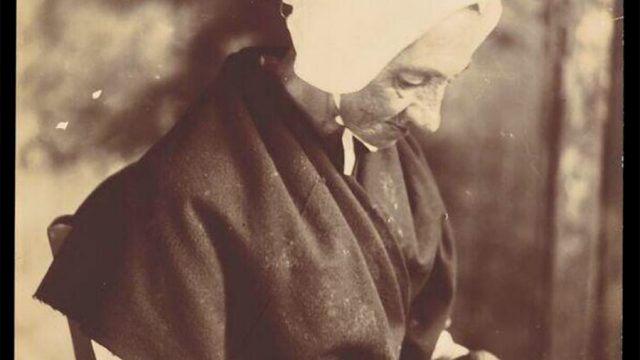
Sarah T. Prideaux, photograph from a private collection featured in Marianne Tidcombe's Women Bookbinders, 1880-1920, New Castle, DE, USA : Oak Knoll Press ; London : British Library, 1996.
Born in London in 1853, Sarah was educated at home before attending Newnham College, Cambridge for just over a year in 1877. She was called back home when her father lost his sight. During this time she maintained a number of interests, most importantly teaching and bookbinding. She taught English until 1888 when she decided to become a professional bookbinder.
A review of her first bindings in The British Bookmaker 1891 was not complimentary, stating they were ‘quaint but not pretty’ and ‘design unconventional, binding poor’. To me, this sounds harsh even for her first attempts but these initial reviews certainly do not speak to the exquisite work she would go on to produce.
Binding by Sarah Prideaux, 1902, Autres poésies de maistre François Villon & de son école by Francois Villon, London: Hacon & Ricketts, 1901. Museum no. L.590-1911
Sarah was a very intelligent person, knowing more about bookbinding than other binders, having had a passion long before pursuing it as a career. She was also knowledgeable about printing and carefully chose the books she bound. She made sure to select only the finest quality leathers and marbled endpapers.
Prideaux employed an expert finisher, a Frenchman called Lucien Broca who worked with her from the mid-1890s to 1900. She did not credit his work, likely because she felt that her bindings were still entirely her own, having been designed and produced to her specifications. This was not uncommon and aligns with the attitudes of most prominent bookbinders of the time who employed skilled craftsmen and women to help realise their work.
Binding by Sarah Prideaux, 1902, 'Rubaiyat of Omar Khayyam of Naishapur', by Omar Khayyam, translated by Edward FitzGerald, London: Vale Press, 1901. Museum no. L.591-1911
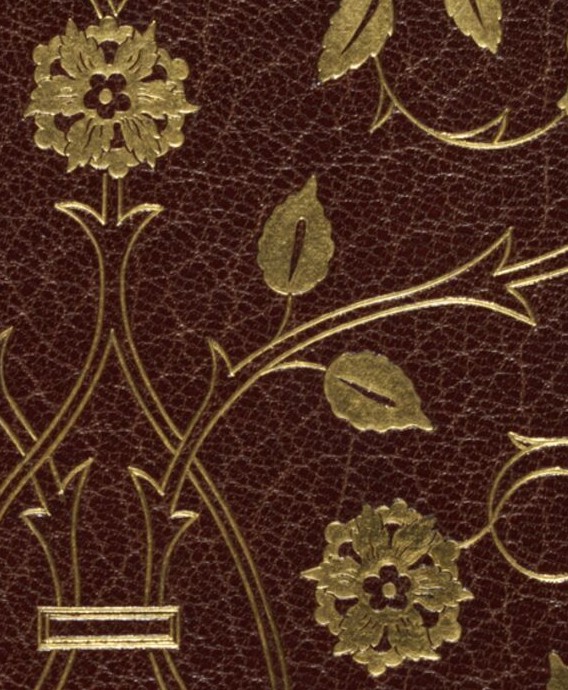
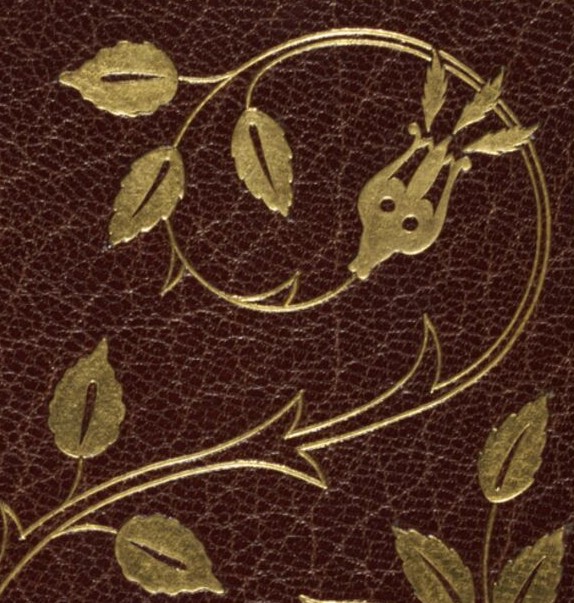
In the late 1800s, she designed a group of large tools inspired by patterns on Turkish and Syrian tiles in the V&A collection. These were used on a few of her bindings, including a copy of The Rubaiyat of Omar Khayyam published in 1901 by the Vale Press. The binding is signed and dated 1902 on the inside cover and was donated by Prideaux in April 1911. During this project, my favourite part has been seeing the tools come to life on bindings held in the National Art Library. Below you can see the tools next to The Rubaiyat of Omar Khayyam binding and how the impressions appear when tooled onto the leather. Click each image to have a closer look.
Bookbinding tool, decorative floral finishing tool, Sarah Prideaux, c.1888-1904. Museum no. L.2008-1911
Bookbinding tool, decorative floral finishing tool, Sarah Prideaux, c.1888-1904. Museum no. L.2008-1911
Detail of ‘Rubaiyat of Omar Khayyam of Naishapur’ binding by Sarah Prideaux, 1902. Museum no. L591-1911
Bookbinding tool, decorative floral finishing tool, Sarah Prideaux, c.1888-1904. Museum no. L.2006-1911
Bookbinding tool, decorative leaf finishing tool, Sarah Prideaux, c.1888-1904. Museum no. L.2024-1911
Detail of ‘Rubaiyat of Omar Khayyam of Naishapur’ binding by Sarah Prideaux, 1902. Museum no. L591-1911
Tile painted in underglaze blue, black, sage green and turquoise; Damascus (Syria), ca.1550-1600. Museum no. 483-1900
Siliceous glazed earthenware, painted with flowers, Turkish, 15th century or 16th century. Museum no. 1315-1893
Sarah Prideaux proudly referred to herself as the first woman to make a career in bookbinding and to teach it. Having a successful career as a woman in the 19th century was rare but Sarah did not see a reason why women should not partake in activities and practices that were, at the time, reserved for men. She participated in sports like hockey, tennis, sailing, riding and shooting as well as going on long cycle trips through Europe and taking up skiing and bobsleighing in her middle age. She even stated later in life that she regretted not having learned to fly.
By the end of her career, Sarah Prideaux had produced well over 300 bindings. I find her inspiring not only because of her beautiful bindings but also her ambition and strong sense of self.
Beautiful books, and a fascinating story behind them, Sarah Prideaux clearly overcame many challenges to achieve her ambitions, thank you for the blog post.
Thank you for illuminating all of this! Gorgeous.
Add a comment
Please read our privacy policy to understand what we do with your data.






Beautiful books, and a fascinating story behind them, Sarah Prideaux clearly overcame many challenges to achieve her ambitions, thank you for the blog post.
Thank you for illuminating all of this! Gorgeous.