James’ research focuses on the ceramic and glass collections now held at the V&A that were transferred from the Museum of Practical Geology (MPG) in 1901. Using a watercolour of the MPG painted in 1875 by John Philipps Emslie (1839 – 1913), this post explores how objects shown in a 19th-century display case can be identified in the V&A’s collections today. It offers an example of how close looking at images and objects can help reconnect museum collections with their earlier histories of display.
Between 1851 and 1901, Britain’s first state-funded science museum, the Museum of Practical Geology (MPG), exhibited ceramics and glass prominently as part of its displays.
At the heart of one section of the museum stood a large glass-fronted display case filled not with fossils, rocks or mineral specimens, but with Chinese porcelain, Japanese cloisonné enamels, carved stones, and glass. The scene is recorded in a watercolour by the artist John Philipps Emslie, whose detailed view of the museum’s interior captures this unexpected juxtaposition.

The majority of the MPG’s ceramic and glass collections were transferred to the V&A in 1901, making Emslie’s watercolour directly relevant to the study of the V&A’s collections today. Recent research returned to Emslie’s painting with a simple question: can any of the objects he painted be identified and what do they tell us about the MPG? Several can, and some still carry labels that link them directly to the very case at the centre of his painting.
The Museum of Practical Geology
The MPG was founded in 1835 and formed part of the Geological Survey of Great Britain, the world’s first national geological survey, established to investigate the Earth’s rocks, soils, and underground structures. In 1851, the museum moved into a purpose-built ‘palace of science’ between Jermyn Street and Piccadilly, opened by Prince Albert two weeks after the opening of the Great Exhibition.
At first glance, ceramics and glass may seem out of place in a geological museum, yet they aligned closely with the MPG’s founding purpose: to demonstrate the ‘application of geology to the useful purposes of life.’ The museum was concerned not only with raw materials, but with how they were transformed and put to use. Within this framework, ceramics and glass had a natural place. Clay and silica – the raw geological materials used to make ceramics and glass – were central to the museum’s geological collections, while finished objects offered tangible examples of firing, glazing, and technological innovation.
By the 1870s, the MPG had become an important centre for the study and display of pottery and porcelain, and was even credited with contributing to a wider British ‘mania for pottery.’ Its displays combined British ceramics with a growing number of international examples, catalogued as ‘Foreign Pottery and Porcelain.’ These objects were valued not only for their visual appeal, but for the technical and material knowledge they embodied, from mineral composition and glazing methods to firing techniques and global traditions of craftsmanship.
Following the clues in the paint
While a small number of photographs record other areas of the museum’s interior, none document the MPG’s ceramic and glass displays with comparable detail to Emslie’s watercolour. For this section of the museum, the painting provides the most informative visual evidence.

Careful comparison between the image and surviving objects has made it possible to identify several of the objects Emslie depicted, now held in the V&A’s collections. They include Chinese porcelains, cloisonné enamels, and a nephrite carving.
This matters because it turns the watercolour into more than a decorative view of a Victorian museum. It becomes a way to reconnect today’s objects with a specific 19th-century display, revealing not only what the museum owned, but what it chose to exhibit.
‘Removed from the Oriental Porcelain Case’
Two objects provide the clearest link between the V&A’s collections and Emslie’s painting. Both are Chinese porcelain vases: a crimson-glazed fungus-form vessel and a yellow-glazed vase decorated with figures in a garden.


On their bases, handwritten notes read: ‘Removed from the Oriental Porcelain Case, Nov. 1897’. The term ‘Oriental’ reflects the MPG’s system of classification and appears consistently in its published records. It is used here in its historical context to accurately reflect archival evidence.

These small labels preserve both the name of the display case and the moment when it began to be dismantled. They fix a date – November 1897 – within the museum’s late 19th-century reorganisation, and directly link the surviving objects to the case depicted by Emslie.
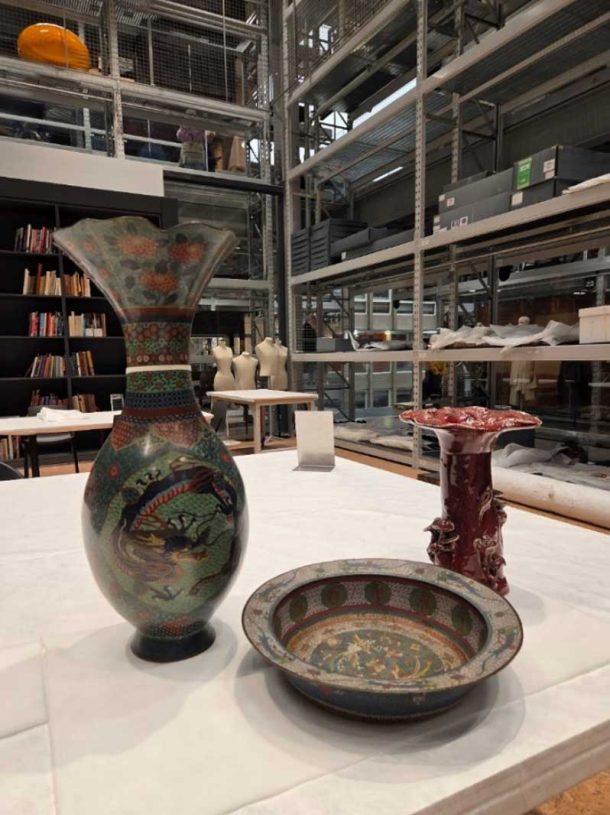
Other pieces can also be matched through distinctive shapes and decoration. These include a cloisonné enamel dragon vase attributed to Kaji Tsunekichi, a cloisonné bowl with bird and floral motifs, a carved nephrite lotus with stand, and a brown stoneware teapot with dragon decoration.

Taken together, these objects help reconstruct the display Emslie depicted, one in which East Asian ceramics and enamels formed a visually prominent part of the MPG’s exhibition space. As the museum refocused its galleries on scientific research in the 1890s, its ceramic and glass collections were judged less central to its aims and were transferred to the V&A in 1901. The objects shown in Emslie’s watercolour were part of that transfer, allowing their histories to be traced from the MPG to the V&A today.
Several of these pieces have recently been reunited for the first time since 1901. Seen alongside Emslie’s painting, they reinforce the identification of the objects and offer a clearer sense of how prominently global ceramics were once displayed within the museum.

What the catalogues leave out
The MPG published four editions of its Catalogue of British Pottery and Porcelain between 1855 and 1893. Each presented the collection as an overview of British ceramic manufacture.
‘Foreign’ wares appeared only at the end, described in a brief paragraph as ‘a few samples… mostly presentations’, and the catalogues stated that expanding this part of the collection was ‘not considered desirable.’ The catalogues did record the presence of ‘Oriental porcelain in Pedestal Case 5,’ but they offered no descriptions of specific objects, explaining that such material fell ‘beyond the scope’ of a catalogue devoted to British ceramics.
Emslie’s watercolour suggests a different emphasis. The display case at the centre of his painting contained a substantial display of Chinese, Japanese and other East Asian wares. Their prominence within the gallery suggests that international material played a more active role in the museum’s displays than the catalogues imply.
Put simply: the museum recorded one story on paper, and showed another story in the gallery.
That contrast is a reminder that catalogues do not always reflect what visitors actually saw. Even when publications make encyclopaedic claims, they can still reflect boundaries of focus and leave other parts of a collection under-described.
Looking underneath
In the end, the clearest evidence lies with the objects themselves.
The handwritten labels that record the dismantling of the case in 1897 still cling to the bases of the porcelains, yet, until now, they have not been acknowledged in the V&A’s official records. These small fragments of handwriting retain an entire chapter of curatorial history, hidden in plain sight.
Reuniting the objects with Emslie’s painting restores a story that had slipped from view. It shows that 19th-century classifications could hide as much as they revealed, and that narratives of collecting and display are always open to revision. It also points towards future work tracing the global trajectories of the MPG’s collections – material gathered through the Geological Survey’s networks and brought into a museum designed to teach ‘useful knowledge.’
For now, though, reopening the ‘Oriental Porcelain Case’ allows these objects to speak again. After more than a century apart, they have returned to view and offer a simple reminder: sometimes the surest route to forgotten histories begins with looking closely, patiently, and quite literally turning an object over.