
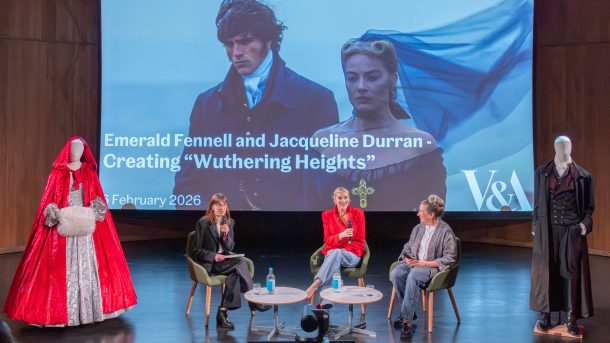
Wuthering Heights director Emerald Fennell and costume designer Jacqueline Durran visited V&A South Kensington on Friday 6th February for an exclusive members’ talk.
Ahead of their film’s release on Friday 13th February, the pair were giving V&A Members an exclusive insight into how it was made, bringing with them a selection of the costumes featured on screen.
Here are five things we gleaned about Wuthering Heights on the night.
1. Reality TV was an influence
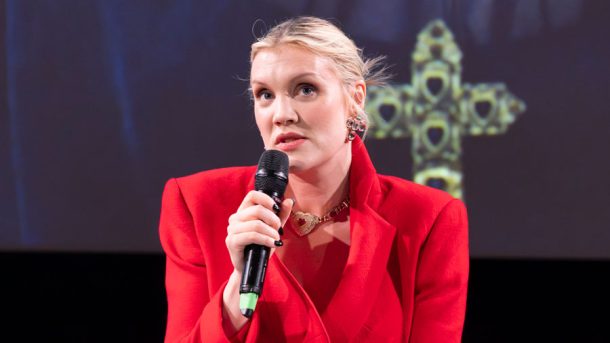
As well as cinematic pioneers Powell and Pressburger, the legendary artist and filmmaker Peter Greenaway, Gothic melodrama and Romeo + Juliet, Fennell also namechecks a more contemporary influence on her writing of Wuthering Heights: reality TV.
“What I’m always reminded of when I watch shows like First Dates is how transparent we all are,” she says. Like the characters in her films, people believe they can conceal their burning desire or ambition – but it never works. “No matter how in our minds we think we’re really clever, – and not showing that we love someone, or that we’re angry – people aren’t good actors.”
This fascination feeds directly into Wuthering Heights, a story structured around sex, class and power – themes that also preoccupy Fennell’s previous feature-length, Saltburn.
“Sex and power fuel every exchange in life,” Fennell says. “That makes it sound like going to buy a newspaper is quite a fraught experience for me. It’s not. But power is central to any drama.”
2. The film features walls made of skin (and other uncanny things)
In Fennell’s interpretation of Wuthering Heights, Edgar Linton (portrayed by Shazad Latif) takes Cathy (Margot Robbie) on a tour of his family’s stately home, Thrushcross Grange. “When they asked me what colour it should be, I said it should be the most beautiful colour in the world,” he says. “The colour of my wife’s sweet face.”
For Fennell, the Grange is not just a building; it is a body. And like all bodies, it grows and leaks. Its walls are padded panels printed with photographs of Margot Robbie’s skin – freckles, veins – overlaid with latex so they can glisten, bulge, and even host leeches. “If you look a bit closer, there are hairs growing out of the moles,” says Fennell. “That’s what the Gothic is to me, and that’s what interests me – pulling a hair out of a mole in a wall.”
The Grange represents nature suppressed: pressed flowers, taxidermied animals. In the end, says Fennell, Cathy herself becomes fully absorbed into the architecture. “One skirt starts where the red of the floor starts – she’s literally camouflaged into the house.”
3. It’s a period piece, but only to a point
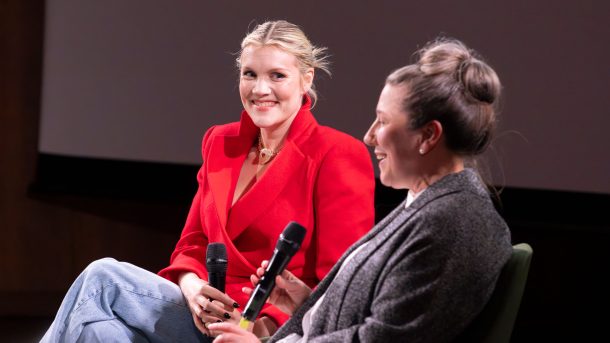
Fennell’s approach to historical accuracy is fluid. What matters more to her is emotional thrill – how a fabric, a silhouette, or a room feels, rather than what decade it technically belongs to. “We’re not making a realistic costume,” she says. “We’re referencing it as a costume. It’s only a period drama, to a point. The suspension of disbelief is why it’s so fun.”
The film’s visual language instead draws as much from 1950s melodrama, fairytales, and paperback romance covers as it does from Brontë’s 1800s.
Fennell’s reasoning is that all period films eventually betray the decade they’re made in. For example, she adds, while John Schlesinger’s 1967 adaptation of Thomas Hardy‘s Far From the Madding Crowd was set in the 1860s, it features Julie Christie in false eyelashes and a beehive.
For Wuthering Heights, Cathy’s wedding dress is futuristic-looking, as if it’s made of opalescent, iridescent wrapping paper. “In that dress, we called her the wedding present,” says Fennell. “It was the first stage of Cathy being a possession.”

As well as classic femme fatale archetypes in culture, another inspiration for one of Cathy’s costumes was Red Riding Hood – a fitting muse, says Fennell, as the character must return “home to a wolf”. Jacqueline Durran’s interpretation of the hooded cloak could have existed in the early nineteenth century but very explicitly looks like a costume – Georgian shapes are used for emotional, not chronological, reasons.
4. For Heathcliff, the clothes maketh the man

According to Fennell and Durran, trying on Heathcliff’s clothes confirmed Jacob Elordi as their perfect choice for the role. “The minute he put on the sample shapes of the Georgian costume, we were like – well, that’s it,” Durran recalls. “He was literally made to wear this costume.” Elordi himself – Fennell notes – had the same reaction. He looked in the mirror, paused, and said: “Oh. Wow.”
Heathcliff’s wardrobe charts his transformation with more restraint than Cathy’s, rooted more firmly in historical reference – particularly Yorkshire costume illustrations from the 1820s – but still guided by instinct rather than accuracy.
Edgar Linton, meanwhile, presented something more complex. Durran thought Victorian silhouettes risked dullness – a man swallowed by his own respectability. For his wardrobe, she instead chose excess: shinier fabrics, unfamiliar textures, wealth and sterility. His slippers remain unscuffed. His dressing gown is made of the exact same fabric as his wallpaper.
5. Charli XCX injected Brat into Brontë
Alongside Anthony Willis’s classical score, Charli’s music for the film provides a contemporary pulse. Fennell, who has been a fan since the beginning of Charli’s career, asked the pop star to read the script, saying: “If it makes you feel something, then let me know.” Fortunately, it did.
At first, Fennell suggested a song, but Charli wanted something more ambitious – a whole album. Their creative chemistry came from a mutual passion. “She understands the dark feminine instinctively,” says Fennell. “[Charli’s last album] Brat was such a phenomenon because [it was] needed… It wasn’t just that the album was genius – we needed that feeling.”
Charli XCX’s soundtrack album, Wuthering Heights, is also released on Friday 13th February.
Talks like these are just one of many benefits experienced by V&A Members. Join today to get free, unlimited visits to exhibitions at all V&A venues (even if tickets have sold out), priority booking opportunities, access to our premium Members rooms, and a subscription to the V&A Magazine.
Quotes from V&A Members who came to the ‘Creating Wuthering Heights‘ talk:
“I really loved it – learning about the costumes, jewellery, and behind-the-scenes details was so intriguing, playful, and fun. This is such an amazing museum – my favourite in London, no question. The quality of the exhibitions is outstanding. What’s not to like?”
“I’ve been to tonnes of events at the V&A – I always leave feeling inspired.”
Sex and power that seems very powerful in my opinion. In terms of expressions itself. I find myself in a situation, where in need to search for sex in order to gain a power. Lately, my main spot for free porn videos has been minuporno.com. Their collection is really expansive, with everything from different national styles like German porn to specific categories such as milfs, teens, or even a section for trans. They’ve also got new channels and live-sex options, so there’s always something new to check out, which keeps things interesting. The site’s layout makes it easy to browse and discover content I wouldn’t usually find elsewhere.