The V&A is redesigning its South Asia Gallery. As part of this transformation, a finely carved 19th-century wooden ceiling from a temple structure in Kochi, South India, will be brought out of storage, carefully restored, and displayed for the first time in over 70 years.
The historic coffered ceiling measures 6 metres by 1.7 metres and originally consisted of 45 carved wooden panels measuring approximately 35.5 cm × 35.5 cm. Over half of these panels are now missing.
This commission offers a unique and exciting opportunity for an artist/designer to create new panels to replace those that are missing and to integrate them into the restored ceiling.
The V&A invites expressions of interest from designers and artists to collaborate on this commission, responding to the original structure with sensitivity in design, material, and technique.
A brief history of the ceiling
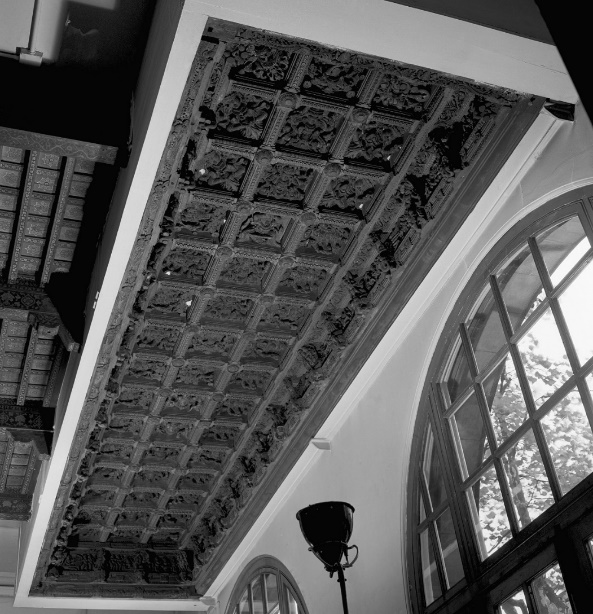
The ceiling was made in the 19th century for a temple or palace temple in Kerala, South India. It is an example of highly accomplished craftsmanship and demonstrates the imagination, dexterity, and aesthetic sensibilities of the skilled artisans who created it. Ceilings such as this may have formed part of the Namaskara Mandapa or the ceiling above the stage in the Koothambalam, a structure within the temple complex where ritual dance and theatrical performance take place.
Characteristic of Kerala’s architectural traditions, the ceiling’s structure is a grid of square central panels framed by richly-decorated beams. The longitudinal beams are carved with elephant corbel heads, while the transverse joists feature ornate medallions. Recent research has identified that one of the decorative friezes depicts the story of Krishna and Rukmini. Another frieze depicts courtly life with procession scenes including palanquins, attendants, and sepoy escorts in European costumes carrying muskets and bayonets, as well as an epic battle scene with arrow storms, combat, and casualties. Research to further identify this scene is ongoing.
The ceiling is made from teak, a material prized for its dense, hard-grained, water-resistant yellowish-brown wood. It offers a strong base for the rich polychromatic carved decoration that is widely used in Keralan temple architecture. In southern India, there is little distinction between wooden architecture and sculpture, as the same craftspeople often worked on both structural elements and decorative figures.
When originally made, the coffered ceiling would have been entirely painted in bright natural pigments. The surviving colour remains vibrant in places, subdued in others, and missing in parts. Overall, the ceiling retains an appearance of aged splendour.

The ceiling will be suspended dramatically from the roof of the new gallery and will become a focal point for visitors. It will provoke a sense of awe and wonder, encouraging them to look upward and reflect on the interplay between traditional craftsmanship and contemporary artistic practice. By reimagining the missing elements of the ceiling, it will create a compelling visual dialogue between past and present and become one of the key displays to transform the gallery.
More images of the ceiling can be seen on Explore the Collections, here and here.
How to apply
For information on how to apply, email e.raheja@vam.ac.uk with the subject ‘Kochi Ceiling Commission‘.
Applications for the Expressions of Interest will be accepted until 23:59 GMT on 28 February 2026.
Shortlisted artists will be notified by end of March 2026 and invited to develop a more detailed concept proposal in collaboration with the project team which they will present to the commissioning panel.
The South Asia Gallery project is partly funded by the National Lottery Heritage Fund.
Below are a selection of the existing carved panels from the temple ceiling: