Students on the V&A/RCA History of Design Postgraduate Programme can enrich their learning experience by contributing to live museum projects. In this series, we share some of the exciting discoveries made by students who helped to rehome the National Art Library’s large collection of children’s books when it moved to V&A Storehouse earlier this year.
One book stood out for me during my recent placement with the National Art Library: The Twenty-Four Cases of Filial Piety. Its bevelled wooden covers sandwich a concertina-style bound silk interior. This folds out like an accordion, becoming a successor to the ancient scroll format used in Chinese painting and calligraphy. When closed the book measures 15 cm by 22 cm. Carved into its wooden cover is the Chinese character for good fortune, seemingly hand-painted in green. Within the book are twenty-four Confucian tales with brightly rendered illustrations along with Chinese and English texts for each story. As delightful as the object is at first sight, delving into the tales it contains offers a compelling glimpse into the culture and philosophies of the book’s time and place.

The book was designed to introduce children to Confucian moral exemplars from Chinese history. While this particular volume is believed to have been produced in the 1920s, it is based on an original text by Guō Jūjìng, a man who lived during the Yuán dynasty (1260-1368) and was evidently well-known for his filial piety.
Filial piety is a core virtue in Confucian ethics that emphasises the crucial responsibility of children to honour, obey and care for their parents and elders. This sustenance of the family unit has served as a foundational institution in society for millennia in China. Confucius, born in the state of Lu (now Shandong province) in 551 BCE, was a philosopher, teacher and theorist whose teachings have profoundly shaped the cultures of China, other East Asian regions and their diasporas. Such is his influence that millennia later in Canada, as a child of Chinese Diasporic parents, his teachings of filial piety were carried forth by my parents and elders into my young self.

The twenty-four stories were collected by the original author from even older sources and are not a part of the official Confucian canon. But nonetheless they have become widely popular since their first publication. The tales are short, lively and often hyperbolic in their display of filial piety, perhaps in an attempt to invoke humour. In one tale, a young boy is bombarded by blood-sucking mosquitos yet keeps them near him in order to save his parents from their menace. Another portrays a grown man who decides to bury his own baby boy to save his starving mother by giving her the little food they have. He is saved by the heavens at the last moment in recognition of his dutiful act.
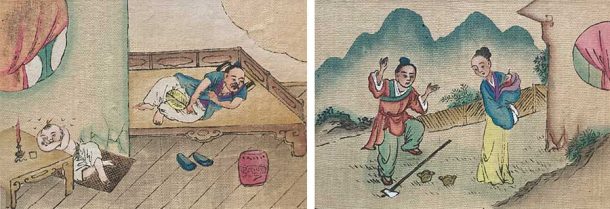
The accompanying illustrations are wonderfully coloured miniature paintings. Each shows a pivotal scene from the tale and visually appeal to both children and adults alike. It is worth noting that all but one tale employs a male protagonist, which is likely reflective of the patriarchal nature of traditional Chinese culture and perhaps of some Confucian ideals, which are deeply intertwined. It is a fascinating book to explore in and of itself, as well as a point of departure for further research into the place of Confucian values in Chinese cultural history.

To see what else V&A/RCA History of Design students have been up to, read our other blog posts or check our pages on the RCA website. You can even find out how to apply for 2026/2027 admission to MA V&A/RCA History of Design.