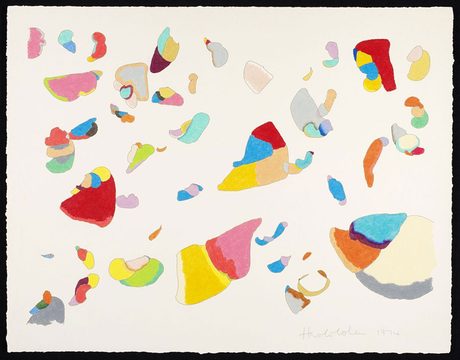
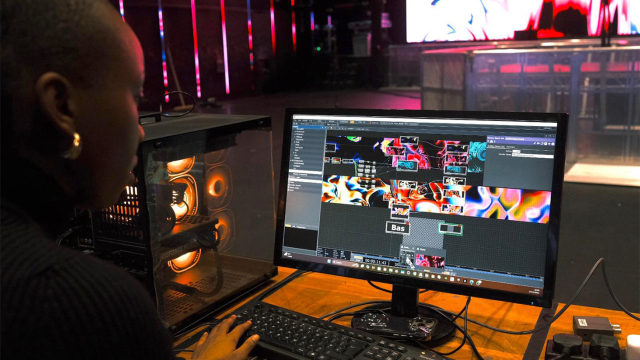
Collaboration in many forms, from institutional support to informal peer networks, has long been central to both artistic production and how artists are supported throughout their careers. Within computer art’s history, collaboration has also been essential to how artists accessed and understood new technologies and tools. Early computer artists relied on close exchanges with scientists and engineers: Lillian F. Schwartz spent thirty years at Bell Labs; Vera Molnar worked in French computer laboratories from 1968 onwards; and Harold Cohen, introduced to programming by the computer scientist Jef Raskin at The University California San Diego, went on to spend two years at Stanford’s Artificial Intelligence Laboratory in the early 1970s.
Where these early computer artists might have waited days for a single output, or depended on engineers who had built the programming tools they used, artists today can write and run their own programs in seconds, generating thousands of variations whose outcomes they cannot fully foresee. The process itself is not new: as early as 1975, Molnar described, in her article ‘Toward Aesthetic Guidelines for Paintings with the Aid of a Computer’, generating a series of variations and assessing which ones, sometimes unexpectedly, succeeded aesthetically. What has changed is the scale and speed at which this is possible. As the artist Tyler Hobbs reflects in his essay Direction, Reaction, and Messy Ideas, the constraint is no longer access but abundance: the difficulty lies in judging which results to pursue, which surprises matter, and when a work is finished. In this exchange the machine becomes something closer to a collaborator, and this shifts familiar ideas about process, influence, and dialogue. When a work develops across thousands of iterations, its making is spread between writing rules, generating outputs, and selecting among them, leaving it unclear where the work itself resides. Influence becomes reciprocal: the artist shapes the system, but its unexpected results redirect the artist in turn. And while the rhythm of proposal and curation resembles dialogue, the machine has no intentions of its own, raising the question of whether the artist is in conversation with the machine or, through it, with themselves.
These questions take on another dimension when the exchange includes not only a machine but a collection. For the 2026 Digital Art Season, the V&A and Avant Arte partnered to open the museum’s archives and collection, which hold works by Molnar, Schwartz, and Cohen, to a new generation of digital artists. Curators Corinna Gardner and Melanie Lenz invited Matt DesLauriers and William Mapan to work with the collection, examining the relationship between cultural memory and artistic authorship. Both artists rose to prominence in the Generative art community through early participation in online networks of exchange, a contemporary counterpart to the informal peer networks through which artists have long sustained their practice. Working with the collection, each developed their own view of our relationship to code and to machines.
Matt Deslauriers
Matt DesLauriers is a Canadian artist based in London who has been creating generative art since 2014. His research-based practice explores building custom tools and systems from the ground up. Often writing in JavaScript, he prefers custom solutions over third-party libraries because, as he describes, ‘authorship lives in the infrastructure as much as in the work itself.’ This allows DesLauriers to deeply refine his algorithms, developing an aesthetic style built on a suite of technical approaches. For example, the careful selection and fine-tuning of noise functions, deterministic mathematical functions that produce smoothly varying values, achieves a look that carries across many of his works. Unstructured random numbers in code would produce scribbles, but DesLauriers uses specific transformations of simplex noise, a noise algorithm that shapes the smoothly undulating virtual terrain beneath each work. From this, he has developed a distinctive visual language across his series from Meridian to Subscapes and Sierra, in which virtual terrains are choreographed through line. This sense of landscape is carried into his newest body of work, Serac.
While visiting the V&A collection, DesLauriers was most drawn to the collaborative work of Colette and Charles Bangert, who began creating computer-generated plotter drawings in 1967. In their Grass series, DesLauriers was captivated by how organic and fluctuating lines emerged from such a precise mechanical process. This prompted him to explore how structural linework might convey a sense of place, leading him to nineteenth-century studies of the landscape, including John Ruskin’s studies of Alpine peaks such as the Aiguille du Plan, and Orra White Hitchcock’s geological diagrams of rock strata. Serac carries this research forward across print and digital outputs as a direct study of lines and structure.
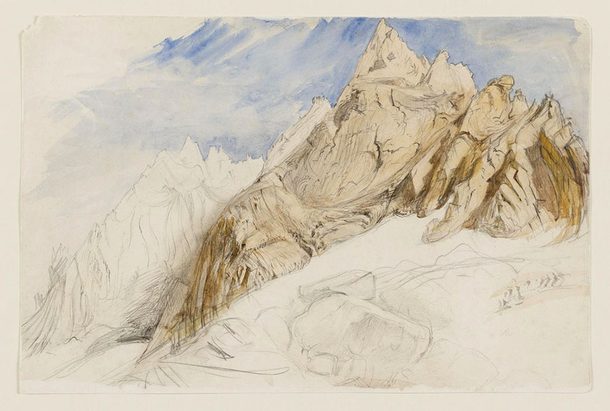
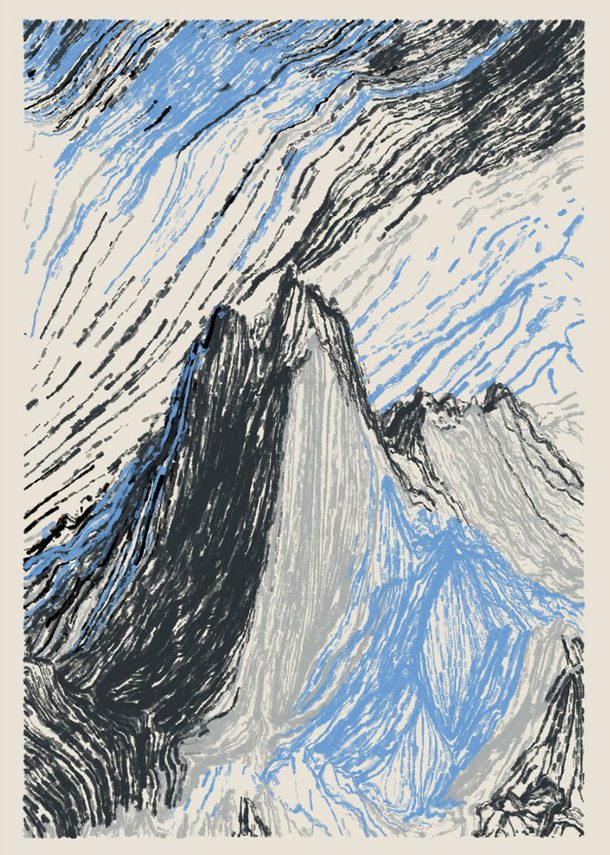
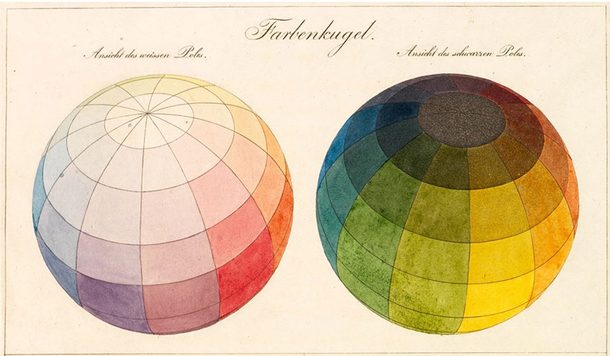
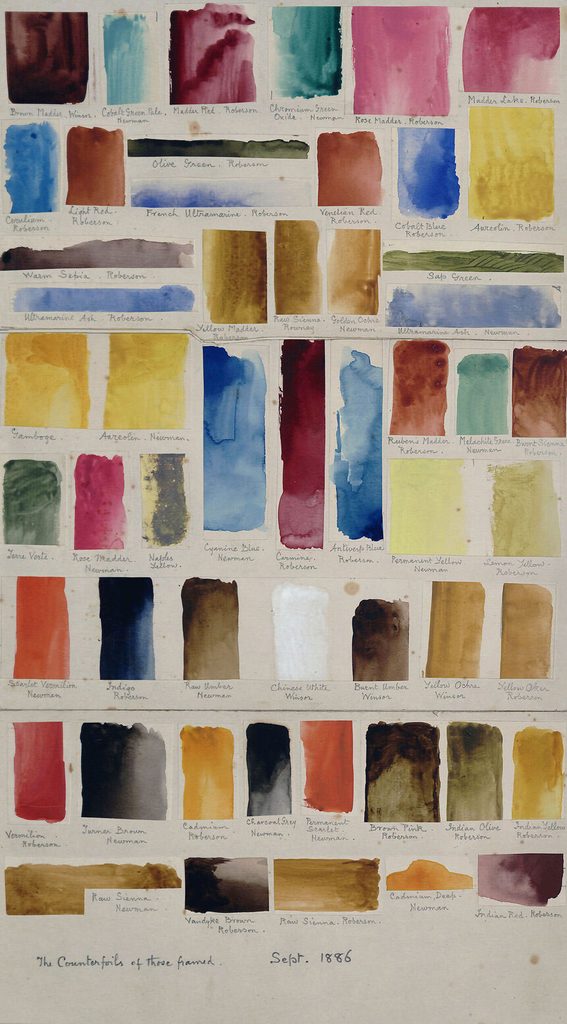
Beneath each work in Serac lies a virtual terrain plane, across which DesLauriers’ algorithm lays thousands of strokes. Following the slope of the land, the lines reveal fractured structures resembling columns of glacial ice–a serac– which give the work its title. In many digital drafts, ‘a jagged peak rises from the valley floor’, recalling Ruskin’s Aiguille du Plan, as DesLauriers notes. As the algorithm would generate hundreds of thousands of outputs, Deslauriers would print and pin a selection to his studio wall and then adjust the code after inspecting them. DesLauriers likens this process to a mapmaker refining a chart as the system’s terrain would reveal new edges and peaks with each iteration. For the colour palette, he drew on colour theory from Philipp Otto Runge’s colour sphere and Arthur Hopkins’ watercolour specimen sheets, treating colour itself as a sample within the system. Through this process and exchange, DesLauriers curated a selection of 1,000 digital works.
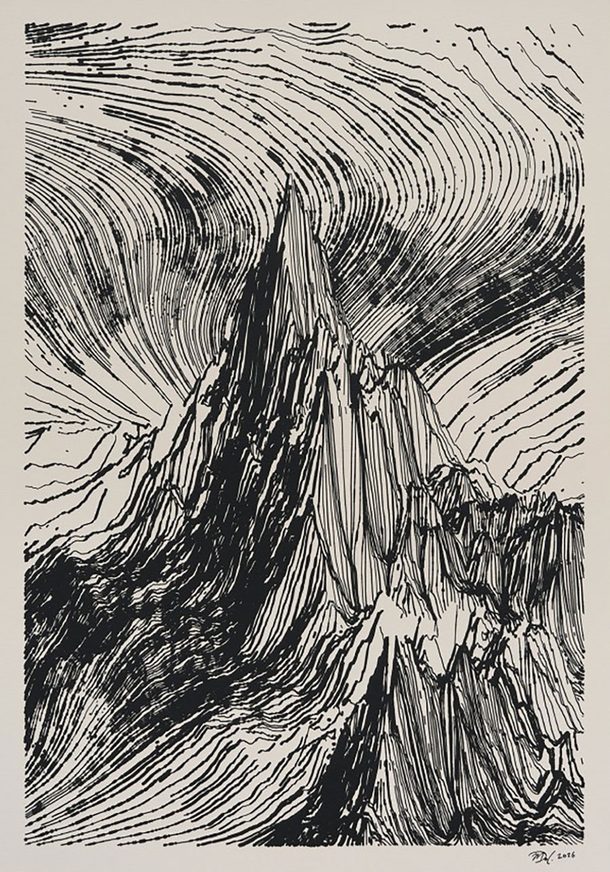
For the silkscreen print, DesLauriers deliberately chose a monochrome black composition. By stripping the work to just lines, he chose to highlight what he states as ‘the underlying mechanism and the underlying structure that I’ve been focused on this whole time’. For DesLauriers, ‘detail emerges at every scale’, from the small turns at the edge of a line and the layering of the ink on the silkscreen to the way individual marks gather into a larger landscape. He connects this back to Bangerts’ Grass series, as both explore organic forms emerging from precise mechanical processes. Through each line, DesLauriers examines his relationship with the computer and the vastness held within the system, questioning how much still might be unknown to him.
Read Curating Abundance: Matt Deslaurs and William Mapan – Part 2