This essay is Part 2 exploring ideas about collaboration in the work of Matt DesLauriers and William Mapan. Read Part 1 here.
While Matt DesLauriers’ Serac investigates structure, line and colour with a machine William Mapan’s work explores the intimacy and physicality of drawing with code. Mapan is a Paris-based artist, whose practice draws on a background in software development and more than fourteen years of working with code. Across series such as Dragons and Sketchbook B, Mapan has brought the gestures of drawing and painting into computational systems, building most of his libraries himself from his daily sketches. Over the past five years, his painting practice has developed alongside his code as he seeks a shared ‘grammar’ between digital and physical mark-making.
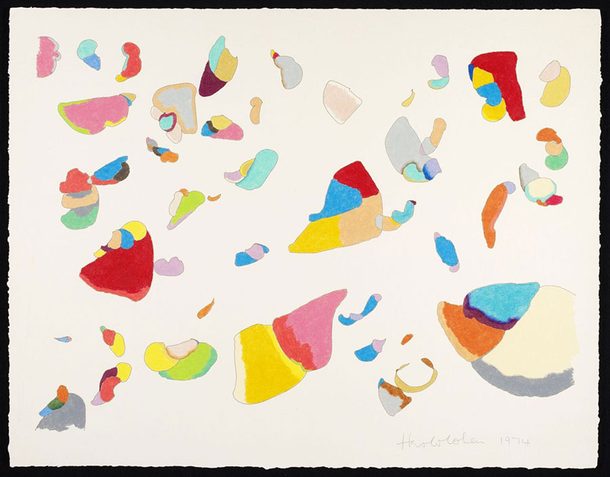
At the V&A, Mapan was particularly struck by the influential work of artist Harold Cohen and his decades-long collaboration with AARON, his autonomous art-making program. Seeing the work for the first time in person rather than on screen, Cohen’s work revealed its imperfections where the plotter marked the paper. This surprised Mapan, prompting him to respond by steering his 3D algorithm towards Cohen’s opaque forms, bold outlines and use of colour and negative space, while keeping his own focus on movement and the mark of a brush or crayon. This observation marks a new direction in Mapan’s practice in an algorithm he has been developing over the course of two years, showcasing a more graphic style. The body of work is split into two parts: the digital and physical to which Mapan’s chosen titles Confined and Un)confined invert a familiar assumption. We tend to imagine the internet as infinite and a physical artwork as finite, yet in Confined, the digital work, Mapan’s shapes are held inside a room with windows looking out, while in (Un)confined, the print, these shapes move ‘beyond its walls.’ For Mapan, the two form a pair, best understood when viewed together.
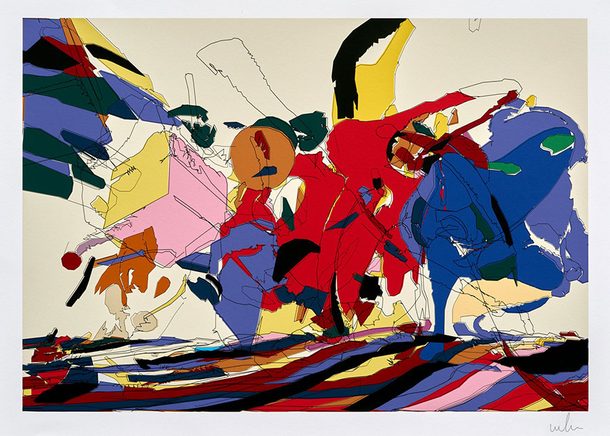
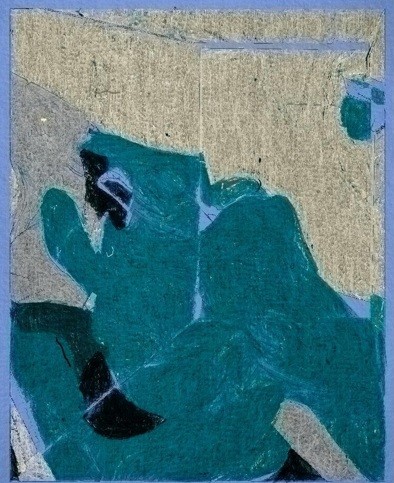
The underlying system in the body of work began in Mapan’s sketchbook. He draws daily, annotating each gesture with notes on its ‘logic,’ he then translates these observations into code (javascript). Mapan questions where a line starts, which direction it travels, how much pressure and thickness it carries. Mapan photographs his Sennelier oil pastels and maps how each colour mixes with one another, generating palettes which he describes as either ‘fighting’ or ‘calming’ each other. However, the hardest quality to encode, he explains, is the flow of the arm moving across a surface. In Confined, the image is drawn progressively, thousands of strokes, so imperfections accumulate as they would in physical mark-making. Mapan has noted that his work in software demands code without bugs, in his art he searches for errors and ‘cracks’, places where the improvisation of drawing can enter a system bound by rules. He describes this process as ‘extracting his identity and giving it to the computer.’
Today we encounter machine-generated content at every corner of our lives, from algorithmic filters and vibe coding to the deepfakes on news and social media. As these systems grow more pervasive and elusive, our relationship with them naturally becomes more apprehensive. This collaboration between Matt DesLauriers, William Mapan, the V&A and Avant Arte arrives at a timely moment, offering a different way of encountering these systems and highlighting the quieter and more private ways these artists collaborate with machines. Neither artist positions the computer as just an autonomous creator; in their work we see the idea of collaboration as an ongoing exchange between code and the conditions that shape the work’s emergence. Both artists, in their own distinguished ways, capture an ongoing exchange with computers, exceedingly surprised by this new interaction with seemingly infinite possibility.Perhaps, then, like DesLauriers and Mapan, we are prompted to look away from the current polarization and acknowledge our own relationship with the technologies we create, and how collaboration with a computer becomes a way of engaging with randomness and uncertainty.