Halloween may be over, but Spooky Season is alive and well. To celebrate, we are highlighting some of the terrifying treasures that sit within the National Art Library collections at V&A East Storehouse.
With around 300,000 library books held at Storehouse, spanning theatre and performance, local history and British topography, and historic children’s books, there is no shortage of weird and wonderful publications.
The seven titles listed here represent just a few frightful favourites, all available to view in the Storehouse Study Centre.
Harrap’s guide to famous London graves by Conrad Bailey (1975)
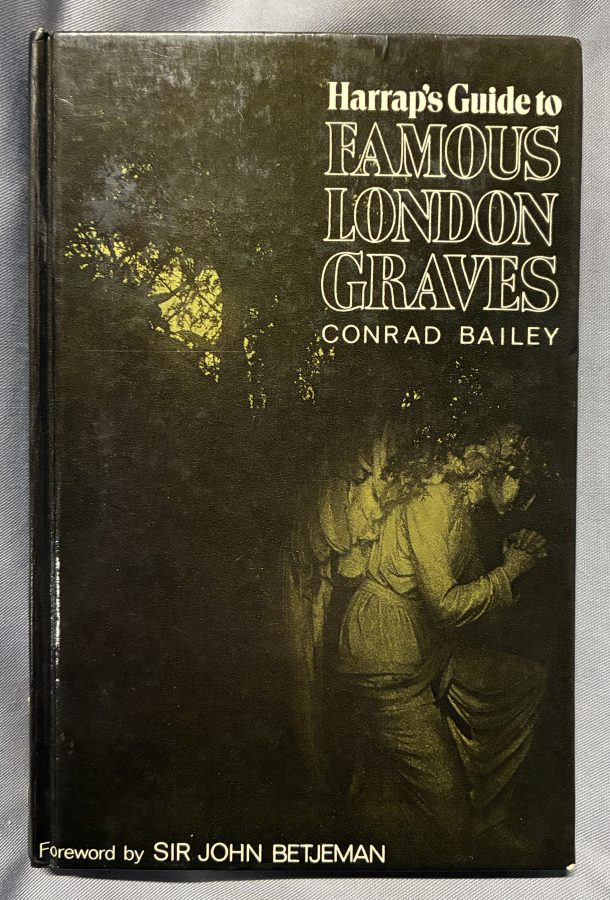
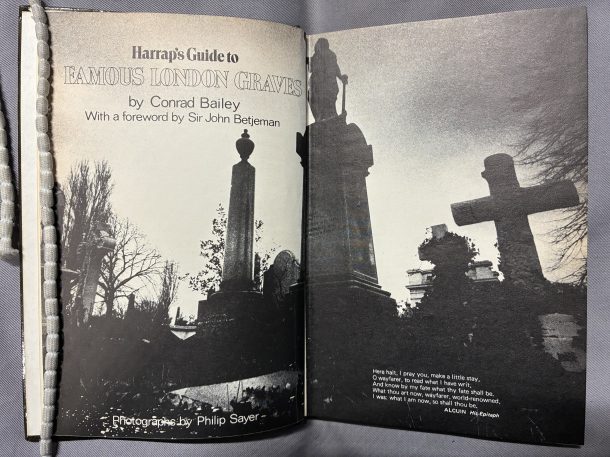
It stands to reason that a city as old and as large as London would have seen its fair share of burial grounds and high-profile funerals. This guide highlights some of the most famous graves across the City of London and beyond. From London’s ‘magnificent seven,’ the large garden cemeteries built by the Victorians to alleviate crowding and unsafe burial grounds, to medieval churchyards, the book maps the burial places of kings, queens, pickpockets, artists and more.
Karl Marx, William Blake, George Eliot and V&A’s very own Henry Cole are just a few of the illustrious graves to be found in this book. What better way to spend Halloween weekend than strolling amongst the tombs of London’s historic graveyards?
Sarah Bernhardt: [cuttings albums relating to her death and funeral], 2 volumes, (1923)
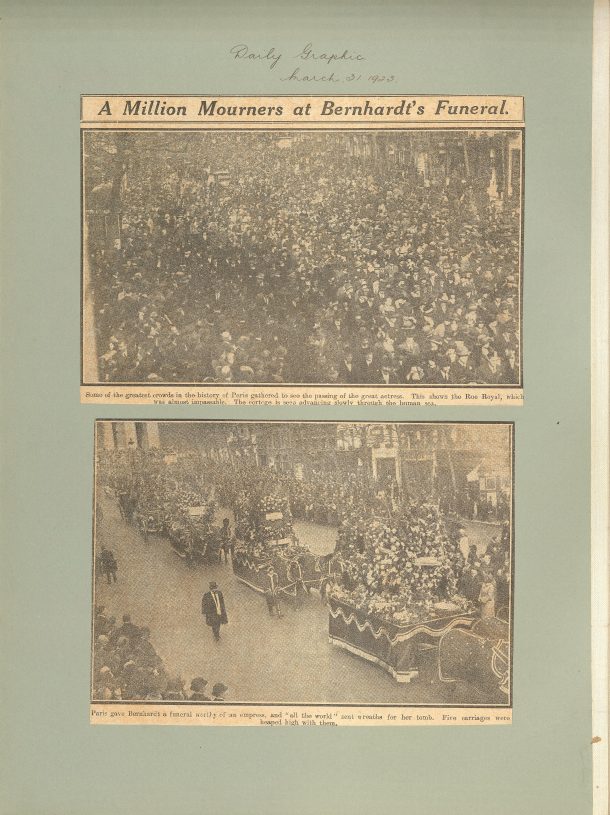
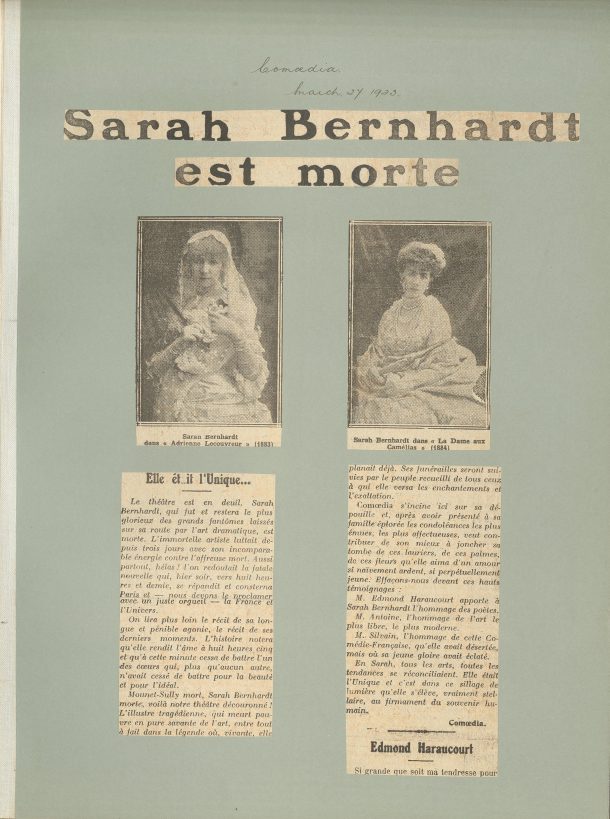
It would be fair to say that Sarah Bernhardt was comfortable with the idea of her own mortality – as a tragedienne, she was used to dying in front of an audience night after night. But she was also known for keeping a satin lined coffin in her bedroom, which she often slept in, lay in whilst preparing her roles, and posed for photographs in, contributing to her dramatic image.
Sarah Bernhardt was one the most famous French stage actresses of the late 19th and early 20th centuries – so it isn’t surprising that when she passed away in 1923 aged 78, a crowd of 30,000 mourners attended her funeral, and accompanied her casket across Paris to the Père Lachaise Cemetery, stopping off at the Sarah Bernhardt Theatre along the way.
This scrapbook, compiled by an unknown fan, collects obituaries and articles documenting her incredible life and career as well as her elaborate funeral, which included extravagant floral arrangements, black plumed horses to pull her cortege, and an accompanying entourage of mourners.
Emblems of mortality: representing, in upwards of fifty cuts, death seizing all ranks and degrees of people… by John Bewick after Hans Holbein (1795)
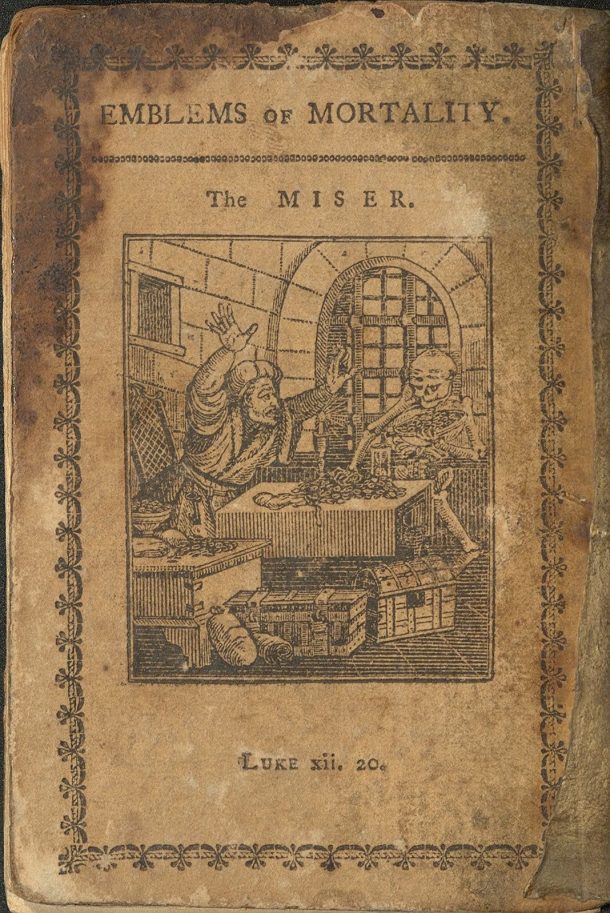
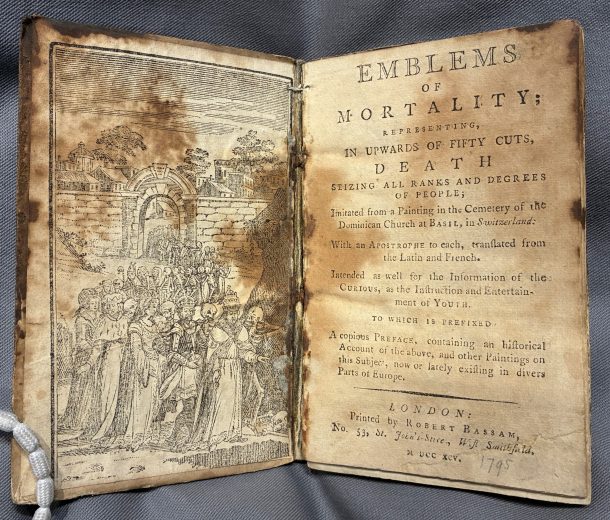
This pocket-sized book of emblems is jam packed full of skeletons! These skeletal images are reproductions of Hans Holbein’s Dance of Death (first published 1538). The Dance of Death or Danse Macabre was a popular allegorical genre from the late Middle Ages, where a personification of Death, in the form of a skeleton, invites representatives from all walks of life into a dance to the grave. They were produced as memento mori, or reminders of the reader’s own mortality- whatever your position in society, death was the great leveler.
These reproductions were made by John Bewick, a wood engraver active in the 18th century. His brother, Thomas Bewick, was widely credited as being a pioneer of wood engraving, his fine lines and the naturalism of his animal prints in works such as A history of British birds earning him widespread popularity. John Bewick was apprenticed to him before forging his own career as an engraver, predominantly working on children’s books. Sadly, he passed away at the age of 35, before he was able to establish his own reputation as an artist and engraver.
The Fakenham Ghost: a true tale by Robert Bloomfield (1806)
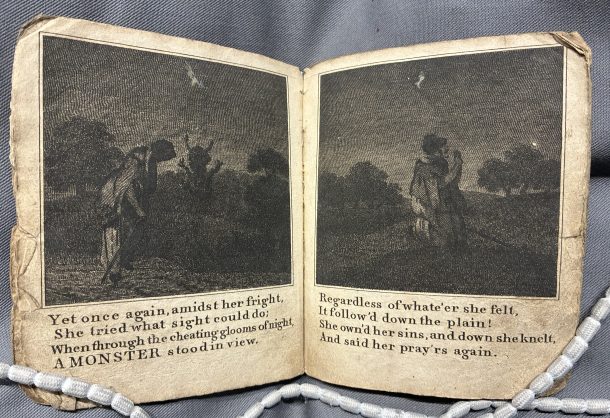
Haven’t we all had moments where our imagination gets the better of us in the dark? The Fakenham ghost tells an eerie tale of walking home at night through the Norfolk countryside, and of being followed by an unseen, possibly malevolent presence… Though initially frightening, Robert Bloomfield’s poem masterfully balances tension and humour, and the accompanying unsigned prints also reflect this in their interplay of darkness and light. Though eerie, the illustrations also hint very early on at what, or who, the ‘ghost’ may be…perhaps a small donkey?
Robert Bloomfield was a self-taught poet and cobbler from Suffolk, whose poetry about rural life met with great praise during his lifetime. The Fakenham ghost was originally published as part of his poetry collection Rural Tales in 1802. This 1806 edition was published by William Darton, who specialized in children’s books.
Spectropia, or, Surprising spectral illusions: showing ghosts everywhere, and of any colour by J. H. Brown (1864)
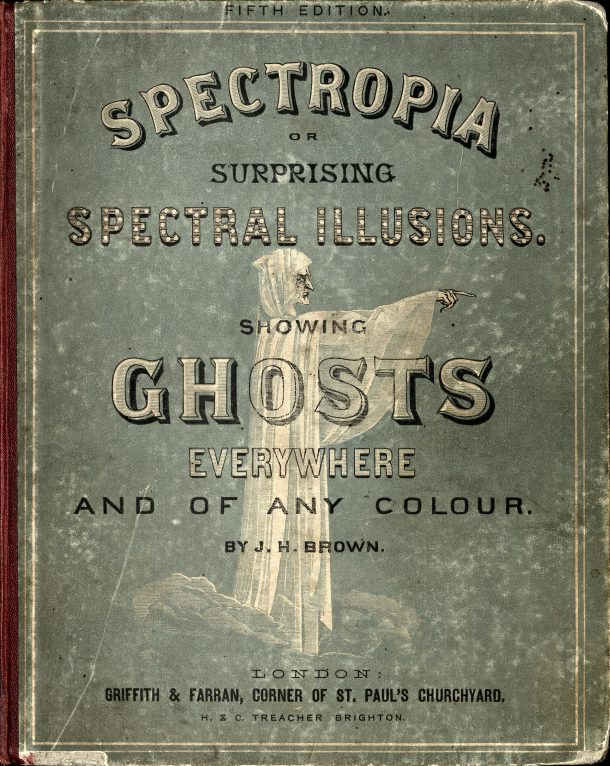
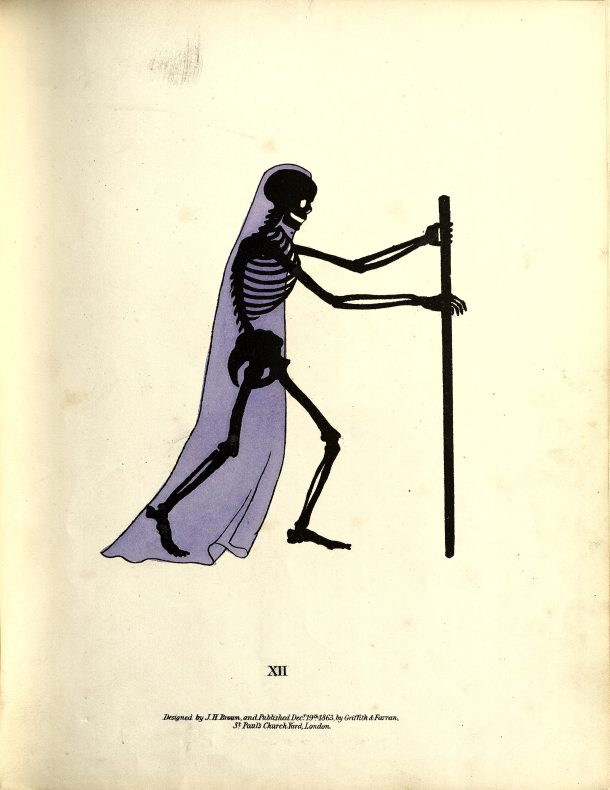
The 19th century saw a rise in Spiritualism – the belief that the living can commune with the dead, usually through mediums or seances. J. H. Brown, the author of Spectropia, was not so taken with this belief, and in 1864 set out to prove that ghost sightings were nothing more than an optical illusion.
Following an introduction condemning the “absurd follies” of Spiritualism, this book presents 16 lithographed plates—13 hand‑coloured—designed to produce vivid afterimage illusions.
Readers are instructed to stare at a marked point on the illustration for about 20 seconds under strong light. When their gaze shifts to a blank wall or ceiling, the “ghost” will appear in inverted colours due to the afterimage effect – a phenomenon where the image continues to appear in one’s vision after exposure to the original has ceased.
By offering a scientific explanation on the properties of light, colour, and the structure of the eyes, Brown hoped to bring about the “the extinction of the superstitious belief that apparitions are actual spirits”. However, the book was largely marketed as a toy book or parlour game for children. Copies now sit in the collection of Children’s Books in the National Art Library, and we leave it up to the reader to decide whether ghosts are real or but an illusion…
The haunted library : a Novocastrian reminiscence by John F. Layson (1880)
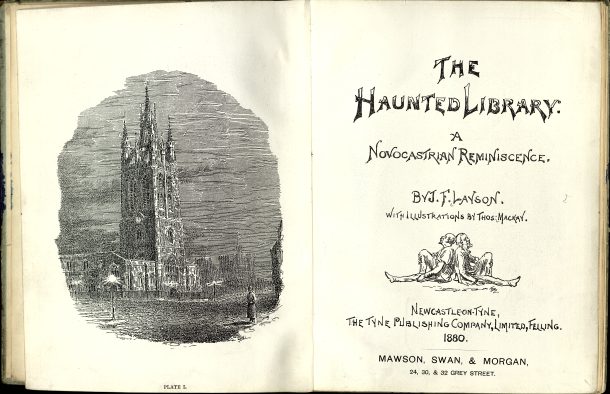
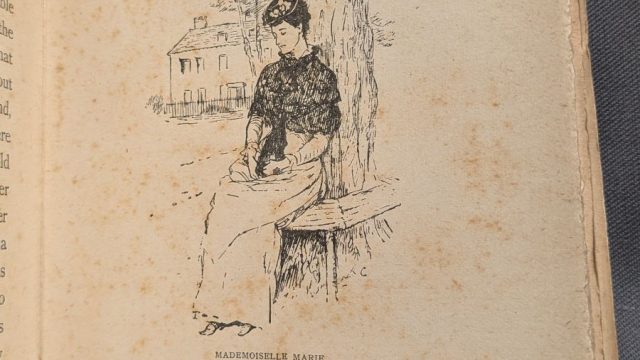
Libraries are of course full of ghosts. Voices from beyond the grave reach us each time a book is taken from the shelf, and such is the premise of John Layson’s Haunted Library. Told in verse and set in the hallowed halls and shadowy stacks of Newcastle’s City Library, our protagonist – a perplexed doctor – stumbles upon a ghostly gathering of some of literary history’s most famous figures.
Eerie and enigmatic line block illustrations accompany the text as the likes of Chaucer and Shakespeare return for an otherworldly discussion on the evolution of literature and the power of libraries.
Tipped into our copy is a letter of correspondence from W. J. Haggerston, Chief Librarian at the Newcastle Library, dated December 28th,1880 and addressed to a “Dear Doctor”. Could it be that this haunting tale was founded on fact?
Haunted House by Jan Pieńkowski (1971)
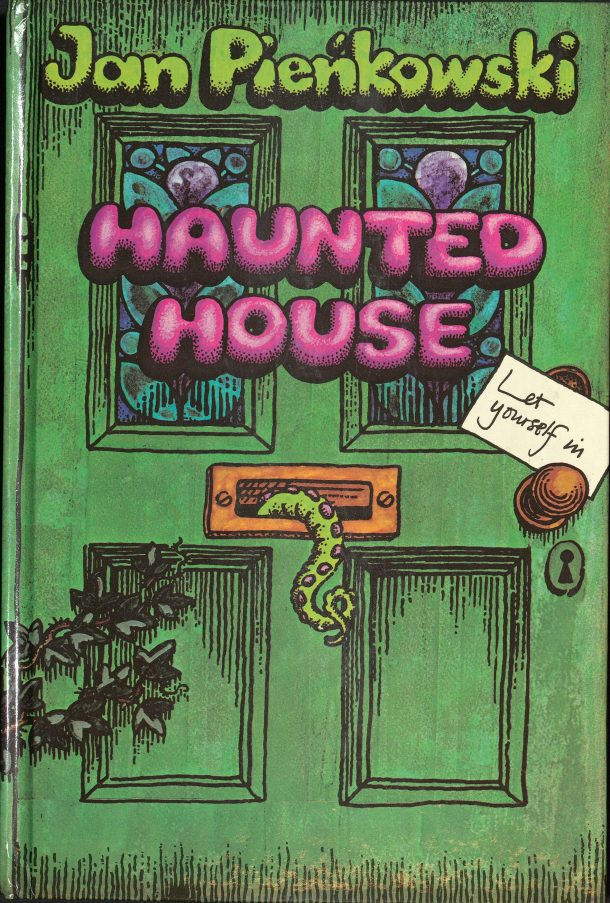
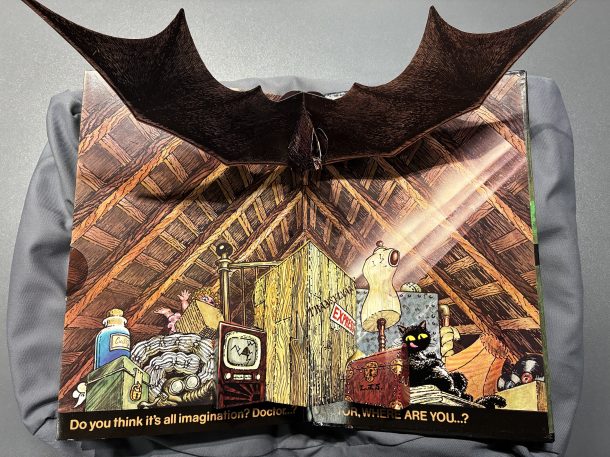
From haunted libraries to haunted houses, Jan Pieńkowski’s Haunted House is a frightening feat of paper engineering. Layered illustration and mechanical folds lead readers through this house of petrifying pop-ups.
Haunted House is one of the best-selling moveable books of all time and won its creator his second Greenaway medal in 1979. The traditional pop-up design is paired with Pieńkowski’s signature art style, creating a terrifyingly tactile tale for all who dare to turn the page.
Best known for his picture book series Meg & Mog, Pieńkowski was also a prolific writer, illustrator and designer of moveable books, many of which are represented across library collections.
You can see these, along with any other items from the library collections at Storehouse in the V&A East Storehouse Study Centre. The Study Centre is open to NAL readers Monday to Wednesday, 10am-5pm, by appointment. To arrange your visit, contact the NAL enquiries team: National Art Library: ask a question – NAL: ask a question
We welcome all researchers, students, creatives, and curious minds to explore these incredible resources—whether for academic study, creative work, or personal interest. Browse the catalogue here.
To explore our collections further, no appointment necessary, come along to our next Library and Archives Discovery Day, from 12-5pm on Friday 4th December 2026.