I am an intern at the V&A, undertaking a 5-month project to catalogue and research works on paper by Randolph Caldecott (1846 – 86). Caldecott was an artist and illustrator, best known for his annual ‘Picture Books’, including ‘The House that Jack Built’ and ‘Babes in the Wood’. Through these blog posts I hope to shed more light on his life and career, and the process of finding out more about the V&A’s collection of his work. This project is supported by The Randolph Caldecott Collection Trust.
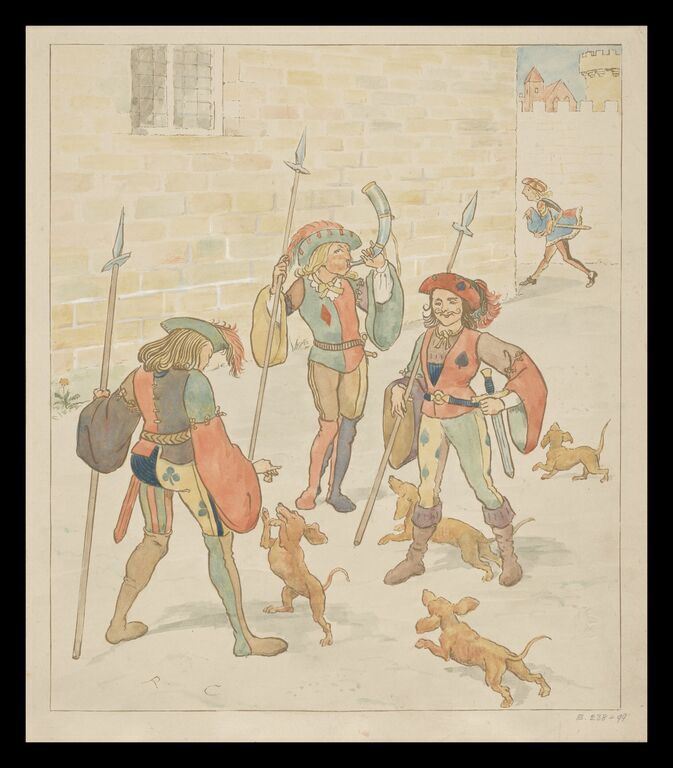
Randolph Caldecott’s legacy not only lives on through his published works, but also in the over 700 drawings, proof prints and other pieces of art in the V&A collections. These fascinating objects give a closer look at the process behind creating his iconic ‘Picture Books’, including hand-coloured proof prints and unpublished illustrations. Nearly half of this collection was purchased from Marian Caldecott, Randolph Caldecott’s wife.
Marian and Randolph’s life in Kent
Marian Brind married Randolph in 1880 in Kent, where they had met and were both living. Marian was from the village of Chelsfield, the daughter of a businessman. The Brind family trade was as wine merchants, though her father had several other ventures. The Brinds were neighbours with Heinrich Sigismund Uhlrich (1846 – 1937), a German wood engraver who had emigrated from Norway in the early 1870s. Randolph Caldecott lived seven miles away in Kemsing, where Marian joined him after their marriage. Uhlrich contributed to the Graphic newspaper, which Caldecott also contributed to as an illustrator. Ulrich was even responsible for engraving the portrait of Randolph Caldecott that accompanied his memorial in the newspaper after his death in 1886.

It seems highly coincidental that these two men not only worked for the same newspaper, but had connections to the same small village. Like the chicken and the egg, it becomes a question of which came first?
It is unlikely that Caldecott introduced Uhlrich to Chelsfield. Caldecott was still living in London when Uhlrich came to England and began working at the Graphic. He did not move to Kent until a year after Uhlrich married Sarah Anne Morgan, the daughter of a Chelsfield farming family. In fact, it might have been this marriage that introduced Caldecott to not only Chelsfield, but his future wife. Sarah Morgan and Marian Brind were very close in age, and the garden of Marian’s family home shared a wall with the church where Sarah and Heinrich were married in 1878. Although Caldecott’s published letters shed little light on how he met Marian, there’s a possibility it could have been this wedding. Randolph and Marian were married in the same church, just two years later.
Depictions of Marian Caldecott
Marian and Randolph travelled together, both for Randolph’s work and his health, spending the winters in the warmer climates of the French Riviera. According to the Randolph Caldecott Society, she is depicted in one of his illustrations for Breton Folk, though it is not clear which one. Perhaps the figure on the right of the watercolour painting ‘The Gavotte’ could be Marian?

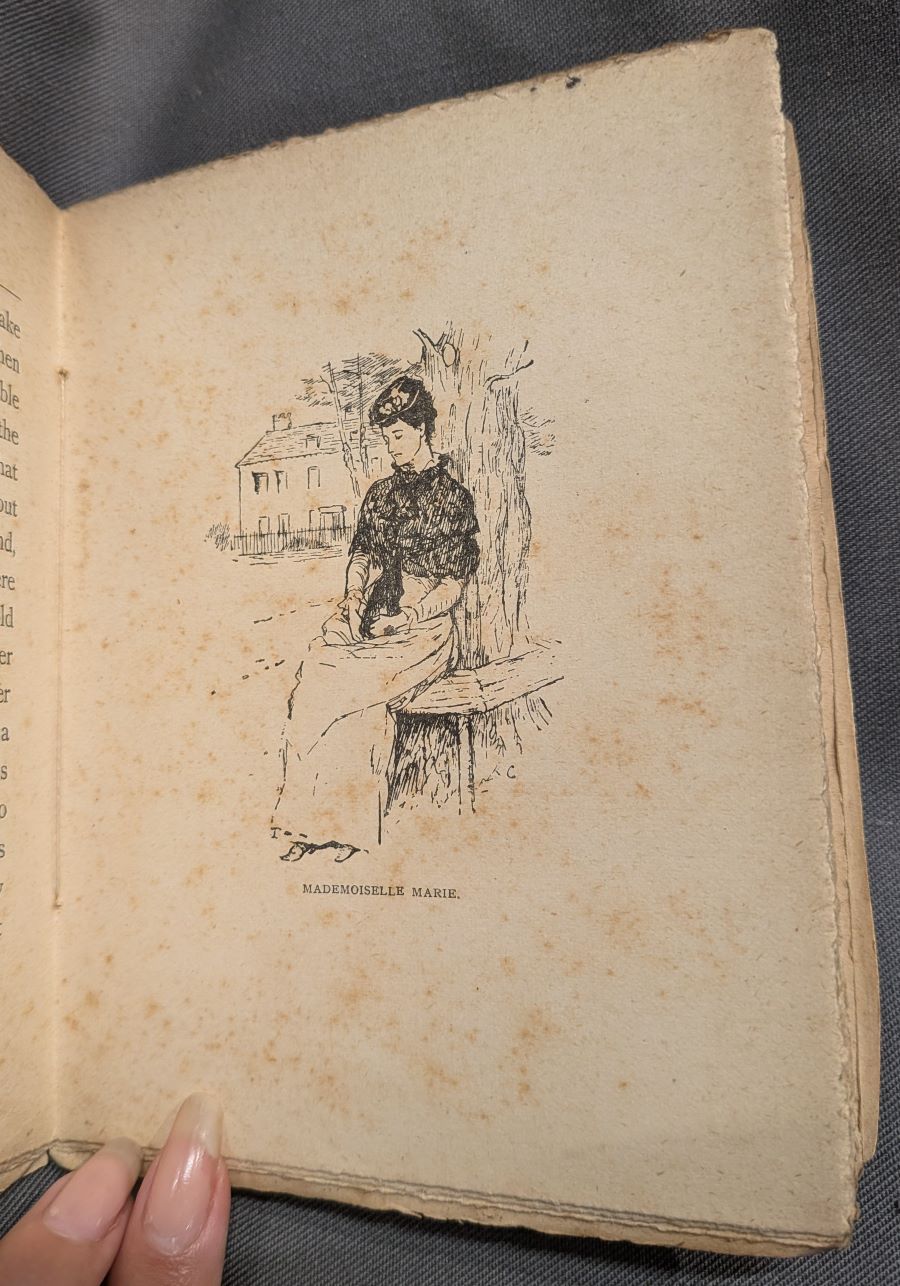
There are almost no depictions of Marian to compare this painting to. An annotated copy of The Owls of Olynn Belfry, discovered after Randolph’s death, revealed that the drawing of ‘Mademoiselle Marie’ was based on Marian. Though her image does not frequently appear, she does feature often in Randolph’s letters, as ‘Mrs. C’. He socialised with a circle of high-profile artists, including Sir Frederic Leighton, John Everett Millais and George du Maurier. Marian was introduced to several of these friends, who were often also Randolph’s professional contacts, and wrote letters to writer Juliana Horatia Ewing. Marian even offered to act as Randolph’s secretary, but he felt he was too particular to let anyone else handle his correspondence.
Marian Caldecott and the V&A
In a letter written in November 1885, Randolph laments that ‘Mrs. C. was not very well’, suffering from seasickness on a voyage to the United States. Unfortunately, a few months later it was Randolph who was not well, as the unseasonably cold weather in Florida worsened his already fragile health. After his death in February 1886, she wrote to a friend of the couple, Frederick Locker-Lampson about forming a committee to create a monument to Randolph. Her wish was that it included “no one who is not known to have some interest in and admiration for Randolph’s work, or him self, no dragging in of names of people who don’t care, just to make a ‘boom”.
Fortunately, admirers of Randolph’s work were not difficult to find. Amongst his prominent friends was painter Thomas Armstrong, who was also director of art at the V&A (then the South Kensington Museum). Marian made several sales of Randolph’s work to the V&A in the years following his death, which Armstrong helped arrange. They were acquired not only as fine examples of illustration, but as a teaching tool for students.


Looking through Marian Caldecott’s nominal file in the V&A archive, you can read correspondence between her and the museum. However, it was not her offerings of Randolph’s work that intrigued me most. I discovered that Marian’s relationship with the V&A extended beyond her husband’s work. In 1896 she loaned an 18th century sack dress to the museum. The dress, dating from the 1770s, shows signs of alteration for fancy dress in the late 19th century. Was this done by Marian? Caldecott did make drawings from costumed models, and many of his works feature non-specific ‘historical’ dress with many similarities to that of the late 18th century. This discovery has given me a new mission whilst cataloguing Caldecott’s work, a constant eye-spy for a familiar dress.

In 1918, the dress was still on loan and on display in the ‘Loan Court’, also known as the ‘Octagon Court’ and now, Gallery 40. In August, the V&A sent a letter to Marian’s London address in light of the ‘possible increase of attack from enemy aircraft’ that would impact the Museum. They asked her to review the conditions of the loan and decide if she was happy for the object to remain on loan. Unfortunately, they received the letter returned as ‘not known’ and ‘gone away’. Initially, I feared this might be the last I could find about Marian, however records show that she had left London and returned to Kent at least twenty years prior. She lived with her sister, Amy, in Tunbridge Wells until Amy’s death in 1931. Marian died the following year. In 2005, the loaned dress was accessioned into the V&A’s collection permanently and can be viewed online through Explore the Collections.

Researching Marian Caldecott has given a glimpse into an intriguing and varied life, that may have otherwise been sidelined to that of her more famous husband. Marian went from a life in rural Kent to socialising with some of the most notable artists of the day, and appeared to take it all in her stride. She travelled the east coast of the United States with Randolph, but made the journey back to Britain alone, eventually returning to Kent. The prints and drawings purchased from her form a large part of the V&A’s collection of Caldecott’s work. Marian’s effort not only preserved work for Randolph’s ‘Picture Books’, but his legacy as a whole.