Mari Katayama is a multidisciplinary artist based in Gunma, Japan. Born in 1987 in Saitama, she graduated with a Master’s degree from the Department of Intermedia Art at Tokyo University of the Arts in 2012. Katayama’s artistic practice begins with intricately hand-sewn fabric objects which feature in her photography, video, and activist art projects. She uses her body as a living sculpture, a mannequin and a lens through which to reflect society and our environment.
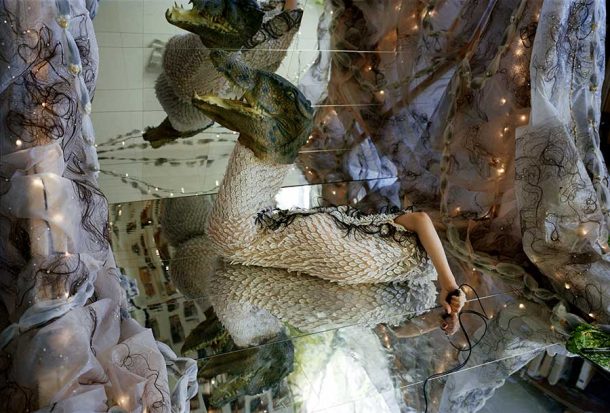
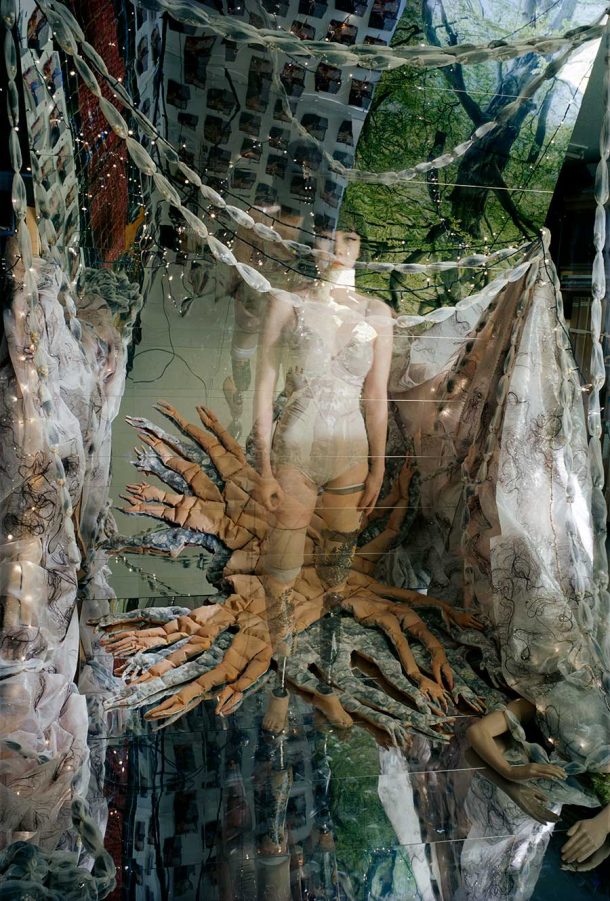
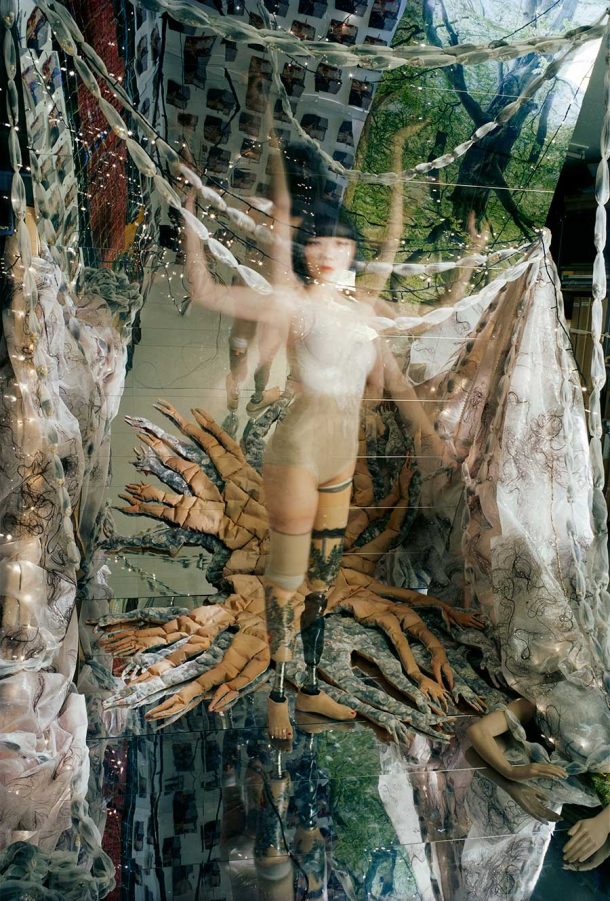
Katayama is the first artist commissioned by the V&A Parasol Foundation Women in Photography Project. Katayama’s artistic practice begins with intricately hand-sewn fabric objects which feature in her photography, video, and activist art projects. In tree of life, Katayama appears amongst elements including her two largest ‘soft sculptures’ to date: a hand-stitched three metre entity with multiple limbs and a twenty-metre-long tube called koilia. She made these photographs in a specially constructed set in her studio using mirrored tiles, which create endless reflections. Using an analogue camera, Katayama captures her self-portraits in a single shutter release. The resulting images are all hand-printed from film in the darkroom. To the artist, the reflections represent how things are relative to one another. Shapes emerge in a continuous flow, resembling maps, rivers, blood vessels, branches and tree roots, each element evoking the cycle of life.
‘tree of life’ is currently on display in ‘Photography Now’ until 12 September 2027.

Fiona Rogers, Parasol Foundation Curator of Women in Photography (FR):
Your mother and grandmother are both talented seamstresses, and your grandfather was an art enthusiast. Can you describe growing up with these experiences, and your early memories experiencing different art forms?
Mari Katayama (MK):
My mother and grandmother were always sewing, making clothes and adding colour to everyday life. They often said to me, “Rather than focusing on what you can’t do, do what you can. If you can’t find what you want, then make it yourself.”
For me, sewing was never a special skill. It was simply part of everyday life, and a form of training—thinking through my fingertips, or body, that touch the needle. With a needle and thread, you can make anything. Even now, I believe these are among the most powerful tools there are.
My grandfather, on the other hand, loved art and frequently took me to exhibitions and museums. I think the way I compose photographs—holding composition, narrative, and concepts within an image rather than explaining them in words—has been deeply influenced by the paintings I encountered during those visits.
Through these experiences, art came to exist for me in the space between living (everyday life) and making, between experience—something close to memory—and thought.


FR:
Your work developed during the evolution of 1990s social media and platforms such as MySpace. What about sharing your work in this format appealed to you? How does your practice continue to respond to contemporary digital culture?
MK:
When I was a teenager, sharing my work on social networking platforms such as MySpace was the only way to get my expression across to others beyond my body, environment, or physical location. I felt both hope and real sense that expression itself could become a form of communication beyond language. Put very simply, I think I just wanted friends.
Through these experiences, I developed a sensitivity to how images circulate, how bodies are seen, and how intimacy can emerge within public spaces. At the same time, I learned about the risks involved. Images are often misread, stripped of context, and received in ways that differ from the maker’s intention. This made me acutely aware of both the power of images and their fundamental uncontrollability. Around this time, I had several experiences of being a model for other photographers. It gave rise to a simple question: “Why does it become the work of those who photographed, even though it’s me in the photographs?” That, I suppose, planted the seed for self-portraits.
Misunderstandings, and the impossibility of communicating one’s thoughts one hundred percent accurately, are things that occur constantly when living with others. I sometimes think that this frustration itself is part of what makes us human. Everything has both light and shadow, and both are also the aspects of humanity—and even of affection. These are the elements I want to continue observing.
I originally studied information processing, which taught me that everything exchanged through computers and networks is ultimately reduced to sequences of 0s and 1s. Looking back, I think I already had, from that time, a sense of distance—or even resignation—toward digital images, as something inherently illusory. Being digital means it is always flexible, reproducible, and endlessly updateable.
It feels that the ideas I encountered when I took a major in aesthetics and art history, concerning images and originality in the age of mechanical reproduction, later helped to understand with words about this distance I felt toward digital imagery.
That is why today I insist on using film cameras whenever possible, and on making hand-printed photographs in the darkroom—methods that require an intense amount of time and physical presence. Even so, I cannot fully let go of the feeling that photography itself is, by nature, an illusion. Alongside that quiet sense of melancholy, I still hold a romantic belief in the capacity of film photography to seal the reality of “we were there”—almost as if vacuum-packing a moment in time. The film after shooting could be considered as an objet d’art.
In this way, my creation is deeply rooted in physical acts such as hand-sewn objects and analogue photography. At the same time, by questioning visibility, repetition, and identities constructed through images—who does the “I” in the photograph actually belong to?—my work continues to respond to contemporary digital culture.
The ambiguous boundary between what appears as “real” and what is merely a mirrored reflection, which is seen in the tree of life series, I believe, embodies such an approach.
FR:
Music is clearly a great influence for you. You’ve spoken about your experiences singing in clubs in Japan, and your husband is a DJ. Can you speak more about your love of music and how this intersects with your installation or performance works?
MK:
I often feel that clubbing culture is similar to the world of the internet. When you are dancing in a space lit only by a mirror ball, attributes such as age, social position, or the form of one’s body lose their meaning. What matters is not who this person is, but what kind of expression emerges in that moment. To me, clubs feel like a place where expression, stripped from the body, is shared in its purest form.
My experience of singing in clubs in Japan became a crucial catalyst for me in thinking about audience. An artwork becomes an artwork because there are people who appreciate it. At the same time, singing in clubs was also an experience of my body being exposed to the public realm—interpreted, and placed within social relationships.
These experiences eventually led to the beginning of the High Heel Project. One day, while singing on stage wearing flat shoes, a customer heckled, “a woman who doesn’t wear high heels is not a woman,” and threw alcohol on me. The vexation and discomfort I felt in that moment became the driving force behind the project.
Through singing, I became strongly aware of how bodies connect with society, how they are seen, and how they are assigned meaning. The High Heel Project began as a personal expression, but over time it expanded into a more public practice through collective and collaborative process—one that asks broader social questions about bodies and freedom of choice.
For me, music is fundamentally an art of time. Sound cannot remain in space—it flows, disappears, and moves irreversibly into the next moment. This sense of irreversible time has deeply influenced my other forms of expression, including photography and installation.
In clubbing culture, no single person is the protagonist. Instead, the space itself seems to breathe, to hold rhythm, and to weave time. And yet, the experience ends in a single night. What remains is only what is etched into the body as experience. This ephemerality is carried directly into my installation practice. I do not think of space as a container to place artworks, but as something that transforms alongside artworks, guided by the existing environment, atmosphere, and the movement of sounds and people.
For me, art is not something that remains private. It gains meaning by being shared with others and opened to society. What runs through my music, installations, and the High Heel Project is, I believe, a motivation of taking responsibility with care for the moment when expression steps into the public sphere.

FR:
Japan plays a long and significant part within the history of photography. Your work was recently included in the publication ‘I’m So Happy You Are Here: Japanese Women Photographers from the 1950s to Now’, alongside artists such as Yamazawa Eiko, Ishiuchi Miyako and Kawauchi Rinko. How do you see your work in relation to these histories?
MK:
I have deep respect for the history of Japanese photography, including the artists featured in I’m So Happy You Are Here. What has accumulated there are diverse practices that have engaged with bodies, everyday life, and memory within specific times and social contexts.
Rather than positioning my work within a single straight lineage, I feel as though I am quietly in dialogue with these artists through shared questions around the body, memory, and lived experience. It feels less like standing in the same place, and more like looking at similar questions from different positions.
FR:
tree of life is the title of your newest work, commissioned by the V&A Parasol Foundation Women in Photography project. Can you tell us more about the work, how you made it and its narrative aims?
MK:
tree of life is a work that explores relationships between society and the world, between you and me, while examining how multilayered the self is holding many faces and roles. In my studio, I constructed a mirrored set in which the distinction between floor and ceiling dissolves. Points of orientation are lost, endless reflections continue to emerge, and it becomes impossible to tell where the ground ends and where the space above begins.
Within this environment, I shot self-portraits using the largest hand-sewn objects I have made to date. The costumes, walls, and elements in the stage are also re-compositions of objects and collages I produced in the past.
When shooting self-portraits, I use a cable release or timer and follow my long-held motto “pressing the shutter myself.” This reflects my intention to flatten the power dynamics inherent in the act of photographing—between the one who takes and the one who is taken. Using a film camera, without digital editing or multiple exposures, and capturing each image in a single shutter release is a way of inscribing time and bodily position directly into the work.
In the tree of life series, the boundary between what appears as “real” and what is merely a mirrored reflection remains ambiguous. I consider this uncertainty itself to be a core practice of the work. Where does the self end, and where does the other begin? Where is reality, and where is image? Rather than resolving these questions, I present a state in which such distinctions continue to waver.
The work reflects my belief that bodies, environments, and histories do not exist independently, but emerge within networks of relationships. Life is not formed through fixed identities, but through cycles. Those cycles move quietly through and beyond our bodies, across time and forms.

FR:
What draws you to self-portraiture as a primary mode of expression, and how has your relationship to it evolved over time?
MK:
Self-portraiture allows me to work directly from lived experience. I do not see my body as a symbol of an autobiographical narrative, but as a site where social, physical, and emotional realities intersect. I believe this is not something unique to me, but something shared by everyone.
Over time, my relationship with self-portraiture has changed. When I first began making photographs, my body functioned merely as a mannequin—a device to explanatorily present my hand-sewn objects. Today, self-portraiture has become a way for me to think about how the self exists within networks of others, materials, and environments.
FR:
What are you working on in the coming year?
MK:
I would like to continue developing tree of life by constructing its stage on a larger scale. Alongside this, I will continue activities for the High Heel Project, and I am also preparing to resume my music practice, including the release of a record.
While working across different contexts—museums, books, and public spaces—I want to remain grounded in everyday life in the rural area where my studio is located, and weave with care the daily routines and handwork I undertake.
‘tree of life’ is part of Photography Now, the current display at the Photography Centre, The Parasol Foundation Gallery (G98) until 12 September 2027. With thanks to the Toshiaki Ogasawara Memorial Foundation.
‘tree of life’ is included in Mari Katayama’s new book ‘ Synthesis’ by Self Publish, Be Happy.