
This blog is part of a series on Henry Cole’s travel diaries, several of which are in the V&A’s collections.
The Weston Cast Court brings together reproductions of a few of the finest examples of Italian Renaissance monuments, some of which have been traced back to Henry Cole’s travels around Europe in 1863. Also displayed there are two copies of mosaics from churches in Ravenna and Palermo – remnants of another of Cole’s journeys, the 1868 tour around Italy. Charting their provenance allows us to shed new light on the original iteration of the Cast Courts themselves, which featured a rather unusual display of what a contemporary guidebook described as ‘reproductions in paper of some of the principal Mosaic Decorations in various Churches in Rome’ [1].

The Cast Court mosaics
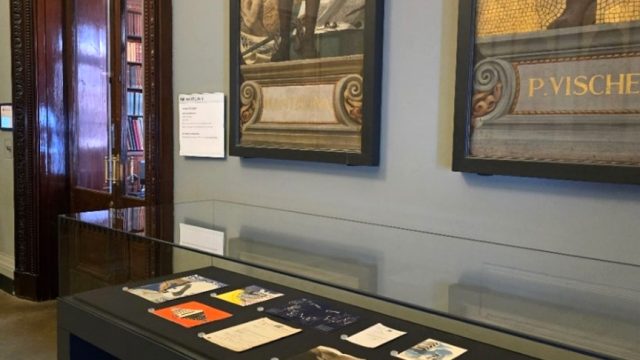
The two mosaics you can see on the wall to the right of Michaelangelo’s David in the photograph above are The Good Shepherd by Salviati & Co. (copied from the 5th-century original in the Mausoleum of Galla Placidia in Ravenna) and the Triumphant Entry of Christ into Jerusalem by Rosario Riolo (after the 12th-century original in the Capella Palatina in Palermo).

The earliest mention of these two copies which I was able to find is from an 1877 catalogue compiled by Johann Wilhelm Appell (1829 – 96), Assistant Keeper in the South Kensington Museum. He describes them as decorating the walls of the ‘Gallery of the South-east Court’ along with another reproduction, a ‘Figure of Christ’ copied by Salviati & Co. from the 13th-century original in San Marco’s Basilica in Venice [2], which I haven’t managed to track down.

To understand how these mosaics came to be part of the V&A’s collection, we have to go back to 1868, when Cole and Henry Scott went on an extensive tour around Italy. The aim of this journey was to prepare ‘a scheme for representing, by means of fac-simile specimens, the art of pictorial wall mosaic from its commencement’ [3]. Travelling the length of Italy from Bergamo to Palermo, Cole and Scott sought to identify examples of mosaics illustrating the various stages of the development of the art, copies of which were to be exhibited in the South Kensington Museum as both educational tools and ‘effective decorations in the New Court’ [4].
The 1868 travel diary, co-authored by Cole and Scott, contains innumerable descriptions of mosaics that captured the pair’s attention as they methodically made their way down the country searching for the best ‘specimens’ to be included in the scheme. The Good Shepherd mosaic proved to be one such specimen, and – as far as I’ve been able to establish – the only one that can be traced in a straightforward way from a passage in the diary, through the report Cole and Scott produced to summarise their findings, to the finished facsimile exhibited in the Museum.

Besides containing a chronological list of mosaics deemed most suitable for copying, Cole and Scott’s report delineated the next steps to be taken in order for the scheme to be realised. They proposed to begin by commissioning ‘careful drawings’ of the ‘principal’ mosaics, from which ‘the most characteristic specimens’ would then be chosen to be reproduced by Salviati & Co., recommended on account of the competitive price they were able to offer [5].
The Good Shepherd mosaic is, in fact, the only instance of this plan being followed to the letter – and at an impressive pace. A drawing of it was received in January 1869 as part of a larger batch made by Salviati & Co., which was clearly intended to facilitate the selection process.

The function this drawing was meant to serve is indicated by the inclusion of the scale bar at the bottom: by knowing the measurements of the original, the Museum would have been able to determine the price of the copy, calculated per ‘English foot’ (‘Piedi inglesi’) of mosaic. By August, the mosaic reproduction had been completed, and Salviati wrote to the Museum to arrange for its reception [6].
Given the ambitious scope of the original scheme, which aimed at nothing less than a comprehensive history of mosaic making, this might seem like an underwhelming outcome. However, another set of reproductions did fulfil the original vision – except they were made of paper instead of tesserae.
Paper casts
The precise origins of the paper casts produced for the South Kensington Museum in the 1870s remain something of a mystery. At some point, the plan Cole and Scott had proposed seems to have been revised: rather than produce replicas faithful to the original materials such as Salviati’s Good Shepherd, the chosen mosaics began to be copied in paper.
In 1872, it was triumphantly announced in the annual report that ‘[t]he reproduction of ancient Italian mosaics by means of paper impressions has been carried on with quite satisfactory results, the copies being so perfect as to be hardly distinguished from the originals’ [7]. By 1873, the Museum had assembled casts ‘illustrative of the two early periods of the Art of Mosaic Working in Rome since the Christian era’, proceeding chronologically from the 1st to the 16th century [8]. A year later, they were displayed on the walls of the North Court. You can see them in the photograph below – on closer inspection, it is possible to make out the inscriptions on the frames, which say ‘Paper cast’, followed by details of what the mosaic depicts and where the original is located.


The paper casts exhibited in the North Court were made for the most part by Caspar Purdon Clarke (1846 – 1911) ‘much in the same way as rubbings from brasses’ and painted by hand [9]. They were evidently valued by the Museum as faithful copies: according to Appell, ‘examining these full-sized reproductions’ would allow visitors ‘to obtain a very good notion’ of the originals, especially if they only knew them ‘from small woodcut illustrations in popular Handbooks of the History of Art’ [10]. For those who could not afford going to Italy, seeing the paper casts in South Kensington was the next best thing.
Out of the twenty-seven casts listed in Appell’s catalogue, only one survives in the V&A’s collection, Ducks and Water Fowl, copied from the original in the Church of Santa Maria in Trastevere in Rome. As such, it is invaluable not just as the only surviving piece of a series of objects that were displayed in the South Kensington Museum for approximately three decades, but also as a rare example of this little-known technique.

Afterlives
The paper casts were taken down and stored away at some point in the early 20th century. By 1915, the North Court had been transformed into a sleek, pared-down exhibition space. But their story does not end there.

In 1930, the V&A discussed with Eustache de Loray, a French archaeologist, the possibility of hosting an exhibition of paper casts and photographs of Byzantine mosaics from the Umayyad Mosque, which he had recently uncovered from underneath layers of plaster. Besides providing the space, the Museum offered to supplement de Loray’s display with twenty casts from its own ‘good collection’ [11]. Having been dug out of storage and cleaned, Clarke’s casts were given a new – albeit brief – lease of life for the duration of the exhibition, though according to a reviewer in The Burlington Magazine, the ‘Italian examples’ paled in comparison with the ‘vivid colouring and bold composition’ of the Damascus casts [12]. Thereafter, the casts fell out of view and eventually became deaccessioned. Even so, they offer a compelling example of the potential of Cole’s diaries to illuminate forgotten aspects of the V&A’s history.

References
[1] A Guide to the Art Collections of the South Kensington Museum Illustrated with Plans and Wood Engravings (Spottiswoode & Co., 1874?), p. 32.
[2] J. W. Appell, Christian mosaic pictures: a catalogue of reproductions of Christian mosaics exhibited in the South Kensington Museum (George E. Eyre and William Spottiswoode, 1877), pp. 16-7.
[3] Henry Cole, ‘Report of the General Superintendent and Director of the South Kensington Museum, Appendix D. South Kensington Museum’, in Sixteenth Report of the Science and Art Department of the Committee of Council on Education with Appendix (George E. Eyre and William Spottiswoode, 1869), pp. 281-8 (p. 281).
[4] Ibid, p. 282.
[5] Henry Cole and Henry Y. D. Scott, Mosaic Pictures for Wall Decorations (1869), p. 10.
[6] V&A Archive, MA/4/7.
[7] Henry Cole and William Edward Forster, ‘Nineteenth Report of the Science and Art Department of the Committee of Council on Education’, in Nineteenth Report of the Science and Art Department of the Committee of Council on Education with Appendices (George E. Eyre and William Spottiswoode, 1872), pp. vii-xxix (p. xx).
[8] Henry Cole, ‘Report of the General Superintendent and Director of the South Kensington Museum, Appendix D. South Kensington Museum, in Twentieth Report of the Science and Art Department of the Committee of Council on Education with Appendices (George E. Eyre and William Spottiswoode, 1873), pp. 433-99 (p. 445).
[9] Appell, p. 5.
[10] Ibid.
[11] V&A Archive, MA/1/L2017.
[12] Martin S. Briggs, ‘Newly Discovered Syrian Mosaics’, The Burlington Magazine for Connoisseurs (April 1931), pp. 180-83 (p. 183)
Great beat ! I wish to apprentice while you amend your website, how could
i subscribe for a blog web site? The account helped me a
appropriate deal. I have been a little bit acquainted of this your broadcast offered vivid transparent
concept http://Name911.com/whois/Www.Dunklesauge.de/topsite/index.php%3Fa%3Dstats%26u%3Dlakeshasloman8