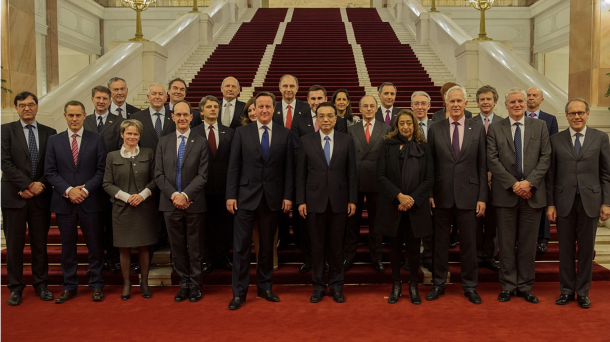
Back in December 2013, a few weeks in to my time at the V&A and off the back of our seminal China Design Now (2008) and Masterpieces of Chinese Painting, 700-1900 (2013) exhibitions – an ambitious survey of one of the world’s great artistic traditions curated by Hongxing Zhang – I was invited, with 48 hours’ notice, to join David Cameron’s trade delegation to The People’s Republic of China.
Hailed as the largest ever UK trade mission to China, and heralding the so-called ‘Golden Era’ of UK-Sino relations, I was on an plane with organisations ranging from Rolls-Royce, JLR, Associated British Foods plc and Huawei (yep) to Cambridge Satchel, Zaha Hadid Architects and Tregothnan (one of the highlights was watching Jonathon Jones OBE with typical British eccentricity disembarking in Beijing carrying a giant teacup that was nearly as big as him!). The National Theatre was there, and Joey the Warhorse wandered amongst the tables at a Shanghai Exhibition Centre lunch whilst a couple of Aston Martins basked in the sunshine outside, as were British Film Institute (BFI) Arts Council England and British Council showcasing a strong contingent from the creative industries. In the Great Hall of the People I got to meet the great Zaha Hadid and Premier Li, and to eat chicken feet with Karren Brady (among others) having not slept for 34 hours. The mood throughout was confident and optimistic (perhaps naively so) and the purpose unambiguous: trade.
As for the Victoria and Albert Museum, we signed an MOU in a Beijing hotel basement conference room with China Merchants Shekou Industrial Zone Holdings Co., Ltd for the creation of the V&A Values of Design Gallery which opened at Design Society in Shenzhen exactly 4 years later, a quietly pioneering project presented to President Xi at the Lancaster House ‘Creative Showcase’ during his state visit in 2015.

Clearly a lot has changed since the hazy sunshine of Beijing, Chengdu and Shanghai in 2013. A decade of protest in Hong Kong and a volatile geo-political context for this visit sees confidence and optimism replaced by diffidence and pragmatism; not so much a ‘Golden Era’ of promise and ambition, but what the Prime Minister has described as a “consistent, durable and respectful relationship”; more Sparta than Rome.
But for cultural institutions like the V&A, as guardians of one of the most comprehensive collections of Chinese art and design outside East Asia, a pro-engagement strategy forged over 150 years of working in and with Chinese creative practice and traditions – clear-eyed and sensitive to the huge complexity of historic and modern China, but alive and curious to its fascinating, chaotic and fast-moving creative landscape and its inescapable global impact – it has been a decade of collaboration and exchange. In Shenzhen we have built on the platform provided by the Design Society partnership, following Values of Design with a successor co-curated gallery called China in the Making, and our wonderful and thought-provoking exhibition Fashioned From Nature, installed during the pandemic by proxy through the China National Silk Museum, Hangzhou in partnership with the V&A on Teams from London.

We have toured V&A exhibitions to a swathe of Chinese cities – from Shijiazhuang and Changsha to Jinan and Guangzhou – through our partnership with Art Exhibitions China, with 10 exhibitions travelling to 29 venues and visited by over 4 million visitors since 2020 alone, from Masterpieces in Miniature to Alice: Curiouser and Curiouser. At the time of writing, the dazzling and scholarly Great Mughals exhibition is on show at the Hong Kong Palace Museum, with Beyond William Morris about to open in its seventh Chinese city with over 2.5 million visitors already welcomed on its tour to date (who’d have thought, William Morris would get over twice as many visitors at the David Bowie is… international tour).
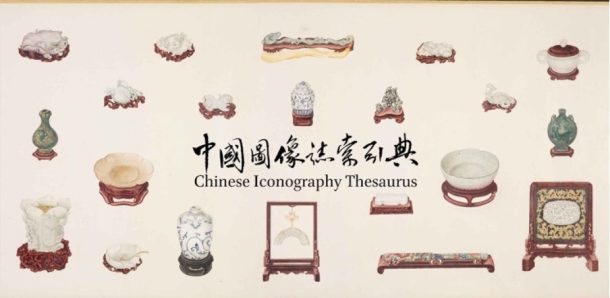
Behind the scenes, in a quintessential piece of deep and scholarly collaboration the V&A has led (Hongxing Zhang again) the development of the Chinese Iconography Thesaurus, bringing together sinology, art history and information studies to create the first alternative classification scheme, especially designed for the Chinese visual culture, with a complementary image archive.
Back at home, bucking the trend for most UK museums, 25% of UK-based visitors to the V&A East Storehouse in the Queen Elizabeth Olympic Park are Chinese nationals, resulting in part from the growing and varied higher education eco-system that surrounds us, from architecture to fashion, while at South Kensington the new Dimensions: Contemporary Chinese Studio Crafts, curated by Xiaoxin Li, sits comfortably alongside porcelain dragons and Qing dynasty treasures. Telling the story of Chinese artists in the 1980s beginning to reimagine craft as a medium for artistic expression, the display explores the dimensions of studio craft practice in China today and the innovations which have grown from China’s longstanding craft traditions which have been celebrated at the V&A for decades.

So, as I clamber aboard trade mission 2026, this time with Octopus Energy, AstraZeneca and Chucklefish Limited, VisitBritain, Birmingham Museums Trust, Royal Museums Greenwich and Natural History Museum – and as the Year of the Horse approaches, characterised by energy, passion and, yes, perseverance – can the V&A look forward to another decade of steady expansion of its mission of ‘art and design for all’?
There is certainly cause for optimism with the first iteration of the Design Values Prize (Design Values Award (DVA), created from that decade-long partnership with Design Society inked on the 2013 trip and celebrating contemporary Chinese design practice across a range of categories, with the ink also dry on a partnership to tour the iconic and globally-renowned Wedgwood Collection (V&A Wedgwood Collection) across the People’s Republic where this particular medium is so replete with resonance and relevance.
I’m fascinated to see how the atmosphere, messaging, choreography and positioning will compare to 2013, as culture exchange continues to endure but at the same time conscious of Neil Mendoza‘s recent warning – not least in an age where hard power predominates – that “We may lose our soft power status if we don’t pay more attention to it”. I shall report back!