
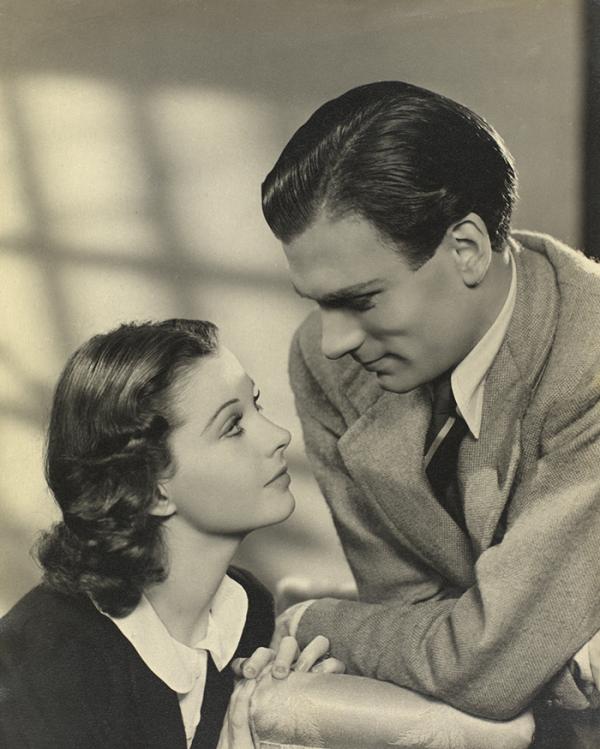
Earlier this year, the V&A acquired the Vivien Leigh archive. This has enabled us to display some of the unique objects from this collection in the Museum’s Theatre & Performance Galleries (103 – 106).

Vivien Leigh (1913 – 1967) is one of the most celebrated actors of the 20th century. Born in India and educated in Europe, Leigh trained at the Royal Academy of Dramatic Art and made her stage debut in 1935. In 1939, Leigh won the role of Scarlett O’Hara in the highly anticipated film version of Gone with the Wind (1939). The film brought her international acclaim and an Academy Award for Best Actress.

The display in the Theatre and Performance galleries highlights just a few of the 10,000 objects there are in the archive, including over 7,500 letters, telegrams and postcards. Sir Winston Churchill was an admirer of Leigh and especially of the film That Hamilton Woman (1941), in which Leigh played Emma Hamilton opposite Laurence Olivier as Lord Nelson.

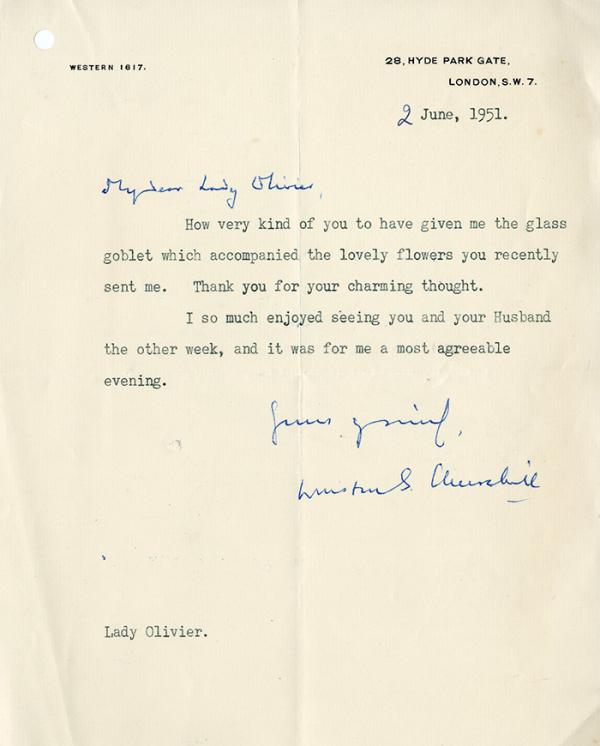

Vivien Leigh and Laurence Olivier married in 1940 and became the most famous acting couple of the 40s and 50s, appearing together on film and stage. Their Old Vic Company tour of Australia in 1948 was greeted with great enthusiasm, and the couple were treated like visiting royalty. In 1951 they appeared together as Caesar and Cleopatra and Antony and Cleopatra on alternative nights at the St. James’s Theatre. In 1943 the couple bought Notley Abbey in Buckinghamshire where they entertained a wide circle of friends and family throughout the 1950s. The visitors’ book on display, records the regular guests that included Terrence Rattigan, Michael Redgrave, John Gielgud, Katharine Hepburn, Rex Harrison, Bette Davis, Humphrey Bogart, Lauren Bacall and Judy Garland.

Leigh’s portrayal of faded Southern belle Blanche DuBois in A Streetcar Named Desire is widely regarded as her finest stage performance. It was a risky choice because of the play’s themes about mental illness, rape and homosexuality. This caused controversy and resulted in a number of cuts demanded by the Lord Chamberlain’s office. Leigh’s hand-written notes describe her approach to the role and her commitment to the art of stage acting: ‘When I said the way I look – I meant right not good’. Leigh recreated her performance in the 1951 film version directed by Elia Kazan for which she won her second Academy Award for Best Actress.


The display compliments other objects relating to Vivien Leigh in the Theatre & Performance galleries.


The Theatre and Performance galleries (Rooms 103 – 106) are located on the third floor of the Museum and entry is free.
Interesting article about Vivien and Laurence. I first became aware of Olivier through his film of Richard the third, it came on TV one weekend. I was so mesmerized by his performance as Richard the third. I decided to find out more about Olivier. I brought a book from a second hand book shop called the Oliviers by Felix barker. I had no.idea that Olivier had been married to Vivien Leigh star of gone with the wind. I had also seen that film on TV with Vivien Leigh as Scarlett O’Hara. Sometime later a cinema in the west end of London called academy put on a season of Oliviers Shakespeare films. Hamlet
Henry the fifth and Richard the third.
I would have liked to have seen Olivier at the old Vic theatre London in some of his greatest Shakespearen roles but unfortunately they where before my time. But at least he made the three films for future generations to enjoy. Vivien Leigh my favourite roles in films was streetcar named desire and lady Hamilton with Olivier as nelson. A d as Cleopatra in Caesar and Cleopatra. I think Vivien Leigh as an actress was a much better actress than ever given credit for. She had talent and beauty. And Olivier was a very diverse actor regarding his acting skills.
P.s and what a handsome man Olivier was in his younger days.