
Music is not something we usually expect to find in a museum. If we want to understand music, we put on our headphones and turn up the volume. Yet the V&A has long been making the case that music belongs in the museum just as much as a painting or a piece of furniture. The recently opened David Bowie Centre at V&A East Storehouse is perhaps the most ambitious expression of this, giving visitors direct access to an archive in its entirety. But it raises a question worth sitting with: what can an archive actually offer that a recording cannot?
It was within this broader conversation that I began my PhD placement at the V&A, cataloguing the archive of British musician PJ Harvey. Over the past months, I have been working closely with archival materials that trace more than three decades of her creative life. From countless press cuttings, bizarre fan art, and unexpected correspondence, the archive opens up a new way of understanding Harvey’s artistry and position within the world of popular music.
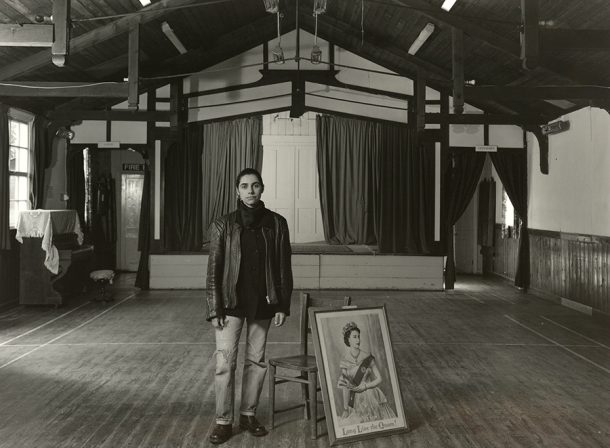
Born in 1969 amidst the rolling hills and farmland of Dorset, Polly Jean Harvey began her music career in the late 1980s as a member of the band Automatic Dlamini, before stepping out under the name PJ Harvey and rising to prominence in the early 1990s with her debut albums Dry (1992) and Rid of Me (1993). She is the first (and only!) artist to win the Mercury Prize twice: for her albums Stories from the City, Stories from the Sea (2000) and Let England Shake (2011). But Harvey’s artistry extends far beyond her solo work. As well as musical collaborations with artists such as Nick Cave and Tricky, she has composed for theatre and television, and published two collections of poetry: The Hollow of the Hand (2015) and Orlam (2022).
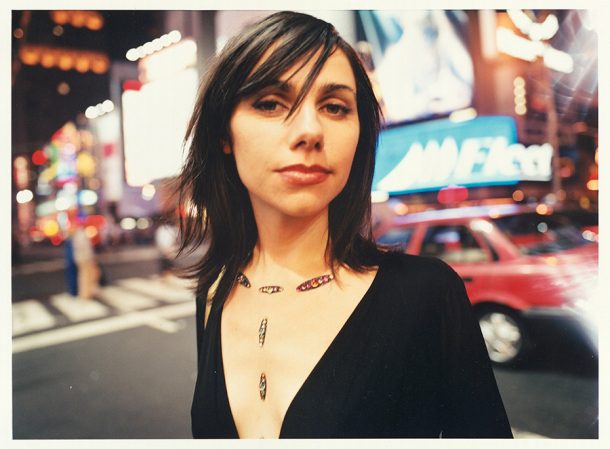
As I began working through the archive, I quickly realised that PJ Harvey’s career resists easy categorisation. Throughout her career, Harvey has consistently refused to let her work be defined in any single way, and the archive reflects that in every box you open. This became particularly clear to me as I was cataloguing press materials. No artist makes music in a vacuum, and the reviews, interviews, cartoons and magazine features spanning more than three decades of Harvey’s career offer a fascinating window into how the world was receiving, and at times struggling to keep up with, her work in real time.
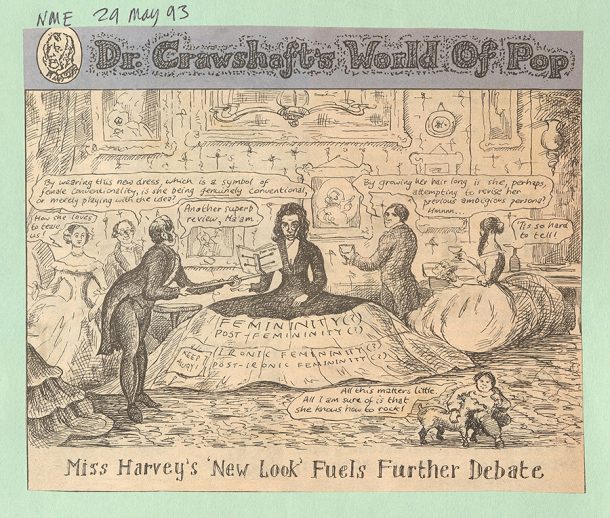
This cartoon, published in NME Magazine on 29 May 1993, perfectly reflects that. PJ Harvey is surrounded by figures that are questioning her artistic choices: Is she conforming to or confronting femininity? Is she being serious or ironic by wearing a dress or growing out her hair? The cartoon is wry and funny, but also shows how every artistic choice that Harvey made was picked apart and argued over. Nevertheless, she never gave into these debates: she let the music speak for itself.
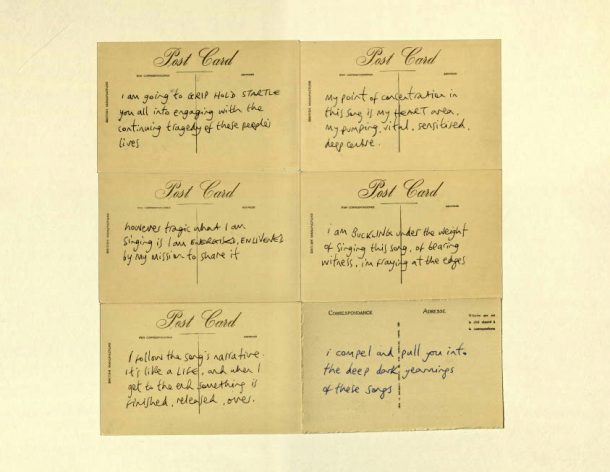
A music archive can also offer something more intimate: a peek behind the curtain of an artist’s creative process. Harvey’s album Let England Shake (2011), a haunting meditation on war and national identity, is a good example. The archive reveals the extraordinary amount of research that went into the album: books on war and conflict, research into army marches, and a beautifully framed portrait of British nurse Edith Cavell that stood on Harvey’s piano as she worked. But the archive also sheds light on how Harvey brought the album to life on stage. A set of cue cards with ‘points of concentration’, given to Harvey by theatre director Ian Rickson, were used during the Let England Shake tour as prompts before taking to the stage. They might be small in size, but speak volumes about the intentionality and depth that Harvey brought to every performance.
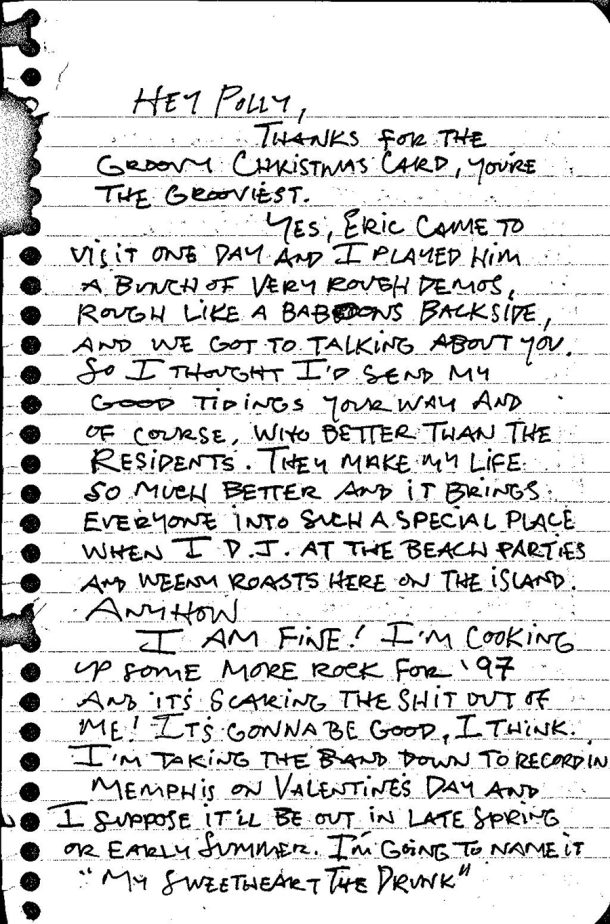
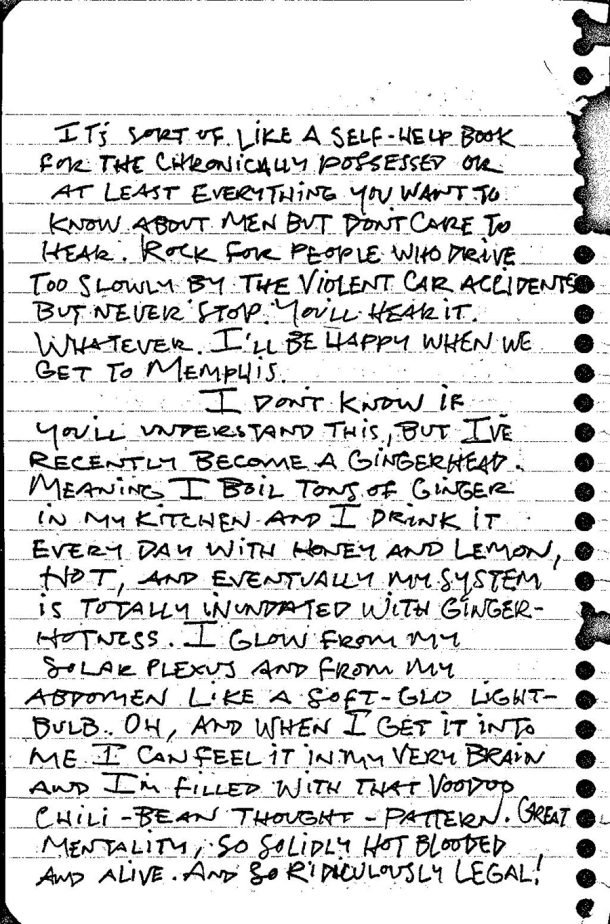
Correspondence is perhaps one of the most revealing categories in any archive, precisely because it shows that an archive is never just about one person. It offers a window into the friendships, collaborations and relationships that shaped their creative life. I was quite surprised when I found a touching letter by Jeff Buckley, sent to PJ Harvey in late 1996/early 1997. In it, Buckley shares his plans for recording his new album and lets Harvey in on a secret: his obsession with fresh ginger tea. It is warm, funny and deeply human. Sadly, Buckley passed away in May 1997, giving the letter a quietly heartbreaking quality in hindsight, and a reminder of just how many unexpected stories a single archive can hold.
Visitors can explore the collection in person by scheduling advance appointments with the Archives team. Theatre and Performance Archives are available to view at V&A East Storehouse on Mondays, Tuesdays and Wednesdays, between 10.00 – 17.00.
delta executor atualizado trouxe melhorias interessantes e está funcionando de forma mais estável. Gostei de encontrar um artigo bem explicado, com informações úteis e organizadas. Parabéns pelo excelente trabalho e por manter tudo sempre atualizado.
delta executor atualizado trouxe melhorias interessantes e está funcionando de forma mais estável. Gostei de encontrar um artigo bem explicado, com informações úteis e organizadas. Parabéns pelo excelente trabalho e por manter tudo sempre atualizado.
The Edith Cavell portrait and the “points of concentration” cue cards answer the article’s opening question beautifully: a recording cannot show the research habits or performance rituals surrounding the music. A carefully designed 3D archive experience could place these small objects in context while preserving the intimacy of the Jeff Buckley letter. The 1993 NME cartoon is also a valuable record of how contemporary criticism tried, and failed, to fix Harvey in a single category.
It’s fascinating to explore the stories, creative process, and history behind influential musicians and their work. Looking beyond the finished songs often reveals how inspiration is shaped by different sounds, experiences, and artistic influences. For music producers searching for authentic and expressive sounds, exploring soul samples can be a great way to bring depth and character to new projects.
I liked how this opens around “Music is not something we usually expect to find in a museum” — that framing for Beyond the music: inside PJ Harvey’s Archive is practical. For planning layouts / notes afterward, a blank sheet music PDF has been handy when I need clean blanks.
Managing the documents those notes become can be harder. That’s where pdf editor from PDFAid comes in. The platform offers a full suite of editing tools that work directly in your browser. I’ve used it to clean up documents, add annotations, and prepare final versions for sharing. The process is fast and the results are reliable. There’s no need to juggle multiple programs. It’s a simple, effective way to handle PDFs. For note-takers and writers, this tool bridges the gap between raw text and polished documents. It’s become a regular part of my workflow.
I liked how the piece approached beyond the music inside harveys archive without making it feel heavier than it needed to be. The practical details make it easier to connect the main idea with something a reader could actually use or think through later. ProfileLoom