
From September 2025 to March 2026, I undertook a CHASE-AHRC doctoral placement at the V&A. As part of its ongoing provenance research initiatives, my project examines the ownership histories of German books acquired by the National Art Library (NAL) during the Nazi era (1933 – 45), a period marked not only by the persecution and exile of people but also by the dispossession and theft of cultural objects.
The NAL’s records from these politically turbulent years before and during the Second World War do not always contain detailed or easily accessible acquisition information. Therefore, my project aims to establish the provenance of German books that entered the V&A’s collection during the Nazi period, as well as the circumstances under which the NAL acquired them.
One of the first books I looked at during my placement is a collection of illustrations by German artist Thomas Theodor Heine (1867 – 1948), titled Small Pictures from a Great Era (Kleine Bilder aus großer Zeit). Heine sat on the editorial board of the popular satirical magazine Simplicissimus and often contributed drawings to the publication. Due to his Jewish background, he was forced to leave the magazine, liquidate his assets and flee Germany in 1933, when the Nazi regime began systematically disenfranchising and persecuting people of Jewish background and others whom the Nazis considered undesirable. Some of Heine’s works were also included in the inventory of ‘degenerate art (entartete Kunst)’, the only complete copy of which is held at the V&A, listing artworks that the Nazi regime confiscated from German collections in 1937 and 1938.
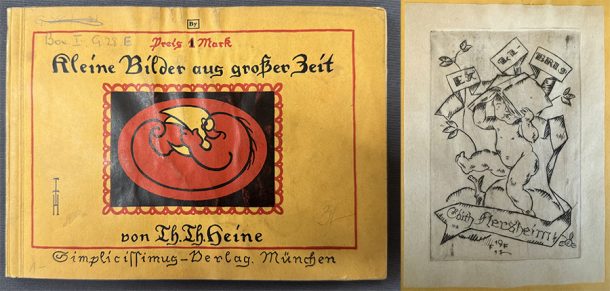
Inside the book’s front cover is a charming ex libris featuring an etching of a putto holding a book. Its inscription names the book’s previous owner, Edith Eberstadt (née Flersheim, 1895 – 1992), the daughter of Frankfurt-based collectors Ernst and Gertrude Flersheim, who amassed an important collection of European modern art. The Nazi regime persecuted the Flersheim family due to their Jewish background, and their art collection became dispersed as they went into exile. Tragically, Edith Flersheim, who escaped to London with her husband and children in 1936, was the only one in her family who survived the Holocaust.
At the time of writing, based on growing but still limited data, the Lost Art Database records more than 72,000 library objects looted by the Nazis or displaced by war. Compared to works of fine art, books are often less valuable and therefore less well documented in records of confiscation, sale or acquisition. As a result, they have received limited attention in Nazi-era provenance research and broader restitution efforts. However, Edith Flersheim’s ex libris is a testament to the fact that, as portable, tactile and intimate objects, books hold just as much, if not more, sentimental value for their owners. Therefore, tracing the journeys of books allows us to gain a deeper understanding of how Nazi persecution shaped the lives of their previous owners and the movements of cultural objects, as well as what role the V&A played in these stories.
I usually start my research by closely examining the books themselves. Information inside, such as acquisition dates, accession numbers and other notable marks, including signatures, stamps and bookplates, provides valuable insight into the books’ provenance. These physical clues form the basis of my further research in the V&A Archives and online databases.
I was able to establish that Small Pictures from a Great Era was acquired on 26 April 1941, and it shares the same provenance as several other books acquired in the 1940s that bear the sticker of the London-based bookseller E. Baer.
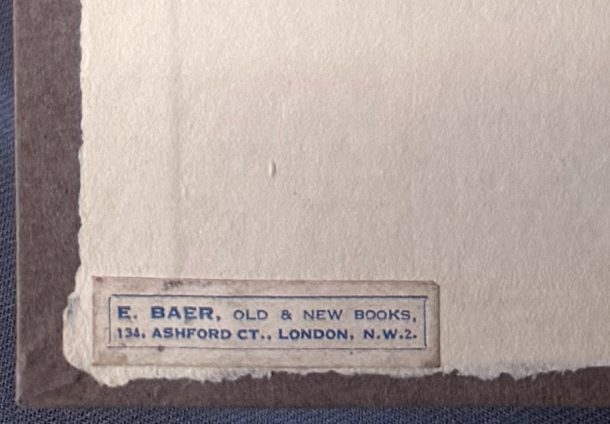
E. Baer, or Edwin Baer (1881 – 1965), was a co-owner of Joseph Baer & Co. in Frankfurt am Main, one of the largest and most significant antiquarian booksellers in Germany since the late 18th century. Due to his Jewish background, he fled Germany in 1933 with limited stocks and attempted to re-establish his business in Geneva and Paris, before finally settling in London in 1937. The NAL holds a copy of the first catalogue published by Edwin Baer and his brother Leopold Baer in Geneva in 1934.
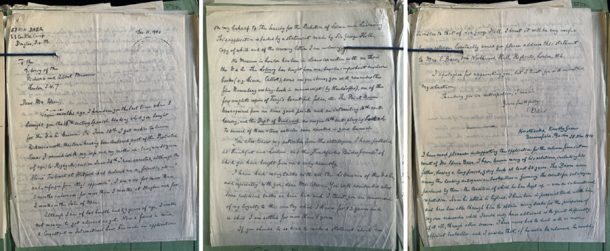
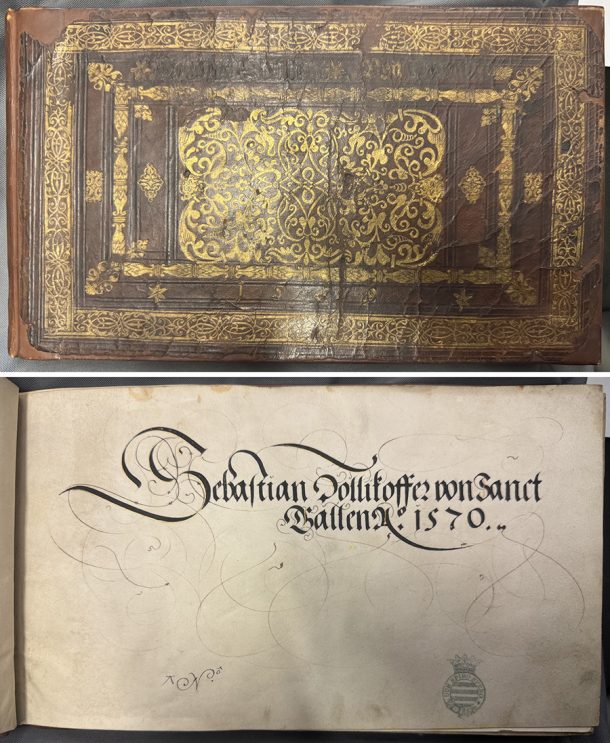
The file on the bookseller in the V&A Archives includes some of his correspondence with the V&A from 1937 to the 1950s. For instance, in December 1940, Baer wrote to Arthur Wheen, Librarian at the NAL, to ask the V&A to vouch for his political conviction and his cultural contributions after being arrested and interned on the Isle of Man despite being declared a ‘friendly alien’ and ‘refugee from Nazi oppression’. In the letter, Baer listed several notable objects that the NAL had purchased from him. These include copies of the Frankfurter Bücherfreund (a periodical published by Joseph Baer & Co.), ‘the fine Nuremberg writing-book in manuscript (by Neudörffer)’ and ‘one of the few complete copies of Terzi’s beautiful folio’.
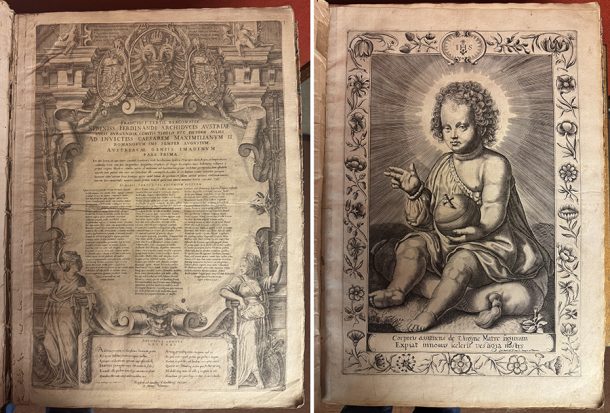
After cross-referencing the sales catalogue published by Edwin Baer in Paris in 1936, which includes detailed accounts of the books’ conditions, I identified the items mentioned in Baer’s letter in the V&A’s collection based on their unique physical attributes. The 16th-century manuscript with handwritten samples by the renowned calligrapher Johann Neudörffer (1497 – 1563) at the NAL has the lettering ‘Sebastian Zollihoffer von Sanct Gallen Ao. 1570’ on its first folio, matching Baer’s description. Similarly, a book celebrating the history and genealogy of the House of Habsburg by Terzi, or Francesco Terzio (about 1523 – 91), court painter to the Austrian royal family, corresponds to Baer’s description due to a distinctive frontispiece depicting the Christ Child. Therefore, I established that the NAL purchased these items in 1936, likely from Baer’s sales catalogue for 4,200 and 1,100 francs, respectively.
Eventually, Baer secured a letter from Sir Eric Maclagan, the then director of the V&A, in support of his release from internment, attesting to his ‘valuable service to scholars and students of the history of art’ as an antiquarian bookseller. In addition to books, Baer also offered various objects to the V&A on approximately 30 recorded occasions. Although many were returned, the Museum acquired a 16th-century games board, a Flemish drawing depicting a scene from the parable of Dives and Lazarus and several portfolios of prints and illustrations. Baer’s file in the V&A Archives suggests that his is a story of resilience, for he attempted to set up businesses repeatedly while he was in exile and did not give up despite Nazi persecution and challenging conditions.
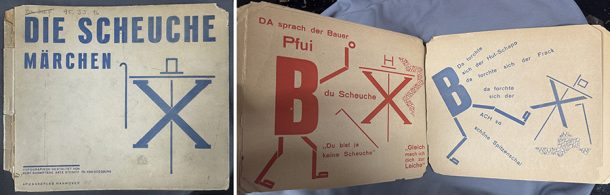
Baer’s story also demonstrates that, through its acquisitions, the NAL could play a role in enabling cultural figures who had escaped Germany due to Nazi persecution to re-establish their livelihoods abroad. For instance, in 1937, Philip James, Keeper of the Library, authorised the purchase, at the listed price, of all the books on the New Typography movement offered by Jan Tschichold (1902 – 74), a German typographer and designer closely associated with the development of modern typography and design. At the time, Tschichold had already escaped to Switzerland after being denounced as a ‘cultural Bolshevist’ and arrested by the Nazis. The NAL’s acquisition of part of Tschichold’s personal collection would not only have helped Tschichold financially during a time of uncertainty but also have facilitated the introduction of these works to the English public. Books acquired from Tschichold are now held in the NAL’s Jobbing Printing collection initiated by James, which includes examples of modern commercial design across Europe.
The NAL’s close relationship with the antiquarian bookshop established by Martin Breslauer, a prominent German antiquarian bookseller, is another case in point. Due to his Jewish background, Breslauer moved to London in 1937 after paying the exorbitant Reich Flight Tax (Reichsfluchtsteuer). He soon set up his firm again with the limited stock he had brought with him, and his son, Bernhard H. Breslauer, took over the business after he died in 1940. Among the books the NAL purchased from Breslauer’s burgeoning business in London is the first edition of an exquisite collection of works by Ernst Ludwig Kirchner (1880 – 1938), a renowned artist associated with German Expressionism.
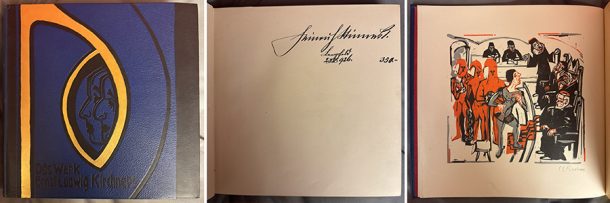
By deciphering the signature inside its front cover and conducting further research, I was able to establish the full journey of this book. Soon after its publication, it was purchased by the Cologne-based collector Heinrich Stinnes in Lengfeld for 350 Reichsmark on 2 December 1926. After the death of Stinnes, the book was offered for sale at Hollstein & Puppel in Berlin in May 1936 for 60 Reichsmark and presumably purchased by Martin Breslauer before he moved to London. Breslauer then listed it in the first sales catalogue he published in London in 1939, priced at £18. The V&A purchased this book from Breslauer in 1943.
The provenance of the book on Kirchner was among the most complete I was able to establish. In fact, such completeness is rare. Although I was able to trace the provenance of the writing-book by Neudörffer and the folio by Terzio and piece together part of Edwin Baer’s story, the provenance of Small Pictures from a Great Era, one of the first books I examined that contains Edith Flersheim’s ex libris, could only be an educated guess due to the lack of records. I suspect that such books circulated within the networks of German expats in England and were not included in Baer’s published catalogues due to their relatively low monetary value. For many other books, which also conceal clues to their journeys and the stories of their previous owners, their histories are yet to be unveiled.
In contexts of persecution, archival records are often incomplete or no longer extant. Even if they exist, official records often provide limited insight into the perspectives and subjectivities of the people they document. As a result, provenance research often produces more questions than answers, more uncertainties than satisfactory resolutions. Every book has a story to tell. I hope that increasing transparency and collaboration in the field will allow more stories of resilience to emerge from archival fragments.
I want to thank Richard Espley, Chief Librarian of the National Art Library, and Alex Watson Jones, Provenance Research Curator, for supervising and providing invaluable guidance for my project. I am also grateful to colleagues at the V&A Research Institute (VARI), including the NAL and Archives, for their help and support, to the National Gallery Library and the Grolier Club for assisting with my research, and to CHASE for the generous funding of my placement.
Very informative and engaging. Levidia appreciates content that highlights the importance of historical transparency.
The books are interesting, but the human stories behind them are what really stayed with me after reading. TAG game