
Archaeologists often describe excavation as reading layers of time. Wallpaper restoration feels remarkably similar. Each sheet removed reveals another beneath it, preserving another moment in its history.
When I joined the restoration of Huijeongdang and Daejojeon – the audience halls and private apartments of Korea’s last emperor and empress within Changdeokgung Palace, a UNESCO World Heritage Site – I expected to reconstruct wallpapers. Instead, I found myself uncovering a forgotten design history.
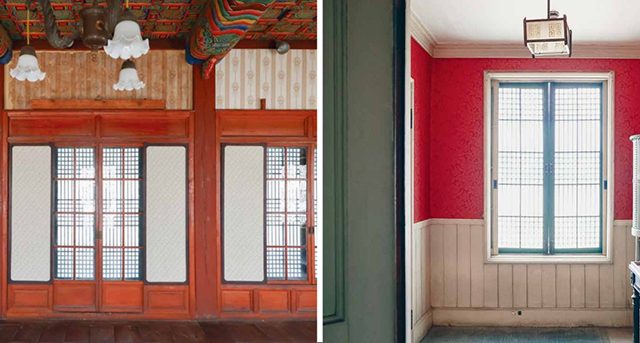
Both buildings were rebuilt in 1921 after a devastating fire in 1917 during the Japanese colonial period. Behind their traditional palace exteriors lay unexpectedly modern interiors finished with British wallpapers, timber panelling, carpet and linoleum. For decades they were understood simply as Western interiors imposed upon a Korean palace through Japanese colonial rule.
The walls told a more complicated story.
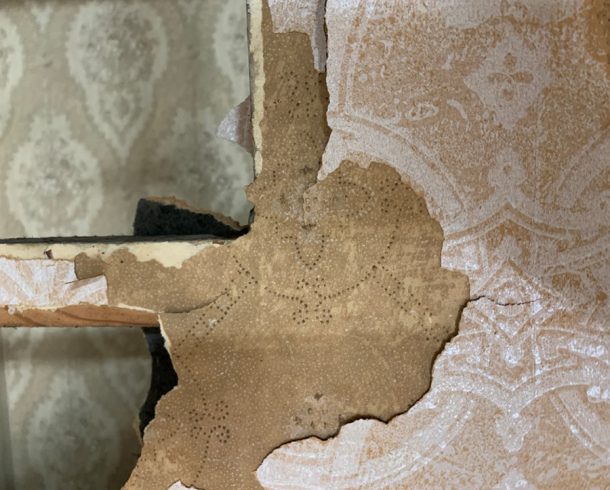
The wallpapers survived as accumulated histories. The original British wallpapers were overlaid by later restorations using traditional Korean patterns, before plain white hanji (traditional Korean mulberry paper) became the standard finish for palace interiors, as it remains today. These successive restorations reinforced the assumption that a royal palace should always look traditionally Korean.
The British wallpapers simply did not fit existing interpretations. The conceptual distance between a Korean palace and British wallpaper proved almost as great as the geographical distance that separated them.
The turning point came from something almost invisible.
Tiny numbers on wallpaper fragments matched entries in the British design registers at The National Archives. A faux-flock wallpaper known only through circumstantial evidence reappeared in Surfaces, a Wallpaper Manufacturers Ltd. sample book at the V&A. Suddenly, British design registers, sample books, and Korean wallpaper fragments began to speak to one another.
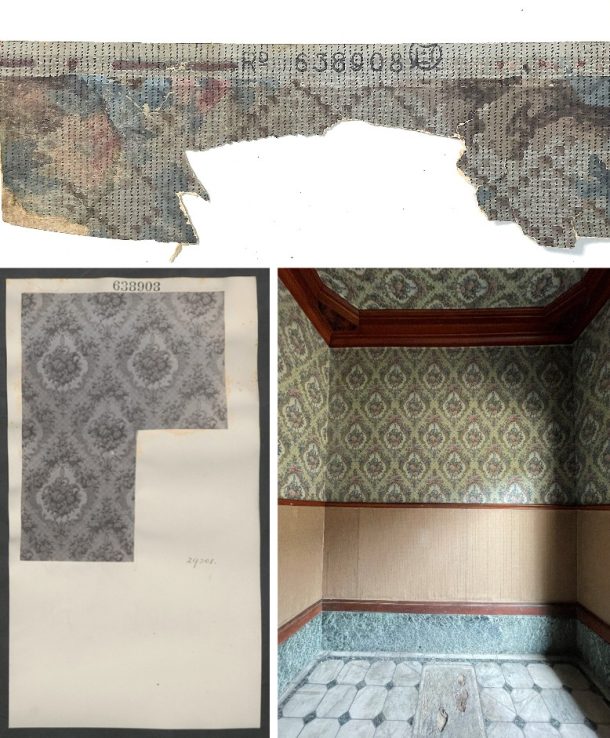
Huijeongdang and Daejojeon no longer appeared as simply colonial Western interiors, but as places where British manufacturers, Japanese commercial networks, Korean craftsmen, palace traditions, and colonial politics intersected. The ’round table of selection’ introduced in Part One began to take material form.
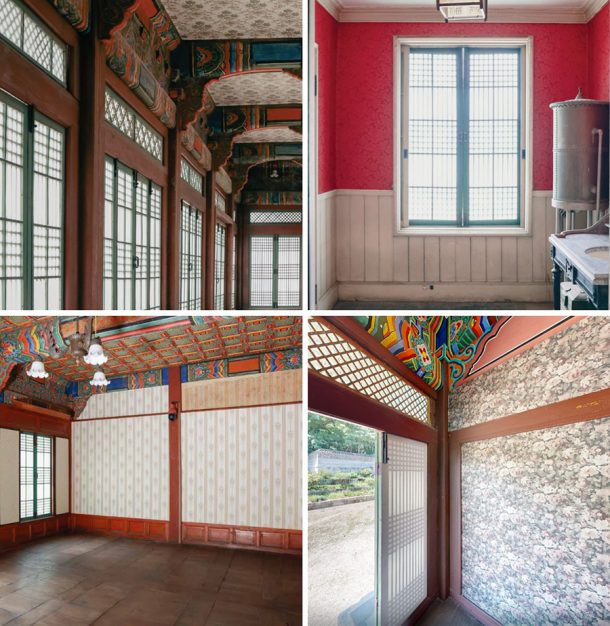
That negotiation can also be read through the organisation of space. Formal reception rooms employed damasks and Neo-Classical designs, while the emperor’s and empress’s private quarters favoured wallpapers imitating tapestry, woven textiles, and naturalistic florals. Victorian decorative conventions remained visible, but were reinterpreted through a different architectural culture, producing a hybrid interior unlike anything found in Britain.
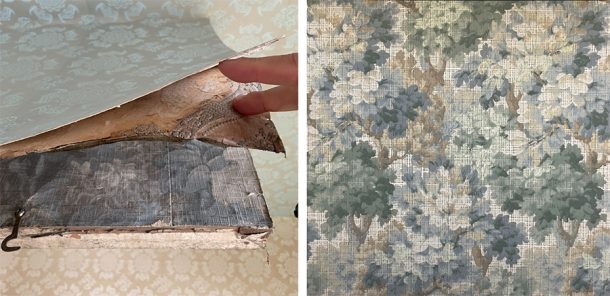
One discovery made this connection tangible. In Heungbokheon, situated beside the king’s bedroom within the Daejojeon complex, I found a tiny fragment of green tapestry-imitation wallpaper on the ceiling – too small to reconstruct. During my V&A Fellowship, its missing pattern reappeared in Surfaces, published by Wallpaper Manufacturers Ltd., and later in a 17th-century Flemish Verdure tapestry displayed in the Acanthus Bedroom at Wightwick Manor. Suddenly, what had seemed an isolated fragment from Changdeokgung became part of a much wider visual lineage, stretching from Flemish tapestry to British wallpaper and finally to the ceiling of a Korean palace.
Yet the mode of hybridity was fundamentally different. Victorian Britain had already developed its own Oriental hybridity. In Victorian townhouses such as Sambourne House, William Morris’s Fruit wallpaper blended a British rural aesthetic with exotic pomegranates imported via global trade. Within these spaces, this hybrid surface was curated alongside Chinese furniture and Japanese ceramics. Early 20th-century Japan developed another model. Wayō secchū interiors combined Western-style rooms with Japanese decorative materials and East Asian objects, reproducing an Orientalist gaze. Changdeokgung instead absorbed British surface aesthetics into an existing Korean spatial order.
Politics reinforced this difference. After annexation, the former imperial family became Wanggongjok (Royal and Public Family) – an ambiguous colonial status positioned squarely between the Japanese imperial family and the titled nobility. Although Victorian Britain and Japan were linked through the circulation of gilt leather paper, Kinkarakami, and Japanese embossed wallpapers, Changdeokgung took a different path. Decorative papers combining elite status with an overtly Oriental aesthetic found little place in the palace. Instead, British industrial wallpapers circulating through Japanese commercial networks became the dominant choice. The result was a third form of hybridity, shaped as much by colonial hierarchy as by Korea’s long-standing culture of paper surfaces.
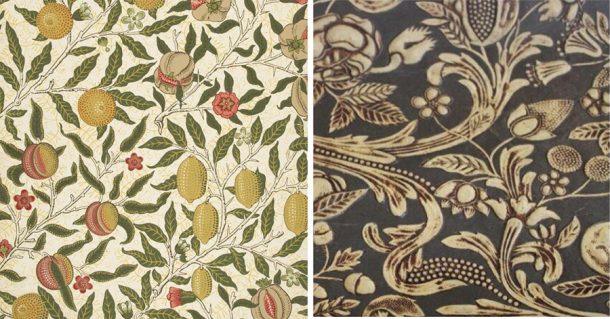
Left: Detail of William Morris, Fruitwallpaper, designed 1865 – 66 and produced 1866. Published by Morris & Co., printed in London. Museum no. E.2743-1980. © Victoria and Albert Museum, London. Right: Detail of Embossed wallpaper, maker unknown, late 19th or early 20th century, paper, embossed. Manufactured in England or Japan. Museum no. E.356-1972. © Victoria and Albert Museum, London
The restoration changed not only the walls, but the questions I began asking.
Korea rarely appears in global design history, while modern Korean design history has often explained Western design as something passively received through Japan. As a result, modern Korea has remained peripheral in one narrative and isolated in the other. Changdeokgung’s wallpapers suggest otherwise. By the early twentieth century, Korea engaged with British surface design far more contemporaneously than is usually assumed.
Moving beyond colonial narratives alone is not enough. If Korea is to contribute meaningfully to discussions of decolonisation, we must first move beyond the assumption that it stood outside the global circulation of design. Only then can we recognise how modern Korea participated in, negotiated, and reshaped those networks. Seen in this light, this history continues to shape Korea’s design culture today.
In the end, restoration proved another form of excavation – not simply of wallpaper, but of design histories buried beneath one another. Each layer revealed another forgotten connection. Restoration was never simply about recovering wallpaper. It was about reconnecting design histories long written apart.
This work was supported by the Ministry of Education of the Republic of Korea and the National Research Foundation of Korea (NRF-2023S1A5B5A16083145).
This is an excellent illustration of why preserving a game file is not the same as preserving the game itself. The one-handed tap, timing, sound feedback, and physical device are all part of the experience. It also raises questions about today’s online arrow and puzzle games. They may appear easier to preserve because they run in a browser, yet their playable form can still depend on embedded runtimes, third-party hosting, browser APIs, and services that may disappear. Screenshots can document appearance, but not timing or player interaction. Perhaps a complete preservation package needs an executable snapshot, an input profile, and recordings of authentic play. The comparison between the original phone and virtualisation shows why that context matters.
HappyMod is a useful resource for people exploring Android apps and games. I found the information about modified apps interesting and easy to understand. You can also visit happymod.tr to explore more about HappyMod and its available content.
HappyMod is a useful resource for people exploring Android apps and games. I found the information about modified apps interesting and easy to understand. You can also visit happymod.tr to explore more about HappyMod and its available content.
Fascinating read — reconstructing an interior that no longer exists through fragment analysis is real detective work. I had no idea the wallpaper traces survived well enough to match pigments across collections. It reminds me of the same problem we face with old digital images: once the original is gone you only have degraded copies left. Anyone curious what happens to image quality after generations of copying can try a low quality image maker meme tool to see it first-hand. Looking forward to part three of this series!
Reconstructing the painted wall surfaces of Gyeongbokgung on this scale is remarkable work — the way you matched pigments over the printed patterns really shows how layered these interiors were. As someone who spends a lot of time with digital images (often deliberately degraded ones, like a low quality image maker meme generator), it’s a nice contrast to see the opposite: forensic-level care to restore original detail.
Quando alguém procura delta executor download, o mais importante é verificar a fonte antes de abrir qualquer arquivo. Recomendo observar permissões, reputação do site e informações sobre segurança. Evitar páginas suspeitas reduz riscos e ajuda o usuário a compreender melhor aquilo que está considerando instalar.
Watch and download anime in HD for free on 9animetv.com.mx Stream your favorite subbed and dubbed anime series and movies anytime.
What a fascinating reconstruction. The attention to the travelling surfaces and the layered pigments really brings the Korean palace interior back to life. I always enjoy seeing how much patience this kind of craft takes, similar to the detailed worlds assembled in games I follow at 2v2io. Thanks for sharing the process in such depth.
Fascinating reconstruction work — the detail recovered on the Korean palace interior is remarkable. It reminded me of how much care goes into building immersive environments; I have been playing sled rider recently and the attention to atmosphere feels similar. Thanks for sharing the process.