
Walls do not move, but their surfaces do. Ordering wallpaper samples online feels ordinary today, yet this mobility is recent. Before the nineteenth century, surfaces travelled with objects – porcelain, folding screens, lacquerware, and textiles. If cultural anthropologist and theorist of material circulation Arjun Appadurai traced the social life of things, wallpaper sample books remind us that the social life of surfaces had already begun long before the digital age.
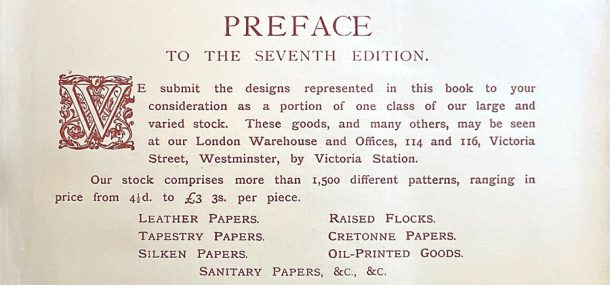
Beginning in the late 19th century and expanding into the 20th, wallpaper manufacturing, mechanical printing, and sample books transformed decorative surfaces into portable commodities. A single sample book could carry hundreds of surfaces across the globe, reaching colonial houses, treaty ports, and the Korean royal palaces.
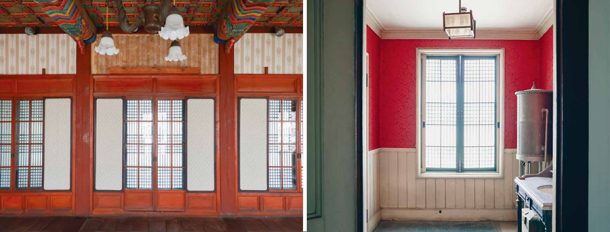
While researching late 19th- and early 20th-century wallpaper collections at the V&A in search of wallpapers matching those found in the Korean royal palaces, I realised that sample books carried surfaces across the world before the wallpapers arrived. By the early 20th century, Wallpaper Manufacturers Ltd. coordinated this circulation through sample books now preserved in Britain, Australia, Japan, and India.
If the same wallpapers travelled across the world, why did they produce such different interiors? The answer lies not in the wallpapers but in how cultures understood decorative surfaces.
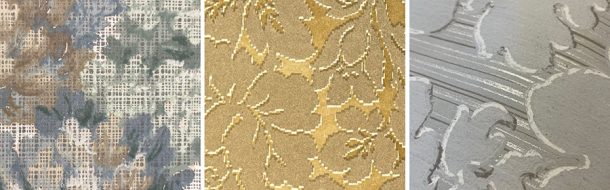
In Europe, wallpaper became a medium of illusion. Paper imitated silk, leather, wood, and stone. Embossing and fine printed dots and lines simulated woven textiles, creating tactile richness, while printed shadows produced depth. Wallpaper Manufacturers Ltd.’s sample book, Surfaces at the V&A, together with wallpaper fragments by Allan Cockshut and J. G. Potter preserved at the V&A and the Whitworth Art Gallery, documents one of the last generations of illusionistic wallpapers before modern design turned towards abstraction. It was this generation of wallpapers that reached the Korean royal palace.
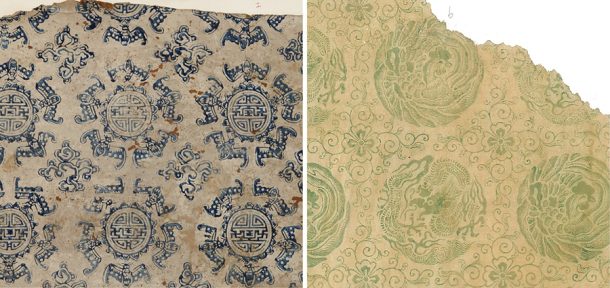
Northeast Asia presents a different story. Across Korea, Japan, and China, decorative papers were valued less for material illusion than for the symbolic meanings in their motifs. Dragons, phoenixes, peonies, clouds, and auspicious characters conveyed authority, prosperity, and longevity. These motifs formed a shared visual vocabulary across dress, objects, and architecture.
Korea provides a particularly revealing case. For centuries, paper had already enveloped interiors, covering walls, ceilings, doors, windows, columns, and even floors. Imported wallpaper therefore introduced not a new material, but new surfaces into an architectural culture already defined by paper.
Yet surfaces did not simply travel from Europe to East Asia. Their movement was not one-directional. While British wallpaper sample books travelled east, Japanese pattern media carried the surface aesthetics of Northeast Asia westward.
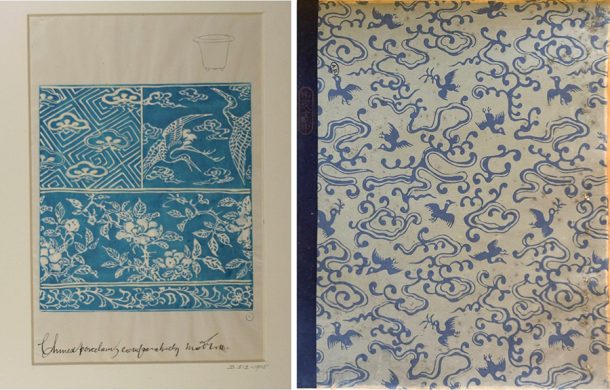
At the V&A, paintings accompanying a manuscript by J. S. Waite reveal how Japanese ceramic decoration circulated as transferable design sources. A similar story appears in Paris, where the designer and collector M. Isaac assembled karakami samples. Used for fusuma (sliding paper doors) in Japan and as wall coverings in Korea, these papers were valued in Europe less as architectural finishes than as repositories of motifs translated into new decorative surfaces. Together, they informed Oriental-style wallpapers.
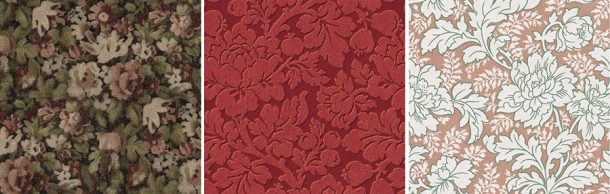
One surprising discovery was the wallpaper collection preserved in the Korean royal palaces. Although Victorian manufacturers produced an extraordinary variety of Oriental wallpapers, these are almost entirely absent. Instead, floral wallpapers dominate, combining peony-like motifs with illusionistic silk, flock, and tapestry effects.
Why? The answer remains open, but the surviving wallpapers suggest that imported surfaces were interpreted through an East Asian system of symbolic meaning. Oriental wallpapers might have seemed the more familiar choice, yet the closer they came to representing East Asia, the less new they appeared. Instead, the palace sought familiar meanings through unfamiliar surfaces: Victorian floral motifs could still evoke prosperity and nobility, while illusionistic surfaces introduced a new visual language of modernity.
Not only did surfaces travel—so did their names. In wallpaper sample books and advertisements, labels such as Italian, French, and Japanese referred to decorative surface effects rather than places of origin. Ironically, what manufacturers intended as carefully controlled commercial assets became something far less controllable: they generated new aesthetic knowledge and new historical categories. The ‘French’ interiors created for the Korean court were often furnished with British-made materials, while many so-called ‘Japanese’ patterns circulating in Europe drew upon a broader visual culture shared across East Asia.
An intriguing example appears in an Essex & Co. pattern book of 1899, which included wallpapers entitled The Corea Design and Charles F. A. Voysey’s The Tokyo Design. Through what images or ideas were “Corea” and “Tokyo” imagined? Such labels reveal less about geographical realities than about how distant places were transformed into aesthetic categories within the late Victorian design market. Yet only the names, the Essex & Co. trade mark, and the price appeared on the reverse. Even Voysey remained uncredited, obscuring the routes through which such ideas travelled.
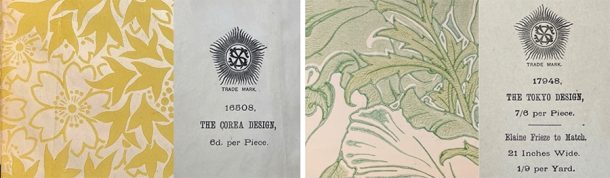
Yet the same sample books that carried British surface aesthetics worldwide also obscured the authorship of the designs they carried. As commercial labels displaced the names of designers and manufacturers, tracing their transmission – and recognising how the same design currents reached the Korean palace – became increasingly difficult.
The story becomes even more complex inside the hybrid interiors of the Korean palace, particularly Huijeongdang and Daejojeon in Changdekgung Palace. Here, British manufacturing, Japan’s imperial distribution networks, local practice, and colonial politics intersected. Rather than seeking a single decision-maker, we can begin to reconstruct the round table of selection—the network of actors, materials, and political conditions that collectively shaped these interiors.
In the next post, I will step inside these palace interiors and explore how travelling surfaces became part of one of the most politically charged spaces during the 1921 reconstruction of Changdeokgung Palace.
This work was supported by the Ministry of Education of the Republic of Korea and the National Research Foundation of Korea (NRF-2023S1A5B5A16083145).
Fascinating read — the idea that wallpaper names like “Italian” or “Japanese” described surface effects rather than origins is such a great detail, and it really reframes how you look at pattern history. As a designer I’m used to the opposite problem: taking a pattern from a photo or scan and adapting it to a different surface or format, which always makes me think about how much “translation” happens along the way. A free tool I use for that, imagestretcher, stretches any image to a different aspect ratio without warping the subject — handy when a wallpaper detail or textile scan needs to fit a different format. Looking forward to Part 2 on the palace interiors!