
The V&A recently added an example of Filipino formalwear, the Barong Tagalog (or barong, for short) to its Asia Collection. Made in 2018, a closer look at this contemporary men’s shirt reveals a rich material heritage.
Adorned with intricate needlework, its translucent fabric is made from a fine weave of silk and pineapple plant fibre. This form of sheer, stiff, light and lustrous textile – sometimes known as nipis (literally ‘thin’) – is synonymous with the barong. Though modern types often use silk-based blends, piña (woven from pineapple fibre) is the most prized material. Cherished for weddings and ceremonial dress, this traditional cloth has been made in the Philippines for centuries. In 2023, piña handweaving from the Aklan Province was recognised by UNESCO as Intangible Cultural Heritage.
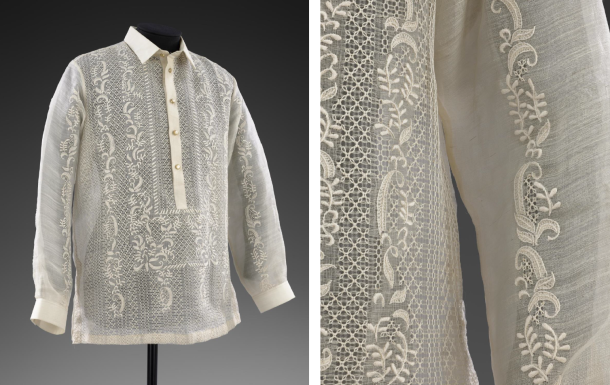
While quintessentially Filipino, both piña and the barong have complex, global histories. Native to South America, the pineapple was brought to the Philippines in the 1500s through Spanish colonisation. Indigenous Filipinos already had a long tradition of preparing and weaving fibres from abacá (banana plant). By the 19th century, using piña for fine nipis garments was the vogue in colonial society.
In recent history, the barong was officially named the national dress of the Philippines in 1975. Western-style suits (or ‘Amerikana’) were prominent during the US occupation, but barongs were re-popularised by Philippine presidents, held as a symbol of independence.
For Filipinos in diaspora, wearing ‘Filipiniana’ dress can be a way to express cultural pride and kinship. Yet despite being Britain’s largest Southeast Asian community, material culture and fashion from the Philippines is relatively obscure in UK museums. A deeper dive into the V&A’s piña collections may help thread more connections to this fascinating, (trans)cultural textile.
Cross-Cultural Stitch: Piña and Europe
The V&A’s tipos del país are a remarkable glimpse into 19th century colonial Manila. These small paintings, depicting locals in typical dress, reveal a cosmopolitan capital city. Here, figures pair barongs with top hats, fusing native and Western fashions.
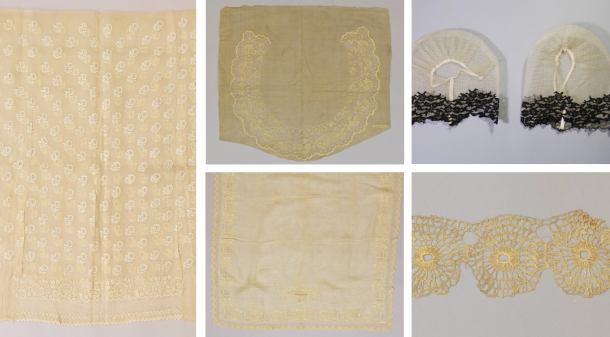
In the National Art Library volume, painted details portray lace-like decoration on cuffs, collars, handkerchiefs and pañuelos. The translucent rendering suggests these garments are made from piña. In the 1800s, whitework-embroidered piña was mostly associated with the elite illustrado and mestizo (mixed Spanish and Filipino) classes.


On our contemporary barong, the piña silk is exquisitely embellished with calado needlework. This tradition – kept alive by burdaderas (skilled embroiderers) in Lumban, Laguna Province – is born from a mix of Indigenous craft and European techniques, learnt from nuns in Spanish missionary schools. Delicate openwork patterns are formed by drawing together, tying and removing individual threads by hand.
Calado can also be seen on the V&A’s collection of piña handkerchiefs, made in 19th century Manila. This example, acquired in Gibraltar, was likely made for the tourist market. It features both European and Filipino motifs: a poodle and a báhay kúbo (or ‘nipa hut’, a traditional house on stilts) appear in opposite corners.

Manila to Madras? Piña and India
Surprisingly, a search for ‘piña’ on Explore the Collections brings up several textiles attributed not to the Philippines, but to South India.
Records show they were transferred from the former India Museum – and previously exhibited at the 1855 Exposition Universelle in Paris. Collected by the East India Company (EIC), these textiles – like thousands of trade goods – were chosen to show the manufacturing potential of Britain’s colonies.
EIC reports from 1855 note samples of ‘pine apple silk’ and fibres prepared in Madras (present-day Chennai). Also mentioned are ‘worked fabrics’ promoting skilled embroidery, including those amongst the ‘Madras Tariff articles’, which showcased the region’s exports and imports.

The sparse mentions of Southeast Asia are interesting, but the gaps also leave room to speculate. An India Museum Slip Book (acquisition record) notes this piña scarf was ‘elaborately embroidered in Madras’, but the ‘fabric imported from the [Malay] Peninshula [sic]’. Could we infer, then, that some Indian pieces were worked upon piña from further East – and possibly the Philippines? Can we trace more threads between these historic port cities of Manila and Madras?


The Philippines, the Globe and the Gaps
The Philippines has sometimes been considered an anomaly in Southeast Asia, its material culture sidelined in Western study of the region. Collection records show much of the V&A’s piña moved from the Textiles to the Far Eastern (now East Asia) Department, finally being transferred to the South and Southeast Asia section in 2000. This shifting categorisation suggests, perhaps, a difficulty in interpreting these pieces previously.
This complexity echoes in the barong: an object weaving many strands to Philippine identity, whether native, colonial, nationalist, diaspora, trans-cultural. An important addition to the V&A’s collection of Southeast Asian textiles – let’s hope it tells even more stories, with even more voices.

Note: This blog builds on existing research by Angela Hermano Crenshaw, and by Abi Lua and Sandra Castro for the Mapping Philippine Material Culture project – where you can discover more.
The Barong Tagalog is a beautiful example of how clothing can carry history, craftsmanship, and identity all at once. I once saw a piña shirt at a cultural exhibition, and the delicate texture looked almost luminous under the gallery lights. Learning how much patience goes into weaving and embroidery makes each piece feel even more special. While browsing fashion references later, I came across https://missinstyle.pissedconsumer.com/review.html and kept thinking about how traditional details continue to influence modern style. Adding this barong to the V&A collection gives visitors a meaningful way to appreciate Filipino artistry, heritage, and elegance up close today too.
Interesting article with clear points. Finding games that are easy to access and enjoyable is always a nice experience. If you enjoy platform adventures, explore play Geometry Dash. It includes unique obstacles, smooth movement, and exciting level layouts. The simple controls make it easy for beginners, while the different stages keep the gameplay interesting for regular players.