Vietnamese embroidery is a remarkable yet relatively little-known part of the country’s textile heritage outside Vietnam. In the late 19th and early 20th centuries, skilled embroiderers in villages across northern Vietnam produced richly decorated silk textiles for an expanding international market. Combining established embroidery skills with imported fabrics and changing tastes, these works offer a fascinating glimpse into Vietnam’s textile industry during the French colonial period (1884 – 1954).
From 6 November 2026, a new display at V&A East Storehouse, presented as part of The Stories of Clothes, brings together three embroidered textiles from the V&A collection, alongside a contemporary example of Vietnamese fashion. Together, they reveal the creativity of Vietnamese embroiderers and the international connections that shaped this distinctive tradition.
Embroidery in colonial Vietnam
The historical region of Tonkin, surrounding the Red River Delta in northern Vietnam, was home to numerous embroidery villages, including Hà Đông, Bắc Ninh and Nam Định. During the French colonial period, embroidery workshops increasingly produced textiles for international markets, responding to the tastes of European and American customers.
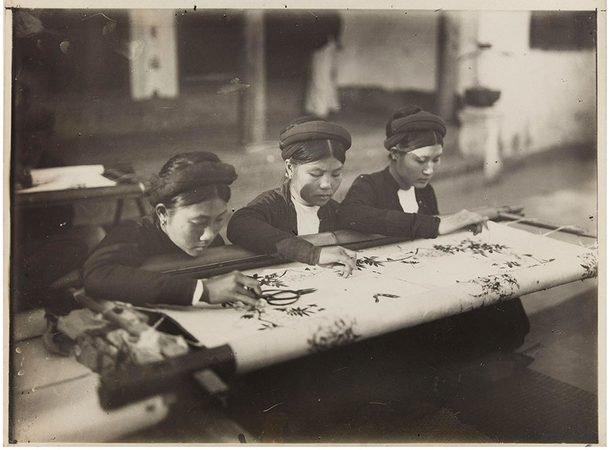
This commercial activity brought together local craftsmanship and imported materials. According to Les Arts Décoratifs au Tonkin (1922), around 1896, Vietnamese embroiderers began producing their work on Lyon satin, using decorative motifs inspired by Chinese, Japanese and French designs. They also expanded the range of colours used in their embroidery silks, giving their new products a distinctly Western orientation. These embroidered textiles were exhibited at the Exposition Universelle in Paris in 1900, where they attracted attention and received awards.
The changing designs reflected the adaptability of Vietnamese embroiderers and their response to new markets and customer preferences. Floral compositions, birds, animals and mythical creatures continued to feature prominently, alongside designs that appealed to international customers.
One notable example was Nam-Quat, an established embroidery firm in Bắc Ninh. Its embroidery design and fabric sample book, produced around 1916 – 20 and now in the V&A collection, offers a fascinating insight into this commercial enterprise. Rather than serving as a working pattern book for embroiderers, it was probably intended for customers to select designs and fabrics when ordering finished products.
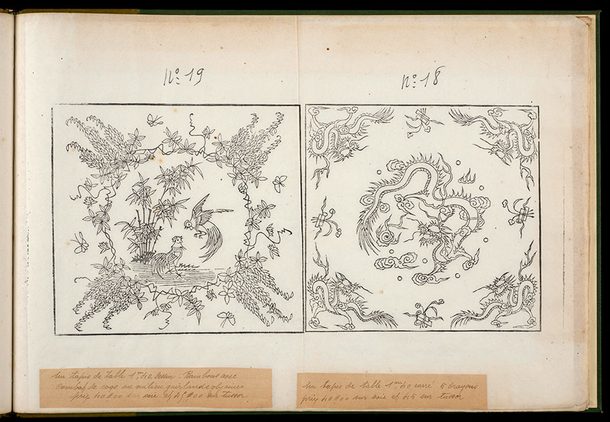
The sample book illustrates an extensive range of embroidered furnishings, including bedspreads, bolster covers, table and piano covers, curtains and screens. Its designs feature flowers such as chrysanthemums, lotus, roses and wisteria, alongside birds, animals and mythical creatures including dragons and phoenixes. The final pages include twelve colour samples of Lyon silk satin available to customers.
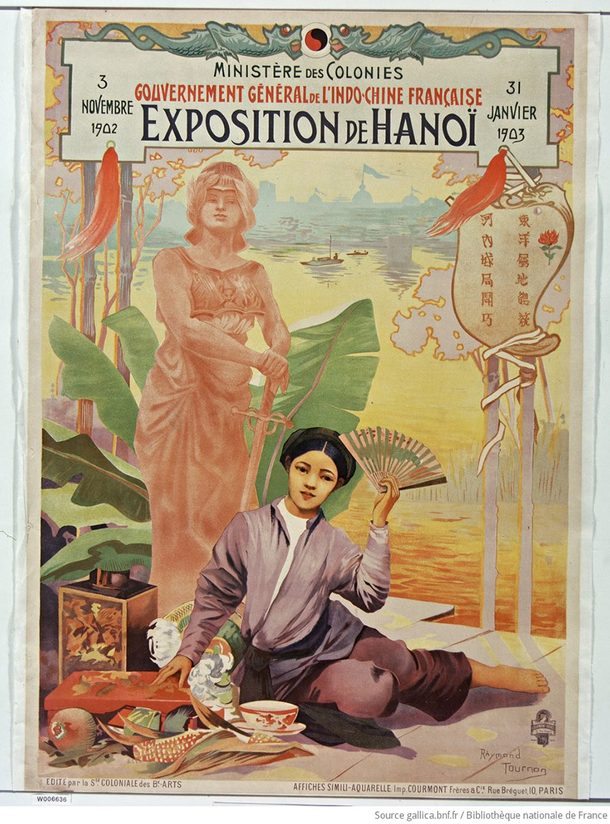
Seeking to expand its international market, Nam-Quat promoted its work through national and international exhibitions, where it received several awards. These included a silver medal at the Hanoi Exhibition in 1902 – 03, a gold medal at the Marseille Colonial Exhibition in 1906 and a silver medal at the Shanghai Exhibition in 1912. The studio also participated in the Universal Exposition in St Louis, USA, in 1904.
Four embroidered textiles and their stories
The three embroidered textiles in the display were collected by Edith Florence Harrop (1890 – 1980), who travelled widely in Asia with her husband, Frederick S. Harrop, a graduate of the Royal College of Art and Headmaster of the School of Arts and Crafts in Bangkok. The couple lived in Bangkok from 1917 to 1930, and the textiles were brought back to Britain in 1930. They remained in the family until their acquisition by the V&A.
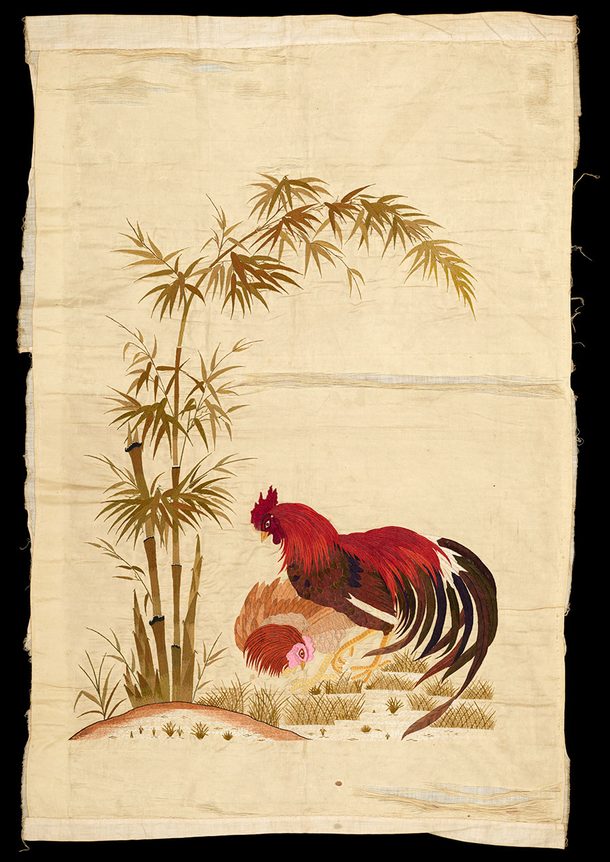
Among them is a hanging embroidered with a rooster and hen beside bamboo. Its design closely resembles motifs found in the Nam-Quat sample book, offering a connection between a surviving commercial design archive and finished embroidered objects. The silk satin was probably manufactured in Lyon, reflecting the links between French textile production and Vietnamese embroidery workshops.
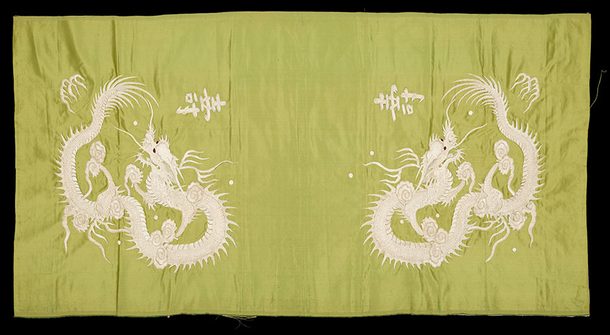
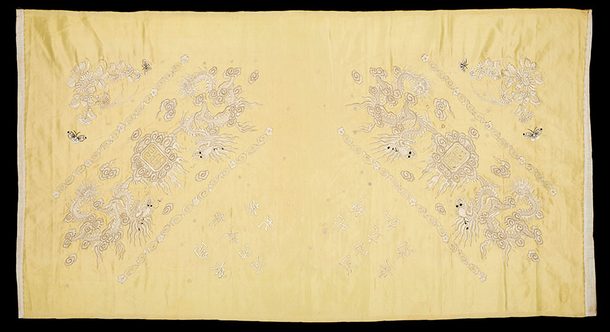
Two unmade cushion covers demonstrate the variety and technical skill of this commercial embroidery. The green satin features a curling dragon among clouds and flames, accompanied by the Chinese character shou, meaning ‘longevity’. The dragon’s head and body are worked in raised embroidery, creating a striking three-dimensional effect. The cream satin features two dragons facing a stylised shou character, with inscriptions that appear to indicate a production centre in Hanoi. Similar designs can also be found in the Nam-Quat sample book. Although both cushion covers are discussed here, only the dragon cushion cover (Museum no. IS.25-2026) is included in the display; the cream satin cushion cover (Museum no. IS.26-2026) can be requested for viewing at V&A East Storehouse.
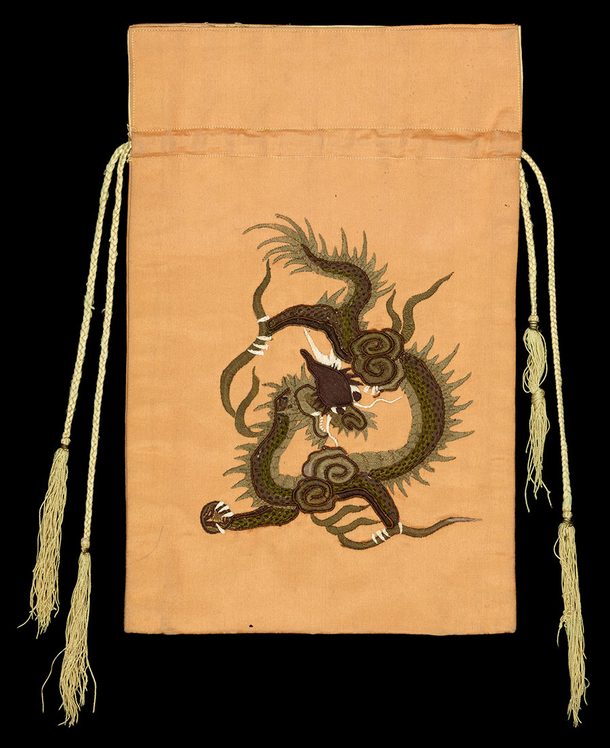
A fourth object, described by Edith Harrop as a ‘mosquito bag’, is particularly intriguing. The small, embroidered purse has drawstrings and may have been used to hold herbs or other fragrant materials intended to repel mosquitoes. Interestingly, similar designs are identified as purses in the Nam-Quat sample book. The different descriptions offer a glimpse into how these objects could be understood and used in different contexts: as commercial products for customers and as practical personal accessories for their owners.
Harrop recorded that ‘most of these cloths are second-hand and have been bought in pawn shops… genuinely “of the country”‘. Her observations offer a rare personal perspective on the textiles and the circumstances in which she collected them
Embroidered stories: a ceremonial procession
Beyond the three textiles featured in the display, the V&A collection holds another example of Vietnamese embroidery: a large panel dating from around 1900, depicting Vinh Quy Bái Tổ (‘returning in glory to pay respects to one’s ancestors’). Procession scenes were familiar subjects in Vietnamese decorative arts and were embroidered on a large scale as decorative hangings for the export market.
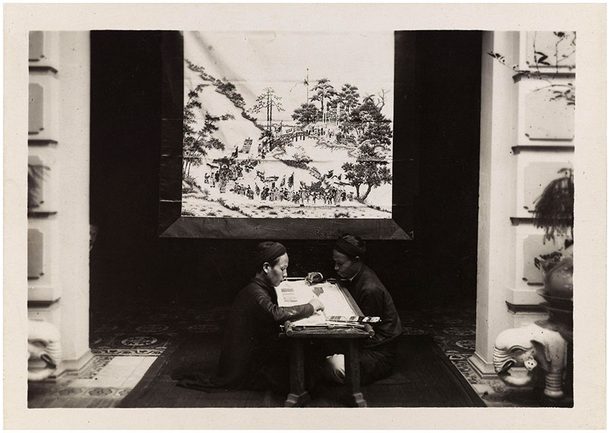
The scene celebrates a scholar’s success in the imperial civil service examinations. Having achieved a high rank, he would return to his home village in a grand procession to pay his respects to his family and ancestors. Accompanied by attendants carrying banners, parasols and other ceremonial objects, his return was a public celebration of academic achievement and family honour. The procession also reflects the importance of ancestral ties and attachment to one’s home village in Vietnamese culture.
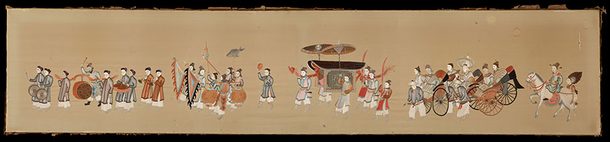
Neither the cream satin cushion cover (Museum no. IS.26-2026) nor the ceremonial procession panel (Museum no. T.388-1960) is included in the display. Visitors wishing to see either object can request access in advance through the V&A’s Order an Object service.
Vietnamese textile traditions in contemporary fashion
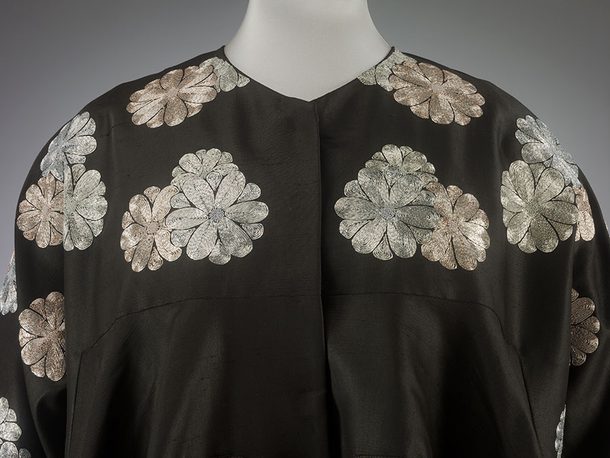
Vietnamese textile craftsmanship continues to inspire contemporary designers. A jacket and skirt ensemble designed by Victoria Roe for the Huế-based fashion brand FASHION4FREEDOM offers a striking example.
FASHION4FREEDOM is a social enterprise that works directly with Vietnamese artisans, villages and cooperatives, supporting traditional craft practices through an ethical and sustainable supply chain.
Made in 2016 – 17, the ensemble combines Lãnh Mỹ A, a distinctive black silk often described as ‘lacquer silk’, traditionally produced in Tân Châu in southern Vietnam, with embroidery drawing on the court dress traditions of Huế, the former imperial capital. The silk is dyed using the fruit of the mặc nưa tree (Diospyros mollis). A lengthy process of repeated dipping, drying and beating gives the fabric its characteristic deep black colour and subtle green sheen.
The embroidered jacket reinterprets the richness of Vietnamese court dress through a contemporary design. Metal-wrapped threads and coloured silks are combined with softer pastel shades and decorative knot stitches, bringing historical embroidery techniques and visual references into a modern fashion context.
From the commercial embroidery workshops of northern Vietnam in the early 20th century to contemporary fashion, these objects reveal the diversity of Vietnamese textile traditions and the creativity of the people who sustain and reinterpret them today.
Discover these embroidered textiles on Level 3, at Display 28, V&A East Storehouse, from 6 November 2026.