Writing Palestinians into their Material History: Reflections from the V&A Collection


November 17, 2026

The Jameel Fellowship programme invites contemporary artists, designers and researchers from the Middle East to spend time in residence at the V&A. Fellows are based in the Middle East section of the Asia Department, and supported by the Jameel Curator. Focused on investigation rather than making, Jameel Fellowships support the development of new lines of enquiry in the Fellows’ work, facilitating research in conversation with the V&A’s extraordinary collections. Nadi Abusaada was a Jameel Fellow in Autumn 2026.

In a museum with nearly three million objects, spanning five thousand years of human history, the eclectic collection of Palestinian material culture at the V&A appears rather minuscule. Yet this small collection raises much larger questions, touching on some of the most fundamental concerns of museum work: Who gets to enter history, and who is kept at its margins? Whose names appear on museum labels, and whose remain buried in accession registers, correspondences, and hidden records?

I arrived at the V&A with a desire to examine its Palestinian collections. I ended up following threads that reveal as much about Palestinian history as they do about the museum’s own. The materials I examined belonged mainly to the three decades of British colonial rule in Palestine (1918–1948), a period during which, unsurprisingly, many Palestinian objects also entered the museum.

During those decades, much of the expertise that the British had developed through their prior occupation of Egypt was transferred to its neighbouring Palestine. Several British experts in architecture, archaeology, and preservation consequently found themselves working there. Yet my interest was not merely in retelling the already-known stories of foreign experts, significant as their roles may have been, but also in recovering the overlooked histories of local Palestinian architects, artists, and artisans who worked alongside them, often making their work possible, and whose names have since largely fallen out of the historical record.

During my time at the V&A, I examined the lives and work of three Palestinian figures whose paths intersected with the museum’s collections in the twentieth century: an architect, George Shiber; a formatore, Mubarak Saad; and an artist, Jamal Badran. All three, as we will see, crossed the boundary between making and repair. What follows is an attempt to piece together their histories through the traces they left behind, both within the V&A’s own collections and records and beyond them.

E.T. Richmond’s Drawings and George Shiber

Unlike many foreign experts who came to Palestine after the First World War, British architect Ernest Tatham Richmond arrived not only with prior knowledge, but also with a measure of humility. Although he had arrived in Jerusalem in 1918 at the invitation of General Allenby and Ronald Storrs, the city’s new governor, Richmond understood that he had stepped into a rich architectural terrain, shaped by centuries of accumulated knowledge and histories of care. He soon earned the confidence of Palestinian leaders, who entrusted him with the study and repair of one of the country’s most precious monuments: the Dome of the Rock in Jerusalem.

Figure 1. “North-east face of Octagon” by Ernest Tatham Richmond. Pencil, India ink, watercolour, 1919. Some of the missing tiles appear. A note to the publisher also appears on the drawing’s bottom left corner. V&A E.2023-1924.

In the V&A’s Prints and Drawings Study Room, together with the curators, we examined 26 elaborate watercolours of details from the Dome of the Rock, donated by Richmond in 1924 (Figure 1). It was particularly revealing to read them alongside his book from that same year, The Dome of the Rock in Jerusalem: A Description of Its Structure and Decoration published by the Clarendon Press at Oxford (Figure 2). Some of the original drawings still bear handwritten instructions to the publisher for their reproduction in the book.

Reading the book alongside the drawings revealed something important about how Richmond understood the monument, and what it meant to document and repair it. Most of the watercolours concentrated on the exterior, where the tiled façade was most exposed to weather and decay. Yet rather than presenting the tiles as fragments of a single, harmonious design, Richmond carefully recorded their differences: shifts in colour, changes in motifs, and variations in technique. What appeared at first to be an inventory of ornament was gradually appearing as a chronology of care. The façade, as he understood it, was a dynamic surface upon which history had accumulated: one that generations of foreign and local artisans had continued to remake.

Figure 2. Pages from Ernest Tatham Richmond, The Dome of the Rock in Jerusalem: A Description of Its Structure and Decoration (Oxford: Clarendon Press, 1924

Richmond understood this continuity through a striking analogy. “The Dome of the Rock is, then, alive—in the sense that man is alive”, he wrote. He saw it as a “living symbol” belonging to “a living faith.” This understanding of the monument as something living, rather than a frozen relic of the past, seems to have informed his own approach to its contemporary study and repair.

The book itself offered further clues. Its cover featured a calligraphic inscription by Abdelqader Al-Shihabi, a Palestinian calligrapher involved in restorations at the Haram al-Sharif. In the preface, Richmond acknowledged the insights of the well-known Armenian ceramicist David Ohanessian, who had arrived in Jerusalem to assist with the restoration of the building’s ceramic decoration. Importantly, Richmond also acknowledged the “valuable help” of “Mr. George Shiber of Jerusalem in the preparation of the drawings.”

What precisely did Shiber contribute? We cannot yet know whether he assisted with the architectural illustrations reproduced in the book, the watercolours now at the V&A, or both. But his appearance in the preface was not the only trace of their collaboration. In Richmond’s unpublished papers at Durham University, he acknowledges Shiber’s contributions in “measuring and drawing” during his work on the Dome of the Rock. Elsewhere in these papers, Richmond mentions other local artisans and craftspeople upon whom his work depended, including a local carpenter and the guards who looked after the buildings themselves. Their contributions, often mentioned only in passing, suggest a much wider network of expertise behind the monument’s preservation.

Figure 3. George Shiber, Jerusalem, 1920s, stamped Mitrys Photo Studio. Laila and Issa Mashy Family Photo Collection

Other records, however, tell a fuller story of Shiber’s life and work (Figure 3). In my research on the first generation of Palestinian architects, I had encountered him as a practising architect in Jerusalem, president of the city’s Arab Engineering Association in the 1940s, and even as an advocate for a School of Design and Engineering in Jerusalem that was never realised due to the 1948 war. In London, I found records of his earlier studies at the Regent Street Polytechnic, where he distinguished himself in drawing, winning first prize in 1913 for the best set of drawings presented in folios. He later taught briefly at Victoria College in Alexandria before returning to Jerusalem to work with Richmond.

The drawings I had first encountered at the V&A under Richmond’s name had thus begun to tell a different story. They were not simply records of a monument undergoing repair, but also traces of the people and skills that made such repair possible. Richmond, who would later identify several tiles in the V&A’s ceramics collection as originating from the Dome of the Rock, understood the building as a living monument, its surfaces bearing the marks of generations of care and renewal. His drawings, too, demanded a similar reading. The question was not simply who had drawn the Dome of the Rock, but whose knowledge had gone into making these drawings, and why some names survived while others disappeared.

The Nazareth Capitals and Mubarak Saad

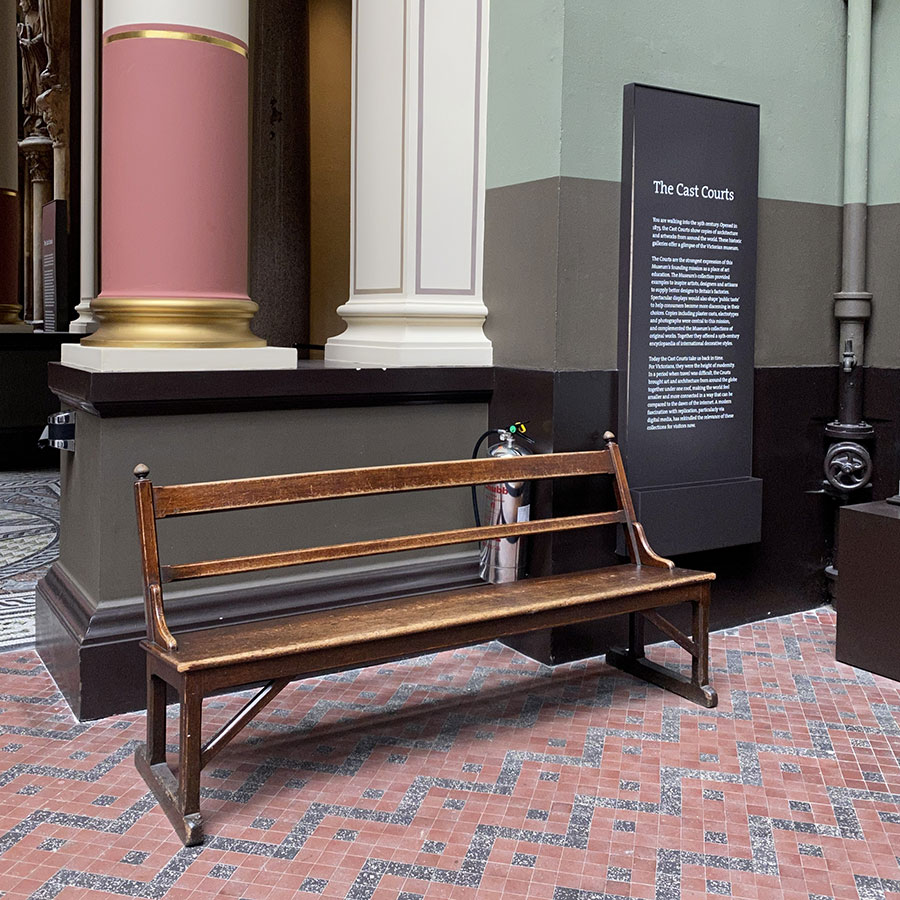
Walking through the V&A’s Cast Courts, on the wall opposite the towering replica of Trajan’s Column, one encounters three plaster copies of intricately carved stone capitals from Nazareth, almost dwarfed by the monumental works surrounding them. The accompanying label identifies them as “Casts of unknown artist, column capitals, about 1170,” and explains that the originals, depicting biblical scenes, were discovered in 1908 near the Church of the Annunciation, where they had lain buried for centuries. But how did these medieval sculptures from Nazareth find their way, in plaster, to a London museum?

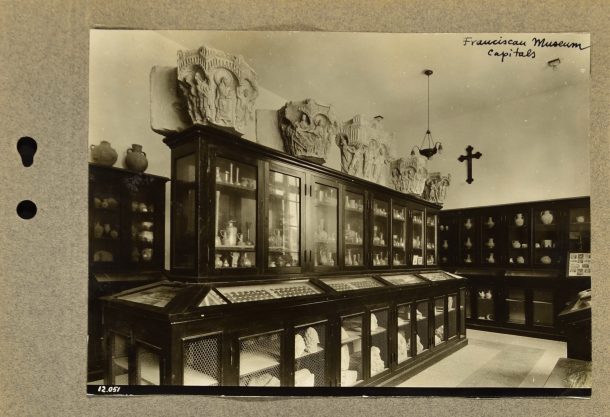
Figure 4. Image of Nazareth Capitals on display at the Franciscan Museum in Nazareth, photographer unknown, date unknown. Israel Anitiquities Authority Archive, SRF/148/94

The story begins in January 1926, when the V&A’s director, Eric Maclagan, visited Palestine as a guest of Ronald Storrs and his wife in Jerusalem. Fascinated by the five capitals which he might have encountered in the Franciscan Museum in Nazareth, Maclagan began corresponding with British officials in Palestine about obtaining copies for the museum (Figure 4). The difficulty was finding someone capable of producing them. Writing in August to John Garstang, then director of Palestine’s Department of Antiquities, Maclagan remarked, “I can quite believe that it is difficult to find a competent formatore out there.”

A formatore is a specialist in making moulds and casts, a skill essential to the reproduction and circulation of historic objects. Producing a faithful replica demanded an intimate understanding of the original’s contours, surfaces, and intricate details, along with the ability to reproduce them without damaging the stone itself.

The project stalled for several years. By 1930, however, the Department of Antiquities had hired the Palestinian artist Mubarak Saad as a formatore (Figure 5). Saad had trained in art at the Franciscan convent of St Saviour in Jerusalem before travelling to Italy to study painting. His paintings ranged from portraits and landscapes to historical scenes, including one painting of Saladin’s entry of Jerusalem, in which Christian and Muslim Arabs celebrate together in the streets. There is a curious irony here: according to a commonly repeated account, the Nazareth capitals had been buried precisely to protect them from Saladin’s advancing armies.

Figure 5. Restorer Mubarak Saad working on a vase, Palestine Archaeological Museum, Jerusalem, 1935. John Henry Iliffe Collection, UQFL514, Album 1, item 62.

As formatore, Saad would become deeply involved in repairing objects that entered the Palestine Archaeological Museum in Jerusalem. Among his assignments was the making of casts of the Nazareth capitals, intended for museums abroad, including the V&A and the Musée des Monuments Français in Paris (also known as the Trocadéro). The work was supervised by Father Mamert Vionnet, who would later be killed in his study by a projectile during the 1948 war.

The correspondences in the V&A archives link Jerusalem, London, and Paris in a chain of requests, negotiations, and technical decisions. E. T. Richmond, by then the head of the Department of Antiquities in Palestine, was involved, as were Maclagan, Vionnet, and Paul Deschamps, the Trocadéro’s director. Saad’s name enters the V&A’s registry file only fleetingly in one of the French letters, as the person who carried out the casting (Figure 6). Yet without his work there would have been no objects to dispatch and no exchange between these institutions.

Figure 6. Clipping from a Letter from Paul Deschamps to Ernest Tatham Richmond, dated 20 May 1929. The letter mentions Mubarak Saad as the maker of the Nazareth casts. V&A Registry, MA/1/P256.

At one point, Maclagan resisted a proposal to send the V&A a surmoulage: a secondary cast made from Saad’s first set of plaster casts intended for the French museum, rather than directly from the original stone. Maclagan’s objection reveals that a replica was not regarded as an interchangeable substitute. Its material genealogy mattered. Each additional generation of copying risked putting another degree of separation between the museum and the carved surface it wished to study. Three casts eventually arrived at the V&A from Jerusalem. Two others, which had proved difficult to produce, were offered later but declined because of the cost.

The identity of the medieval sculptors behind the original Nazareth capitals has long been debated. Their style and iconography have invited competing interpretations of Western and Eastern influences, while the use of local Palestinian limestone raised questions about the relationship between itinerant artists and local traditions of making. Yet alongside this unresolved medieval history lies another, more recent story of artistic production, one for which the maker’s identity can be recovered from the archives.

Seen today in the V&A Cast Courts, the plaster capitals carry two histories at once: that of their medieval creation and that of their twentieth-century reproduction. Saad’s work was not simply a means of transmitting the originals to European museums, but an act of skilled making in its own right. The “unknown artist” of the original capitals identified on the V&A’s label may well remain unknown. But the artist who made the objects now standing before us has a name: Mubarak Saad.

The Aqsa Minbar and Jamal Badran

The third Palestinian figure in this story, artist Jamal Badran, entered the V&A not through its collections but with his own feet. In 1934, Badran arrived in London to study at the Central School of Arts and Crafts, and his surviving student sketchbook offers a glimpse of his encounters with the museum’s collections. Among its pages are studies of ancient Egyptian textiles and Persian ceramics. During my fellowship, I followed these sketches back into the V&A, attempting to identify the objects that had once caught his eye (Figure 7). With the help of the curators, I was able to examine some of them again. The distance between the young student standing before a display and the marks he left on paper suddenly seemed remarkably small.

Figure 7. A drawing by Jamal Badran produced during his time as a student in Central School of Arts and Crafts in London of a ceramic dish at the Victoria and Albert Museum. Photograph by author, 2026. V&A 559-1905.

I also searched the archives of the Central School of Arts and Crafts, where he studied, now preserved within the University of the Arts London collections. Direct evidence of Badran’s time there proved elusive. An important document survived instead with his family: a 1937 letter from the school’s head, Henry George Murphy, recommending him for a teaching position in Jerusalem. Badran’s education included life-drawing, textiles, ceramics, sculpture, and bookbinding, the latter under Douglas Cockerell. The archive offered glimpses of this world, though not quite of Badran within it. Photographs of school life from 1938, taken after his departure, and surviving examples of leatherwork, bookbinding, and gilding evoked an artistic education in which the boundaries between fine art and skilled craft were far less rigid than they might later appear.

Decades later, these skills would be called upon for a task of an entirely different magnitude. In August 1969, an arson attack devastated parts of al-Aqsa Mosque and destroyed its celebrated medieval wooden minbar, an extraordinarily intricate work of carpentry, carving, and ornament. How could something of such complexity be reconstructed when so much of its material substance had been consumed by fire

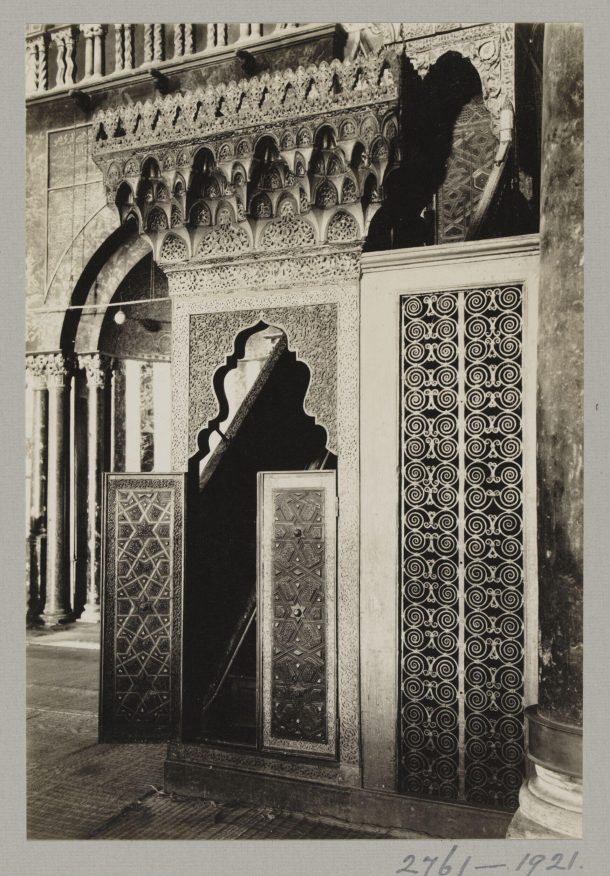
Badran undertook the painstaking task of drawing the minbar anew at a scale of 1:1. He studied its charred remains alongside earlier photographic documentation, particularly the detailed images taken by the architectural historian K. A. C. Creswell, prints of which are held in the V&A collections (Figure 8). Photographs made decades before the fire for architectural study had acquired an unforeseen urgency. They became evidence through which a destroyed object could be studied, measured, and partially recovered.

Figure 8. Portal and door of the minbar of Salah el-Din in al-Aqsa Mosque, Jerusalem, 1919-21. Photographed by K. A. C. Creswell, V&A, 2761-1921.

Yet while a photograph might preserve the appearance of a carved panel, it could reveal little of the depth of its relief, the articulation of its joints, or the manner in which its constituent pieces had been assembled. Badran had to move between what the Creswell photographs showed, what the surviving fragments disclosed, and what his knowledge of materials and making allowed him to infer. He had to reconstruct the decisions behind the original work: how a line became a cut, how a pattern turned a corner, how hundreds of pieces had once formed a single structure.

Here the connection to Badran’s student years comes into focus. His sketches at the V&A were exercises in studying historic ornament as something made rather than merely seen. As his daughter artist Samira Badran would later tell me, he insisted that they “went to the museum not merely to copy objects but to analyse them.” His training in bookbinding, carving, and the decorative arts had cultivated a knowledge that moved between the eye and the hand, between historical example and contemporary practice. Decades later, that knowledge would prove indispensable to his work on the reconstruction of the minbar, even if, much to his disappointment, his meticulous drawings were ultimately not followed.

Figure 9. Palestinian artist Jamal Badran in his studio producing the life-size drawings for the reconstruction of al-Aqsa Minbar, c. 1969-76. Jamal Badran Family Archive.

One detail in Badran’s drawings is particularly telling (Figure 10). The medieval minbar had borne the names of craftspeople who worked on it in the twelfth century. In preparing his reconstruction, Badran, too, inscribed his own name: “The minbar was redecorated after the fire by Jamal Mohammad Hassan Badran from the People of Nablus, 1396 Hijri [1976 AD].” Without claiming authorship of the original, Badran placed his own work within the minbar’s continuing history, acknowledging repair as another act of making.

Badran’s inscription returned me to a question that had accompanied each of these encounters: at what point does the restorer become an author? I had come to the V&A seeking traces of Palestinians who had cared for their material past, only to find that their own histories were equally in need of care. For the past survives not only through what was first made, but through the many hands that have studied, repaired, and kept it alive.

Figure 10. Detail from Jamal Badran’s drawings for al-Aqsa Minbar’s reconstruction, identifying him as the artist behind the reconstruction, 1976. Jamal Badran Family Archive.

Acknowledgements

The author would like to express his gratitude to V&A curator Rachel Dedman for her generous support throughout this Fellowship, and to assistant curator Giorgia Brigatti for her invaluable assistance. Special thanks are also due to curator Dr. Mariam Rosser-Owen for her insights into the ceramic works, and to curator Dr. Ella Ravilious for her guidance in examining E. T. Richmond’s drawings. I am also grateful to artist Samira Badran for sharing relevant materials related to her late father artist Jamal Badran. I am also grateful to Hana Irshaid for sharing her knowledge of the Terra Sancta Museum in Jerusalem’s versions of the Nazareth capital casts. 

This title of this piece is a node to an article by historian Beshara Doumani titled Rediscovering Ottoman Palestine: Writing Palestinians into History published in the Journal of Palestine Studies in 1992.

About the author


November 17, 2026

Dr. Nadi Abusaada is an academic and researcher specialised in the material and visual cultures of the modern Arab region. He is currently an Assistant Professor at the School of...

More from Nadi Abusaada
0 comments so far, view or add yours

Add a comment

Please read our privacy policy to understand what we do with your data.

MEMBERSHIP

Join today and enjoy unlimited free entry to all V&A exhibitions, Members-only previews and more

Find out more

SHOP

Explore our range of exclusive jewellery, books, gifts and more. Every purchase supports the V&A.

Find out more