

For the September edition of Look What I Found at V&A East Storehouse, we were joined by multimedia artist, creative practitioner and researcher Remiiya Badru. As part of her micro-residency at V&A East, Remiiya spent time diving into the V&A’s collections, in preparation for her exhibition at Cody Dock in Canning Town, ‘Common Threads.’ As Assistant Curator based at V&A East Storehouse, I supported her research by facilitating access to object stores alongside Order an Object appointments with our V&A Collections Access team.
Remiiya then presented the objects and research she had uncovered at a free show-and-tell event. This post highlights the key object stories and themes that emerged from her time in the stores, thinking about the collections for her own research into calico and Prussian Blue dyes on the River Lea.
Remiya Badru is an avid walker, listener and practitioner, exploring textiles, dyes and making histories across geographies and time periods, mapping global connections across material culture, with University of Leicester, Royal Museums Greenwich, Museum X, and the Museum of London Docklands. Taking from her many explorations and practices around rivers, Remiiya developed her creative process of ‘Rhumblines’ – a metaphorical device that threads complex river-related and interwoven stories together. This allows her to navigate the often hidden histories and silences of people and place. As a witness to infrastructural change and flux in her local area, she explores these juxtapositions through memories of (post)colonialism, pre- and post-industrial change, cultural heritage, and natural and man-made environments.

Remiiya’s previous work around the River Thames and water histories led to her year-long artist residency at Cody Dock. Cody Dock is a community-led social enterprise that works to conserve the banks of the River Lea in east London, its heritage, and cultural and educational programmes, with a core focus on community and the power of making when creating bonds and healing in a changing, busy part of Newham.
Bromley Hall
As part of Remiiya’s residency at Cody Dock, she has been looking into textile production histories at Bromley Hall in Bromley-by-Bow. One of the oldest surviving brick houses in London used by Henry VIII, Bromley Hall is now owned and being restored by Leaside Regeneration as part of attempts to revitalise the River Lea area. It was once the site of calico printers since the 1740s, run by the Talwin and Foster families throughout the late 1700s. They used copperplate printing techniques for furnishings, using patterns inspired by Chinese motifs and Indian chintz.


In 1955, the Calico Printers’ Association donated a pattern book from Bromley Hall to the V&A’s collection. Finding this link to her research, Remiiya visited South Kensington to view the pattern book in the Prints and Drawings Study Room and then found many of the same printed fabrics from Bromley Hall at V&A East Storehouse, including this Peacock and Hen piece. These Asian-inspired fabrics speak to the wider migration of designs and textiles during the 1700s and 1800s, during which both the River Lea and the Thames were key waterways connecting Britain to the global colonies.
In previous projects, Remiiya has created works in response to narratives of enslavement and the journeys of ships between Britain and its colonies, focusing for instance on histories of cotton production and manufacture. Drawing from this earlier work, Remiiya began to investigate further calico and indigo-related objects from the V&A’s collections. She hoped to uncover more global connections between Bromley Hall printers, trade and the River Lea.
Calico

Remiiya began by looking into historic calico at V&A East Storehouse and found this cut-piece from Uttar Pradesh, India. While studying the close weave of this coarse cotton, Remiiya discovered that this piece of cloth had been cut during the production of John Forbes Watson’s The Textile Manufactures of India in 1866. Textile Manufactures was a series of textile books, which Watson also called ‘mini-museums’, sent to British textile producers in Britain and colonial India showing samples of materials from South Asia to teach them how to weave these textiles themselves.
In the introduction to the volumes, Watson states:
About two hundred millions of souls form the population of what we commonly speak of as India; and, scant though the garments of the vast majority may be, an order to clothe them all would try the resources of the greatest manufacturing nation on earth. [Britain] It is clear, therefore, that India is in a position to become a magnificent customer.
In teaching Indian textiles and their production, Watson’s writing indicates the ways in which imperial Britain sought to gain control of its colonial market, reselling Indian textiles back to their original makers. Through these fluctuating and porous global exchanges of textile production and export, Remiiya became particularly interested in how water not only shapes the physical movement of materials but the making practices, knowledge and markets surrounding textile production.
Ankara

In addition to calico, Remiiya was interested in discovering objects dyed with natural and man-made indigo like this English dress fabric, also known as , a popular printed fabric worn across West Africa. She was drawn to the history of ankara, which grew out of Dutch attempts to recreate Indonesian batik without the intricate and time-consuming hand techniques of wax-resist dyeing. Through Dutch colonial rule of Indonesia, and the later European scramble to control land across the African continent, ankara grew out of complex global exchanges of dyeing techniques marked by European appropriation of traditional textile production. Ankara later became a recognisable fabric representing African self-sovereignty and cultural empowerment, despite its global colonial roots.
Yet, while European control of ankara production through cheaper roller printing techniques allowed countries like the Netherlands and Britain to create markets across Africa dependent on their textiles, Remiiya was interested in this particular object’s imitation of adinkra. Adinkra cloths are fabrics that are block printed, frequently using plant-based dyes, originating from Asante and Bono peoples across what are now Ghana and Cote d’Ivoire. These symbols are also known as adinkra, which can function as storytelling and conceptual visual forms, found across Ghanaian and Ivorian fabrics, pottery, architecture and more.
As Remiiya noticed this ongoing theme of European reproductions of indigenous making techniques and attempts to control colonial markets through cotton and indigo-dyed textiles, Remiiya and I opened up the nearest drawer to find an àdìrẹ cloth, which was fascinating to compare as a Yoruba textile practice that also involves resist-dyeing. This is one of the joys of undergoing object research at Storehouse: often it is in the process of searching through our storage that we discover exciting objects which can redirect research in a whole new direction.
Àdìrẹ cloth

This fabric is an example of àdìrẹ ẹlékọ, a mid twentieth-century innovation in àdìrẹ dyeing techniques, where a thin layer of cassava starch is painted onto cotton fabric using a metal stencil to create intricate patterns through resist-dyeing. In directly comparing the English ankara with Yoruba àdìrẹ, Remiiya was particularly interested in the often-missed marks of indigenous makers’ material intelligence, which cheaper mass-produced fabrics cannot recreate.
These ongoing questions around indigo-dyed cotton, manufacturing and labour led Remiiya to look at other objects in the collection from completely different regions made with similar materials.
Sashiko


Firefighter’s jacket and hood, quilted cotton with resist-dyed decoration, Japan, 1850-1900. FE.107&A-1982
This jacket and hood set would have been worn by a firefighter in Japan, in the mid to late 1800s. It exemplifies a stitching technique called ‘sashiko’ which is typically used in mending, but here is used to quilt many layers of cotton together. This forms a reinforced fabric that could better protect against flames. The outfit would have been doused in water before the firefighter entered a burning building, creating a cooling protection against heat. Additionally, the hood has padding added to the top, giving extra cushioning protection from falling debris. This early example of fire-retardant clothing highlighted, for Remiiya, the way in which textile production has often been adapted and innovated through necessity, weaving the textile practices of labourers across time.
Boro

Staying with this theme of workwear and textile innovation through necessity, Remiiya studied this coat, known in Japanese as ‘noragi’, which is an example of what is also called ‘boro’ or rags. This coat was likely worn by a farmer and repaired by the wearer using patches of recycled indigo-dyed cotton. As well as showing how recycled fabrics have historically been used to mend clothes and particularly workwear, saving money and improving durability, Remiiya saw this as an example of the beauty of sustainable and circular textile practices.
The intricate hand-stitched lines highlight the care, time and thought of the wearer and maker who worked on this utilitarian garment. You can imagine the hands that repaired it, the sweat that imbued the jacket with stories of a hard day’s work, and the eyes that pored over each stitch at night to ensure that it would last another year. These details make the body of the wearer and maker visible to us over 150 years later, granting Remiiya the opportunity to find their hidden voices through textile.

Patchworking community
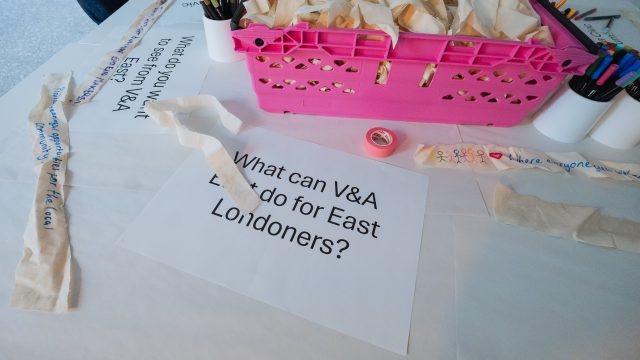
Remiiya’s practice frequently involves creative and arts facilitation so as part of the stories that she’s been weaving across global histories through textile production, she wanted visitors and staff at V&A East Storehouse to come together to make their own patches as part of her display at Cody Dock

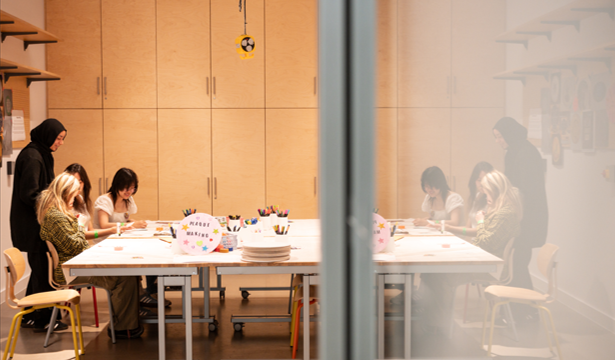
As part of her show-and-tell event at Storehouse, Remiiya invited anyone who was there to come and share a story by making their own decorative patch out of discarded denim, using found materials and scraps from the Storehouse Creative Studios. With the support of Honey Birch, Creative Studio Practitioner for V&A East, Remiiya ran a drop-in workshop which proved very popular with visitors and staff alike!

Inspired by Cody Dock’s uniform of hi-vis vests worn at some point by everyone who volunteers and works there, Remiiya encouraged participants to pin their patch onto what would become part of her display, an homage to the people and communities that make up both Cody Dock and V&A East.

You can now visit this jacket as well as the rest of Remiiya Badru’s Common Threads project at The Boathouse at Cody Dock in Canning Town until 6 November 2026. With special thanks to Remiiya Badru, Bella Quirin and the entire Cody Dock team and volunteers, as well as Derya Adiman, Sally Barton and Honey Birch, V&A East Creative Studios team.

Many thanks for that deep dive into Remiiya’s fascinating work, and for the beautiful photos.
I expect the Cody Dock exhibition is brilliant, but sadly I won’t be able to visit before it ends.
Amazing!!!
I love this! Great work.
Such a detailed read about the exhibition’s links to local history and the research behind Remiiya’s textiles. Having visited the Boathouse last week, I can really appreciate how much it embodies such a strong sense of community.
Such a beautifully considered piece, and what remarkable work by Remiiya! There is something so incredibly profound about the way textiles become vessels of memory, carrying histories of displacement, labour, identity and belonging long after the hands that made them are gone. I loved how you illuminated the stories that live beyond the objects themselves, especially those histories so often overlooked or silenced. A great reminder that material culture is never merely about what survives, but whose stories we choose to remember. Beautifully researched and written! ❤️