Students on the V&A / RCA History of Design Postgraduate Programme can enrich their learning experience by contributing to live museum projects. In this series, we share some of the exciting discoveries made by students who helped to rehome the National Art Library’s large collection of children’s books when it moved to V&A Storehouse earlier this year.

Ketina is a small, mischievous boy who can transform anything he finds into something entirely new. He builds fantastical vehicles and vessels and enlists insects as companions for his daring adventures. But beneath the whimsical plot of this Hebrew children’s book lies the remarkable story of its creation: a story that illuminates a pivotal moment in Jewish material culture history.
The story was written by Hayim Nahman Bialik, today regarded as Israel’s national poet. First published in Odessa in 1917, it found its definitive form in the unlikely setting of Weimar-era Berlin. Bialik’s detailed descriptions of Ketina’s miniature world, where carriages are fashioned from nutshells and drawn by beetles, create a deliberate dissonance with the grand drama depicted: a chariot racing at speed and a ship about to capsize and sink. The protagonist’s name itself reflects this playful contradiction: Ketina, meaning “little one”, becomes an all-powerful creator in his tiny universe, while kol-bo, suggesting one who can do everything, captures his boundless resourcefulness.
This fusion of imagination and material creativity extends to the book itself. Like Ketina himself, Ketina Kol-Bo demonstrates how technical mastery and imaginative vision can transform modest materials into something extraordinary – the book itself transforms a simple children’s tale into a sophisticated artistic statement through its innovative design and craftsmanship.
Berlin had become an unexpected centre of Jewish culture and modern Hebrew bookmaking at the turn of the twentieth century. Jewish creators, writers, and publishers fled Bolshevik Russia, where Hebrew script had been banned, to the tolerant atmosphere of Weimar Germany. The hyperinflation ravaging the Weimar Republic in the early 1920s created a rare opportunity: entrepreneurs could produce high-quality goods at minimal costs due to the strength of foreign currency in Germany.

Among those who seized this moment was Rachel Wischnitzer, a Jewish art historian and one of the first female architects in Europe. Her encounters with medieval Hebrew manuscripts in the British Library and Oxford’s Bodleian Library in 1920 had profoundly shaped her vision of modern Jewish art. The following year, she and her husband Mark established Rimon publishing house in Berlin, with a conviction that contemporary Jewish creativity should maintain a dialogue with its historical traditions.
The publishing house sought to introduce ‘bibliophilic publishing’ into the Hebrew world. These books would be valued not merely for their content but also as artistic objects in their own right. It mattered, too, that this was a moment when Hebrew book culture was experimental and unstandardised, before reading habits and audience expectations had crystallised. These editions targeted the Jewish bourgeoisie, for whom Hebrew was often not am everyday language but who supported the Hebrew revival, often as part of the burgeoning Zionist ideology.
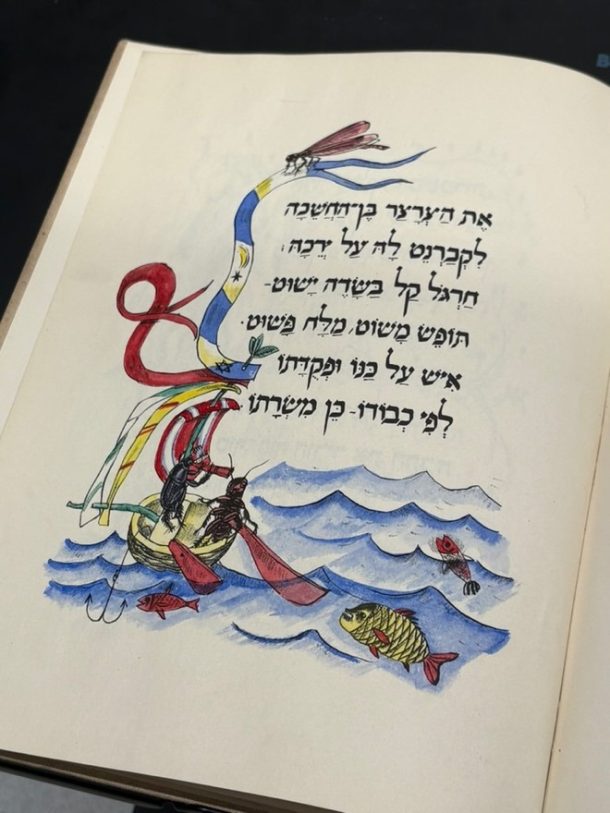
Ketina Kol-Bo exemplifies Rimon’s bibliophilic vision through an extraordinary artistic collaboration. Bialik’s foray into Hebrew children’s literature – itself an innovation in the newly revived language – was matched by equally experimental visual design. The book was printed using lithographic plates designed by renowned typographer Franzisca Baruch and illustrated by Ernst Böhm. Fifty artistic copies were printed on quality paper, hand-coloured and numbered. The National Art Library holds copy 14, signed by both Baruch and Böhm.

Embodying Wischnitzer’s vision, Baruch’s lettering was inspired by a 15th-century Spanish biblical manuscript copied by Moses Ibn Zabara and decorated by Jewish artist Joseph Ibn Hayyim, known as the ‘Kennicott Bible’ (Oxford, Bodleian Library, Kennicott MS 1). Her squared, serifed typography – essentially a scripture font – brings biblical gravitas to a children’s story. Similarly, Böhm’s decorations and illustrations echo medieval manuscripts such as the 14th-century ‘Barcelona Haggadah’ (London, British Library, Add. MS 14761). Like medieval illumination, his work merges ornament with illustration, framing the text with vignettes incorporating elements from the written plot.

The fates of the collaborators would reflect upheavals to come. Bialik immigrated to Palestine in 1924 and died during surgery in Vienna in 1934. Böhm achieved recognition for designing the 1936 Berlin Olympic Games certificate. But he was dismissed from his teaching position a year later, his Jewish wife making him a target of Nazi racial laws. Baruch fled to Palestine when the Nazi Party took power in Germany in 1933. Having honed her skills designing official symbols for the Weimar Republic, she would go on to create the visual identity of Israel itself – its passport, currency, postage stamps and municipal emblems.
Ketina Kol-Bo represents what historian Roger Chartier calls an ‘intellectual object’, a book whose significance extends far beyond its literary content to encompass the technological, economic and artistic conditions of its creation. Here was a children’s story that functioned simultaneously as artistic manifesto, cultural bridge and preservation effort, maintaining a connection to medieval Jewish artistic traditions while pioneering new forms of Hebrew visual culture. The book’s material form preserves not only Bialik’s whimsical tale but also the networks of soon-to-be displaced artists, their experimental publishing ventures and the cultural negotiations that shaped this brief but pivotal moment in Jewish cultural history.
Ketina Kol-Bo thus demonstrates how books carry meaning not just in their words, but in their very substance. Their paper, ink and craftsmanship make them physical witnesses to the worlds that created them.
To see what else V&A/RCA History of Design students have been up to, read our other blog posts or check our pages on the RCA website. You can even find out how to apply for 2026/2027 admission to MA V&A/RCA History of Design here.