
At the heart of the current contemporary display at the V&A’s Photography Centre is a powerful dialogue between two leading South African artists: Jo Ractliffe and Lebohang Kganye. Each brings a unique perspective to photography—Jo through her scarified landscapes shaped by the legacy of conflict, and Lebohang through her personal and performative reconstructions of memory and identity. What follows is a transcribed excerpt from their recent online conversation with Fiona Rogers, V&A Parasol Foundation Curator of Women in Photography.

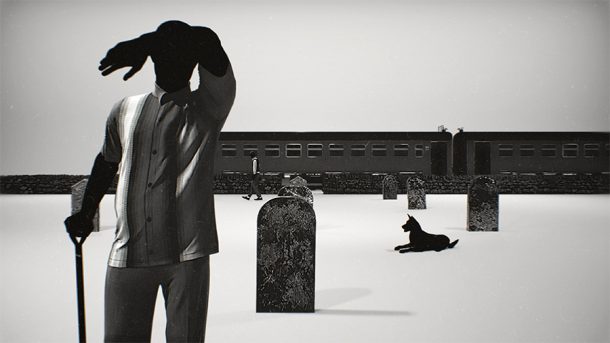
Fiona Rogers (FR): Thank you both for joining us—and thank you to everyone attending this special event. As part of our current Photography Now programme, we’re honoured to be displaying new acquisitions from Jo and Lebohang. Jo’s work, As Terras do Fim do Mundo, explores the lingering legacies of South Africa’s involvement in Angola’s border war, while Lebohang’s animated film, Shadows of Re-Memory, brings archival fragments and personal history into delicate dialogue.
Jo Ractliffe (JR): I remember our first meeting so clearly, Lebohang. You were talking about your mom’s clothes—how you didn’t know what to do with them. We had this beautiful conversation about photography and performance, leading to your series Ke Lefa Laka: Her Story (2013) featuring these ghostly, double portraits. I’ve never forgotten them.
Lebohang Kganye (LK): Yes! And then, of course, those photomontages became physical, theatrical, and deeply performative. I’ll never forget visiting you in hospital in Cape Town, back in 2015 after your spinal injury. That visit bonded us forever, I think. Your book was one of the first photo books I received—it quickly became my favourite.
JR: As Terras do Fim do Mundo follows on from a project called Terreno Ocupado, documenting Luanda five years after the war ended. I came of age in the 1980s during a politically charged, violent time for South Africa, full of states of emergency. Amid this, the apartheid government was also fighting a clandestine war in Angola.
Young white men were conscripted into “border duty,” but the border was never named. Angola was this nameless conflict zone. I’d long been haunted by Kapuscinski’s Another Day of Life, a book about Angola’s independence and near-immediate civil war.
I began photographing how history manifests in landscapes. I wasn’t interested in tanks or bullet holes. I wanted to capture silence, invisibility, how histories settle into the ground—things hard to photograph. The war had left Angola’s countryside all but abandoned because of all the mines laid during the war. I wanted to ask, ‘how does trauma live in the land?’.

LK: I remember that we met during my Tierney Fellowship at the Market Photo Workshop, around 2011 or 2012. That was when Ke Lefa Laka began—though I didn’t know it at the time. It had been two years since my mother passed. Initially, I intended to travel around South Africa tracing our family name, Kganye, which means “light.”
But then I found my mother’s clothes, still hanging in her wardrobe. I recognised the locations of some old family photos, and it struck me—I could return to those places, wearing her clothes, reenacting her poses. That’s how the work started.
At first, I didn’t see it as art. It was an act of remembrance. It was only later that I realised I was making a body of work—one that explored grief, inheritance, and transformation. It evolved into this laying of my image with hers, exploring the blurred line of who lives on and who becomes the ghost.

JR: It’s such a powerful gesture—the personal merging with the ancestral.
LK: I also started looking at the broader family album. All the women—my aunts, my mother—they had similar poses, it struck me that they all had at least one in lingerie. And none of those photos were taken by us. We never owned a camera. They would set a date with the street photographer for their portrait at the house and dress in their ‘Sunday best’. The family album became a space of chosen representation—a way to resist stereotypes and assert idealized selves. That representation was, still is, a political gesture.

FR: That’s such a rich insight. Your work clearly speaks to politics—Jo, yours perhaps more overtly; Lebohang, yours more poetically. Where does that political sensibility come from?
LK: My first real introduction to photography came from reading an essay about the photojournalist Kevin Carter and the Bang Bang Club. I thought I was going to be a journalist! The image he shot in Sudan, haunted me for a while. Before that moment, my exposure to photography was through the family album.
I’ve come to believe that choosing how you are seen—especially in a context where your identity is constantly under threat—is an act of resistance. So yes, my work explores the personal as a site of the political.
JR: I often say: how can any work not be political in South Africa? For me, the 1980s was a binary world—black/white, resistance/complicity. During apartheid, you couldn’t separate art from activism. My peers were photographing protest and police brutality. Social documentary had a very clear visual code. I couldn’t work like that—I was on the margins. I found my own way—in the aftermath, in the stillness of landscape.
David Goldblatt once joked that I liked photographing landscapes because they couldn’t talk back. But land in South Africa is never neutral. It’s layered with history, with violence, with contested meaning. That makes it political by default.

FR: Do either of you feel a burden of representation, especially as South African artists?
LK: There’s definitely that pressure, but I try to navigate between the personal and the collective. Recently I’ve been moving away from family archives, though the work still engages with the legacy of African storytelling. Shadows of Re-Memory, for example, is inspired by and visualises the plays of South African playwright Athol Fugard—I carry those themes with me.

JR: For me, it’s not so much a burden as a responsibility. South African audiences are deeply engaged and aware of their history. They hold you accountable. That can be daunting—but also deeply rewarding.
Visit the V&A’s Photography Centre to see Jo Ractliffe’s ‘The Land at the End of the World’ and Lebohang Kganye’s ‘Shadows of Re-Memory’ as part of our 2025 display exploring political landscapes until September 2025.
Hello, thanks for sharing this. I enjoyed this online talk and their emotionally powerful works in the display.