Contents
1. Entrance
3. Room 1, left side
26. Room 1, right side
47. Room 2, table vitrine
52. Room 2, projection
56. Room 3, left side
63. Room 3, right side and end
Entrance
From its origins in 19th-century Hampshire to its place on today’s runways, the Burberry trench coat is a story of invention, craft and creativity.
Draper and clothier Thomas Burberry revolutionised outerwear with the development of weatherproof gabardine. This laid the foundation for the Burberry trench coat, a garment shaped by military use and later embraced as a fashion icon.
For more than a century, the classic trench coat has been defined by specialist British craftsmanship, from the weaving of signature gabardine to the expert assembly of each garment in the company’s Yorkshire workshops.
Continually reimagined by designers at Burberry, the trench has evolved through changing fashions while retaining the distinctive features that make it one of the world’s most recognisable and enduring garments.
Thomas Burberry (1835 – 1926)
Thomas Burberry was just 21 years old when he founded his business in 1856. A dedication to healthy living and outdoor pursuits drove his experimentation and successful innovations in outerwear, bringing the family-run company to international renown.
Thomas Burberry
Late 19th century
Reproduction courtesy of Burberry
Bust of Thomas Burberry
Charlotte Hern 2016
Plaster
Lent by Burberry
Room 1, left side
Invention
Thomas Burberry’s commitment to innovation transformed his Basingstoke drapery and clothing business into an internationally recognised brand. Central to this success was his invention of weatherproof gabardine fabric in 1879, combined with pioneering approaches to design and marketing.
From its inception, the company produced both menswear and womenswear, broadening its range from conventional town and country overcoats to garments designed for exploration and outdoor pursuits. During the First World War, the protective qualities of the gabardine coat led to its widespread adoption by officers, giving rise to the ‘trench’ coat.
In the postwar years, the Burberry trench evolved into an enduring fashion icon, recognisable by the flash of House Check lining. Today, the celebrated trench is continually reimagined with each new seasonal collection.
Drawer, top
Gabardine
Invented by Thomas Burberry in 1879 and patented in 1888, Burberry gabardine was woven in a unique, tight twill structure from specially prepared yarn. Initially using linen, Burberry in later years applied this process to a range of fibres. The classic Burberry gabardine was made from fine cotton. Water-resistant and breathable, the fabric was produced in a range of weights and colours for clients to choose from.
1. Open Spaces
Edited by Coracias Garrulus, Burberry’s Ltd, London, about 1930
Printed book
V&A 38041001076421
2. A Remarkable Demonstration
c. 1930
Reproduction courtesy of Burberry
3. Points About This Weather Freedom catalogue
1937
Reproduction courtesy of Burberry
4. Burberry gabardine swatches
Protection catalogue, 1928–31, Britain
Printed paper, gabardine
Lent by Burberry
5. Burberry gabardine swatches
Burberry for Men catalogue
c. 1920s, Britain
Printed paper, gabardine
Lent by Burberry
Drawer, bottom
Unlike the conventional rubberised waterproof fabrics of the time, gabardine allowed the body to breathe. This airy quality saw it promoted as a healthy and practical choice for outerwear.
The success of Burberry’s gabardine led to numerous imitations by other manufacturers. Despite several court cases defending Burberry’s trademark, ‘gabardine’ became a generic term to describe similar fabrics.
1. ‘Air-tight Rubber-proofs... Air-free Burberry-proofs’ Burberry Proofs for Ladies XVIII edition catalogue
1907–09
Reproduction courtesy of Burberry
2. Weatherproof for
Health pamphlet
1920–29
Printed paper Lent by Burberry
3. ‘The Rubber Fever’ Gabardine in Peace and
War catalogue
1911
Printed paper Lent by Burberry
Wall images
Establishing Burberry
Thomas Burberry’s business acumen included clever use of marketing to expand the company’s reputation to an international level. One early advertisement, issued in 1867, showcases the wide range of goods offered by Burberry. Incorporating a calendar listing various historical events for each date, it was designed to be kept, ensuring the Burberry name was present all year round in the homes and businesses of potential customers.
1. Advertisement forT.Burberry, Basingstoke
1867
Reproduction courtesy of Burberry
2. Photograph of Burberry store on Haymarket, London
c. 1891
Reproduction courtesy of Burberry
3.Illustration of Burberry’s first international store on Boulevard Malesherbes in Paris, which opened in 1909
c. 1920
Reproduction courtesy of Burberry
4. Photograph of Burberry store in Basingstoke
Late 19th century
Reproduction courtesy of Burberry
Tall vitrine
Alongside gabardine, Burberry produced other fabrics of different weights and fibres with brand names such as Solgardine, Slimber and Solax. A wool version of gabardine, known as Burella, was an ideal choice for winter sportswear such as this ski suit in eye-catching red.
Mannequin
c. 1929, Britain
Wool gabardine, metal, horn
Given by Margaret, Duchess of Argyll V&A: T.308 to F-1978
Image
Margaret Whigham (later Duchess of Argyll) photographed in this ski suit with the Marquess of Donegall in St Moritz.
c. 1929
© Chronicle / Alamy
Drawer, top
Women in Burberry
From its inception, Burberry marketed outdoor clothing to both men and women, at a time when women’s participation in sport was rare. Its catalogues portrayed women enjoying active leisure pursuits such as mountaineering and motoring, despite prevailing social constraints.
1. ‘Winter Sports Gown
’Burberry’s Proofs for Ladies catalogue
1907 – 09
Printed paper
Given by J. W. F. Morton and Courtaulds Ltd V&A: T.187–1977
2. ‘Modèle No.602’
Burberry catalogue
c. 1916
Printed paper Lent by Burberry
3. Woman wearing ‘The Burberry Race Collar’ coat
Burberry catalogue
c. 1913
Reproduction courtesy of Burberry
4. ‘The Slip-On’ coat
Outdoor Garments for Ladies
Burberry catalogue
c. 1900
Printed paper Lent by Burberry
Drawer, bottom
The first decades of the 20th century saw many women embrace activities such as motoring, skiing and flying. Burberry met these new demands with practical, stylish clothing. In 1937, the company even sponsored a record-breaking flight from London to Cape Town by aviators Betty Kirby Green and Arthur E. Clouston, who made the journey in a plane named ‘The Burberry’.
1. Burberry skiwear advertisement
The Sketch
magazine
1926
Printed paper Lent by Burberry
2. Burberry Flying Kit advertisement
1932
Reproduction courtesy of Burberry
3. Photograph of ‘The Burberry’ plane
1937
Reproduction courtesy of Burberry
Wall images
Outward Bound
During the late 19th and early 20th centuries, Burberry advertised the practical and protective qualities of its gabardine clothing in facing extreme weather conditions, including polar exploration.
1. Photograph of Sir Ernest Shackleton wearing Burberry gabardine
Early 20th century
Reproduction courtesy of Burberry
2. Norwegian polar explorer Captain Roald Amundsen, the first person to reach the South Pole, equipped with a Burberry gabardine tent and clothing
1912
Reproduction courtesy of Burberry
Tall vitrine
The crown and star insignia on the epaulettes of this 1939 Burberry trench coat indicate that it was worn by a lieutenant colonel in the British Army. With its weatherproof credentials and practical design, the Burberry trench proved a popular choice for military officers during the First and Second World Wars.
Trench coat Burberry 1939
Cotton gabardine, metal, leather, Bakelite Lent by Burberry
Drawer
The Trench Coat
The predecessor of the Burberry trench was the Tielocken coat. Patented by Thomas Burberry in 1912, the Tielocken was named in honour of its secure ‘tie and lock’ fastening. The First World War saw the creation ofthe Burberry ‘Trench-Warm’, which featured a removable fleece liner and further practical additions: epaulettes to display insignia or hold gloves, a gun flap, D-rings to hang equipment from, a storm shield and adjustable cuff straps for extra protection in wet conditions. Reportedly, over 500,000 Burberry coats were worn by members of the armed forces during the First World War.
1. The BurberryTielocken advertisement
1916
Printed paper
Lent by Burberry
2. ‘The Burberry Trench-Warm’ advertisement
1916
Reproduction courtesy of Burberry
3. War Kit catalogue
1918
Printed paper
Lent by Burberry
Drawer, top
Fashioning the Trench
As the 20th century progressed, the Burberry trench coat became an increasingly fashionable item for both men and women, adapting to contemporary silhouettes. Suitable for stylish events such as the races, it could be paired with Burberry accessories including hats and bags.
1. ‘Burberry Model B485’ advertisement
1920s
Printed paper
Lent by Burberry
2. Men’s coats with swatches The World’s Finest Weather-proofs by Burberrys Ltd London catalogue
c. 1950
Printed paper
Lent by Burberry
3. Women’s and men’s trench coats with gabardine swatches Burberry’s Weatherproof, In-Stock Service catalogue
1955–59
Printed paper, plastic
Lent by Burberry
4. ‘The Burberry’ advertisement
1932
Printed paper
Lent by Burberry
Above, 5. ‘The Burberry’ modified trench coat
The Burberry: The World’s Finest Weather coat catalogue
c. 1956
Reproduction courtesy of Burberry
Drawer, below
Over the decades, Burberry continued to innovate and experiment, embracing new developments in textiles and design. Alongside traditional gabardines, the company introduced new synthetic fibre mixes, creating coats that were easy to wash and care for.
1. Women’s coats Weatherproof
Burberry catalogue
1937–44
Printed paper
Lent by Burberry
2. The Burberry Richmond coat and Piccadilly swatches
Burberry style reference sheet
1970s
Printed paper, gabardine
Lent by Burberry
Vitrine
Childrenswear
Childrenswear has long been a feature of Burberry’s offering. The company promoted the lightweight breathability of gabardine to parents as a healthy choice for children, going so far as to state that a rubberised raincoat would be ‘criminal’. An additional benefit of the trench coat’s relaxed fit was that it allowed room to grow.
1. Children’s cotton trench coat in honey beige Burberry
1970
Gabardine, horn, leather
Lent by Burberry
2. ‘Walking Slip-On’
‘Burberry’s Proofs for Ladies’ catalogue
1907 – 09
Reproduction courtesy of Burberry
3. ‘The Children’s Burberry’ Protection
Burberry catalogue
1928 – 31
Reproduction courtesy of Burberry
4. Burberry Check ‘Thomas’ teddybear
2015
Wool cashmere blend, metal, leather
Lent by Burberry
Room 1 Right side
Drawer
Burberry at the V&A
From the museum’s first acquisition of Burberry-related material in 1919 to today’s display, there is a long history of exhibiting Burberry at the V&A. In 1988, the V&A partnered with Burberry to stage a display of the company’s garments, from early motoring coats to contemporary styles.
1. The Burberry Story exhibition leaflet
1988
Britain Printed paper
V&A Textiles and Fashion departmental library
2. The Burberry Story display
1988
Photograph
Lent by Burberry
Above, 3. The V&A’s first acquisition of Burberry-related material: an advertisement for ‘Burberry Proof Overcoats’
c. 1890s
Reproduction of E.1182-1919
Victoria and Albert Museum
Above, 4.Burberry sales catalogue cover, 1933
Reproduction courtesy of Burberry
Vitrine
Burberry on Display
Burberry garments were first displayed at the museum during the Britain Can Make It exhibition, staged at the V&A from September to December 1946. Backed by the British government, the exhibition sought to showcase the design and manufacturing industries of postwar Britain.
Burberry trench coats were featured in two areas of the exhibition: Women’s Fashions and Children’s Wear. The exhibition attracted almost 1.5 million visitors.
1. Map of Britain Can Make It exhibition
1946
Ashley Havinden for the Council of Industrial Design
Reproduction © Victoria and Albert Museum
2. Britain Can Make It exhibition catalogue
Council of Industrial Design, London, 1946 Printed book
V&A 38041993101195
3. Display of women’s fashion at the Britain Can Make It
exhibition
1946
© DCA-30-1-13-32-4.
Design Council Archive, University of Brighton Design Archives
Reproduced photograph
4. Britain Can Make It exhibition poster
1946
Reproduction
© Victoria and Albert Museum
Tall vitrine
This outfit, featuring a bottle-green trench coat, was donated to the V&A Museum by Burberry in 1988. It was included in the museum’s display on the company that same year. The ensemble was part of the Thomas Burberry range, aimed at a younger clientele.
Outfit Burberry 1988
Britain
Gabardine, silk, cotton drill, leather, wool and acrylic
Given by Burberry
V&A: T.25 to J-1990
Drawer
The Burberry Service
From the 1910s into the postwar period, the trench was available to buy from Burberry stores, by mail order and through retailers across the world. Customers could complete a self-measure form included in sales catalogues to receive a coat in the correct size. A steadfast wardrobe staple, the trench coat was supported by Burberry’s repair and reproofing service, allowing customers to refresh their coat after years of wear.
1 – 4.Burberry catalogues
1926 – 37
Britain Printed paper
Lent by Burberry
5. Burberry self-measure form
c. 1930
Britain Printed paper
Lent by Burberry
6. ‘Sameday delivery’
1934
Reproduction courtesy of Burberry
7. ‘Burberrys clean Burberrys best’ advert
c. 1950
Britain Printed paper
Lent by Burberry
Drawer, top
Headwear
Combining practicality and style, Burberry offered a wide selection of accessories throughout the 20th century, often utilising gabardine fabrics in a range of colours.
1. ‘Triangle Headscarf’ Burberry catalogue
1960s
Britain
Printed paper and gabardine swatches
Lent by Burberry
2. ‘Burberry caps, Burberry hats’ Burberry catalogue
1922 – 26
Britain Printed paper
Lent by Burberry
Wall mounted
London Landmarks
Inspired by a print in the Burberry Archive, Chief Creative Officer Daniel Lee designed this silk scarf for guests attending the Winter 2026 runway show at Old Billingsgate Market. The scarf featured a map of London, with the venue marked by a Burberry ‘B’.
Above, 3. Silk scarf, Daniel Lee for Burberry 2026
Britain
Lent by Burberry
Drawer, bottom
Legwear
Burberry’s extensive range for outdoor pursuits extended beyond full garments to include a range of specific accessories designed to protect the wearer from head to toe.
1. ‘Burberry Leg Gear’, Burberry catalogue
c. 1910
Britain Printed paper
Lent by Burberry
2. ‘Burberry Leg Gear’ Burberry catalogue
1937 – 45
Britain Printed paper
Lent by Burberry
Drawer
House Check
First introduced as a coat lining in the 1920s, the signature Burberry Check is now internationally renowned and has been reimagined in myriad forms, appearing on everything from umbrellas to teddy bears. In 2018, Chief Creative Officer Christopher Bailey created a version incorporating the rainbow stripe of the Pride flag in celebration of the LGBTQI+ community.
1. House Check Barrelbag
2026
Cotton, leather
Lent by Burberry
2. ‘Accessories and Luggage by Burberrys’
1970s
Printed paper
Lent by Burberry
3. Scarf in House Check
1990s
Britain
Cashmere wool blend
Lent by Burberry
4. Scarf in House Check with rainbow stripe
Christopher Bailey for Burberry Autumn/Winter 2018
Britain
Cashmere
Lent by Burberry
5. ‘The Burberry Look’ advertisement
1988
Reproduction courtesy of Burberry
Vitrine
Weather for ducks
With their water-repellent feather coats, ducks were an appropriate motif for Burberry’s weatherproof gabardine ranges and were often featured in catalogue artwork during the interwar period. In a playful nod to this unofficial avian mascot, this hand-crocheted wool hat was specially produced for Daniel Lee’s debut Winter 2023 collection.
1. Burberry Check toy duck
c. 1980s
Wool, leather, canvas
Lent by Burberry
2. Duck hat
Daniel Lee for Burberry Winter 2023
Hand-crocheted wool Britain
Lent by Burberry
3. Burberry barometer
c. 1980s
Wood, glass, metal
Lent by Burberry
Above, 4. Wellington boots
1990s
Rubber
Lent by Burberry
Above, 5. Umbrella
Winter 2012
Wood, steel, polyester and cotton
Lent by Burberry
Tall vitrine
This Burberry trench coat belonged to Sir Edwin Hardy Amies, a key figure in the London fashion world known for his personal style. Amies was couturier to Queen Elizabeth II and owned a prominent fashion house on Savile Row, in the heart of London’s tailoring district. With the Burberry trench a must-have for the stylish man about town, Amies sewed his own name label into his coat for identification.
Trench coat Burberry 1979
Gabardine, leather, metal, horn Britain
Lent by Burberry
Drawer, top
Burberry Runway
As early as the 1920s, Burberry staged fashion shows featuring its trench coats, gradually expanding to present trade shows around the world. Since the late 1990s, the house has been a fixture on the international fashion calendar.
While early invitations were traditional in style, more recent invites have used innovative creative designs.
1. Photograph of Burberry fashion show at British Week in Milan, 1965
Lent by Burberry
2. Invitation for the preview of the December/January 1939 Burberry Sale
Printed card
Lent by Burberry
3. Single-stem flower with wrapped invite poster, runway show invitation Summer 2024
Paper, plastic, organic matter
Lent by Burberry
4. London skyline pop-up card, runway show invitation Autumn/Winter 2014
Printed card
Lent by Burberry
5. Runway show invitation Winter 2025
Printed card
Lent by Burberry
6. Bronze metal check card, womenswear runway show invitation Autumn/Winter 2010
Metal, printed card
Lent by Burberry
Drawer, bottom
Burberry in Fashion
In the late 1990s, a new design approach and series of high-profile advertising campaigns brought Burberry to the forefront of the fashion world, introducing the brand to a new international clientele as a leader in British fashion.
1. British Vogue magazine Spring/Summer 2000 Burberry campaign Roberto Menichetti for Burberry Photography by Mario Testino
March 2000
Printed paper
V&A Textiles and Fashion departmental library
2. BritishVogue magazine Autumn/Winter 2003 Burberry campaign Christopher Bailey for Burberry Photography by Mario Testino
September 2003
Printed paper
V&A Textiles and Fashion departmental library
Framed images
The Burberry Image
Since the 1960s, Burberry has partnered with leading photographers and models to create striking and playful imagery for their seasonal advertising campaigns. Often set within recognisably British locations, the images invariably reference Britain’s characteristically changeable weather.
1. Trench coat with Tower Bridge
1970s
Reproduction courtesy of Burberry
2. Zhang Jingyi in the campaign ‘It’s Always Burberry Weather’
Alasdair McLellan
2024
Reproduction courtesy of Burberry
3. ‘Highand Dry in Burberry Country’
1968
Reproduction courtesy of Burberry
4. Jodie Turner-Smith in the campaign ‘It’s Always Burberry Weather: London in Love’ for Summer 2025
Drew Vickers
2025
Reproduction courtesy of Burberry
5. Trench coats on Eastbourne beach
Lord Lichfield
1980s
Reproduction courtesy of Burberry
6. Jacqui Hooper in the campaign for the Winter Runway 2026
Glen Luchford
2026
Reproduction courtesy of Burberry
Room 2 Table Vitrine
Craft
Craft is an inherent part of the Burberry trench coat. The skills and knowledge required have remained centred in Britain since the founding of the company. Today, its signature gabardine fabric is produced at the Burberry Mill in Keighley, West Yorkshire. Every piece of gabardine is inspected by hand before being cut to shape.
Each Heritage Trench Coat is put together by specialist tailors at Burberry’s Castleford factory, where they have been produced since the late 1960s. Crafting a Burberry trench involves more than 190 processes and each coat is made up of 90 individually shaped pieces. Cutting a single part can take up to 25 minutes.
Table vitrine
Fabric Swatches
Burberry has consistently designed with all weathers in mind, offering different weights of fabric for all seasons. First introduced in the 1890s, tropical gabardine has a looser weave, allowing greater breathability. Today, it is the lightest gabardine option atalmost half the weight of Burberry’s classic weave.
Gabardine swatches 2026
Lent by Burberry
The Burberry Knight
The recognisable Equestrian Knight that graces the Burberry label was introduced following a 1901 public competition to design a logo. The knight’s banner reads Prorsum, the Latin word for forward, nodding to Thomas Burberry’s bold outlook.
Box of assorted Burberry labels 1960s – 90s
Textile, card
Lent by Burberry
Table vitrine
Labels
While Burberry trench coats have been sold across the world since the 1900s, their production has remained in Britain. These labels, produced for the many department stores and retailers selling Burberry coats in the USA, proudly proclaim the garment to be ‘Made in England’.
Burberry labels 1980s – 90s
Textile
Lent by Burberry
Label for Burberry collection for dogs, 2000s
Textile
Lent by Burberry
Collar
The Burberry trench coat collar is composed of eight pieces of fabric including an internal layer of Irish linen to give structure. It takes 270 stitches to curve the collar so that it hugs the neck. Every collar is sewn onto the coat by hand. It can take up to a year to learn how to perfect the construction.
Partially sewn collar pieces Burberry, 2026
Gabardine, linen
Lent by Burberry
Table vitrine
Buttons and Buckles
A classic Burberry trench has 21 buttons and four buckles, at the belt, throat latch and cuffs. Traditionally made from horn, Burberry buttons are now composed of 90 per cent bio-based resin, a natural material derived from plants. The Burberry buckle is famous for its leather-wrapped finish and four rows of stitching.
Buttons, buckles and D-ring Burberry, 2026
Bio-based resin, leather, metal
Lent by Burberry
Pin board
Making the Burberry Trench
2022
Reproducted courtesy of Burberry
Room 2: Trench projection
Throat Latch
An ergonomically shaped gabardine panel with buttoned closure to secure the collar and protect the neck against cold winds.
Textile
Lent by Burberry
When not in use, the throat latch can be securely buttoned under the collar at the back.
D-rings
Brass D-rings are secured to the belt as a practical addition for carrying equipment and accessories.
Gun flap
Originating as an extra layer to give protection from recoil when rifle shooting, this panel of gabardine also acts as a weather shield for smooth water run-off.
Epaulettes
Developed to secure equipment and display military insignia, buttoned epaulettes are now a distinctive point of style.
Belt
A matching gabardine belt has reinforced stitching along each edge for durability. It fastens with a leather-wrapped buckle, stitched eyelets and a belt loop. The belt can also be tied or knotted to express the wearer’s personal style.
Stormshield
A panel of gabardine sits away from the main body of the coat allowing rainwater to run off the coat efficiently, reducing rainwater on the rest of the coat.
Double breasted closure
The signature double-breasted fit traditionally uses 10 buttons, ensuring secure protection in all weathers.
Back vent
A high vent opening ensures the wearer’s movement is unrestricted. A mid-way button fastening allows for extra weather protection.
Cuff straps
Adjustable cuff straps with a signature leather-wrapped buckle can gather the cuffs to keep out the elements.
House check lining
The lining in house check is a signature of the Burberry trench coat.
Room 3 Left side
Room 3: Creativity
The classic Burberry trench remains a globally recognised style archetype. Since the early 2000s, the Burberry trench has been continually reimagined on the runway by a series of talented Chief Creative Officers who have led the design studio.
The seasonal collections provide an opportunity for thematic reinventions. The distinctive elements of the trench coat are replicated in a multitude of fabrics, finishes and proportions to create innovative and surprising new versions of this fashion favourite.
Burberry collections have drawn on diverse inspirations – from art, literature, music and craft to nightlife and nature – to create a trench coat for every occasion and for all weathers.
Image above
Detail of Hampstead Heath, Branch Hill Pond, 1828
John Constable(1776 – 1837)
V&A: FA.35[O]
Reproduction
See more of Constable’s painting nearby in Room 88a
Mannequins, left to right
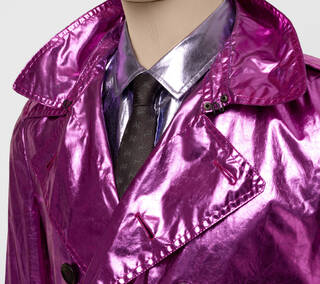
Outfit, Runway Look 6, Christopher Bailey for Burberry Spring/Summer 2013
Jewel-coloured metallics were a motif of Christopher Bailey’s Spring/Summer 2013 collection.
Here, the classic men’s trench coat is radically reimagined in a pop pink. The foil-like laminated silk gives a futuristic feel to the storied style.
Britain
Laminated metallic silk, seersucker cotton, silk jacquard, laminated metallic cotton
Lent by Burberry
Outfit, Runway Look46, Christopher Bailey for Burberry Spring/Summer 2008
Britain
Metallic crocodile leather, polyester, cotton Lent by Burberry
Outfit, Runway Look 33, Christopher Bailey for Burberry Spring/Summer 2011
This studded-sleeve mini trench coat, inspired by biker culture, came from a notable collection that introduced a revolutionary digital innovation to fashion.The show was live streamed globally and customers could order the garments directly after the runway presentation.
Britain
Bonded nappa leather, python leather, patent leather
Lent by Burberry
Outfit, Runway Look 11, Riccardo Tisci for Burberry Autumn/Winter 2022, Britain
Metallic bonded viscose, silk and polyester, cashmere, acetate, metal
Lent by Burberry
Outfit, Runway Look 44, Christopher Bailey for Burberry Autumn/Winter 2007
Silk, wool, cotton, alligator leather, calf leather
Lent by Burberry
Outfit, Runway Look 18, Christopher Bailey for Burberry Spring/Summer 2004
Transformed into a short capelet, this ‘trench’ retains signature elements such as the epaulettes, gun flap and throat latch. Modelled on the runway by Kate Moss, the splattered print of the silk dress was designed to evoke the idea of being caught in the rain.
Cotton, silk
Lent by Burberry
Outfit, Runway Look 47, Christopher Bailey for Burberry Spring/Summer 2016
Polyester, silk, calf leather
Lent by Burberry
Outfit, Runway Look 54, Daniel Lee for Burberry Winter 2026
The pattern on this trench coat is inspired by a map print in the Burberry Archive. In a collection evoking London nightlife, the shiny texture and dark colours conjure the city’s streets at night.
Polyester, wool, silk, mohair
Lent by Burberry
Outfit, Runway Look 1, Daniel Lee for Burberry Winter 2026
For Winter 2026, Daniel Lee was inspired by the atmosphere and energy of London at night. Materials associated with eveningwear featured heavily, with sequins, velvet and faux fur accenting the garments. The satiny sheen and soft ruffled collar of this womenswear look transformed the trench’s usual structured practicality into a seductive elegance.
Polyester, viscose
Lent by Burberry
Room 3 Right side and end plinth
Right to left
Outfit, Runway Look 41, Daniel Lee for Burberry Summer 2026
Suede, leather, cotton
Lent by Burberry
Outfit, Runway Look 35, Christopher Bailey for Burberry Spring/Summer 2012
Britain
Leather, raffia, alligator leather
Lent by Burberry
Outfit, Runway Look 1, Daniel Lee for Burberry Summer 2026
Described by Vogue as ‘a trench-ified homage to Mary Quant’, this brightly checked mini trench was the opening look of Daniel Lee’s Summer 2026 runway collection.The coat retains most of the characteristic elements of a Burberry trench, rendered in a radically different colourway and striking 1960s-style silhouette.
Britain
Viscose, polyester, silk, polyamide, leather
Lent by Burberry
Outfit, Runway Look 38, Christopher Bailey for Burberry Spring/Summer 2009
Britain
Straw, metal, alligator leather, silk
Lent by Burberry
Outfit, Runway Look 46, Daniel Lee for Burberry Winter 2025
For his Winter 2025 collection, Daniel Lee was influenced by the grand and eclectic interiors of British country houses and the ‘sumptuous, somewhat faded’ textiles within. A sense of lost decadence and romance is suggested by the historically-inspired pattern of this trench coat, while a frayed-edge skirt gives a dramatic, textured finish.
Polyester, viscose, cotton
Lent by Burberry
Outfit, Runway Look 2, Christopher Bailey for Burberry Autumn/Winter 2014
This hand-painted coat was inspired by the artistic Bloomsbury Group. The collection included references to the art, textiles and painterly surroundings of Charleston House in Sussex, where members of the group lived.
Suede, silk, gabardine, leather, wool
Lent by Burberry
Outfit, Runway Look 37, Daniel Lee for Burberry Summer 2025
Britain
Viscose, polyester, silk, polyamide, suede
Lent by Burberry
Outfit, Runway Look 46, Christopher Bailey for Burberry Spring/Summer 2014
This trench coat is made from Nottingham lace, a traditional British textile now more commonly associated with interior fabrics. The lace was created by the company Cluny Lace, which still produces on traditional Leavers lacemaking machines. The coat is richly embellished with substantial bejewelled rosettes that contrast with the delicacy of the fabric.
Britain
Cotton and nylon lace, metal, PVC, alligator leather
Lent by Burberry
Outfit, Runway Look 48 Christopher Bailey for Burberry Spring/Summer 2015
Britain
Cotton, glass mirror, leather, cashmere
Lent by Burberry
Outfit, Runway Look 30 Riccardo Tisci for Burberry Autumn/Winter 2022
Cotton
Lent by Burberry
Acknowledgements
The Board of Trustees of the V&A wishes to express its sincere thanks to Burberry and the Burberry Archive who have generously lent objects and shared intellectual property to support this display.
Exhibition Curators: Oriole Cullen, Connie Karol Burks
Exhibition Management: Ellie Alexander, Claudia Stanley, Olivia Oldroyd
Exhibition Design: EEP Studios
Graphic Design: Jen Campbell-Colquhoun
Lighting Design: Matt Haskins
Sound Design: Gareth Fry
Exhibition Contractor: MER
AV Hardware: DHD Services
Graphics Production: OMNI Colour
With special thanks to Carly Eck, Laura Lockwood and the Burberry Archive team.