A note on names
The city’s names reflect its rich and varied past.
In 324 CE, Constantine I became Roman emperor. The status of Rome had dwindled, and he chose a new capital at the ancient Greek city of Byzantion. Constantine renamed it Nova Roma (New Rome) in 330 CE. The city soon became known as Constantinople, the capital of what we call the Byzantine Empire. In everyday speech it was referred to simply as ‘the City’. Over time the Greek phrase eis ten polin (‘to the City’) evolved into its current Turkish name, Istanbul.
Introduction
For 16 centuries, one city was the capital of two mighty empires. The Roman Emperor Constantine I raised it to this status in 330 CE. As Constantinople, it remained the seat of his successors, the Byzantine emperors. In 1453, the Byzantine capital fell, and the empire ended. Without pause, the city rose again as Istanbul, the new capital of its Ottoman conquerors, which it remained until 1922. The city lies on important sea routes, at the meeting point of Asia and Europe. Its fine natural setting was enhanced by great architecture and outstanding public works. Wealth from loot, taxation and trade flowed in to pay for these projects and for the arts of imperial luxury. Religion too played a vital role, shifting from Roman paganism, through Christianity to majority Islamic.
The population, always diverse, included visitors and merchants from across Europe, Africa and Asia. Among its inhabitants were gifted craftspeople, whose work still inspires wonder. They practised within two distinct traditions of art and design, and these traditions, and the city’s own fabric, are the subject of this exhibition.
Film Projection
Director: Luke Jaden
Producers: Diane Michelle & John Tuma
Director of Photography: Jonathan Patterson
Editor: Eilish Boyd @ New International Picture Company
Colourist: Dan Swierenga
Running time: 34 seconds This film has no sound
One city, two traditions
The city was the home of two contrasting views of art, especially in relation to religious images. In Byzantine Constantinople, images of Christ and other sacred figures were central to religious and political life, filling churches, palaces and public spaces. Christ Pantocrator, ‘Ruler of All’, was the most recognisable.
The Ottomans avoided such images, sometimes expressing reverence through text instead. The calligraphy on the right describes the physical and moral qualities of the Prophet Muhammad.
Ivory plaque of Christ Pantocrator (left)
Constantinople 950–1000
Ivory
The Fitzwilliam Museum, University of Cambridge, Frank McClean Bequest,
M.13-1904
Calligraphy description of the Prophet (right)
Hâfız Osman
Istanbul
1691
Ink, pigment and gold on paper, mounted on card
On Loan, Trustees of the Chester Beatty Library, Dublin,
T.559.4
Roman beginnings
Constantinople was conceived as the New Rome for a new age. It replicated the old imperial capital with its colonnaded streets, baths, senate and a Hippodrome for public spectacle. Ancient monuments brought from across the Roman world gave the city prestige and antiquity. Splendid churches and monasteries transformed the city’s skyline as Christianity began to dominate.
In 395, the Roman empire was divided into western and eastern halves, with Rome and Constantinople as capitals. After the fall of the last western emperor in 476, Constantinople became the undisputed capital of the Roman world. Its strategic position between the Black Sea and the Mediterranean attracted merchants, artists, scholars and pilgrims from many lands, creating a diverse, cosmopolitan metropolis. Though largely Greek-speaking and Christian, its inhabitants considered themselves Romans and their rulers styled themselves 'emperor and autocrat of the Romans'.
Restoration inscription of Emperor Michael III and Bardas
Constantinople’s walls were its principal defences and a symbol of imperial authority. Both were threatened by earthquakes, weathering and enemy attack. Emperors demonstrated that they maintained the walls with inscriptions on the towers. Here a poetic description of the restored wall as a ‘delightful embellishment’ for the city presents the work as both a practical necessity and an aesthetic achievement.
Constantinople
858–66
Marble
İstanbul Archaeological Museums, Türkiye 1654 (T), 2476 (T)
Two Views of the Theodosian Land Walls
K.A.C. Creswell
The photographs depict sections of the walls near the Golden Gate, the ceremonial entrance to the city reserved for emperors and select envoys. Located at the south-western end of the peninsula, it marked the start of imperial processions towards Hagia Sophia. The Gate still stands but these images, taken before modern restorations, are an important record of the monument’s condition.
Istanbul
1919–21
Gelatin silver print
V&A, 2882, 2883-1921
Purchased from Professor Sir K.A.C. Creswell, 1921
Fragments of head and torch of Selene from the Golden Gate
Little survives of the Golden Gate’s sculptural decoration, which combined Christian symbols, imperial imagery and mythological motifs. These fragments represent the head of Selene, the Greco-Roman goddess who personified the moon. Originally she was shown descending toward her sleeping lover Endymion in a chariot, her lowered torch signalling the transition into night. Despite its Christian identity, Constantinople’s grand public spaces and baths remained rich in classical imagery.
Probably Constantinople
500−600
Marble
İstanbul Archaeological Museums, Türkiye, 4213 (T), 4214 (T)
Securing the City
Constantinople’s prosperity and security rested on two remarkable feats of engineering: its land walls and its water-supply system. The Theodosian Walls, stretching 5.6 km from the Sea of Marmara to the Golden Horn, were a formidable triple line of defence with a turreted inner wall, a lower outer wall and a moat. Equally impressive was the water supply centred on the 4th-century Aqueduct of Valens, sustaining the capital in peacetime and under siege.
The city’s inhabitants believed their ultimate protector was the Virgin Mary, whom they called Theotokos (‘Mother of God’). In times of danger, her relics and icons were carried along the walls, to keep enemies and natural disasters at bay.
The new Jerusalem
For centuries, Constantinople possessed more Christian relics than any other city, rivalling the sacred treasures of Rome and the Holy Land. Relics were the physical remains of saints which themselves had spiritual power. Emperors considered it their duty to acquire the most prestigious relics and having so many strengthened the city’s claims to be the new Jerusalem.
The Trier Adventus
This unique ivory probably depicts the adventus (ceremonial arrival) of Saint Stephen’s relics in Constantinople in 421. Bishops bring the casket to an emperor and empress waiting before a church, where builders are still finishing the roof. The scene is bursting with spectators, some chanting and others holding censers. Together they populate the colonnade evoking the Mese (Middle Street) and the Great Palace.
Constantinople
Possibly 450–500
Ivory
Hohe Domkirche Trier – Domschatz
Heavenly defenders
The belief in divine protection found powerful expression in personal devotion. Continuing a Roman tradition of wearing carved gemstones as amulets, Byzantine elites adapted the practice for Christian use. These initially showed the Virgin Mary and Christ, but their imagery expanded to military saints and the Archangel Michael as military threats to the empire mounted. Worn near the body, these cameos invoked the protection of those depicted on them. Certain stones were associated with healing properties. This group includes a rare lapis lazuli cameo inlaid with gold wire, once kept in the treasury of Saint-Denis alongside the French crown jewels.
1. Cameo with Christ Pantocrator
Constantinople
1100−50 and 1500−1600 (mount)
Rock crystal, mounted in silver gilt set with rubies and pearls
Benaki Museum, Athens, E 2113
2. Double-sided cameo with Christ and the Virgin
Constantinople
1100–50
Lapis lazuli inlaid with gold wire, mounted in silver gilt set with pearls and turquoises
Paris, Musée du Louvre, Département des Objets d'art, MR 95
3. Cameo with Archangel Michael
Constantinople
1000−1100
Amethyst
Wyvern Collection, UK, 1354
4. Cameo with Sts Theodore,
George and Demetrius blessed by Christ
Constantinople
1000−1200
Sardonyx, mounted in gold Wyvern Collection, UK, 1166
Beresford Hope Cross
This pectoral (chest-worn) cross offered protection of an even more exclusive and potent kind. With the Virgin Mary on one side and the Crucifixion on the other, it once had fragments of the True Cross inside. This was said to have been rediscovered by Saint Helena, mother of Constantine I. Images and relic worked together to invoke divine intercession, while also declaring its owner’s faith.
Byzantine empire
850−900
Gold, silver gilt and cloisonné enamel
V&A, 265-1886
Triptych with the Deesis
Sacred defence was expressed in this magnificent product of the imperial workshops. Its central panel shows the Virgin Mary and Saint John the Baptist interceding with Christ. A host of saints surround them conveying a sense of orderly hierarchy. Military saints with armour and weapons form a guard across the upper parts of the wings. The triptych evokes a celestial court, placing its elite owner under the protection of powerful heavenly intercessors.
Constantinople
About 1000
Ivory, with traces of gilding and paint
Musei Vaticani, Città del Vaticano, 62441
Sacred waters
Constantinople’s vast network of aqueducts and cisterns supplied the city with fresh water and helped its citizens endure sieges. Water also had deep religious significance. Sacred springs associated with the Virgin Mary, many beside the city walls, attracted pilgrims seeking healing. Over time, the relics and miracle-working icons housed there eclipsed the springs themselves, reinforcing the Virgin's role as Constantinople’s heavenly guardian.
A bird’s eye view of Constantinople and Pera
No city view of Constantinople by its own inhabitants survives. Florentine monk and geographer Cristoforo Buondelmonti, who visited the city around 1414, included this view in his influential guide to the Aegean islands, Liber insularum archipelago. Churches dominate the skyline, but so too do the city's monumental columns, evoking its ancient and glorious past. This shaped the enduring image of Byzantine Constantinople as a legendary walled city embraced and protected by water.
Florence
1485
Tempera on parchment
The British Library, Arundel MS 93, folios 154v–155r
Cameo with the Virgin Blachernitissa
The celebrated icon from the Blachernae gave rise to an iconographic type showing the Virgin Mary with her arms raised in prayer and the Christ Child suspended in a medallion over her chest. From the 11th century, this image was reproduced throughout the Byzantine empire and beyond, from monumental marble reliefs and painted icons to coins and seals used by ordinary people in everyday life.
Constantinople
1150−55
Bloodstone
V&A, A.4-1982
Processional cross with the Virgin Blachernitissa
The Greek inscription identifies the Virgin Mary as Blachernitissa, after the famous miracle-working icon at the monastery and spring of the Blachernae in north-western Constantinople. The sanctuary also housed the relic of the Virgin's veil, believed to have saved the city from attacks by the Avars in 626 and the Rus’ in 860. Annual processions commemorating these miracles underscored the Virgin’s role in protecting the city.
Constantinople
1000–1100
Cast copper
Benaki Museum, Athens, E11442
Icon of the Virgin of Zoodochos Pege
The monastery of Zoodochos Pege (‘Life-Giving Spring’), just outside Constantinople’s walls, grew around a sacred healing spring that attracted early imperial support. Its revival during the Ottoman period inspired a wave of icons depicting the shrine. Here the Virgin Mary and Christ Child appear above the spring. Its waters miraculously cure the pilgrims below, including a blind man.
Probably Istanbul
1804
Egg tempera and gold on wood
Benaki Museum, Athens, E12359
Icon with the Virgin Hodegetria
The Hodegetria, Constantinople’s most prized icon, was kept in the Hodegon Monastery near the Imperial Palace. According to tradition, it was painted by Saint Luke. It was carried along the city walls during sieges and taken on military campaigns. Although the original was lost after the Ottoman conquest, copies such as this one were believed to contain the authority and miraculous power of their prototype.
Constantinople
1300–1400
Egg tempera and gold on wood
The Hellenic Ministry of Culture/Byzantine & Christian Museum, BXM 00989
Water in Ottoman Istanbul
Water supply remained a key issue under Ottoman rule. The old Byzantine system was restored and extended to meet growing need. Water was piped to mosques for ritual washing before prayer, and to street fountains for local residents’ needs. The map shows the water allocation for the main imperial residence, Topkapı Palace.
The fountain in the photograph was built in 1732–3 by Saliha Sultan, mother of Sultan Mahmud I. Drinking water was supplied to passers-by from the grilled windows.
Map of a water-supply system
Istanbul
1748
Ink and pigment on paper
Topkapı Palace Museum, Türkiye
120/1815
Figures at a fountain
James Robertson
Istanbul
About 1853
Albumen print
V&A, E.402-2005
Given by Susan Persaud
Power and Spectacle
The Hippodrome was Constantinople’s heart. Originally built for chariot racing, the Roman empire’s favourite sport, this vast arena could host 100,000 spectators. Constantine I is thought to have expanded the site to accommodate state ceremonies, including imperial proclamations and triumphal processions. Here emperors appeared before their people in a private box (kathisma) directly linked to the Great Palace. This made the Hippodrome a symbol of imperial power, but it was also a place where rulers might face popular unrest. By the 7th century it was the only surviving stadium of the empire. Chariot races were held there until the late 12th century, while ceremonies of state were increasingly transferred to Hagia Sophia.
Medallion of an emperor in a chariot
A triumphant emperor in a chariot had long been part of Roman imperial iconography, but from the 4th century it also evoked the ceremonial world of the Hippodrome. Here an emperor holds an orb, symbolising world dominion, and is crowned by Nike, the Greco-Roman goddess of Victory. A Christian monogram presents his power as divinely sanctioned. These medallions adorned belts worn to proclaim wealth and imperial allegiance.
Discovered in Marqab, Syria
500–600
Gold
Paris, Musée du Louvre, Département des Arts de Byzance et des Chrétientés en Orient, MNE 648 - BJ 2273
Textile fragment with an emperor in a chariot
The same imagery of imperial triumph appears on this rare silk. A haloed emperor stands in a four-horse chariot (quadriga). He is dressed in pearl-studded regalia including a cross-topped diadem. Although popular across other media, this motif survives on only a few silk textiles, including one reputedly found in the tomb of Charlemagne (reigned 800–14), the first Holy Roman Emperor.
Probably Constantinople
800–900
Silk with compounds twill weave
V&A, 762-1893
The Clephane Horn
Carved from the upper part of an elephant tusk, this horn depicts chariot races, probably in Constantinople. Four-horse chariots (quadrigae) race across the upper zone. Below, an official holds palm branches to crown the winners. The imagery captures the excitement of the races and reflects the enduring allure of the Hippodrome across the medieval Mediterranean.
Southern Italy
1000–1100
Ivory
The British Museum, 1979,0701.1
Chariot panels
These bronze panels probably come from ceremonial chariots used in parades and races. Both show hunting scenes featuring deer, wild boar, leopard, bear, antelope and lion. Hunters appear on horseback or on foot, accompanied by dogs and servants carrying prey on poles. Hunting was the preserve of Constantinople’s elites and its iconography decorated the interiors of their homes and the objects within them.
Panel from a piece of a chariot Rome or Constantinople 350–400
Bronze, inlaid with silver
Wyvern Collection, UK, 2283
Panel for the hub of a chariot wheel
Rome or Constantinople
350–400
Bronze, inlaid with silver
Wyvern Collection, UK, 1667
Entertainment and authority
Consular diptychs were precious ivory gifts sent out each year by the city’s new governor, or consul, to celebrate the start of the games at the Hippodrome. Some of them feature stony-faced consuls presiding like statues over scenes showing the excitement and chaos of the games. This expressed the contrast between formality and violence, which was integral to the Hippodrome’s allure, and the myth of government in general: the ability of the ruler to create order from chaos.
Consular diptych of Clementius
Clementius, consul of Constantinople in 513, sits on the consular chair and holds the mappa. Dropping this cloth signalled the start of the games. Flanking him are figures representing Constantinople and Rome. Their visual unity signals the parity between eastern and western parts of the empire. Above, busts of Emperor Anastasius I and Empress Ariadne are set next to a cross, uniting imperial and Christian symbolism.
Constantinople
513
Ivory
Lent by National Museums Liverpool, World Museum, M.10036
Leaf of consular diptych of Anastasius
This ivory commemorates Flavius Anastasius taking the office of consul in 517. He is wearing the trabea, a heavily embroidered ceremonial costume, and holding the mappa in his right hand. The Hippodrome scenes below include a man with a crab attached to his nose, in what seems to be an act of comical endurance.
Constantinople
517
Ivory
V&A, 368-1871
Leaf of Venatio diptych
This is a depiction of a venatio, a staged hunt of wild animals providing spectacular public entertainment in the Hippodrome. The upper section depicts three magistrates identifiable by their togas as men of senatorial rank. Below, stags are shown fleeing and being killed by a hunter wearing protective gear. Animal keepers enter from side doors, while on one door a victorious hunter holds a triumphal wreath.
Probably Rome
400–500
Ivory
Lent by National Museums Liverpool, World Museum, M.10042
Ottoman era Hippodrome
Under the Ottomans, the Hippodrome remained an important space for sport, entertainment and ceremony, but it was now less formal and controlled. Chariot-racing was replaced by jereed, in which galloping riders attempted to strike opponents with lances. The Hippodrome’s surviving monuments provided a stage for sultans’ processions, circumcision festivals, guild parades and military displays.
View of the Hippodrome from the Freshfield Album
This album features views of the key landmarks of the city, probably painted from life. Here the monuments of the Hippodrome are shown with Hagia Sophia rising in the distance. In the foreground are the Walled Obelisk (right), the Serpent Column with heads still intact, and the Egyptian Obelisk erected by Emperor Theodosius I in 390.
Istanbul
1574
Watercolour and ink on paper
The Master and Fellows of Trinity College, Cambridge, O.17.2, folios 20v–21r
The Serpent Column and statues of horses at the Hippodrome
The Ottomans kept monuments of the Hippodrome, with some valued for their talismanic powers. This richly illustrated Books of Wonders contains tales of fabulous monsters, buildings and idols. Ninety of its images depict Byzantine monuments and rituals. This folio shows the Hippodrome with its original statues, although the Serpent Column has four snake heads instead of three and there are three bronze horses instead of four.
Probably Istanbul
About 1595
Ink and gold on paper
The British Library, Harley MS 5500, folio 30a
The ancient columns of Constantinople
Around 300 classical statues, including those
of pagan gods, once lined the streets and forums of Constantinople and proclaimed the power and reach of the empire. This watercolour records the principal stone columns that survived into the Ottoman period. These included Constantine I’s porphyry column from his forum, as well as the Obelisk of Theodosius I (depicted from all four sides) and the Walled Obelisk from the Hippodrome.
Istanbul
About 1809
Watercolour on paper
V&A, D.147-1895
Emperor Theodosius I in the imperial box (top centre), presiding over the games at the Hippodrome
Detail of the carved base of the Egyptian Obelisk of Theodosius I, set up in Constantinople in 390 CE
Image © Ionut David / Alamy
Fragment of a serpent’s head of the Serpent Column
The Hippodrome’s imperial status was reflected in the prestigious monuments on its spina, the central barrier of the 450-metre-long racetrack. Its key monument was the Serpent Column, a pillar of three intertwined serpents from Delphi in Greece. Originally commemorating the Greek victory over the Persians in 479 BCE, it was reputedly brought to Constantinople by Constantine I, where it became a potent symbol of imperial power.
Ancient Greece
About 479 BCE
Bronze
İstanbul Archaeological Museums, Türkiye, 18 (M)
Illustration of the Serpent Column with serpent heads intact
From the Freshfield Album, 1574
Image © The Master and Fellows of Trinity College, Cambridge, O.17.2. folio 21 ff.
Goose
This is one of only three surviving bronze sculptures associated with the Hippodrome. The others are the Serpent Column and the four horses looted by Venetians in 1204, now at San Marco. Reportedly found in the Hippodrome, the goose may once have served as a fountain spout, as suggested by the pipe in its beak and the discovery of water conduits nearby. It may also have evoked Rome's sacred geese, famed for warning Romans of an attack in 390 BCE.
Constantinople
300–400
Cast bronze
British Museum, 1859, 0601.1
Classical Heritage in a Christian City
Pagan cults had largely declined by the 6th century, but the visual language of classical antiquity remained embedded in Constantinople’s culture. Classical forms, materials and motifs were adapted to express the capital’s Christian identity.
The Great Palace, residence of Byzantine emperors and seat of government, was central to this transformation. Neighbouring the Hippodrome, it rivalled the palaces of ancient Rome and dazzled visitors with shimmering mosaics and opulent silk hangings. It was also a centre of intellectual activity. Scribes copied ancient Greek texts, including Homer, helping to preserve the classical legacy into the modern age. Beyond the palace, aristocrats shaped the city through their own commissions, from finely carved sculpture to lavish churches that rivalled imperial monuments in scale and splendour.
Women patrons
Byzantine society expected women to remain within the domestic sphere, but some had great cultural and political influence. Built by the noblewoman Anicia Juliana, St Polyeuktos was the largest and most lavish church in the city. Its extraordinary interior included a gilded roof and marble sculptures inlaid with coloured glass and gold. The church proclaimed Juliana’s imperial ancestry and challenged the legitimacy of Emperor Justinian’s low-born dynasty. Five years later, he commissioned Hagia Sophia.
Donor portrait of Anicia Juliana from the earliest surviving copy of De Materia Medica, a 1st century Greek pharmacological encyclopedia
From the Vienna Dioskorides manuscript, 512–515
Image © ÖNB/Wien, Cod. med. gr. 1 fol. 6v
Capital with a peacock
Although only the foundations of St Polyeuktos survive, excavations in the 1960s uncovered intricately carved architectural fragments revealing the church's former splendour. Peacocks and grapevines were recurring motifs in its decoration, both inherited from Roman visual culture but imbued with new Christian meaning. The bird symbolised immortality and paradise because it was believed that its flesh did not decay, while the vine represented eternal life and salvation.
Church of St Polyeuktos, Constantinople
524–27
Marble
İstanbul Archaeological Museums, Türkiye, 2655 (T)
Sarcophagus panel
Imperial sarcophagi (stone coffins) were carved from a rare, deep purple rock quarried in Egypt called porphyry. Aristocratic sarcophagi were typically made from marble. On this panel, Christian imagery is integrated into established classical sculptural forms. The angels echo Nike, the winged goddess of Victory, carrying wreaths now marked with a subtle cross. The lower border was added when the panel was re-carved in the 12th century.
Constantinople
400–500 and 1100–1200
Marble
İstanbul Archaeological Museums, Türkiye, 5798 (T)
Mosaics from the Great Palace
Only one coherent part of the Great Palace has survived: the extraordinary floor mosaics from a colonnaded courtyard. Measuring 180 square metres, these depict a series of at least 75 seemingly unconnected scenes of animal combat, mythology and daily life. In the larger fragment, which comes from the pavement’s wide border, winding acanthus stems frame a strikingly naturalistic male face. The smaller mosaic features a helmeted man against a background of white tesserae arranged in a scalloped pattern.
Border with an inhabited scroll
Constantinople
Probably 450–500
Tesserae of stone and glass
The Great Palace Mosaics Museum, Türkiye, 19
Helmeted man
Constantinople
Probably 450–500
Tesserae of stone and glass
The Great Palace Mosaics Museum, Türkiye, 28
Heaven and Earth
For centuries Constantinople was the Mediterranean’s artistic and intellectual heart. By the 6th century, no European capital could rival its size, wealth, or cultural reach. Its churches were conceived as temples of God, their soaring architecture evoking heaven. Their monumental mosaics featured the emperor alongside Christ and the Virgin Mary, expressing the union of spiritual and earthly authority.
Art and design were central to life in Constantinople, where religious images were believed to make the sacred present and secure divine favour. This perceived power provoked fierce controversy in the 8th and 9th centuries, when emperors temporarily banned the veneration of images. Over time, artists in the city developed a visual language that prioritised spiritual presence and symbolic meaning over the naturalism and idealised forms of Greco-Roman art. Yet classical traditions never disappeared, and the city played a vital role in preserving the classical legacy.
The Great Church
Built between 532 and 537, Hagia Sophia embodied the ambition and splendour of the Byzantine empire. Commissioned by Emperor Justinian I (reigned 527–565), it was then the largest building ever constructed and remained the greatest enclosed space in the world for nearly 1000 years. The 55-metre-high dome appeared to float above the nave, as though suspended from heaven by a golden chain. Walls covered in marbles from across the empire and shimmering mosaics dissolved the boundary between earthly and divine. Hagia Sophia was the empire’s spiritual heart and the stage for coronations. Its significance and prestige ensured the building’s survival after the Ottoman conquest, when it was converted into a mosque.
Ottoman restoration
The Ottomans revered Hagia Sophia for its age, remarkable size and ambitious design, preserving it over the centuries. The building influenced Ottoman architectural traditions, most notably the imperial mosques. In 1847, following earthquake damage, Sultan Abdülmecid I (reigned 1839–1861) commissioned Swiss-Italian architects Gaspare and Giuseppe Fossati to restore it. Their lithographs offered non-Muslims a glimpse of Hagia Sophia’s otherwise inaccessible interior, helping establish its global reputation. The Fossati brothers’ repairs revealed Byzantine mosaics, later covered again to respect the Muslim ban on figural images.
View of the nave of Hagia Sophia
Gaspare Fossati London
1852
Hand-coloured lithograph
Purchased with the assistance of the National Heritage Memorial Fund, Art Fund, Shell International and the Friends of the V&A
V&A, SP.270:2
Mosaic of the Virgin and Child receiving the gifts of the city and Hagia Sophia from Emperors Constantine I (right) and Justinian I (left)
Photograph of the southwest vestibule of Hagia Sophia
Image © David Hendrix
Exterior view of Hagia Sophia
Gaspare Fossati, based on a drawing by Alexius Geyer London
1852
Hand-coloured lithograph
Purchased with the assistance of the National Heritage Memorial Fund, Art Fund, Shell International and the Friends of the V&A
V&A, SP.270:8
Interior and exterior elevations of Hagia Sophia
After Giuliano da Sangallo
This is a copy of a drawing by Florentine architect Giuliano da Sangallo. The original is based on sketches by Ciriaco of Ancona (1391–after 1452), one of the first westerners to record Byzantine Constantinople. While the exterior is recognisable, the interior is inaccurate. Limited access after 1453 meant that such depictions, however flawed, were the only way for an outsider to experience Hagia Sophia.
About 1625–35
Probably Rome
Pen and brown ink and brown wash over black chalk
His Majesty The King / The Royal Collection, RCIN 910443
The Augustaion square
This image is from an illustrated version of The Travels of Sir John Mandeville, a popular medieval travel account. Constantinople and its treasures loomed large in the medieval imagination and books such as this, however unreliable, provided a form of mental pilgrimage.
The artist has imagined the Augustaion square with Hagia Sophia and the statue of Justinian I to resemble the Gothic architecture of a western European town.
Bohemia
About 1410
Silverpoint, ink and watercolour on green dyed parchment
The British Library, MS 24189, folio 9v
Interior of Hagia Sophia
Richard Phené Spiers
This atmospheric and accurate view of Hagia Sophia features the celebrated Egyptian porphyry columns and the verde antico columns brought from the Temple of Artemis in Ephesus. Captured during Spiers’ extensive research trip around Europe and the Eastern Mediterranean funded by the Royal Academy, this work reflects a growing British fascination with Byzantine art and design and an emerging scholarly interest in Constantinople’s monuments.
Istanbul
1866
Watercolour and pencil on paper
V&A, E.393-1932
The word of God
The Bible was central to Byzantine religious life because it contained the Word of God. The Four Gospels, written first in Koine Greek, bore witness to Christ’s life and teachings. During the liturgy the Gospel was placed on the altar and presented as a symbol of Christ. The most luxurious examples were written on parchment and illuminated. Constantinople became a major centre of manuscript production, inspiring artistic traditions from Georgia and Armenia to Western Europe.
St James and the opening of his Epistle
No labour or expense was spared in the decoration of this splendid manuscript, created in a leading scriptorium of Constantinople. Luke the E angelist is shown here in the act of writing, dipping his pen into an inkwell with a scroll resting in his lap. Set against the luminous gold ground, he glows with an inner light and inhabits a sacred realm deliberately removed from this world.
Constantinople
950–1000
Tempera and gold on parchment
The Bodleian Libraries, University of Oxford, MS. Canon Gr 110, folios 1v–2r
Menologion for the month of September
The veneration of saints intensified from the late 9th century, prompting the production of specialised liturgical books such as menologia. These contained accounts of saints’ lives, martyrdoms and miracles, arranged according to the liturgical calendar and read aloud on their feast days. This exceptionally lavish example includes a gold-ground illustration of the miracle of Saint Michael diverting two rivers threatening to engulf the church at Chonai in Asia Minor (Anatolia).
Constantinople
1000–1100
Tempera and gold on parchment
The British Library, MS 11870, folios 59v–60r
St Luke and Theophilus with the Ascension above
In this masterpiece of Byzantine illumination, author portraits are paired with narrative scenes, set within richly ornamented architectural frames. Saint Luke is accompanied by a medallion of Christ’s Ascension, because the opening lines of the Acts of Apostles, which he authored, were read on Ascension Day. The crowned figure in purple silk with red shoes may be the book’s imperial patron disguised as Theophilus.
Constantinople
1125–50
Tempera and gold on parchment
The Bodleian Libraries, University of Oxford, MS.Auct. T. infra. 1.10, folios 231v–232r
Christian ivories
Constantinople was the foremost centre of ivory carving and trade throughout the medieval period. A hallmark of Byzantine luxury art, ivory was prized for its smoothness, luminous colour and capacity for highly detailed carving. From the 6th century, ivory workshops produced pieces with both imperial and Christian subjects. Conventions of imperial imagery, such as hierarchical scale, static poses and frontal presentation, shaped representations of Christ and the saints.
Evangelists with scenes from Christ’s life
Clothed in tunics, evangelists raise their hands in rhetorical gestures, resembling Roman senators or philosophers. Above them are scenes showing Christ’s encounter with the Samaritan woman at the well and the miracle of the Healing of the Paralysed Man. The evangelists’ solemn faces are not strongly distinguished from one another. This reflects a shift in early Christian art away from individualised portraiture and naturalistic representation towards abstraction and more standardised iconography.
Constantinople
501–600
Ivory
The Fitzwilliam Museum, University of Cambridge, M.10, 11-1904, Frank McClean Bequest
Craftsman stripping the husk from an elephant tusk
From Cynegetica (Treatise on Hunting), 1050–70 Image © Venezia, Biblioteca Nazionale Marciana, Gr. Z479, folio 36r
Ivory statuette of the Virgin Hodegetria
By the 7th century, freestanding statuary had all but disappeared from Constantinople, giving way to two-dimensional portraiture in mosaic and painting. In this only example of Byzantine sculpture carved fully in the round, the Virgin supports the Christ Child on her left arm while gesturing towards him with her right. Their pose comes from the Hodegetria, the most beloved image of the Mother of God in Byzantine art.
Constantinople
About 1000
Ivory
V&A, 702-1884
Plaques with the Crucifixion and Christ’s Mission to the Apostles
The scene called Christ’s Mission depicts him commanding the apostles to ‘make disciples of all nations.’ Here Christ presides over the rows of apostles like an emperor at his court. The Crucifixion shows Christ’s emaciated body surrounded by the grieving Virgin Mary and apostles. Although lifeless, Christ’s body remains upright suggesting triumph over death. The plaques may originally have formed a diptych for the private devotion of a high-status patron.
Constantinople
950–1000
Ivory
Paris, Musée du Louvre, Département des Arts de Byzance et des Chrétientés en Orient, MRR 422
Plaque of St John the Baptist and Four Saints
Saint John the Baptist, the prophet who baptised Christ, was especially venerated in Constantinople, where the relics of his head and arms attracted pilgrims. John’s Christ-like appearance here underlines his status in Byzantine thought as Christ’s ‘precursor’. Around him half-length portraits of four apostles are linked by delicate foliage to form a gossamer network. The openwork carving is exceptionally skilful, but it has made the plaque more vulnerable to fracturing.
Constantinople
950–1000
Ivory with traces of gilding
V&A, 215-1866
Devotional Opulence
The splendour of Constantinople’s churches lay not only in their architecture, but in every aspect of their decoration and furnishing. Emperors, clergy and wealthy citizens commissioned mosaics, reliquaries, textiles and precious liturgical vessels, as acts of devotion and displays of status.
Today the architectural heritage survives in the city, while portable objects are mainly found in western Europe. Some arrived as gifts or by trade. Others were plundered by the forces of the Fourth Crusade, which captured Constantinople in 1204 and occupied it for 57 years. Together, they reveal how the Byzantines used every precious and beautiful material to enrich their churches.
Grotto of the Virgin
This spectacular object is a composite, incorporating a Byzantine votive crown as its base, with busts of Emperor Leo VI (reigned 886–912) and apostles. The Venetians adapted it by adding a statuette of the Virgin Mary within an ancient rock crystal grotto. Recorded in Venice by 1324, it may have served as a candle holder above the high altar in San Marco.
Constantinople and Venice
About 900 (crown); 300–400 (grotto); about 1400 (statuette).
Silver gilt, cloisonné enamel, rock crystal, pearls Procuratoria di San Marco, Tesoro 116
Incense burner in the shape of a domed building
Although it resembles a Byzantine church, this perforated object may instead represent a garden pavilion. The crosses are a later, Venetian addition. The decoration includes personifications of Courage and Prudence alongside fantastical animals. Initially, the incense burner was probably used at court, where sensory experience was carefully staged. The Venetians transformed it into a reliquary for the relic of the Holy Blood, brought from Constantinople in 1204.
Byzantine empire or southern Italy
1100–1200
Silver gilt
Procuratoria di San Marco, Tesoro 142
Censer
Censers were central to the performance of Byzantine liturgy. Filled with burning incense and swung by a deacon, they contributed to a powerful multisensory experience during the service. The body of this lavish example from Emperor Justinian I’s reign was hammered from a single sheet of metal and features elegantly posed apostles beneath arches supported by fluted columns, imitating a church interior.
Constantinople
527–65
Silver, silver-gilt and bronze
Wyvern Collection, UK, 1466b
Processional cross
This fine cross has on its front the Deesis scene, where Christ is flanked by the Virgin and Saint John, and on its back the Virgin and Child. Above them appears Constantine I, whose conversion to Christianity in 312 was inspired by his vision of the Cross. The front names the goldsmith as monk Mark of Loiparos. Crosses like this were carried in liturgical processions, marking deliverance from droughts and earthquakes.
Probably Constantinople
1050–75
Silver, silver-gilt, niello and iron
Wyvern Collection, UK, 1438
Stoclet Paten
This dish was once used to hold the bread of the Eucharist, the main Christian ritual in which bread and wine commemorate Christ’s sacrifice. The central roundel depicts Christ with his apostles at the Last upper, the biblical event that established the ritual.
This opulent example reflects the finest craftsmanship of Constantinople’s imperial workshops. Like many other treasures, it reached the West in the aftermath of the Crusader attack on Constantinople in 1204.
Constantinople and Paris
885–915 and about 1300 (border enamels)
Agate, silver gilt, cloisonné enamel,
émail de plique and gemstones
Paris, Musée du Louvre, Département des Objets d'art, OA 11878
Two tiles with the Virgin and Child and a peacock
These remarkable examples of Byzantine glazed pottery once formed part of a templon, the screen separating the holiest part of the Byzantine church from the main domed space. The Virgin and Child and the peacock, an ancient symbol of paradise and renewal, reveal how every architectural element of the Byzantine church carried sacred meaning. Inherently fragile, few examples of ceramic decoration from Constantinople’s churches survive today.
Byzantine empire
900–1000
Coloured and transparent glazes on white ceramic
Musée du Louvre, Paris, Département des Arts de Byzance et des Chrétientés en Orient, AC 83-84
Fragment of a mosaic of the Virgin
This is the only surviving mosaic from the monastery of Stoudios, a major intellectual and artistic centre founded in the 5th century. Now in ruins, its interiors were once covered with thousands of glass tesserae, while its opus sectile pavement featured mythological scenes, of which only fragments remain. With the exception of Hagia Sophia, very few mosaics from Constantinople survive, making pieces like this especially rare.
Monastery of St John Stoudios, Constantinople
900–50
Glass and marble tesserae
Benaki Museum, Athens, 9074
Roundel with the bust of the Virgin Orans
Carved from a rare serpentine stone, this roundel depicts the Virgin Mary with her arms raised in prayer. The Greek inscription invokes her aid on behalf of Emperor Nikephoros III Botaneiates (reigned 1078–81), so it must be dated to his short, troubled reign. Its original function and setting are unclear. It may have decorated Nikephoros’ tomb at the monastery of Theotokos Peribleptos, where he retired as a monk after his forced abdication.
Constantinople
1078–81
Serpentine
V&A, A.1:1, 2-1927
Fragments of an inlaid icon of the Virgin
The Lips Monastery was founded in 907 by Constantine Lips, a court official under Emperor Leo VI (reigned 886–912). It was lavishly decorated with sculpted images made from coloured stones and marbles inlaid into larger slabs of contrasting marble. During the Ottoman period, the monastery was converted into the Fenari Isa Mosque. These fragments of the Virgin’s head and hands were excavated in 1929.
Lips Monastery, Constantinople
About 907
Limestone
Benaki Museum, Athens, E 13548 - 13550
Icon of St Eudokia
This striking icon and the fragments to the right come from the sculptural decoration of the Lips Monastery founded in 907. It was made by setting coloured stones and glass paste into cavities carved in white and brown marble. Saint Eudokia is depicted crowned and in imperial purple, but also with a saint’s halo. Eudokia may be the wife of Emperor Leo VI; she died in childbirth in 901 and he supported her recognition as a saint.
Lips Monastery, Constantinople
About 907
Marble, inlaid with limestone and glass paste
İstanbul Archaeological Museums, Türkiye, 4309 (T)
Contested images
During the 8th and 9th centuries, Constantinople was divided over the making and venerating of icons – images of Christ, the Virgin Mary and the saints. Iconoclasts condemned their use as idol worship, arguing that Christ should not be represented. Icons were subsequently banned and their defenders persecuted. The opponents of the ban argued that, because God had taken human form in Christ, he should be depicted. The controversy ended in 843, under Empress Theodora (reigned 842–56). The use of icons became a defining feature of Orthodox Christianity, distinguishing it from I slam and Judaism.
Relief of Christ
Tangible examples of image breaking in Constantinople are rare, but this relief appears to have been deliberately hacked away. Nine more panels survive from the same church in similarly damaged condition. Constantinople may have been the epicentre of iconoclasm, as early Byzantine art survives in other parts of the empire.
Church of St Polyeuktos, Constantinople
524–27
Marble
İstanbul Archaeological Museums, Türkiye, 6175 (T)
The Theodore Psalter
Remarkable images populate the margins of this book of Psalms, hymns sung during the liturgy. A Roman soldier pierces Christ’s side on the left page; on the right iconoclasts whitewash his icon. Destruction of Christ's image is equated with the torment inflicted on Christ at the Crucifixion. This reflects the Byzantine belief that an image is intimately connected to the holy person it depicts. The manuscript was produced at Constantinople’s foremost monastery whose monks had clashed with the emperor in their defence of icons two centuries earlier.
Monastery of St John Stoudios, Constantinople
1066
Tempera and gold on parchment
The British Library, Add. MS 19352, folios 87v-88r
Icon with the Triumph of Orthodoxy
This icon commemorates the restoration of icon veneration in 843, still celebrated by the Orthodox Christians annually as the Triumph of Orthodoxy. It presents an assembly of imperial, ecclesiastical and monastic figures among the sacred images they defended. The upper centre shows the icon of the Virgin Hodegetria, to the left are Empress Theodora, who oversaw the restoration, and her son Michael III. Shown just below them is Saint Theodosia who was persecuted for defending an icon of Christ of the Chalke Gate in 729.
Constantinople
About 1400
Tempera and gold on wood
The British Museum, 1988,0411.1
The rise of icons
Icons gradually reclaimed their place in the Byzantine world, filling churches and homes. They were now understood as sacred portraits mediating the holy presence, providing direct access to the sacred figures. The Byzantines bowed to, touched and kissed icons, giving them the same reverence as the saints they depicted. Today we associate icons with painted panels, but they ranged in material, shape and form. The most luxurious incorporated precious metals, making them targets of looting and reuse.
Reliquary of the True Cross
After Byzantine iconoclasm, some icons assumed a comparable significance to relics. This remarkable object combines the two traditions, with the sacred presence of the relic inside and rich imagery on all its sides. On the lid the Virgin Mary embraces her son’s feet in an expression of grief rare in Byzantine art. Its reverse depicts Saint John Chrysostom, the 4th century archbishop of Constantinople. Apostles Peter and Paul appear beside the relic cavity inside.
Constantinople
950–1000
Tempera and gold on wood
Musei Vaticani, Città del Vaticano, 61898
Miniature mosaic icons
Miniature mosaic icons were luxury objects commmissioned for private devotion by the wealthy. They were fashioned from thousands of tiny pieces which allowed for a level of detail comparable to painting. Prized for their intimate scale, luminosity and craftsmanship, many were acquired by Renaissance collectors who saw them as both sacred images and works of art. In the icon of the Transfiguration, in which Christ reveals his divine nature to the apostles, the use of gilded bronze tesserae helps suggest their overwhelming and dazzling vision.
Icon of the Transfiguration of Christ
Probably Constantinople
About 1200
Tesserae of gilded bronze, marble, lapis lazuli and glass set in wax on wood panel
Musée du Louvre, Paris, Département des Arts de Byzance et des Chrétientés en Orient, ML 145
Icon of St George Slaying the Dragon
Probably Constantinople
1300–1400
Tesserae of copper, silver, marble and glass, set in wax on wood panel
Musée du Louvre, Paris, Département des Arts de Byzance et des Chrétientés en Orient, OA 3110
Icon of St George
Saint George is shown dressed in rich armour and presented as a youthful warrior saint. His steady gaze and composed expression convey vigilance, emphasising his role as a divine protector. Military saints such as George, Theodore and Demetrios were associated with the defence of the empire and the protection of Orthodox Christianity, reflecting the interconnection between warfare and faith in Byzantium.
Constantinople
1300–1400
Tempera and gold on wood
The Hellenic Ministry of Culture/Byzantine & Christian Museum, BXM 1355
Icon of the Dormition of the Virgin
Painted icons offered a powerful way of expressing sophisticated theological concepts. This example gives visual form to the Dormition (Koimesis), the Virgin Mary’s peaceful death before her Assumption into heaven. She lies on an ornate bier among mourning apostles, led by Saint Peter with a censer and Saint Paul embracing her feet. Christ carries her soul in the form of a swaddled child.
Constantinople
1400–25
Tempera and gold leaf on wood
The Hellenic Ministry of Culture/P. and A. Canellopoulos Museum, Athens, E 122
Icon of the Dormition of St Ephrem the Syrian
Under Venetian rule from 1212, Crete became a leading centre of icon production. Its painters, including refugees from Constantinople, worked for both Orthodox and Catholic patrons, preserving Byzantine traditions while responding to Italian art. This icon depicts monks mourning the 4th century Saint Ephrem. An icon of the Virgin Hodegetria presides over the funeral, asserting the continuing authority of the capital’s devotional traditions after 1453.
Crete
1470–80
Tempera and gold on wood
The Hellenic Ministry of Culture/Byzantine & Christian Museum, BXM 01545
Russian version of the Virgin Hodegetria
Byzantine traditions of icon painting shaped the artistic practices of its neighbours. After 1453, Moscow styled itself as the Third Rome, claiming the political and spiritual inheritance of the Byzantine empire. Its rulers believed that the Virgin Mary offered Moscow special protection. By adapting Constantinople’s most celebrated icons of the Virgin, they sought to harness their power. The Virgin’s solemn expression and contemplative gaze reflect Byzantine understanding of icons as portraits of the soul.
Moscow
About 1500
Tempera and gold on linden wood
The Temple Gallery
Courtly splendour
Constantinople was not only the political and spiritual centre of the empire but also its creative powerhouse. The emperor and aristocracy dressed sumptuously, lived in palaces decorated with silks and mosaics, and employed the most skilful artists from across the empire and beyond. At the heart of this network were the imperial workshops, which produced luxury goods for court use and diplomatic exchange. Gold, silver, ivory and enamels were used for small-scale objects, and marble, bronze and porphyry for larger sculpture and architecture. Silk was perhaps Constantinople’s most prestigious and coveted product, its rarity and expense proclaiming the wealth and splendour of the empire.
Object in Depth: Icon of the Annunciation
Filmmaker: Marco Carini
© Victoria and Albert Museum, London
Photos of Hagia Sophia Mosaics © David Hendrix
Photos of Hodegetria Icons © Dumbarton Oaks, Coins and Seals Collection, Washington, DC
Running time: about 4 minutes
This film has sound
Icon of the Annunciation
This icon, which weighs 100 grams, demonstrates extraordinary craftsmanship. Rich in narrative and ornamental detail, it shows the Annunciation within an opulent architectural setting. Gabriel delivers God’s message to the Virgin Mary, who recoils in surprise. She is holding a distaff and scarlet wool. Spinning was exclusively women’s work in Constantinople, here it may symbolise the Virgin’s role in fashioning Christ’s body.
Constantinople
1320s
Tesserae of gilded copper, silver, terracotta, lapis
lazuli, azurite, coloured marble and green glass, lead white paint, set in wax on wood
V&A, 7231-1860
The Lincoln College Typikon
For elite women, patronage of monasteries was a religious duty and a means of shaping the life of the city. This is a rulebook for a convent founded by Theodora Palaiologina, niece of Emperor Michael VIII. It contains eight double portraits depicting Theodora (depicted here with her husband on the left) and her relatives, all in sumptuous silk. These images are exceptional records of Byzantine textile culture, illustrating how dress expressed status and identity.
Convent of the Virgin of Sure Hope, Constantinople
1327–35
Tempera and gold on parchment
By permission of the Rector and Fellows of Lincoln College, Oxford, MS. Gr. 35, folios 1v–2r
Aristocratic women and their taste
Constantinople’s elite women expressed their wealth and social standing through jewellery and richly woven silks decorated with gold thread. Imperial laws restricted men’s adornment, but women could wear gemstones and other precious materials without restraint. Pagan imagery found on early jewellery later gave way to symbols of abundance and fertility such as peacocks and a tree of life. Images of holy figures, especially the Virgin Mary, expressed devotion and invoked divine protection.
Bracelets
These bracelets illustrate changing approaches to goldsmithing across five centuries. Decorative motifs endured even as techniques evolved. The two earlier examples are worked in opus interrasile, a technique where patterns were cut from sheets of gold to create lace-like designs. One also bears an image of the Virgin Mary in prayer on its clasp, showing how sacred imagery became integrated into personal adornment. The later bracelet retains similarly intricate scrolling ornament but abandons openwork in favour of black niello inlay.
1. Bracelet with a scroll
Byzantine empire
1000–1100
Gold and niello
Paul and Alexandra The Hellenic Ministry of Culture/P. and A. Canellopoulos Museum, 14
2. Bracelets with embossed and pierced floral decoration
Byzantine empire
About 600
Gold
Benaki Museum, Athens, E 1835–1836
3. Bracelet with a bust of the Virgin
Byzantine empire
About 600
Gold
British Museum, AF 351
Marriage belt
In the larger medallions at the centre, Christ blesses bride and groom with the traditional Roman gesture of joined hands, affirming marriage as both a sacred union and a social contract. Surrounding them are 20 smaller medallions featuring figures associated with Dionysus and the classical world, recalling traditions of fertility and revelry. This blending of Christian and pagan imagery reflects the co-existence of classical and Christian visual motifs in this period.
Byzantine empire
550–600
Gold
Paris, Musée du Louvre, Département des arts de Byzance et des Chrétientés en Orient, MNE 645, AC 910, BJ 2270
Earrings
Crescent-shaped earrings with pierced openwork are among the most characteristic forms of early Byzantine jewellery. Although often associated with Constantinople, their distribution across the Mediterranean suggests many centres of production and the spread of imperial tastes beyond the capital. Although the lunette shape remained largely unchanged, from the 10th century openwork was increasingly replaced by techniques such as filigree, while polychrome decoration was introduced through enamel.
1. A pair of earrings
Byzantine empire
900–1100
Gold
British Museum, 19710802.11-12
2. Earring with a bust of the Mother of God
Byzantine empire
950–1100
Gold
The Hellenic Ministry of Culture/P. and A. Canellopoulos Museum, P 197
3. A pair of crescent earrings
Byzantine empire
600–700
Gold
V&A, M.6&A-1970
4. A pair of crescent earrings
Byzantine empire 950–1100
Gold, cloisonné enamel, pearls and semi-precious
stones
The Hellenic Ministry of Culture/P. and A. Canellopoulos Museum, 449a–b
Imperial workshops
The Byzantine court valued rich colours, costly materials and superb artistry. The imperial workshops produced the finest ivories, metalwork and enamels, with the artists themselves living in the palace. Some of their creations were sent as diplomatic gifts, projecting imperial prestige abroad. Others entered treasuries in Venice and Paris after the Crusader attack on the city in 1204. Over time, the techniques and designs of Byzantine court art were imitated elsewhere. This extended Constantinople’s artistic traditions across the medieval world.
The Harbaville Triptych
This extraordinary ivory triptych allowed its imperial or aristocratic owner to hold an entire heavenly court in their hands. Christ sits upon an opulent throne, flanked by the Virgin Mary and Saint John the Baptist. Below are the apostles, while the wings feature martyrs and military saints in courtly garments. The composition presents a vision of the disciplined, structured heavenly court, echoing the splendour and hierarchy of the imperial court.
Constantinople
950–1100
Ivory with traces of gilding and red paint
Paris, Musée du Louvre, Département des Arts de Byzance et des Chrétientés en Orient, OA 3247
Enkolpion triptych with the Deesis and apostles
The interior of this triptych reveals Christ flanked by the Virgin Mary and Saint John the Baptist, with the archangels Michael and Gabriel above and apostles on the wings. At Christ’s feet kneels Constantine, the high-ranking courtier who commissioned the triptych and wore it on his chest. His beardless face and courtly dress identify him as a eunuch. These were castrated men serving at the Byzantine court, often entrusted with the most powerful advisory roles.
Constantinople
1000–1100
Gold, cloisonné and champlevé enamels, lead
Wyvern Collection, UK, 2268
Cloisonné enamels
1. Pendant reliquary cross
Constantinople
950–1000
Gold and cloisonné enamel
British Museum, London, 1965,0604.1
52. Plaque with Helena and Constantine
Constantinople
1050–1100
Gold and cloisonné enamel Wyvern Collection, UK, 2557
3. Enamel pendant Constantinople
1000–1100
Gold and cloisonné enamel
Wyvern Collection, UK, 625
4. Roundel with St Demetrius Constantinople or Georgia
1085–1115
Gold and cloisonné enamel
Musée du Louvre, Paris, Département des arts
de Byzance et des Chrétientés en Orient, OA 6457
5. Roundel with Archangel Gabriel
Constantinople
1050–1150
Gold and cloisonné enamel
Wyvern Collection, UK, 426
6. Roundel with St Andrew
Constantinople
1050–1150
Gold and cloisonné enamel Wyvern Collection, UK, 370a-b
Plaque with the Virgin Hodegetria
Reputedly found on the Venetian island of Torcello, this plaque demonstrates the spread of Byzantine imagery beyond the empire’s frontiers. Such easily portable pieces may have influenced the development of Venetian altarpieces in precious metals, known as pale, from the 12th century onwards. Torcello Cathedral’s late-11th-century mosaics include the Hodegetria, reflecting the prestige of Byzantine visual culture in Venice before 1204.
Constantinople
1050–1100
Embossed copper-gilt
V&A, 818-1891
Byzantine silk
Silk production began in Constantinople in the 6th century, after silk farming was introduced from China. Byzantine silk was highly coveted across Europe because before the 12th century no other land in Europe had its own silk-weaving industry.
The empire produced 12 grades of silk, with the finest dyed in purple and reserved for the imperial family and, on occasion, offered to foreign rulers as diplomatic gifts. The rarity and cost of Byzantine silk, at times more valuable than gold, proclaimed the empire’s wealth and superiority.
Fragment of silk with the Annunciation
Byzantine silk fragments survive in church treasuries in Western Europe, because they were prized for wrapping the relics of saints and the bodies of kings. This fragment was found at the Lateran Palace in Rome, the former residence of Catholic popes. Sources record frequent gifts of Byzantine silk to the popes, who in turn redistributed them to churches across Rome.
Constantinople or Syria
About 800
Serge silk in five colours
Musei Vaticani, Città del Vaticano, 61231
Pallium of St Lawrence
This extraordinary textile was a gift from the future emperor Michael VIII Palaiologos to the republic of Genoa, marking the Treaty of Nymphaeum in 1261. The agreement secured Genoese naval support for the planned recovery of Constantinople, occupied by western European Crusaders since 1204. In the upper centre, Michael VIII is led into Genoa’s church of San Lorenzo by Saint Lawrence, Genoa’s patron saint, and the Archangel Michael. This is both a luxury object and a masterpiece of Byzantine silken diplomacy.
Nicaea (modern Iznik)
About 1261
Embroidered samite silk with gold and polychrome
thread
Genova, Museo di Sant’Agostino, PB 2073
Translation of the Latin inscriptions identifying the scenes on the Pallium of St Lawrence
1. Saint Lawrence leading the Supreme Emperor of the Greeks, the Lord Michael Doukas Angelos Komnenos Palaiologos, into the Church of Genoa.
2. Saint Sixtus, the Pope of Rome, commanding the Archdeacon Saint Lawrence to distribute church vessels.
3. Saint Lawrence selling the vessels of the Church.
4. Saint Lawrence distributing to the poor the money collected from the sale of the vessels.
5. Saint Sixtus arguing with the Emperor Decius.
6. Saint Sixtus decapitated by a sword.
7. Saint Sixtus buried.
8. Saint Lawrence arguing with the Emperor Decius over the vessels that he sold.
9. Saint Lawrence with disabled and blind people, driving them on carts to the emperor.
10. Saint Lawrence flogged.
11. Saint Lawrence in prison.
12. Saint Lawrence in prison, healing all the ailing who come to him.
13. Tiburcius Calinicus, the prison guard, believing in Christ.
14. Saint Lawrence baptising Tiburcius Calinicus.
15. Saint Lawrence on a hot gridiron commending his spirit to God.
16. Saint Hippolytus burying Saint Lawrence.
17. Saint Hippolytus arguing with the Emperor Decius.
18. Saint Hippolytus tortured by iron nails.
19. Saint Hippolytus pulled apart by wild horses.
20. Saint Hippolytus buried.
Classical legacy
Constantinople saw itself as a leading city of the Christian world, but it was also central to preserving classical culture. The elites used Homer to learn literary analysis and rhetoric, and enjoyed classical myths as stories of heroic deeds, stripped of pagan religious meaning. Imagery of gods and heroes were popular in elite visual culture, with Christian artists rendering classical subjects in naturalistic style that recalled ancient models. This liberal approach ensured the transmission of the art and ideas of the ancient world.
Cynegetica (Treatise on Hunting)
This manuscript contains Pseudo-Oppian’s poem on hunting (3rd century CE) with an extensive set of illustrations of hunting and mythological scenes. Several motifs reveal close affinities with objects produced in the imperial workshops, suggesting artists working across different media with a shared repertoire. The scene with Hera in a chariot drawn by panthers in the lower right closely echoes the depiction of Bacchus on the side of the nearby Veroli Casket.
Constantinople
1050–70
Tempera on parchment
Venezia, Biblioteca Nazionale Marciana, Gr.Z.749, folios 39v-40r
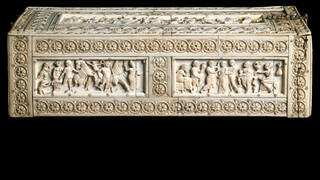
Veroli Casket
This masterpiece of Byzantine carving draws entirely on Greco-Roman mythology. It combines well-known classical stories with more mysterious subjects, united by revelry, eroticism and mockery. The crisply carved and naturalistic figures contrast with the style used for religious art at the time. This contrast reflects both Constantinople’s rich visual culture and the enduring centrality of Hellenic culture.
Constantinople
950–1000
Ivory and bone with traces of gilding
V&A, 216-1865
Replica of the mosaic of Theodora with her courtiers, Ravenna
Ravenna in Italy was part of the Byzantine empire in the 6th century. Theodora, wife of Emperor Justinian I (reigned 527–65), is depicted richly dressed in purple silk with elaborate jewellery, reflecting the power and resources of the empire at its height. Perhaps Constantinople’s most influential woman, she played a key role in court life and government and also supported disadvantaged women and refugees.
Ravenna
1952–58
Tesserae of stone and glass
Municipality of Ravenna,
Collection of the copies of the ancient mosaics of Ravenna
The end of Constantinople
By the 1440s, the Byzantine empire had shrunk to Constantinople and the surrounding area. Its territory had been steadily conquered by the Ottomans, who now controlled most of Anatolia and large areas of the Balkans. Constantinople stood between these two parts of their empire. The Ottoman Sultan Mehmed II began a siege of the city, which fell on 29 May 1453.
Istanbul: A city reborn
The Ottoman Sultan Mehmed II set about reviving the city, now known by its Turkish name, Istanbul. He invested in economic infrastructure, including an impressive shipyard, and brought new residents from across his empire. He began reshaping the city into a predominantly Islamic metropolis, with mosques and places of learning. The Ottoman empire grew and its capital prospered.
A capital reborn
Ottoman Istanbul was a magnificent city, just as Byzantine Constantinople had once been. Some Byzantine elements survived – the land walls were repaired, the water-supply system was revived and extended and the church of Hagia Sophia was converted into the mosque of Ayasofya. This building was the greatest symbol of Ottoman success and its domed form was repeated in the new mosques built by Ottoman sultans.
However, the city’s new magnificence reflected other traditions. The Ottomans brought with them long-established practices founded on Islam and the court cultures of Muslim monarchs. Ottoman art forms developed and changed, partly because altered patterns of world trade brought new materials and ideas.
Huge revenues poured in to support court expenditure. Sultans, their servants and even their horses were dressed luxuriously. Imperial processions brought this into public view.
Portraying the ottoman sultan
After his conquest of Constantinople in 1453, Sultan Mehmed II publicised his great victory internationally. He was also quick to adopt innovations. New forms of portraiture were developing in Italy, one the medal cast in bronze and the other the portrait in oils. By his death in 1481, Mehmed had commissioned images of himself in both media.
Influenced by religious objections to portraiture, some of Mehmed’s successors stopped this practice. Nevertheless, printed portraits of Ottoman rulers circulated in Europe. Small-scale portraits were occasionally painted in watercolours in Istanbul. From the 1570s, the scale of production increased. Series of imperial portraits were included in manuscripts, emphasising the long history of the dynasty.
Italian medals
Taken from life by Italian artists, these medals offer a rare opportunity to compare a Byzantine and an Ottoman ruler depicted in the same medium. John VIII was the second last Byzantine emperor, who ruled from 1425−28. His medal commemorated his visit to Italy. Mehmed II’s medal reflects his international fame as the conqueror of John’s empire.
Portrait medal of Emperor John VIII
Antonio di Puccio, called Pisanello
Ferrara
About 1439
Cast bronze
V&A, 7711-1863
Portrait medal of Sultan Mehmed II
Costanzo da Ferrara Naples
1481
Cast bronze
V&A, A.208-1910
Illuminated decree
The most common visual symbol of an Ottoman sultan was his tuğra, an elaborate calligraphic device combining his name and titles. Its form remained remarkably consistent for more than 600 years, even as sultans changed. Originally placed above the text of imperial decrees, the tuğra proclaimed the authority of the sultan. This magnificent example appears on a decree granting land to Beşir Agha, the chief eunuch of the Imperial Harem. Born in Ethiopia, the Agha was brought to the Ottoman empire as an enslaved child and rose to become one of the most powerful figures at court.
Istanbul
1745
Ink, pigments and gold on paper
The Manuscript Institution of Türkiye, 2234
Tuğra of Sultan Süleyman
Istanbul
1520−66
Ink, pigments and gold on paper
© The Trustees of the British Museum. All rights reserved. 1949,0409,0.86.
Prophets and sultans
The rule of the Ottoman dynasty was presented as the culmination of history. The Ottomans claimed their predecessors included the prophets of Islamic tradition and great monarchs. In this work, the Ottoman story is shown as a genealogical diagram. The figures on the right run from King David to Jesus, son of Mary, while on the left are Sultans Murad II, Mehmed II and Bayezid II.
Baghdad
1598
Ink, pigments and gold on paper
On Loan, Trustees of the Chester Beatty Library, ms. T.423, folios 21r and 27r
Sultan Mehmed II to Sultan Ibrahim
The Ottoman dynasty regularly commissioned portraits of themselves for inclusion in manuscripts. Nevertheless, many of their Muslim subjects understood these portraits to be contrary to Islam, and some took action to maintain this rule. As a result, the sultans in these illustrations are shown without hands and with roses in place of their faces.
Istanbul
1747
Ink and pigments on paper
On Loan, Trustees of the Chester Beatty Library, ms. T.444, folios 336v−337a
Portrait of Sultan Mehmed II Gentile Bellini
This is the most famous image of Mehmed II (reigned 1444–46 and 1451–81). During a period of peace with the Ottomans, the Venetians sent their leading artist Gentile Bellini to work for the sultan. This portrait in oils, a new technique, was one result. Most examples showed the subject in profile. Bellini’s is one of the first where the sitter’s face is turned towards the viewer.
Istanbul
1480
Oil, originally on wood, transferred to canvas
National Gallery, London, NG3099, Layard Bequest, 1916
Topkapı Palace
Istanbul’s Topkapı Palace is one of the most significant buildings in Europe, the main home of 25 Ottoman sultans over four centuries. Construction began in 1459 on a hilly peninsula at the east end of the city. An area of almost 600,000 square metres was walled off and filled with buildings and gardens of many shapes and sizes.
The most important buildings stand around three courtyards laid out along the hilltop. The first was a vast parade ground. The second was for the public functions of the monarchy while the third contained the sultan’s private quarters. Two great gatehouses give access to the first and second courts.
Tile panel
Istanbul
About 1731
Fritware painted under the glaze
Benaki Museum, Athens, E 69
Seeing the sultan
Ottoman sultans lived in the third court of Topkapı Palace and the adjacent Harem. Privileged outsiders were received in a special pavilion by the main gate of the third court. On ceremonial occasions such as an accession or a great festival, the sultan was enthroned in the second court where officials paid him homage.
The sultan left the palace every Friday to pray in one of the city’s mosques. He also left to go hunting or to war. These were occasions for processions allowing the city's population to see their ruler.
Jewelled ivory belt
Being rare and expensive, precious and semi-precious stones were regularly worn by the sultan and his family. If anyone else wore such stones, they were probably a royal gift. Belts and girdles were one focus for jewelling and this ivory example was placed in the tomb of Sultan Selim II when he died in 1574.
Istanbul
1525−75
Ivory inlaid with a black substance and gold, spinels
or rubies, and turquoises
İstanbul Turkish and Islamic Arts Museum, Türkiye, 482
Head ornament of Hürrem Sultan
Hürrem Sultan entered the Harem of Sultan Süleyman as a concubine but became his sole legally married wife. This elegant ornament was found in her tomb at the Süleymaniye Mosque, where she was buried in 1558.
Istanbul
About 1550
Gilded wire, pearls
İstanbul Turkish and Islamic Arts Museum, Türkiye, 439
Turban ornaments
In public, the sultan was marked out because he wore an aigrette – a tall feather in a socket of precious metal. The aigrette’s flat lower section was inserted between the folds of the turban cloth, and the chains and hooks were pinned into it. The type of feather and the way it was worn changed over time, but its significance remained the same.
Aigrette-holder set with gems
Istanbul
1525−75
Gold, spinels or rubies, turquoises
İstanbul Turkish and Islamic Arts Museum, Türkiye, 416
Aigrette of peacock feathers
Istanbul
1525–75
Gold, peacock feathers
İstanbul Turkish and Islamic Arts Museum, Türkiye, 438
Gold pistols
In the 18th century, the Ottoman government began to send ambassadors to other European states. In 1793, Sultan Selim III (reigned 1789−1807) sent Yusuf Agâh Efendi as his first ambassador to Great Britain. The envoy was received by King George III (reigned 1760−1820), and these gold pistols were recorded among his gifts.
Istanbul
About 1793
Ferrous metal encased in gold
His Majesty the King/The Royal Collection, RCIN 62832
Qaran unhorses Barman
This painting illustrates a scene from the Book of Kings, a great epic poem in Persian. It is from a manuscript of exceptional splendour, made for the first Safavid rulers of Iran. A Safavid ambassador presented the book to the Ottoman sultan Selim II in 1567. Selim treated all gifts from Iran as tribute and gave nothing in return.
Tabriz
About 1525−35
Ink, pigments and gold on paper
The Sarikhani Collection, I.MS.4025
Gifts for the sultan
The exchange of gifts was an essential part of Ottoman court life. On the right, Sultan Süleyman receives an Iranian ambassador; his gifts for the sultan include birds of prey for hunting. On the left, court officials hold the gifts brought by John Sigismund Zápolya. Zápolya needed the sultan’s support to remain king of Hungary.
Istanbul
1579
Ink, pigments and gold on paper
On loan, Trustees of the Chester Beatty Library, Dublin, ms. T.413, folios 14v and 56r
The grand vizier receives the British ambassador Francis Smith
Ambassadors received at the Ottoman court first visited the grand vizier, in this case Bahir Mustafa Pasha (seated). The Ottoman statesmen are in fur-lined robes of honour and high muslin turbans. The ambassador, Henry Greville who is also seated, wears British court dress, but he and his party will soon receive robes of honour, seen piled in the foreground.
Probably London
1763−64
Watercolours on paper
His Majesty the King/The Royal Collection, RCIN 917142
Sultan Mustafa III receives Henry Greville
Francis Smith
Henry Greville, now dressed in a yellow robe of honour, has reached the third courtyard of Topkapı Palace. The sultan receives Greville in the Chamber of Petitions, seated on the wide, canopied throne.
As is usual, he gives no sign of acknowledgement. A translator bows before him, while translating the ambassador’s address. A reply on the sultan’s behalf was relayed back through the translator.
Probably London
1763−64
Watercolours on paper
His Majesty the King/The Royal Collection, RCIN 917143
Processions and parades
The streets of Istanbul were a stage for processions and parades, carefully managed events which displayed the sultan’s power and magnificence. They exemplified the good order his rule brought to the empire. They demonstrated his commitment to Islam, whether he was riding out to Friday prayers or going to war in its name.
Other processions included regular ‘cradle parades‘, when the palace sent a jewelled cradle to the home of a newborn member of the royal dynasty.
A cradle and a cradle procession
The sultan’s daughters were often married to his ministers and lived in grand houses in the city. When they gave birth, the sultan’s mother sent them a jewelled cradle which was carried through the streets. This reminded Istanbul’s inhabitants of the importance of the usually invisible women of the dynasty, as well as celebrating their fertility.
Cradle
Istanbul
1600–1800
Walnut and mother of pearl
Topkapı Palace Museum, Türkiye, 108/912
A cradle procession
Istanbul
About 1809
Watercolours on paper
V&A, D.106-1895
Kaftan ‘woven from gold’
Ottoman sultans and their courtiers dressed in extraordinary silk textiles, usually locally made. This example contains enormous quantities of gold-and silver-wrapped thread and has been identified as zerbâft, a cloth ‘woven from gold’. The huge circular pattern contains one sunburst within another, alluding to royal glory.
Bursa or Istanbul (textile), Istanbul (tailoring)
1566−74
Silk and metal thread, cotton
Topkapı Palace Museum, Türkiye, 147/177
Bishop’s vestment (sakkos)
The textile is woven from thread wrapped with thin strips of silver (the background) and gilded silver (the pattern), with red outlines. Such expensive cloth was used for the finest ‘robes of honour’, placed over the shoulders of officials and envoys received by the sultan. In this case, the robe was later recycled as a very grand church vestment.
Probably Bursa (textile), and Istan[bul (tailoring)
1629 (date of tailoring)
Silk and metal thread, silver
Benaki Museum, Athens, E 9349
Equine magnificence
Horses ridden in parades were fitted out with trappings as luxurious as their riders. The textile’s shape and border on three sides show that it was designed to cover a horse’s hindquarters. It would have been attached to a piece of plain cotton or linen cloth that extended forward under the saddle. The armour designed to protect a horse’s head looked good in parades, but the metal is too soft to be useful in battle.
Velvet saddle cloth
Bursa
1550–1600
Silk and metal thread, cotton Benaki Museum, Athens, E 3809 Gilded chamfron
Istanbul
1550–1600
Gilded copper
Harbiye Military Museum and
Cultural Site Command, Türkiye, 208-65
Two muskets
During the 16th century, muskets began to appear in imperial processions. They were often richly decorated, turning them into status symbols that were suitable as parade arms. Originally, Ottoman muskets were armed with a matchlock mechanism of a type used across Asia (above). In the early 17th century, ‘miquelet’ flint-based mechanisms were introduced from Hungary (below).
Musket with matchlock mechanism
The barrel signed by Mustafa Ottoman empire
1600–1700
Steel, wood, bone, silver
Harbiye Military Museum and
Cultural Site Command, Türkiye, EN 8865
Musket with flint-based mechanism
Ottoman empire
1600–1700
Steel, gold, wood, ivory, mother of pearl, silver, imitation semi-precious stones
V&A, 406-1874
Sultan Mahmud II rides out to Friday prayers
Every Friday when the sultan was in Istanbul, he rode out in a magnificent procession to attend the Friday prayers at one of the city’s great mosques. Here Mahmud II (reigned 1808–39) emerges from the Imperial Gate, the outer entrance of Topkapı Palace. His turbaned head is visible above the huge fans of feathers on the headgear of his bodyguard, the solaks.
Istanbul
About 1809
Watercolours on paper
V&A, D.123-1895
The corpse of Sultan Süleyman l eaves Szigetvár
In 1566, Sultan Süleyman died during the siege of Szigetvár in Hungary. After the town had been conquered, the victorious army set out for Istanbul. The sultan’s remains were borne on a carriage, with the textile covering shown lifted back to reveal his turban resting on the coffin. The eventual destination was the sultan’s tomb, next to the Süleymaniye Mosque in Istanbul.
Istanbul
1579
Ink, pigments and gold on paper
On Loan, Trustees of the Chester Beatty Library, ms. T.413, folios 113v−114r
Object in Depth: Ottoman Processional Scroll
Filmmaker: Marco Carini
© Victoria and Albert Museum, London
Still imagery of Ottoman Processional Scroll © Courtesy of The University of Manchester
With our thanks to the John Rylands Library, The University of Manchester
Running time: about 4 minutes
This film has sound
Procession scroll
The scroll is almost eight metres long and shows the Ottoman sultan in a procession with 200 participants, both on foot and on horseback. The figures are well spaced, with captions in French and Turkish, so that the scroll’s owners could learn to identify each one. The owner was probably a foreign diplomat resident in Istanbul.
Istanbul
1600–1700
Ink and watercolours on paper
Courtesy of The University of Manchester, ms. Turkish 4
Malkoç Ali Pasha leaves for Egypt
Malkoç Ali was a senior page in the service of Sultan Mehmed III until 1601, when he was made governor of Egypt. A great procession accompanied him to board his ship to Egypt. Ali appears on the right. Unusually for an Ottoman official, he has only a moustache, as pages to the sultan did not grow a full beard.
Istanbul
1603
Ink, pigments and gold on paper
The Manuscript Institution of Türkiye, ms. Halet Efendi 612, folios 9b−10a
Textiles from the Holy Places
Special silks were made as hangings for the Holy Places in Mecca and Medina (now in Saudi Arabia). From 1517, the sultan sent new textiles every year. After a year in contact with the Holy Places, the textiles became religious relics. Some were sent back to Istanbul, others divided among the faithful.
The textiles all have zigzag patterns filled with Arabic inscriptions. The red silk was used to cover the interior of the sacred Ka‘bah in Mecca. Green-ground silks were coverings for the tomb of the Prophet Muhammad in Medina.
Red silk for the Ka‘bah
Bursa
About 1800
Silk and metal thread
V&A, 1063-1900, given by Dudley Myers, Esq.
Green silk for the Prophet’s tomb
Bursa
1600–1700
Silk and metal thread
V&A, 781-1892
The Saz style
In the 16th century, Istanbul’s court artists developed rich styles of decoration. One group of patterns was the Saz style, which had strong international connections. It was devised in the 1520s by Șahkulu who had moved to Istanbul from Azerbaijan in north-west Iran.
In the Saz style, pattern structures varied. In the silk, the stems form a symmetrical pattern along its length. On the tiles, the stems rotate to fill the hexagonal space. In both cases, large blossoms based on Chinese lotus motifs are prominent.
Length of silk
The interweaving stems bear four different composite blossoms and a variety of leaves. The larger leaves are overlaid with floral elements, including hyacinths. This shows how the Ottoman designer was decorating a flat surface, not trying to create an illusion of reality in three dimensions.
Bursa
1540−60
Silk and metal thread
Benaki Museum, Athens, E 3897
Soffit panel
The central field and borders are filled with distinct but complementary patterns. Saz-style elements dominate, but they do not cover the whole surface. In the field, they are confined in a row of scalloped circular and elongated shapes. In the border, a chain of Saz-style blossoms and leaves is combined with a formalised vine scroll.
Istanbul
About 1545–48
Wood, paste, pigment and gold
V&A, 774-1884
Quiver and arrows
The four sides of the quiver are painted with a sophisticated Saz design. Ottoman art of the early 18th century is usually presented as the first period of ‘Westernisation’. The quiver shows that the court’s focus at the time was a return to Ottoman tradition.
Probably Istanbul
1700–40
Painted and varnished wood (quiver); wood, feathers,
thread, bone, paint (arrows) V&A, 11 to 11e-1897
Two tiles from an Istanbul bath house
Both tiles bear a scrolling floral design set with huge imaginary blossoms. This was executed in solid blocks of colour on one tile (left). A more graphic technique was used on the other, where the pattern includes two ducks. As ducks can fly, they belong to the world above our heads, indicating the overall pattern refers to the heavens.
Tile with ducks
Iznik
About 1530
Fritware painted under the glaze
V&A, 1680-1892
Tile with large blossoms
Iznik
About 1530
Fritware painted under the glaze
V&A, 396-1905
Steel mirror Muhammed Can Tabrizi
The craftsman who signed this mirror worked for Sultan Süleyman (reigned 1520–66). He specialised in steel objects overlaid with designs in gold. The overlay in the centre forms a six-part Saz pattern while the band around the edge contains verses in Persian.
Istanbul
1520−50
Steel, gold
Private collection
Patterns of re-use
Court patterns were associated with the sultan’s power. Objects with these designs were therefore desirable to people outside the court, even when they were second-hand. This was true even for the inhabitants of relatively remote Aegean islands, as in the case of the dress shown here. Similarly, court patterns were eagerly re-used in luxury products such as cushion covers that were common in better-off homes.
Woman’s dress from Thasos
Silks of this quality were so precious that they were repeatedly made and re-made into clothing or furnishings. In this case, the silk was eventually used for a woman’s sleeveless dress on the island of Thasos in the Aegean Sea. It has the date embroidered in gold thread.
Bursa (textile), Thasos (tailoring)
Textile 1575−1625, tailored in 1775
Silk and metal thread
Benaki Museum, Athens, EE 1536
Cushion cover
Court styles were adopted by more prosperous households as a sign of status. One way of doing this was the purchase of sets of velvet cushion covers woven in Bursa. A huge number were produced in the city in the 17th and 18th centuries. They bear an infinite range of adaptations of court designs.
Bursa
1625−50
Voided and brocaded silk velvet
V&A, 104-1878
Byzantine and Ottoman earthenware
Throughout the Byzantine period fine earthenware was made for the Constantinople market. This varied enormously. On one dish, the potter scratched a fish design through a covering of slip (liquid clay) before adding green glaze. Another, showing a dancing woman, has had spots of colour added to the glaze before firing.
In the Ottoman period, the imitation of Chinese blue-and-white porcelain re-shaped this production. A potter coated the red body of the bowl with white slip. When dry, it was painted with a design in cobalt blue before glazing and firing.
Bowl with blue-and-white decoration
1450–1500
Glazed earthenware
V&A, C.17-1982
Dish with a fish Byzantine empire
900−1125
Glazed earthenware
V&A, C.43-1915
Dish with a dancer Byzantine empire
1200–1400
Glazed earthenware Benaki Museum, Athens,
E 13609
Porcelain dish from China
Blue-and-white porcelain was developed in China under the Yuan dynasty (1279–1368) and became one of the world’s great ceramic traditions. It was very popular among the rulers of the Middle East, including the Ottomans. Their enormous collection of these wares is still one of the great treasures of Topkapı Palace.
China
About 1350
Porcelain painted under the glaze
V&A, 786-1894
Interaction with China and Italy
The desirability of Chinese blue-and-white porcelain caused a revolution in Ottoman ceramics in the 1470s. Then a finer white body material called fritware (stone paste) was introduced. Like ceramic glaze, it was principally made of ground pebbles rather than clay. Fritware matched Chinese porcelain more closely.
By the 1530s, Iznik fritwares were being exported to Italy, where multicoloured pieces were popular. This spurred the introduction of more colours into Iznik production, resulting in ceramics of astonishing beauty.
Ewer and dish
The shapes are based on Ottoman silverware but the white-on-blue and blue-on-white decoration imitates Chinese models. The pattern on the dish – a meandering scroll set with lotus blossoms – is also close to Chinese examples. The elongated clouds and lotus scroll patterns on the ewer were originally Chinese, but their combination here is distinctively Ottoman. The ewer was damaged and repaired in silver.
Blue and white ewer
Iznik
About 1520
Fritware painted under the glaze, silver
V&A, C.2008-1910, Salting Bequest
Dish with scroll pattern
Iznik 1560–90
Fritware painted under the glaze
V&A, 922-1898
Tondino with a portrait bust
This is the only known Iznik vessel with a portrait. It was clearly made for the Italian market. The portrait shows a youth in Italian clothing and the tondino shape, with a broad, flat rim, is also Italian. In Italy, multicoloured ceramics were in favour which explains why the potter has added a dull sage green to the standard blue-and-white.
Iznik
1535−40
Fritware painted under the glaze
V&A, 5763-1859
Dish and vase with garden flowers
These vessels mark a high point in Ottoman ceramic production. Both have a brilliant white ground and clear colours beneath a bright, close-fitting glaze. On the dish, the painter combined garden flowers, a cypress tree and a curving leaf, elegantly but apparently at random. On the vase flowering plants flow round the walls of the vessel, as though blown by a spring breeze.
Dish
Iznik
1560−90
Fritware painted under the glaze
V&A, C.2007-1910, Salting Bequest
Vase
Iznik
1560−90
Fritware painted under the glaze
V&A, 232-187
Life in the city
The city of Istanbul grew to be the largest, richest and most sophisticated in Europe in the 16th century. It retained that status into the 18th century, when it was outranked by Paris and London. Its economy was based on receiving much of the empire’s tax revenue, which generated a huge demand for goods of all kinds. This made the city a great commercial and manufacturing hub.
The sultan’s richer subjects shared in this prosperity. They included Jews and Christians as well as Muslims of different traditions. Western Europeans and South Asians came to sell imported wares such as watches and textiles and to export its products. It was a cosmopolitan place.
The city was a good place to enjoy yourself – so long as you avoided rowdiness. The luxuries developed there eventually became common across Europe. If your bathroom has tiled walls and ‘Turkish’ towels with a looped pile, you are an heir to Ottoman Istanbul.
Women Out Walking Osman Hamdi Bey
The women pass the Mosque of Sultan Ahmed, its perimeter wall pierced by grilled openings. Most wear the tailored ferace (ferajeh) while one has the less revealing çarşaf (charshaf). The expensive coloured silks and fashionable accessories mark the women as members of the Ottoman upper class.
Istanbul
1887
Oil on canvas
Yapı Kredi Collection, Türkiye
Qur’an manuscript Mustafa son of Mehmed
Copies of the Qur’an were produced in huge numbers in Istanbul. The text was considered the literal Word of God and was written with precision to avoid any ambiguity. This manuscript is larger than usual and decorated with illumination of exceptional quality, which may indicate a scribe of high status.
Istanbul
1650−1700
Ink, pigments and gold on paper
V&A, MSL/1890-9-23
A city of many religions
Istanbul was a city of the three major religions of Islam, Christianity and Judaism. After the conquest in 1453, immigration expanded the population, bringing mainly Turks, Greeks and Armenians to the city. Western Christians – Catholics and later Protestants – were also present, as were Jews of different traditions. When Jews were expelled from Spain and then Portugal in the 1490s, so many found refuge in Istanbul that Spanish-speaking Sephardim became a majority among Jews.
Islam was the state religion, but non-Muslim communities governed their internal affairs under their own leaders, such as the Orthodox patriarch.
Islam itself encompassed varied rites, including the mystic practices known as Sufism. Sufis engaged in prayer, self-deprivation and activities including dancing to achieve enlightenment.
Depiction of the Holy Mosque
When the Muslims of Istanbul pray, they face south-east, towards the Holy Mosque in Mecca, now in Saudi Arabia. This mosque contains the building known as the Ka‘bah, which is also the focus of the annual Hajj pilgrimage. Tile panels with views of the holy site commemorated the Hajj or encouraged others to perform it.
Whoever is fortunate enough to visit the Ka‘bah, God will show him mercy. Everyone invites those they love to their home.
Turkish verses above the Holy Mosque
Probably
Iznik
1600–1700
Fritware painted under the glaze
Benaki Museum, Athens, E 124
Qur’an chest
This chest was probably made for the library of Sultan Mahmud I (reigned 1730–54) in the Ayasofya Mosque, which opened in 1739. The domed lid fits over a base containing compartments into which books could be slotted. It was probably made to contain a multi-volume copy of the Qur’an.
Istanbul
About 1739
Wood, ivory, mother of pearl, turtle shell
İstanbul Hagia Sophia History Museum, Türkiye, 13683
The Romance of Alexander in Armenian
This novel-like Romance was written in Greek by the early 4th century CE, long after its protagonist Alexander the Great had died. It became immensely popular and was translated into Armenian as early as the 5th century. This illustrated copy was produced in a monastery in Istanbul’s Samatya district. The patron was Astvadzadur, Armenian patriarch of Constantinople in 1537–50.
Istanbul
1544
Ink, pigments and gold on parchment
Courtesy of The University of Manchester, Armenian ms. 3
Printed Torah
Eliezer ben Gershom Soncino
Jews from Spain and Portugal produced Istanbul’s first printed books, which were in Hebrew. They were joined in this trade by Jews from Italy, including Ben Gershom’s forebears. His own output included this edition of the Torah, the first five books of the Hebrew Bible. In the margins are translations and commentaries in Aramaic, Judeo-Arabic and Judeo-Persian.
Istanbul
1546
Printed book
The British Library, Or.70.c.10
Poetic anthology Cevrî Ibrahim Çelebi
Poetry was the most prestigious form of literature in Ottoman Turkish. This anthology includes compositions by Cevrî Ibrahim Çelebi (died 1654). Cevrî was also the scribe, using the ‘hanging’ or ta‘lîk style. This and the long, narrow format were both common features of books of verse. Cevrî was a member of the Mevlevi order, and his poetry expressed its values.
Istanbul
1632
Ink, pigments and gold on paper
On Loan, Trustees of the Chester Beatty Library, ms. T.436
Mevlevi shrine
The shrine honours Mevlana Celaleddin Rumi, a great 13th century poet. He died at Konya in Türkiye where his family established the Mevlevi Sufi order. Mevlana is represented by his headgear, thought to have been a white felt cap wrapped with a turban of green silk.
His followers wore brown felt caps of the same shape.
Probably Istanbul
1865−1900
Cardboard, cloth, paper, glass, pigments, gold
Sadberk Hanım Museum, Türkiye, 18263, Y.247
Album page
Istanbul’s Muslim population generally avoided paintings depicting living beings, but there were exceptions. Human beauty was seen as an earthly reflection of God’s own indescribable beauty. Gazing at pictures of attractive youths or young women could therefore have a spiritual benefit.
Probably Istanbul
About 1620
Ink, pigments and gold on paper
On Loan, Trustees of the Chester Beatty Library, ms. T.439, folio 1r
An ecclesiastical silk from Ottoman looms
Bursa, south-east of Istanbul, was the empire’s greatest centre for silk-weaving. It made silks for export and for home consumption. Among them were special categories used in different religious contexts. This brocaded silk was one of many produced for church vestments. The pattern combines Orthodox Christian iconography with Ottoman ornament. At the centre is the Virgin Mary holding the infant Jesus Christ, with an angel at either shoulder. The combination of motifs suggests that the design was drawn by someone with a good knowledge of both traditions.
Silk lampas
Bursa
1550−75
Silk and metal thread Benaki Museum, Athens,
E 3864
Three church cruets
Cruets held the water, wine and holy oil used in Christian religious ceremonies. The silver gilt drinking jug (centre) was re-purposed by fitting a lid, which matches those on similar vessels used as cruets. The blue-and-white ewer (left) has a complex shape based on a silver original. Unusually, it bears an inscription in Armenian on the foot, including the date 1510. The fish is a Christian symbol, explaining the shape of the third cruet (front).
Drinking jug with later lid
Probably Istanbul
1500–25 and laterSi
lver gilt
V&A, 158-1894
Ceramic ewer
Kütahya
1510
Fritware painted under the glaze
British Museum, London, G.1983
Fish-shaped cruet
Kütahya
1500−25
Fritware painted under the glaze
Benaki Museum, Athens, E 10
Chalice
In the 18th century, the Russian empire emerged as a newly assertive Orthodox power to the north of the Ottoman empire. After Russia embraced the Western Baroque style under Peter the Great (reigned 1682–1725), the Ottomans’ Orthodox subjects adopted a style based on similar principles for their own church silver.
Istanbul
1756
Silver, parcel gilt
V&A, 208-1892
Yellow entari
The entari had a long history as indoor wear for the women of Istanbul. It was always open at the front, with two slits up the sides. This example was made for a relative of the painter Osman Hamdi Bey. It has several fashion-based features, including the long, trailing skirts and sleeves and the undulating edges. The embroidery and the wide band of lace along the edges have the same pattern.
Istanbul
Late 19th century
Silk fabric, light silk cord
Sadberk Hanım Museum, Türkiye, 2654, K.72
Two-piece dress of bindallı velvet
The jacket and skirt are cut on lines derived from Paris fashions but the choice of materials is distinctively Ottoman. The combination of velvet and silver gilt thread is called bindallı, a reference to ‘a thousand leafy boughs’ and was meant to impress. The heavy embroidery has a large-scale, Italianate design.
Istanbul
Early 20th century
Silk velvet, silver gilt thread, chiffon lace
Sadberk Hanım Museum, Türkiye, 9480, K.370a, b
Fashioning a modern elite
In the 19th century, many aspects of life in Istanbul changed radically. One was how the elite dressed. During the Napoleonic Wars (1803−15), most European monarchs began to dress in military uniform. To maintain his parity with them, Sultan Mahmud II (reigned 1808−39) legislated for change in 1829, exchanging his own traditional robes for
a military uniform. A red felt fez with a silk tassel marked him out as an Ottoman. This became standard for all men of high status.
Women’s fashions changed more slowly. At first garments in the Parisian style, which led European fashion, were absorbed piecemeal, but towards the end of the century, a jacket and long skirt along Parisian lines became standard. In public, however, these international styles disappeared beneath modest, Ottoman-style outer clothing.
Ferace of green silk
The ferace was the outdoor clothing for better-off women in Istanbul for four centuries. This late example integrates a close-cut coat with a loose, floor-length cape. It is modest enough to conceal the wearer’s figure and sturdy enough to protect her fine clothes. A yashmak of white muslin hid the lower face, and a second length was wrapped around a brimless hat.
Cairo or Istanbul
Early 20th century
Silk fabric, silk ribbon, braid of metal thread, muslin
Sadberk Hanım Museum, Türkiye, 18298, K.1286
Çarşaf of patterned silk
The modest çarşaf was little known in Istanbul until the 1870s, when it was introduced from Syria. Two pieces of patterned silk were joined at the waist, which was gathered by a sewn-in sash. In 1892, Sultan Abdülhamid II (reigned 1876–1908) banned the garment, fearing assassins would use it to secrete weapons, but its use continued away from the palace.
Sivas, central Türkiye
1875−1900
Silk, cotton
Sadberk Hanım Museum, Türkiye, 9722, K.392
Parasol
Britain
Early 20th century
Silk, metal, ivory
Sadberk Hanım Museum, Türkiye, 19536, K.1625
Ankle boots with galoshes
Istanbul
Late 19th or early 20th century
Leather, wool, cotton, wood, metal, elastic
Sadberk Hanım Museum, Türkiye, 10358, K.439
A bath and a cup of coffee
Istanbul was a hive of religious activity, but it was also a great place to enjoy yourself at a funfair, in a coffee shop or at a bath house, or hamam. Sometimes religion and enjoyment were linked. Funfairs were held on religious holidays, and the profits from bath houses supported religious foundations. Coffee houses, first established in the 1550s, were viewed by some as sites of sedition and immorality but they survived to become a familiar part of Istanbul life.
These activities occurred not just in the walled city of Istanbul, but also in the settlement of Galata to the north, on the far side of the Golden Horn. It was presided over by the great Galata Tower, erected by the Genoese in 1348.
Coffee house scene
Istanbul’s Muslim men, forbidden alcohol and the taverns where it was drunk by non-Muslims, invented the coffee house as a place to socialise. In the right corner, a young man is making the coffee. The outer and inner spaces are lined with men wearing turbans and other headgear that proclaim their high status.
Istanbul
About 1809
Watercolours on paper
V&A, D.125-1895
An Istanbul funfair
This funfair has many different rides, currently being enjoyed only by men. The women (bottom right) are there as spectators. On the left, two figures play a drum and a shawm, the forerunner of the clarinet, which were often heard in the streets of Istanbul during celebrations. From their dress, we know all the figures are Muslim.
Istanbul
1616−32
Watercolours on paper
V&A, MSL/1889/1392, folio 63v
Coffee pot
Coffee was made using a long-handled copper vessel heated over an open fire. The coffee was then decanted into a pot of this kind. Civilised behaviour dictated that it was then poured into a cup in the presence of the person being served.
Probably Istanbul
1775−1825
Copper, silver, gilding
V&A, 369-1897
Coffee cup
Many factories outside the Ottoman empire targeted the Istanbul market. The Meissen porcelain factory in Saxony, Germany, produced these small, handleless coffee cups in great quantities. Porcelain production began in Istanbul in 1892 under imperial patronage.
Meissen, Germany
1765−75
Porcelain painted under the glaze
V&A, C.400-1919, presented by Lt Col K. Dingwall, DSO,
with the support of the Art Fund
Coffee pot, cup and saucer
These wares are from Kütahya, south of Istanbul, an important centre for luxury ceramic production in the 18th century. One of the main product lines was equipment for consuming coffee. This saucer has a socket for the cup to make it more stable when carried.
Coffee pot
Kütahya, western Türkiye
About 1725
Fritware painted under the glaze
V&A, 599-1874
Cup and saucer
Kütahya, western Türkiye
About 1725
Fritware painted under the glaze
V&A, 602&A-1874
Double-sided games board
This board was used for playing tavla, the Turkish version of backgammon. The reverse is laid out for playing chess. Combining turtle shell and mother of pearl in marquetry became the fashion under Sultan Murad III, who reigned from 1574 to 1595.
Probably Istanbul
1575−1700
Wood, turtle shell, mother of pearl
V&A, 576-1872
Long-necked lute
The history of Ottoman music was marked by dynamic changes. Until the middle of the 17th century for example, the Turkish version of the harp was popular. It then declined rapidly, disappearing by 1700. At about the same time, this type of long-necked lute, the tanbur, replaced it as the stringed instrument of choice.
Probably Istanbul
1750–1800
Wood, turtle shell, mother of pearl, ivory, frets of
animal gut, metal strings
V&A, 861-1907
The Streets of Istanbul
Excerpts from Constantinople: scenes de rues, soldats français and A Constantinople pendant l’occupation française. Les fêtes du Ramadan.
May and June 1919
© Réalisateur inconnu/ECPAD/1919/Défense
Editor: Marco Carini
Running time: about 3 minutes
This film has no sound
The court dress of Sultan Mahmud II
This portrait shows the formal dress of the sultan before 1829. He wears a silk kaftan trimmed with black fur. False sleeves trail to the ground. The frogging set with diamonds across his chest matches the jewelled hilt of his dagger and the socket of his aigrette of black and white feathers.
Istanbul
About 1809
Watercolours on paper
V&A, D.24-1895
Portrait of Sultan Abdülmecid John Nash, after Sir David Wilkie, printed by C. Hullmandel
Wilkie was the leading Scottish painter of his time and painted this portrait on a visit to Istanbul. The sultan is in court dress, with a cloak over his frock coat. His informal pose, sitting on a sofa, would have contrasted with everyone else at court who had to stand in his presence.
London
1843
Hand-coloured lithograph
V&A, SP.652:3
Purchased with the assistance of the National Heritage Memorial Fund, the Art Fund, Shell International and the Friends of the V&A.
Portrait miniature of Kabuli
Mehmed Pasha
Rupen Manasv
Mehmed Pasha was an Ottoman diplomat and he wears official dress, with an order of chivalry at his neck. In 1850, while a diplomat in London, he met a young Italian woman Giulietta Anichini. He presented her with this portrait, which he inscribed in French as, ‘More pleasing than the original.’ Sadly for him, she later married a fellow Italian.
Istanbul
8 April 1850
Watercolour on ivory, gilt metal frame, velvet-covered board
V&A, ME.1-2007
The hot room in a men’s hamam
In the central domed space is a raised platform, heated from below. Other areas have white marble basins and panels with hot and cold taps. The men, both masseurs and clients, wear wooden clogs, or pattens, waist wraps and white towels. Turkish baths, or hamams, are double, with separate men’s and women’s sections, or single with different sexes using them on alternate days.
Istanbul
About 1809
Watercolours on paper
V&A, D.118-1895
Six tiles from a bath house
These very different tiles were part of the original decoration of one particularly luxurious bath house, the Zeyrek Çinili Hamam, in Istanbul. The tiles covered the dados – the lower part of the walls. Some rooms had dados of square or hexagonal tiles while in others, hexagonal and triangular tiles were combined. Only one main pattern was used for each surface, set off by borders of rectangular tiles with a different design.
Two hexagonal tiles
Istanbul or Iznik
1530s
Fritware painted under the glaze
V&A, 1020-1892, C.7-1953
Square tile
Istanbul or Iznik
1530s
Fritware painted under the glaze
V&A, 508-1900
Two triangular tiles
Istanbul or Iznik
1530s
Fritware painted under the glaze
V&A, 961, 1042b-1892
Wrapping cloth (bohça)
When people went to a hamam, they took clean clothing and other equipment wrapped in cloths called bohça. These were of infinite variety in terms of size, colour, decoration and design and were as grand as the owner could afford. Here the pattern simulates the woven-in design of an Ottoman court textile.
Probably Istanbul
1600–1700
Silk textile, silk and metal thread
V&A, 588-1890
Towel with a looped pile
The distinguishing feature of a ‘Turkish’ towel is the short, looped pile that makes it more absorbent. This example was taken to London for the 1851 Great Exhibition. Also on display were looped-pile towels manufactured by Christy’s of Manchester in imitation of the Turkish originals. Queen Victoråia was so impressed she ordered six – an early stage in the spread of the product around the world.
Istanbul or Bursa
Before 1852
Linen, silk and metal thread
V&A, 757-1852
Women’s bath pattens
Pattens protect the wearer’s feet from heat radiating upwards from the floor in the hot room of a hamam. The exaggerated height and rich inlay assert the owner’s higher social status. This pair were made for display at the 1867 Exposition Universelle in Paris and do not have the usual loops for the wearer’s toes.
Probably Istanbul
Before 1869
Wood, mother of pearl
V&A, 1020&A-1869
So to the bath house
Walking in procession to the bath house are three figures. In front a servant carries on her head the equipment needed, wrapped in cloth (bohça). The Latin caption tells us she was a ‘bought slave’. At the back is her owner, clearly a woman of some wealth. Between them is a small boy, still young enough to go to the bath house with his mother.
Istanbul
1600–1700
Ink and watercolours on paper
The Bodleian Libraries, University of Oxford, ms. Bodl. Or. 430, f.102r
Two calligraphic panels Sâmî Efendi and Hüsnî
Inscriptions in Arabic, usually of a religious nature, indicated that a space was occupied by Muslims. By the 19th century, they were often mounted and framed in the manner of paintings and prints for display inside. These inscriptions contain a popular saying of the Prophet Muhammad and a quotation from the Qur’an:
Verily God is beautiful and loves beauty
(above)
I have succeeded only with God’s aid
(below)
Panel with blue ground
Istanbul
1866
Gold on paper
Sadberk Hanım Museum, Türkiye, 13897, Y.76
Panel with plain ground
Istanbul 1905
Ink and gold on paper
Sadberk Hanım Museum, Türkiye 15628, Y.221
Two architectural fantasies
Sopon Bezirdjian
Bezirdjian was an Ottoman Armenian designer and decorative artist from Istanbul. He worked for Sarkis Balyan, architect to Sultan Abdülaziz. AfterAbdülaziz’s death in 1876, Balyan fell from favour and Bezirdjian moved to Britain.
The drawings show two unrealised projects. On the right is the façade of a pavilion entitled Étoile Casino in the eclectic style of Bezirdjian’s work in Istanbul. The plan on the left shows an imperial tomb laid out as a crescent moon and star, the symbol on the Ottoman flag.
Façade of the Étoile Casino
Probably Istanbul
Before 1915
Ink and colour on paper
V&A, ME.13-2017
Plan for an imperial tomb
Probably Istanbul
Before 1915
Ink and colour on paper
V&A, ME.17-2017
Before the end
At the end of the First World War in 1918, the Ottoman empire was a defeated power. The victorious Allies, including the British, occupied Istanbul. In 1922 the Grand National Assembly, meeting in Ankara, deposed the last sultan. The next year, the Republic of Türkiye was established, with Ankara not Istanbul as its capital. After almost 16 centuries, the city that was once Constantinople and is now Istanbul ceased to be the residence of an emperor or sultan.
In the decades before these events, the city’s artistic traditions, Byzantine and Ottoman, were celebrated internationally by artists and designers, as they still are today. In the decoration of this museum, Byzantine mosaic-making skills were adapted and still add to the building’s beauty.
Hagia Sophia Dice Kayek
This dress was inspired by the Byzantine mosaics of Hagia Sophia. Its shape echoes the winged seraphim set immediately below the building’s dome. Glass beads and rich embroidery re-create the reflective quality of the original ornament.
The garment is part of a collection called Istanbul Contrast, which evokes the city’s architectural and artistic heritage. The collection was awarded the Jameel Prize at the V&A in 2013.
Paris
2009
Silk, metal thread, glass
Given by Ayse and Ece Ege. Copyright Dice Kayek, V&A, ME.1-2015
The pattern of an Ottoman silk re-used
Britain’s Arts and Crafts movement valued the design ideas offered by Ottoman textiles. The green-ground silk on the left, acquired by the V&A in 1877, inspired a pattern used by Morris and Co. The drawing in the centre was probably made by the company’s art director, John Henry Dearle. Dearle adapted the Ottoman design for a printed cotton fabric called Eden, seen on the right. The colourway is similar and there are lilies, tulips and pomegranates in both designs.
Ottoman silk
Probably Bursa
1550−1600
Silk and metal thread
V&A, 1356-1877
Drawing of an Ottoman silk
John Henry Dearle
London
About 1900
Pigments on paper
V&A, E.60-1940, bequeathed by Miss Mary (May) Morris
Eden silk
Morris and Co.
Probably Merton, Surrey
Cotton
About 1905
V&A, T.24-1955
Photograph of the mosaic portrait of Prince Albert, in the archway above the Prince Consort Gallery at V&A South Kensington
London
Mosaic completed July 1865
© Victoria and Albert Museum, London
Design for the north end of the Prince Consort’s Gallery
Godfrey Sykes
The V&A’s first gallery buildings were a perfect testing ground for architectural mosaics, including this design featuring Albert, the Prince Consort (1819–61). He was Queen Victoria’s husband and a key figure in the Museum’s history. Amongst other monumental mosaic decoration schemes in the V&A were 35 artist portraits in the South Court, nicknamed ‘Kensington Valhalla’.
London
About 1863
Watercolour and pencil on paper
V&A, 1112
Byzantine No.3 Owen Jones
Architect and designer Owen Jones’ influential Grammar of Ornament (1856) assembled decorative traditions from across cultures and centuries. These included Byzantine and Ottoman designs. Jones visited Istanbul in 1833–34 and his book became a key source for British designers who had no first-hand experience of the city and its design languages. This drawing features mosaic designs from San Vitale in Ravenna and Venice’s San Marco
England
Before 1856
Watercolour, gold paint, gouache and ink on paper
V&A, 1603
Mosaic panel
Vitreous Mosaic Company
The V&A’s first director, Henry Cole, was an early champion of architectural mosaics, commissioning work from established British glass makers such as Jesse Rust. This sample from Rust’s Vitreous Mosaic Company demonstrates the range of tesserae his firm could supply. In 1862 Cole also established mosaic classes exclusively for women within the V&A’s own training school, producing work for the museum’s interior.
London
1860–90
Tesserae of glass
V&A, A.3-2010
Panorama of Constantinople
G. Tomkins (etching) and F.C. and G. Lewis (aquatint), after Henry Aston Barker
Istanbul’s unique topography was portrayed in many media throughout the Ottoman period. The panorama shows Istanbul in 1799, as seen from the Galata Tower. It was first displayed to fee-paying visitors in 1802, in a specially constructed building in London’s Leicester Square. The printed version was published later in eight sheets.
Barker’s father Robert was the Irish-born inventor of the panorama, a term he coined. Istanbul was the first city outside Britain to be presented in this medium.
London
1813
Etching and aquatint, hand-coloured
SP.77:1 to 8, purchased with the assistance of the National Heritage Memorial Fund, the Art Fund, Shell International and the Friends of the V&A.
