Pioneers of print
Käthe Kollwitz (1867 – 1945)
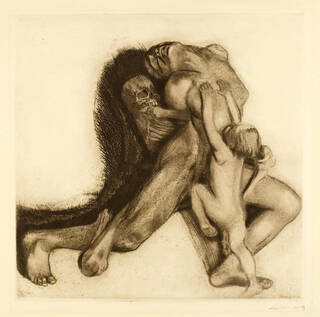
Artist Käthe Kollwitz used print to convey the stark injustices she witnessed in early 20th-century Germany. Originally trained in painting, Kollwitz initially [KH1] found print challenging. In 1891, she saw Max Klinger’s print series ‘A Life’, which introduced her to the medium and changed the trajectory of her career. Kollwitz’s family not only provided her with access to an arts education but also encouraged progressive ideas. Following her marriage to her husband, who was a doctor working in Berlin, she saw first-hand the plight of the lower classes, particularly mothers, struggling with poverty and illness.
Norma Morgan (1928 – 2017)
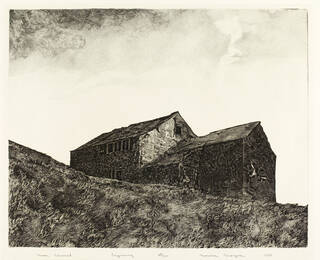
Norma Morgan took inspiration from abstraction, nature and mythology whilst creating work across her career. Morgan’s ‘Moor Reclaimed’ was one of the first artworks by a named, living, Black woman to be acquired by the V&A in 1963. Born in New Haven, Connecticut, Morgan was an active part of the American print scene, joining the famed print studio Atelier 17 in 1950. In the following year she won a Whitney Foundation award, which enabled her to travel across England and Scotland for a year exploring the moors.
Sue Gollifer (born 1944)
Sue Gollifer is a pioneer in digital art, known as both an artist and educator for her experimental use of digital print techniques. She began her career in the late 1960s, using her background in screen printing to layer works in and outside computer environments. With a focus on systems art, minimalism and experimental dyes, Gollifer uses rule-based mathematical systems to create her works.
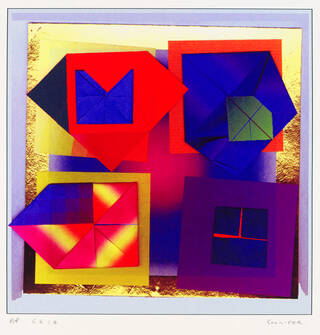
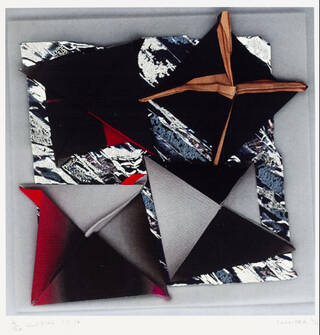
Painter-printmakers
Though some artists consider themselves predominantly printmakers, many are also painters, sculptors, photographers or even performance artists. Printmaking often forms just one part of an artist’s diverse practice.
Laura Knight (1877 – 1970)
One of the most prolific artists of the early 20th century, Laura Knight was a woman of many firsts. Born in Derbyshire in 1877, Knight was attending art school by the age of 13. In 1929, Knight was the first woman artist to be made a Dame, and in 1936 she was the first woman since founders Angelica Kauffman and Mary Moser to become a member of the Royal Academy.
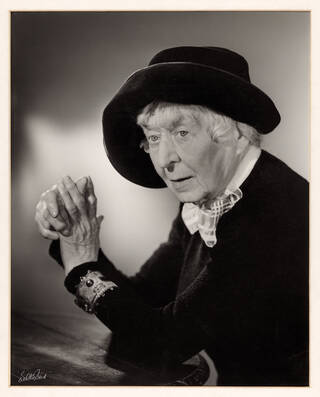
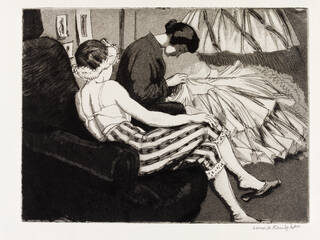
Though Knight is known as a painter, she was a gifted printmaker. Her prints focussed on portraits and community, especially those of performers, such as dancers, actors, and theatre workers, using the technique of aquatint to cast shadow and light and allowing us a glimpse of the backstage.
Celia Paul (born 1959)
Celia Paul’s practice revolves around her close relationship with her sitters. Born in India in 1959, Paul is one of four sisters, who along with her mother, were Paul’s most frequent sitters. After studying at Slade School of Art, Paul began working as both a painter and a printmaker in her top floor studio in central London. Though Paul is primarily a painter, she uses print to expand her practice. Using soft ground etching to emulate her painting style, Paul credited printmakers Marc Balakjian and Dorothea Wight of Studio Prints with assisting her in capturing the atmosphere she was aiming for.
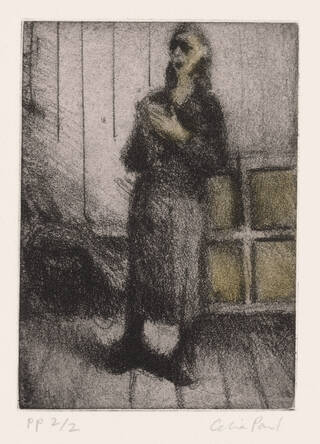
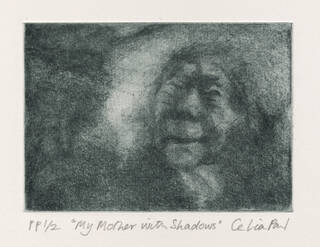
Community driven
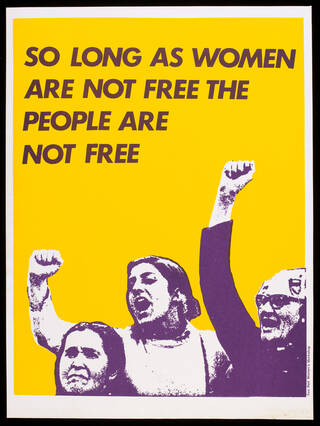
Print is used by communities across the globe to disperse ideas quickly. Whether creations by individual artists, or collaborative groups like the See Red Women’s Workshop, print can be used as a tool to record and respond to the demands of the era.
See Red Women’s Workshop (1974 – 1990)
Formed in the mid 1970s in South London, See Red Women’s Workshop were a collective of women using screenprint to challenge negative views of women in the media. Community was central to the DNA of the workshop as members shared skills, knowledge and collectively collaborated on projects tackling a range of feminist causes. Screenprint was central to this work, as it was easy for new members to learn and allowed the workshop to create a large volume of posters quickly in a variety of different styles.
Pearl Binder (1904 – 1990)
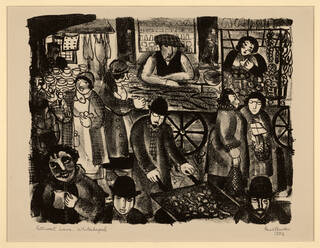
From London’s working-class icons the Pearly Kings and Queens to Punks, East London Jewish districts and theatre back rooms, artist and illustrator Pearl Binder used lithography to document the everyday experiences of working-class communities across Britain. Born into a Jewish family in 1904, Binder studied at the Central School of Art and Design in London, before beginning her artistic career as part of the new post-war generation. Binder was a prolific printmaker, utilising the textural and tonal qualities of lithography to capture her subjects.
Faith Ringgold (1930 – 2024)
Interdisciplinary Harlem-born painter, sculptor, writer, performance artist and activist, Faith Ringgold is known globally for combining art with storytelling. In the only work by Ringgold held in the V&A’s collection, the artist uses lithography to tell the story of the fictional ‘Sunflower Quilters Society of America’. Members of the society include fictional character Willa Marie Simone as well as prominent historical figures such as Harriet Tubmen and Rosa Parks. Ringgold's practice celebrates the contributions of famous African American women whilst highlighting the prejudices of American society.
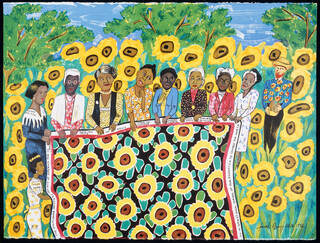
Print for protest
Print is often used during periods of protest, as visibility and the means to disseminate information are crucial for ongoing campaigns. Whether through limited print runs, community print presses or even internet dissemination, the medium has been used by Women printmakers to protest social structures used to protest built to hold them in place.
Guerrilla Girls
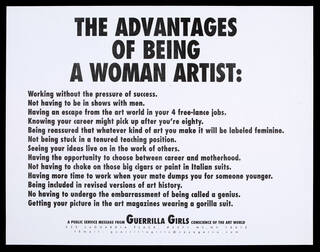
Recognised only by their gorilla masks, Guerrilla Girls use their anonymity as a weapon to disrupt the art establishment. Since the 1980s, Guerilla Girls have used print to their advantage, combining damning statistical information about inequity within museums with striking imagery. The group aims to hold the art world accountable for discriminatory practices, particularly when it comes to representing the work of women and artists of colour.
Suffragettes
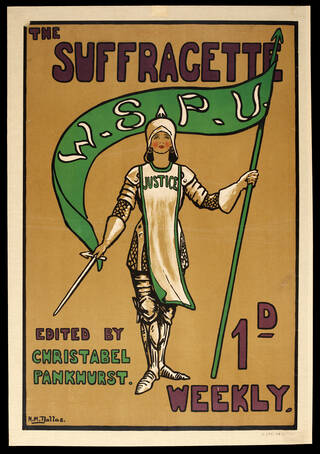
Hilda Dallas (1878 – 1958) was a member of Suffrage Atelier, a group that formed out of the Women’s Social and Political Union (WSPU) to create art to forward the women’s movement. Dallas created this striking advertisement using the suffragette’s colours of green, purple, and white combined with the image of Joan of Arc, the patron saint of the suffragettes.
Experimental printmaking
Contemporary artists are pushing the boundaries of what printmaking can be – exploring new ways of making prints by combining techniques, using new materials, and experimenting with the concept of print itself.
Cornelia Parker (born 1956)
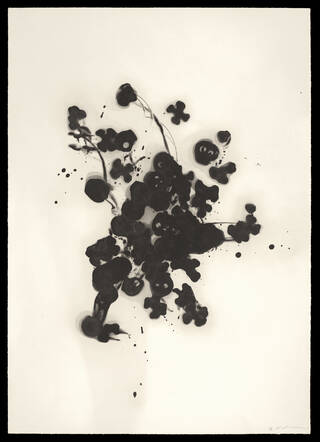
Playfulness and experimentation are at the heart of Cornelia Parker’s practice with process taking centre stage in her work. Parker works across a variety of disciplines, such as printmaking, sculpture, drawing and photography – using whichever medium best represents an idea. In the print ‘Black Ice’, working alongside Thumbprint Editions expert printmaker, Pete Kosowicz, Parker experiments with polymer photogravure. Ice in the shape of a skull and crossbones is placed onto a photogravure plate and exposed to UV light. In the time it took for the plate to be exposed, creating the image, the ice began to melt producing abstract lines and pools of transparency.
Ky Lewis (born 1964)
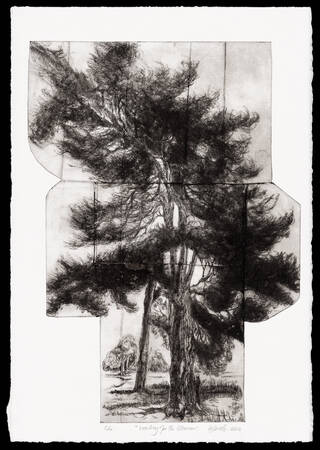
Ky Lewis uses Tetrapak cartons, such as milk or juice cartons, to create sustainable intaglio prints. Similar to drypoint printmaking, this process uses tetrapak in place of a traditional metal plate. An image is incised into the back of the carton which can then be printed. Lewis prefers not to use traditional printmaking equipment and instead fashions her own portable tools using found objects, which allow her to continue a longstanding tradition of working outside.
Gal Leshem (born 1998)
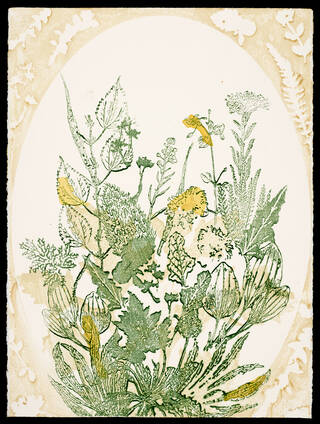
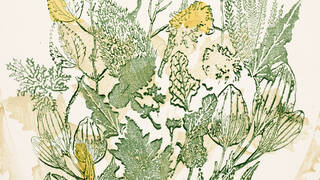
For many contemporary artists, printmaking is just one medium that helps them realise their ideas. This is true for artist Gal Leshem, who experiments with a wide variety of mediums and techniques, including textiles, papermaking, and printmaking. Her work is concerned with using natural flora and fauna to explore ideas of movement and the ways in which nature defies man-made geographical boundaries. In her print Against Classification: My Mother Sees a Salad in Every Field (2021), Leshem used dyes made from plants that she had foraged using knowledge passed down to her from her mother. The process of making this print is as much a part of the artwork as the final print itself.v