Trompe l’œil translates from French as ‘deceive the eye’. The use of visual trickery to make images appear real is an artistic tradition begun in antiquity and popular from the Renaissance (late 1400s to the early 1600s) through the Enlightenment (late 17th to 18th century). One of the earliest stories about painting concerns a competition in ancient Greece between artists Zeuxis and Parrhasius. As recounted by Pliny the Elder in his Natural History (77AD), Zeuxis painted grapes so realistic that birds flew down to peck them. Eager to see the painting by his rival Parrhasius, Zeuxis asked that he pull back the curtain that was covering it, only to discover that the curtain itself was the painting, and Parrhasius had defeated him. This popular story laid down a gauntlet for future artists.
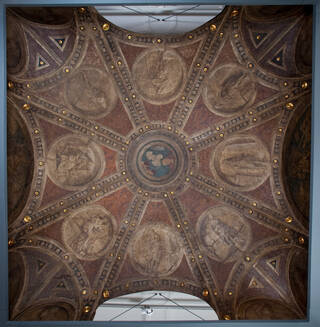
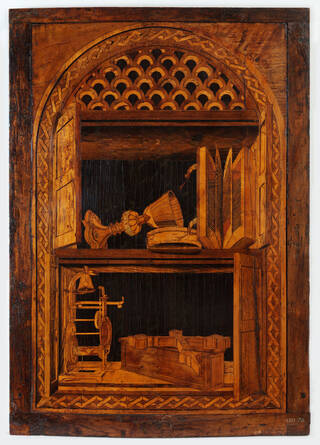
In Renaissance Italy, artists used trompe l’œil in interior schemes to expand their spaces and enrich their decoration. Painted ceilings could gain an oculus, seemingly open to the blue sky, and faux reliefs of the muses and Roman emperors, with paint mimicking carved stone. Northern Italian woodworkers used the art of tarsio, later known as intarsia, to create illusionistic panels for rooms, suggesting architectural features, cabinetry and arrangements of desirable goods.
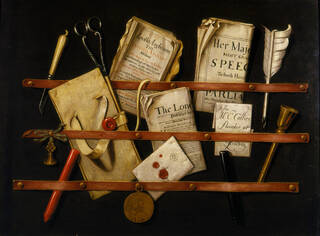
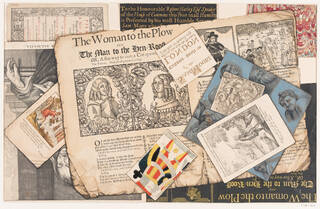
In the 17th century, a distinct genre of still life trompe l’œil easel painting emerged in the Netherlands and quickly spread across Europe. Convincingly painted letter racks, featuring printed texts, handwritten notes and sealed letters, and even the quills and seals themselves were a speciality of artist Edward Collier (about 1642 – 1708). Likewise ‘medley images’ on paper mimicked the appearance of ephemera strewn across a surface, with different printmaking techniques, and even marbled papers, faithfully imitated by artists in pen and pencil.
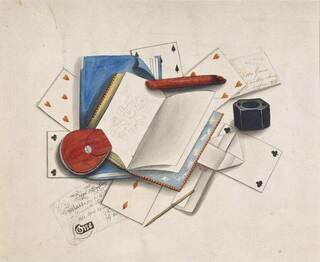
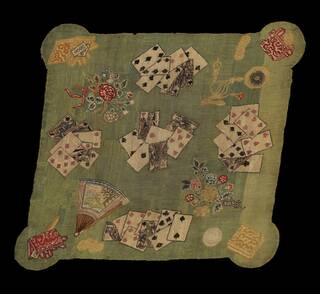
Playing cards became a common motif during trompe l’œil’s 18th-century heyday. The ubiquitous nature of card play in this period meant that images of cards found their way not only into illusionistic works on paper, but also embroideries made as covers for the very card tables on which play took place. Trompe l'oeil depictions of cards played a game between artist and viewer which deliberately confused the difference between the actual cards and those depicted, and also between the familiar images printed on the cards and the intellectual art of painting.
Still life was not the most prestigious genre of painting, and this deliberate flouting of artistic hierarchies would be the downfall of trompe l’œil. Soon after French artist Louis Léopold Boilly (1761 – 1845) exhibited a painting titled Un trompe l’œil in the 1800 Paris Salon – the first use of the noun – it became deeply unfashionable.
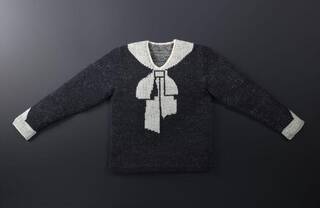
A revival of fortune came for trompe l’œil in the early 20th century, particularly among modern artists eager to blur the boundaries between art and life, artifice and reality. Cubism emerged from a concern with how to represent the world on the flat surface of a painting. In the 1910s, artists including Pablo Picasso and Georges Braque flattened and fragmented traditional perspective and introduced collage elements, paper ephemera, such as cards and newspapers, alongside illusionary ones, such as woodgrain wallpaper. Schiaparelli was familiar with Cubism, and her conceit of translating the undulating, three-dimensional forms of a tied cravat into the flat simplicity of a knitted sweater may have been a subtle nod to modern painting.
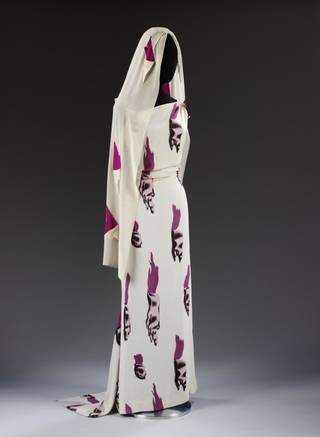
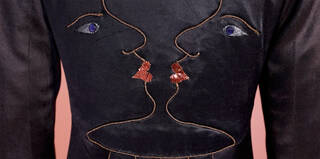
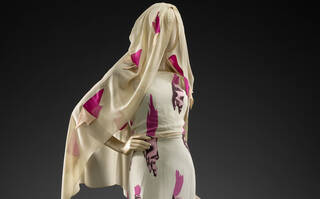
In the 1920s and 30s, another avant-garde movement would adopt trompe l’œil to very different ends. For some Surrealists, an illusionary style of painting allowed them to create extraordinary worlds with a dream-like quality and show the viewer something beyond reality. The most famous of these artists was Salvador Dalí, who collaborated with Schiaparelli from 1935 on garments, accessories, perfume bottles and furnishings for her premises on Place Vendôme in Paris, France. For Schiaparelli’s Summer 1938 Circus collection, they created the Tears Dress from a textile printed with illusionistic tears, suggesting that the fabric itself, or perhaps even the flesh beneath, had been torn. By contrast, on the veil the tears become three dimensional, with fabric carefully cut, sewn and layered to orchestrate damage. The dress responded to a series of Dalí paintings, two of which Schiaparelli owned, featuring women in torn dresses in imaginary worlds.
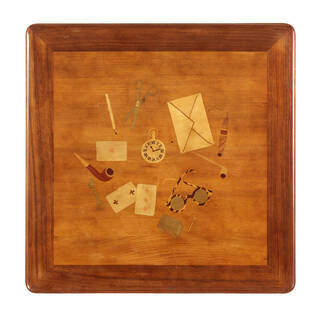
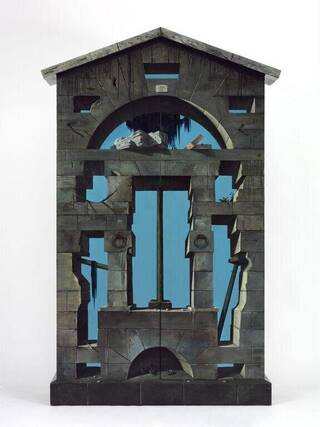
Schiaparelli was not alone in playing with space in three dimensions as well as two. In the same period that she and Dalí created the Tears Dress, the Paris-based Japanese artist Foujita (1886 – 1968) designed a wooden occasional table with intarsia motifs common to the trompe l’œil tradition, including playing cards and an envelope, and Eugène Berman (1899 – 1972) transformed the bulk of a wooden wardrobe into a stone arch with blue sky behind. Schiaparelli would have been familiar with such playful designs, the wardrobe was exhibited in a surrealist exhibition at Galerie René Drouin in Paris, next to Schiaparelli on Place Vendôme.
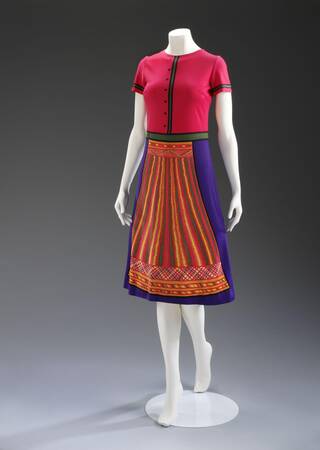
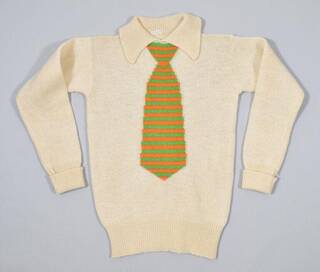
Schiaparelli’s trompe l’œil fascination not only connected her with artists past and present, but created a lasting fashion legacy. In the late 1960s, fellow Italian Giuliana Coen Camerino (1920 – 2010), designed a trompe l’œil dress for her fashion line Roberta di Camerino. The jersey dress is printed with an image of a blouse, belt and a skirt with a pattern evoking Mexican designs, inspired by Camerino’s recent trip to Guanajuato. Soon afterwards in London, Mr Freedom, a boutique known for its bright, fun clothes, created a masculine riposte to Schiaparelli’s Cravat sweater, complete with knitted shirt collar and striped tie.
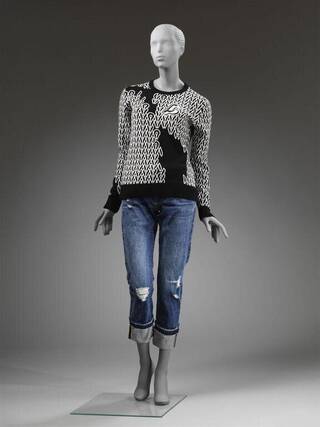
The influence of Schiaparelli designs continued beyond her lifetime. In 2014, UNMADE and Opening Ceremony created a knitwear collection with customisable trompe l’œil designs. The sweater, customised by SHOWstudio editor Lou Stoppard, features a pattern of oversized knitting stitches in black and white which are broken across the body to create the effect of an unravelling sweater. This bold design reimagines and combines Schiaparelli’s Cravat sweater and Tears Dress to create a contemporary nod to a fashion icon steeped in art history.