One of the more recent eras she looked back to was the Belle Époque. Spanning 1871 to 1914, this period of prosperity saw a flourishing of artistic creativity, especially in Paris. The era was named 'beautiful' in retrospect, both from the viewpoint of the horrors of the First World War, when people were already nostalgic for the optimism of the preceding decades, and the rise of aesthetic art movements from Impressionism, post-Impressionism and Art Nouveau. The period is epitomised by elegant posters, from the swirling forms of the Czech artist Alphonse Mucha to the now iconic image for the Parisian cabaret Le Chat Noir by Théophile Alexandre Steinlen.


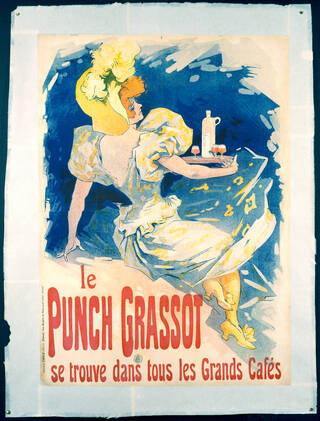
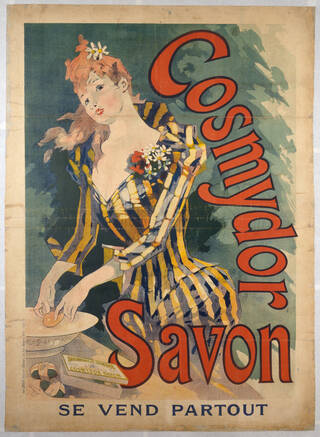
These posters capture the spirit of the age, from cabaret venues to newly available consumer products and its distinctive fashions. Jules Chéret, known as the Maître de l'Affiche, or the ‘Father of the poster’, was particularly skilled at making alluring images of women wearing 1890s fashions, with stylised forms which complemented dynamic poses.

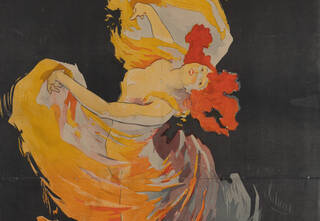
Schiaparelli collected posters by Chéret, including one of his most famous, advertising the Paris debut of the American dancer Loïe Fuller at the Folies-Bergère in 1893. Chéret portrays her performing the ‘Serpentine’ dance in her diaphanous costume, which perfectly matched Fuller's exuberant line.
Away from the world of performance, Chéret and many of his contemporaries delighted in depicting exaggerated silhouettes, from outrageously oversized sleeves (known as ‘gigot’ or ‘leg-of-mutton’) to the infamous bustle, a pad or structure which thrust out of the back of the skirt at the waist. And it was these fashions which drew the eye of Schiaparelli.
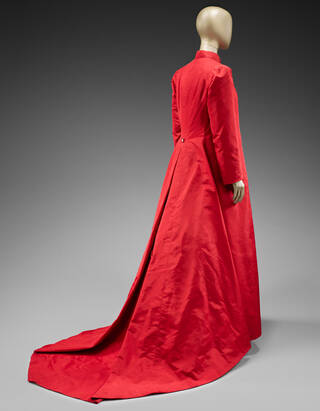
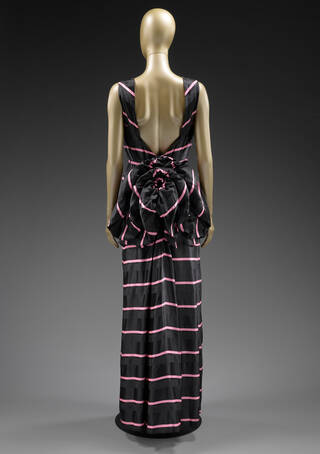
In the late 1930s, with the looming threat of another war in Europe, Schiaparelli created collections which took a nostalgic look back at Belle Époque fashions. A case in point is her summer 1939 season, often posthumously referred to as the Bustle collection. Rather than historical recreations, Schiaparelli took a more playful approach, and as the House announced, ‘Fullness appears cunningly in unexpected places’. In a striped evening dress she created a bustle-like fullness at the small of the back. A striking red evening coat from the same collection features a long train, which can be fastened into bustle‑like gathers.
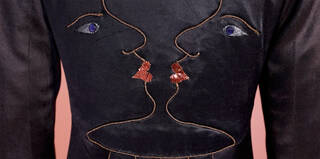
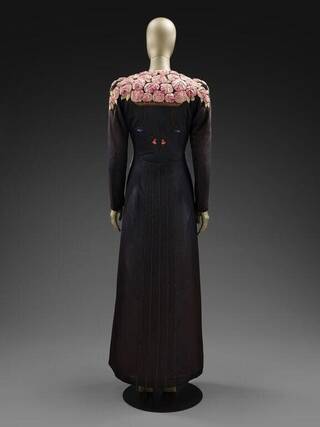
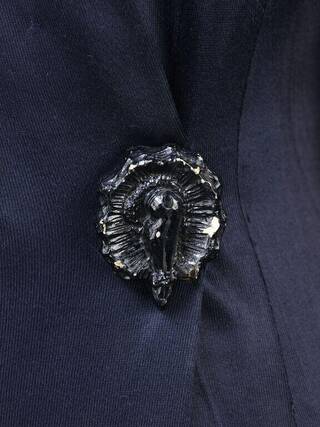
Schiaparelli had already shown interest in the Belle Époque in 1937 with a coat she designed with her contemporary, the artist and writer Jean Cocteau. While this coat is best known for the design of two faces in profile and a vase with roses on the back, on the front it features a button shaped like a can-can dancer’s leg, surrounded by layered skirts. This playful design is typical of Schiaparelli’s eye-catching and original buttons and also recalls the high-kicking dancers in posters by Henri de Toulouse-Lautrec.
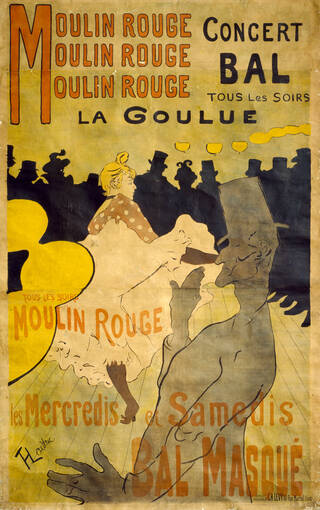
In the 1890s, Toulouse-Lautrec made numerous posters advertising theatres and cabarets, including the infamous Moulin Rouge in Montmartre. In 1891, he depicted La Goulue (The Glutton), stage name of the dancer Louise Weber, in action on the dancefloor with her right leg raised. She almost seems to kick her dance partner, Valentin le Désossé (Valentin the Boneless), stage name of Jacques Renaudin, who is seen in profile in the foreground, and her white skirts contrast against the top-hatted silhouettes of her audience in the background.
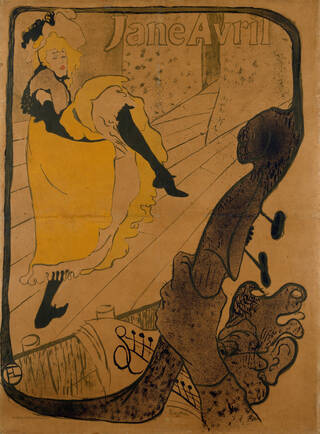
A similar can-can pose appears in Toulouse-Lautrec’s poster advertising the performance by his friend the dancer Jane Avril at the Jardin de Paris in 1893. Avril appears not with the profile of a fellow performer, but with the head of a string instrument, suggesting that we are looking up at her from the orchestra pit. As in the image of La Goulue, the contrast between the black stockinged leg and the pale dress and petticoats draws the eye to the centre of the composition.
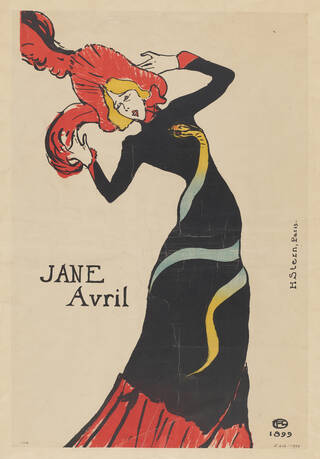
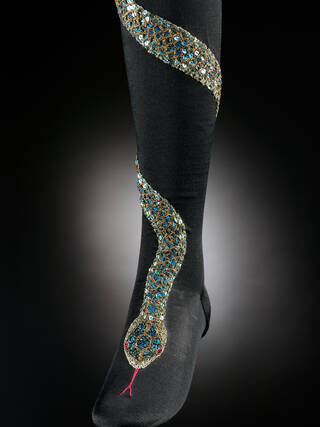
A pair of black stockings made in France around 1900 may provide a clue as to the kind that Avril herself would have worn. They feature a winding snake motif, made of sequins and beads, similar to the one on Avril’s dress in another image by Toulouse-Lautrec.
This image in turn inspired Elsa Schiaparelli’s costumes for the 1952 film Moulin Rouge, directed by John Huston. This biopic of Toulouse-Lautrec starred Zsa Zsa Gabor as performer Jane Avril. At Huston’s request, Schiaparelli created six historic costumes for this character, all inspired by his advertisements for the Parisian cabaret, including a faithful recreation of the snake dress with feather bonnet. Filmed in brilliant technicolour, the movie showcased Schiaparelli’s daring colour palette, one costume featuring a scarlet dress and an oversized flower, in Schiaparelli’s signature shocking pink, on the shoulder.
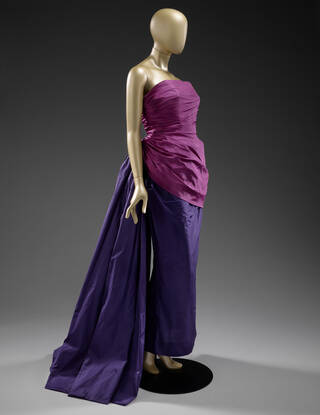
This return to Belle Époque fashions late in Schiaparelli’s career is also present in her collections. For Spring 1952, she created a dress in contrasting shades of purple, which featured an asymmetrical draped train to create volume.
Schiaparelli could always be relied upon for an innovative twist on fashions from the past, and from her provocative buttons to protruding bustles, she always made people look twice.