Giorgio Armani was born in Piacenza, Italy in 1934. After studying medicine for several years, from 1957 Armani worked in various roles for the Milanese department store La Rinascente and then as a designer for Nino Cerruti. Following several years as a freelance designer for a variety of ready-to-wear companies, in 1975 Armani launched his own men’s and women’s ready-to-wear label with the help of business partner Sergio Galeotti.
Armani’s designs for Richard Gere in the 1980 film American Gigolo showcased the unstructured tailoring, soft palette and understated approach to dressing that would become his signature. The designer’s 1978 financial agreement with textile company Gruppo Finanzario Tessile (GFT) helped Armani translate the urban energy and design rigour of Milan to a global audience.
When Time magazine featured the designer on its cover in 1982, this heralded not just Armani’s arrival, but that of Italian ready-to-wear. Armani’s international recognition was extended through a varied stable of collections including A/X: Armani Exchange, Emporio Armani, Armani Casa and, since 2005, the Armani Privé couture line.
Evening dress, Autumn/Winter 2012
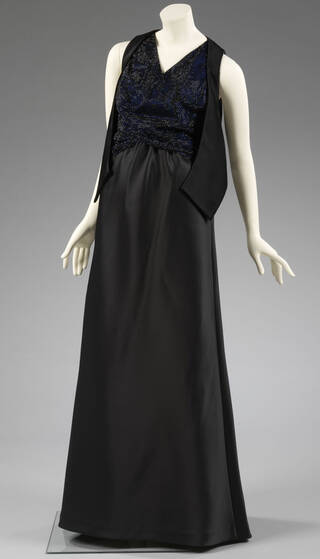
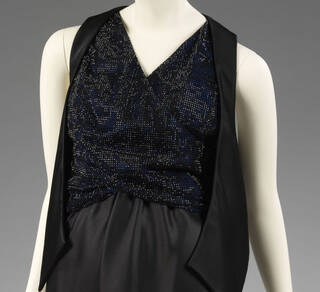
This couture evening ensemble from the Autumn/Winter 2012 collection represents the Armani signature style of easy-to-wear elegance in versatile colours, subtle textures, and luxurious fabric. The full-length black silk shantung skirt contrasts with the smoother texture of a black silk satin waistcoat top. The top is solidly embroidered with dark blue Swarovski crystals, adding a subtle colour accent and sparkle.
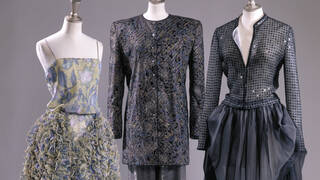
Evening dresses and trouser suit, Autumn/Winter 1990
These three stunning couture outfits were designed by Armani in Milan in 1990 and featured in his Autumn/Winter collection that same year.
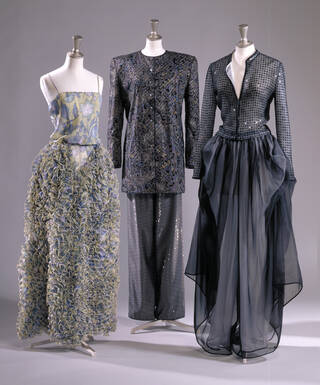
On the left we have a silk two-piece evening dress with an ankle length skirt densely covered in ruffles with scalloped edges.
In the centre is an evening trouser suit consisting of a jacket and trousers made from black and white printed silk and entirely covered in clear square sequins. In the late 1960s, tailored, hip-length jackets with standing collars and a long placket of buttons became popular in Europe. These garments were widely referred to as 'Nehru jackets' as they took inspiration from garments worn by Jawaharlal Nehru, Prime Minister of India from 1947 to 1964.
On the right, another fabulous evening ensemble consisting of black chiffon and organza trousers and a jacket lined with white chiffon with sequinned detail on the jacket.
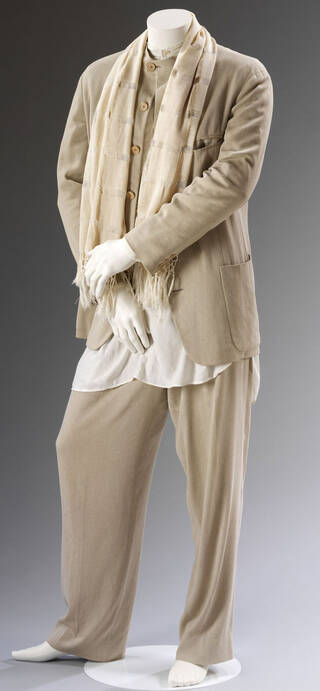
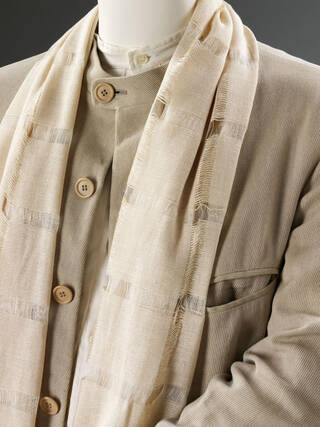
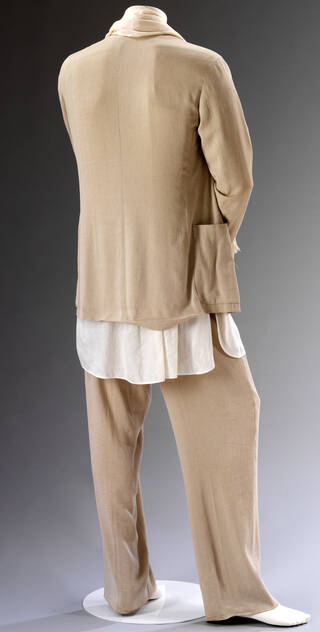
Man's suit, Spring/Summer 1994
Although Giorgio Armani oversaw numerous product lines, menswear remained central to his success.
"When I began to design, men all dressed in the same way. American industry called the shots, with its technicians scattered all over the world ... all impeccably equal, equally impeccable ... They had no defects. But I liked defect. I wanted to personalise the jacket, to make it more closely attuned to its wearer. How? By removing the structure. Making it into a sort of second skin."