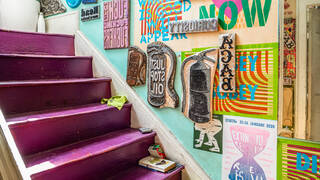
The V&A has a number of Miles' artworks in the collection, including woodblock printed flags, which were featured in the V&A's Barricade and Beacon display (2024). Miles has lived and worked in his East London home since 1990. Here he talks about how living in Dalston has led to creative collaborations and how it continues to inspire his work.
"I just want to be doing work that's going to be part of a revolution where we make a better world."
East London artistry
Why did you want to become an artist?
I always liked to draw when I was a kid and was very encouraged by my mum. But also, I wasn't very good at anything else. That meant it was quite simple to decide what I was going to do. My mum was always into art, my dad politics, so they would have been quite happy with how I ended up.
Where did you learn your craft and style? Was your time at Leicester Art College a period of experimentation with different techniques and media?
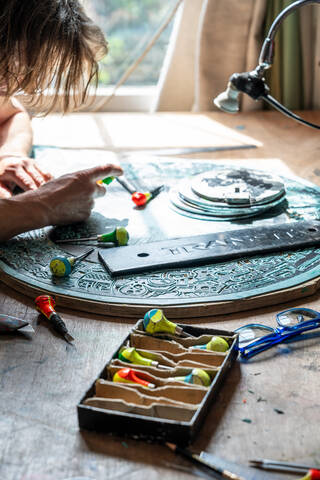
I went to do an art foundation at Harrow College of Higher Education. That was a really good place. After that I went to Leicester Art College and did Fine Art. I kind of ended up doing things that were strangely figurative. I was always quite keen on the artist Philip Guston. When my artwork didn’t go well, I kind of stopped and then I made sculpture. After I left college, I gave up making art quite a few times and worked in the film industry and on commercials doing scenic art. There's a sort of utility in the film industry. It's kind of the opposite to an artist sitting at home, instead you go somewhere very designed, very fast, with lots of money, and things look amazing. I then did computer graphics for 10 years, mainly 3D computer animation. That was just awful, but it means I know quite a lot about using computers for things and that's quite useful in some ways. I also made jewellery, which is essentially sculpture. I made some amazing things.
Why did you move to London after art college?
I moved to where I am now in 1990 and that was partly because of artist studios and that sort of thing. I think I thought the artists were in East London. I think they were. There were, and there are, artist studios and there was housing for artists here as well.
When did you meet Clare Farrell (designer and a co-founder of Extinction Rebellion) and how did that change the way that you were working?
I met Clare in 2015 when we began a project together, which became the Body Politic movement (#BODYPOLITIC). The project centred the use of the body as a message and started my move towards creative collaborations. We were interested in politics because it was near the period of Brexit, or just before it happened. The stuff with Clare was political and focused on the human body, doing workshops with people, even more collaboration. So very much the opposite of a solitary, non-political art, which is kind of what fine art is.
How has your experience of Dalston changed over the years?
In East London, Dalston was looked down on by all the other bits around it at that time until the multipurpose queer venue, Dalston Superstore, opened and things changed. From Dalston being like a s*** hole, it suddenly had the coolest bar in London. And that happened like instantly. I remember when I first went there, it really felt like Brooklyn. I've been to Brooklyn. I've been to New York. It was just really like that. Suddenly, it was the coolest place. It's very authentic. That must have been in the early 2000s.
How has living in Dalston inspired your work?
The texture of this area is quite rich and there are a variety of things to see around here. XR (Extinction Rebellion) was strong in Hackney, and the Art Group gang was strong in Hackney, so lots of the people who worked around here or came to volunteer in my house before we had the XR Factory (a studio space for XR creative projects) came from East London. It was relatively affordable and a good area for activist culture.
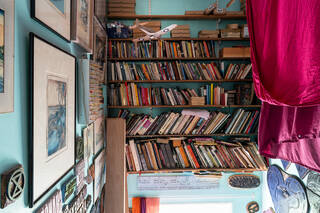
A big influence on me and Clare was going to 'teach outs' by Dr Debs Shaw, who teaches at the University of East London (UEL), and lives nearby. The Italian philosopher Antonio Gramsci came up with the idea that you teach for free in the community, and that way you create the ideal worker, or the cultured individual. Debs did a really good short course called Power and Politics. When we formed the Body Politics project, we had begun to think about things like that. And then that led into meeting loads of people, people we then went on to collaborate with in the community. I was saturated in what we were trying to do, and we're all still trying to do it, although not in XR anymore. So, to me, Dalston has some kind of saturated activist culture and politics.
You mentioned that the texture of the area is quite rich. Can you tell us more about that?
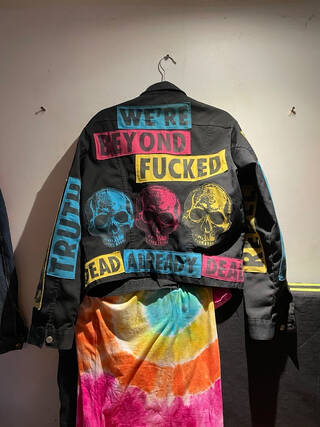
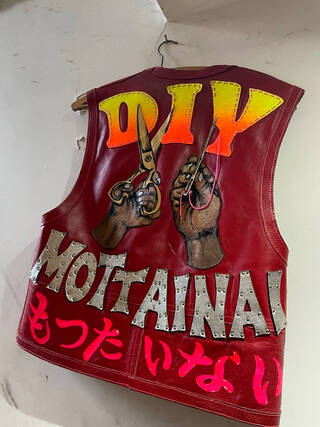
I think going through Ridley Road Market is interesting to see how things are made. I was always quite into glass beads and things. There are still industrial parts of East London, so if I cycle to see people, I still see those places, but they’re getting smaller.
The home
How did you end up living in your Dalston home?
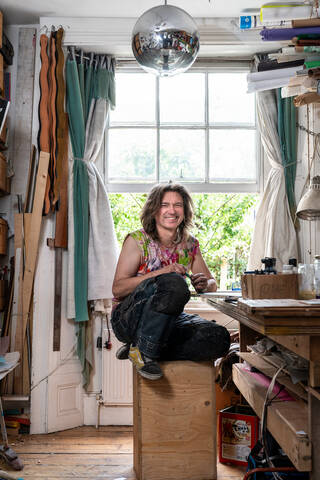
I like being near the market and it being quite lively. When my grandfather died, he left me some money, and that gave me the opportunity to buy this house, which was almost falling down. I've had to learn how to fix it over the years. It's given me this stability that other people don't have. I used to have a studio not in the house at one time. There are advantages and disadvantages to living and working in your house.
How has your home and archive evolved over the years?
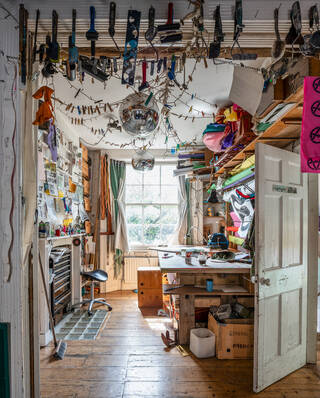
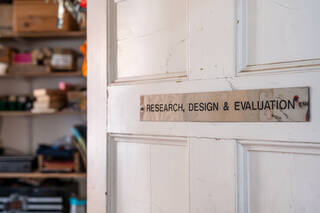
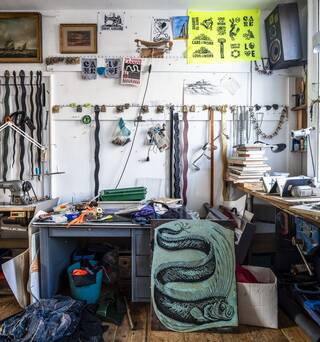
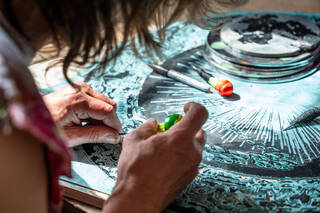
The ground floor has kind of always been my studio, and it has always changed. It was a jewellery studio, and now I'm trying to print a different way up, so it's got big tables in the middle at the moment. I have a digital archive that I constantly add to, kind of organised by type, though my website is starting to be alphabetical.
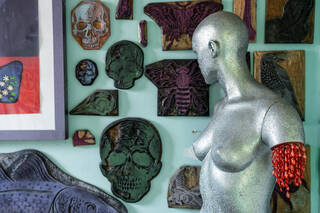
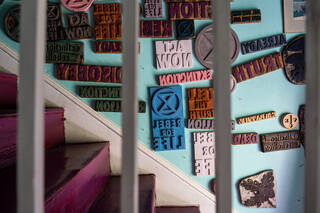
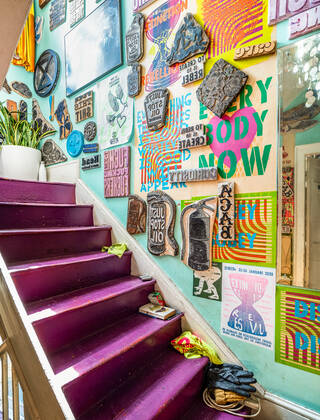
I started to put woodblocks up in my home around 2019. I do it so that I can find things and put everything back in the same place. If I’m using a block, I write on the wall what is supposed to go there. Things have started to go up in the bathroom, which is a sign, isn't it? I may be running out of space, but that’s okay.
What would your dream project look like?
I just want to be doing work that's going to be part of a revolution where we make a better world. I understand using the work to make a banner that goes on a wall, or is used in a demonstration, or to use in decor for a fundraiser or where people have meetings or something. I understand that. That makes sense to me. I can make a banner. However, if somebody wants something to go on their wall as a sort of pretty object, I kind of struggle with that a bit.
Printing the 'MagicAlphabet'
Tell us about your upcoming book which features your ‘MagicAlphabet’ series
We just want to print the book as big as possible and make it as cheap as possible. You would then basically use the book in order to create from it as well. You could buy three and then start tearing them up to paste up, to stick letters on the wall. So, the book's as utilitarian as possible and less of a permanent object, less fixed. Though there may be something fancier later.
Your work is rich with symbolism, motifs and storytelling. It’s particularly apparent in the design of your alphabet for the book
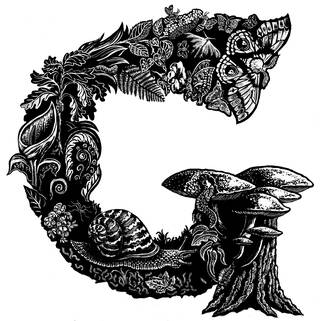
If we take a close look at the letter 'G' in the alphabet, that might help answer your question. There are things growing and mushrooms and then slugs eating mushrooms – it's about rebirth cycles.
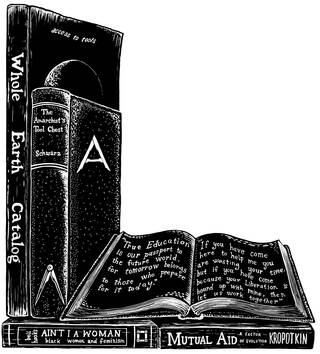
For the design of the letter 'L', Kropotkin was an early anarchist thinker. And then something by Bell Hooks. 'Ain’t I A Woman', which is the name of a speech that was given by the American activist Sojourner Truth, that's a phenomenal text on its own. So, it's nice to have that because it's showing influences and direction forwards. And the Whole Earth Catalog, which is like a pre-internet guide to survival ecology. The Anarchist's Tool Chest, which is a classic book on carpentry. There's a Malcolm X quote: "True education is our passport to the future world, for tomorrow belongs to those who prepare for it today", and there's a quote from a group of activists in Australia, part Aboriginal and part white: "If you have come here to help me in wasting your time, but if you have come because your liberation is bound up with mine, then let's work together". So yeah, maybe this does cover some of the areas that me and my friends are always thinking about.
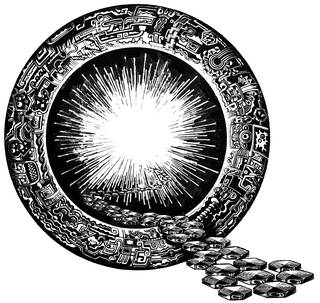
The 'Q' is everyone's favourite, which is lovely. The idea of going through some portal transformation, a crossing – it's a bit sci-fi. I was really into sci-fi when I was a kid.
What else are you inspired by whilst creating?
With jewellery I got really into the idea of making things the best I could and only a few things. Making one thing that's the best ever is much better than having 10 things that are really good. So currently with the letters, the process of me working on them is so torturous that I can't even bear to print them by the end. I'm so sort of sick of them. But that's okay.
With the genocide in Gaza, I started working on and finished the word 'Grief'. And I made the word 'Peace' relatively swiftly because there was an urgency. The 'Peace' and 'Grief' banners got used in a vigil by my friends in a fundraiser in Marylebone (London). I made the pigeon flags then, which were pigeons carrying a red key, a symbol of the return of the Palestinian people to their homes and it had an olive branch.
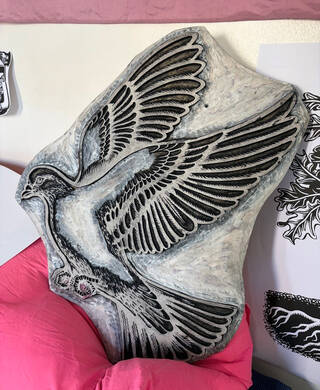
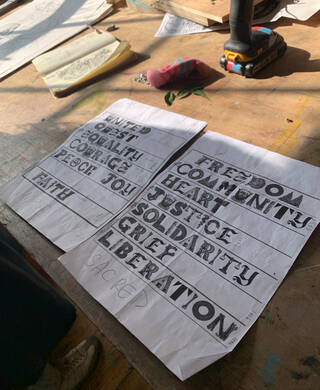
So, you're designing the letterform to convey the meaning of the word?
Yeah. And there's also a kind of thing which is that each word seems to need plant forms, you know. There's a lot of nature. They don't really work without the plant forms, things need to have a sort of softness. The banners are all on my website, so they can be borrowed. There’s a list of all the ones still to be done on the bottom of the web page.
Any final thoughts? How would you describe your practice as an artist?
All I want to do is give something that helps some transformation of society. I like things down to earth. I like things that aren't too fancy and highfalutin and I think that it makes life sort of democratic, you know, but it's best to make things that everybody can have.
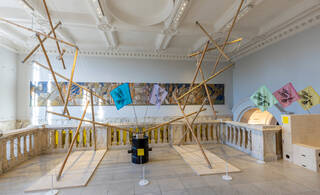
Miles’ designs and flags can be viewed on request in the Print and Drawings Study Room, V&A South Kensington.