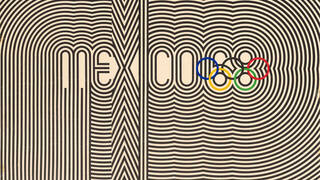
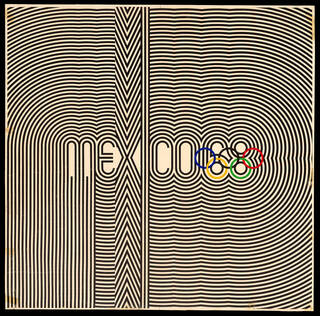
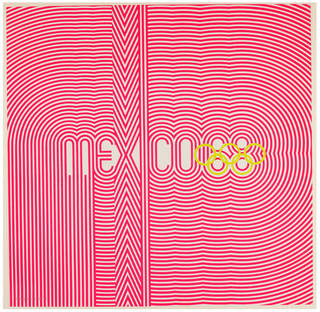
Printed in a distinctive square format, the poster design was a development of the neatly geometric ‘Mexico 68’ logotype, designed by the American graphic designer, Lance Wyman, and developed under the direction of Ramirez Vazquez (architect and President of the Organising Committee for the Games) and Mexican artist Eduardo Terrazas. Inspired by the Olympic rings symbol, Wyman developed the five circles into the year number ‘68’, then unified it with the lettering of the word ‘Mexico’ by means of radiating parallel lines.
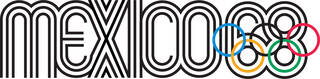
For the poster, the parallel lines were extended, radiating outwards to the four borders with dazzling impact. As well as the black and white version, the design was also printed in various vibrant colourways.
It’s interesting to compare the official identity with an earlier poster for the Games issued by the organising committee before the final graphic programme had been confirmed.
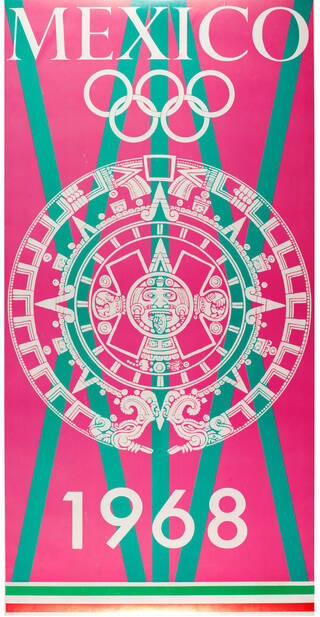
Mexico City had outbid Buenos Aires, Detroit and Lyons to host the 19th Olympiad in 1968, so becoming the first Latin American location for the Games.
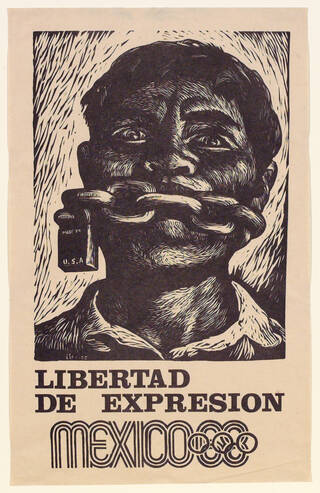
Ten days before the Games opened, protests led by Mexican students over the government’s heavy investment in Olympic facilities rather than in social programmes, were harshly put down by police and army units. A print by the militant Mexican artist Adolfo Mexiac, a prominent member of the artists’ print collective Taller de Gráfica Popular (‘People's Graphic Workshop’), showed a protestor symbolically gagged by a padlocked chain. Mexiac had originally designed ‘Libertad de Expresion’ (Liberty of Expression’) as a fine linocut in 1954. In sympathy with Mexican students, the artist adapted his design by adding the ‘Mexico 68’ logo, making a sarcastic connection between its circles and the links of the imposing chain.
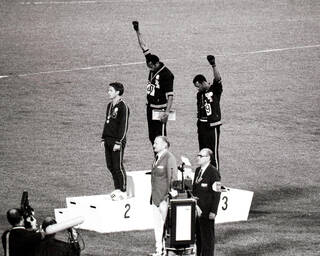
A demonstration of another kind became an enduring image of the Games: two black American athletes, Tommie Smith and John Carlos (gold and bronze medallists in the 200 metres), staged a silent protest against racial discrimination in the United States, giving a Black Power salute as the American National Anthem played during the victory ceremony.