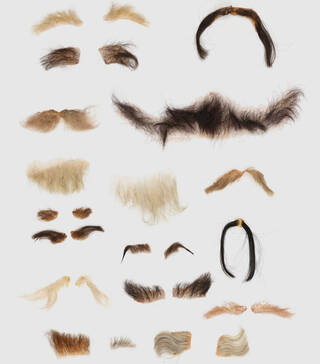
Music hall was the popular entertainment of its day and the range of moustaches, beards, sideburns and combinations was as diverse as the type of acts on the stage, many of whom played characters that reflected and satirised contemporary society.
Playing a character
Music hall programmes featured a mixed bill of short performances, with costume used to signal the type of act to the audience. Stars like Marie Lloyd wore the latest fashions to cement her status as the leading lady of the music hall stage. In contrast, Harry Lauder wore a kilt, sporran and carried a gnarled walking stick to reinforce his stereotyped Scottish stage persona.
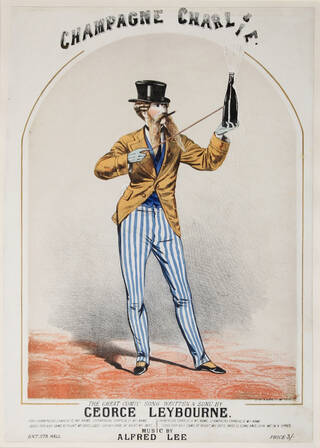
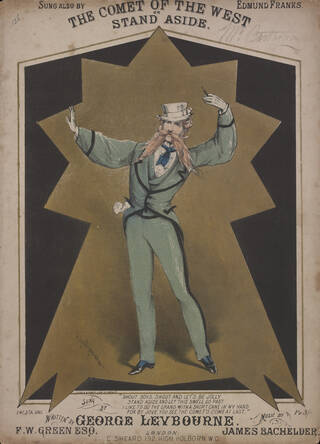
‘Champagne Charlie’, a champagne-guzzling dandy character performed by George Leybourne (1842 – 84), best exemplifies the rowdy music hall atmosphere, with audiences encouraged to drink and sing along to his comedic songs. He wore fashionable clothes that lampooned the modern middle-class ‘swell’, and sported exaggerated drooping 'mutton chops'.
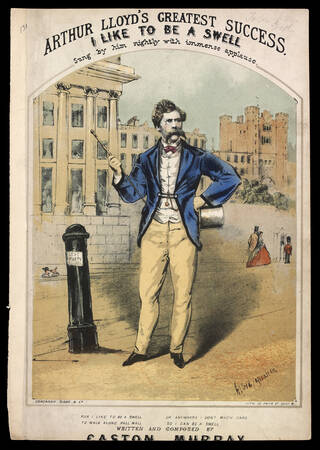
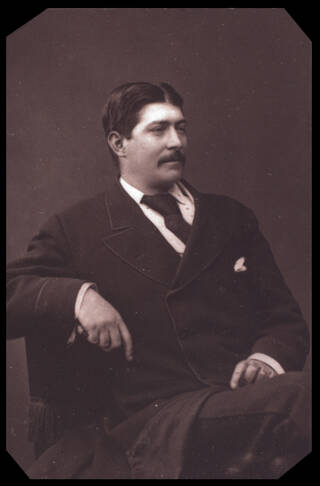
Described as ‘a Lion of a Comic’, the popular music hall character type became known as the 'lion comique', with variations played by other leading music hall artists, Arthur Lloyd (1839 – 1904), Alfred Vance (1839 – 88), also known as 'The Great Vance', and G.H. MacDermott (1845 – 1901), all with extravagant facial hair.
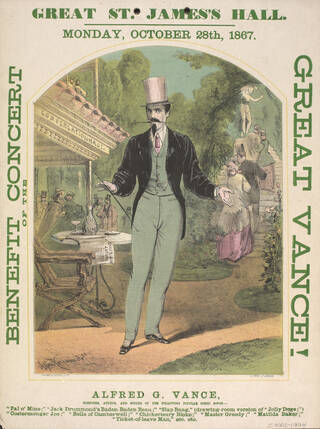
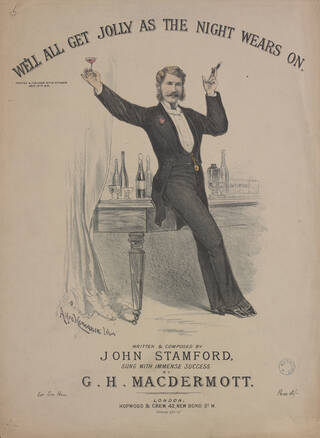
In reality Leybourne had a more modest moustache, wearing a fake one on stage. However, the distinction between the performer and his alter ego blurred. Leybourne found phenomenal success with his act, performing at multiple halls each night, driven around in his carriage pulled by four white horses and sponsored by French champagne house Moet and Chandon. However, the demanding lifestyle severely impacted his health and he died at age 42.
Music Hall variety acts
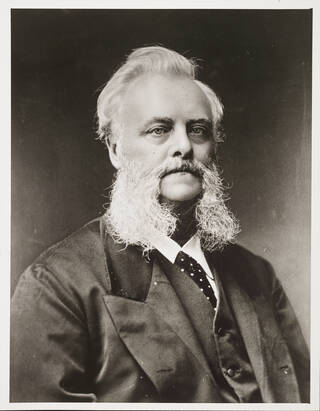
John Wilton (1820 – 81) was the proprietor of Wilton’s Music Hall and among his many admirable attributes was his ability book leading acts of the day, to retain an 'orderly house' in a 'notoriously difficult neighbourhood', being a founding member of the Music Hall Protection Society, and a Trustee of the Music Hall Sick Fund Provident Society. He also sported a magnificent set of 'mutton chops'.
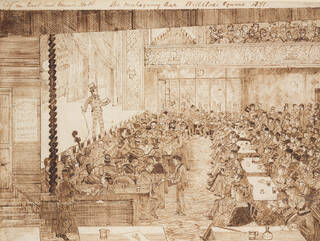
The music hall manager hosted the evening’s entertainment and acted as a master of ceremonies, speaking to the audience and introducing the acts. He was positioned in front of the stage and would have been visible to the audience throughout. His stylish appearance and facial hair would have contributed to the prestige of his music hall.
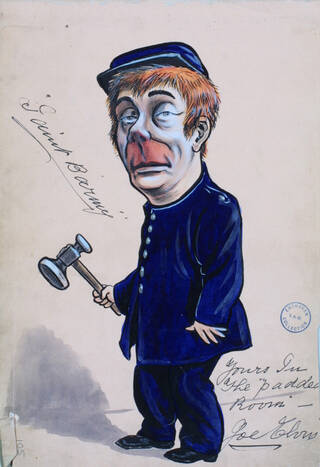
Facial hair was as varied as the acts on stage and supported their characters. Joe Elvin (1862 – 1935) specialised in comedy sketches and song and dance routines. He wore a bushy red moustache alongside a matching wig to create his trademark character.
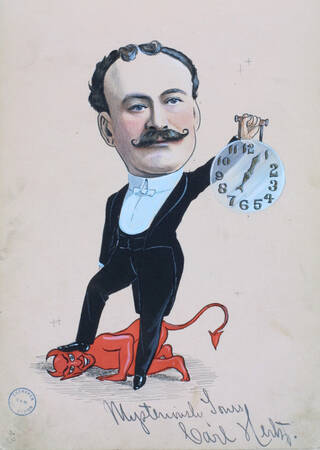
In contrast, magician Carl Hertz (1859 – 1924) wore a waxed and curled handlebar moustache – neat and well-groomed example that complemented his evening wear – demonstrating his control and mastery of illusion.
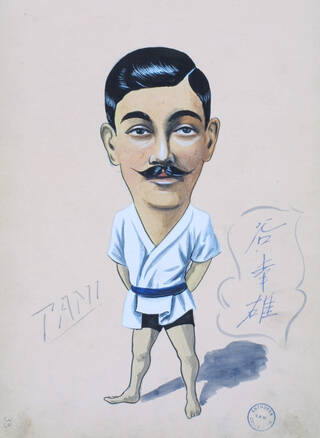
Another smart, waxed moustache was worn by Jiu-Jitsu expert Yukio Tani (1881 – 1950), indicative of his discipline in martial arts. On the music hall circuit, Tani would entertain by doing demonstrations and offer to fight audience members, with a reward for anyone who could defeat him. He allegedly only lost once, to fellow Japanese fighter, Taro Miyake. In 1904, Tani founded the Japanese Society for Jiu-Jitsu on London's Oxford Street.
Character and reality
One of the world’s most famous moustaches was born in music hall. Charlie Chaplin (1889 – 1977) performed on stage from a young age and, in 1908, was signed to Fred Karno’s music hall company. He received praise for his character parts, including a drunk who disrupted the evening’s entertainment. During a US tour, Chaplin transitioned to filmmaking, creating the legendary character, 'The Tramp’.
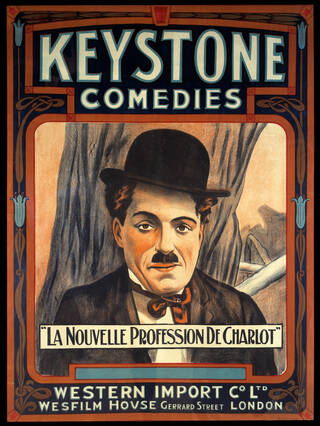
Chaplin’s father had been a music hall performer with some success but played no part in Chaplin’s early life, leaving Charlie, his mother, and brother Sydney in poverty. His upbringing between the workhouse and the stage informed The Tramp character, his rundown costume and the pathos within his stories. The Tramp’s bowler hat, cane, tight jacket, baggy trousers and, crucially, his toothbrush moustache, are instantly recognisable and remain a defining image of cinema.
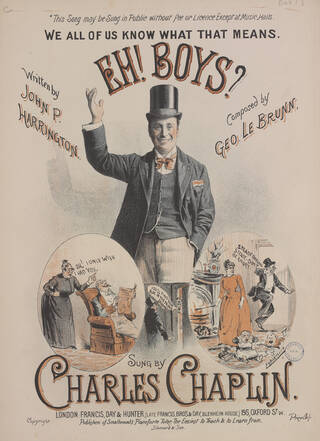
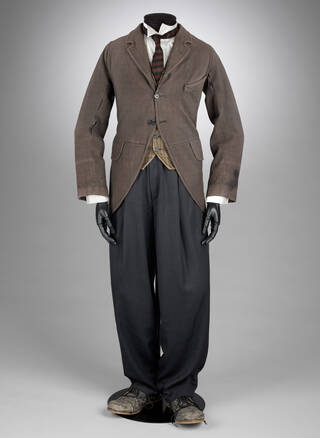
Chaplin’s early short films resemble music hall sketches, with a simple scenario, a recognisable character and slapstick humour. As silent films, the comedy is universal and Chaplin found worldwide fame. The Tramp costume and moustache remained consistent as Chaplin began to evolve the character and later moved to feature length films.
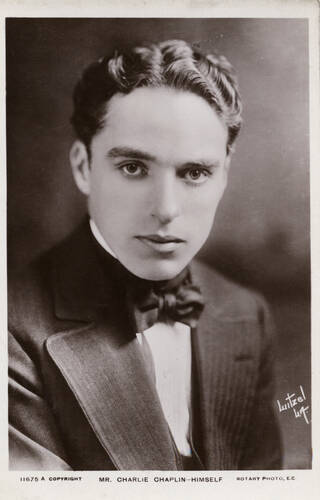
Chaplin kept The Tramp silent, even as talking pictures arrived, allowing him only a nonsense song in his final appearance in Modern Times (1936). For his next film, The Great Dictator (1940), Chaplin played a Jewish barber with striking similarities to The Tramp, retaining his iconic moustache. He also played Adenoid Hynkel, a character that satirised Adolph Hitler.
Chaplin and Hitler were born only four days apart and their distinctive toothbrush moustaches created a resemblance which Chaplin incorporated into the film. Finally giving a voice to his character, Chaplin used his platform and his moustache to denounce fascism and the ills of the modern world. Working in Hollywood, it was an impassioned speech designed to encourage US engagement in the Second World War.
Comedy sketches
Just as Chaplin had evolved The Tramp, music hall itself had grown and adapted into the more respectable variety entertainment. By the mid-20th century, variety performers like Tommy Cooper and Morecambe and Wise were as comfortable performing on television as on a theatrical stage. Shows continued a mixed programme of comedy with music or magic and guest performers.
Television enabled comedy acts to film short scenes in advance, with the sketch show featuring the same fast-paced acts in a music hall programme, but often from a single performer or group. Costume and disguise were used to create immediately identifiable characters, as performers jumped between roles. The Two Ronnies, Ronnie Barker (1929 – 2005) and Ronnie Corbett (1930 – 2016), enjoyed enormous success on stage and screen.
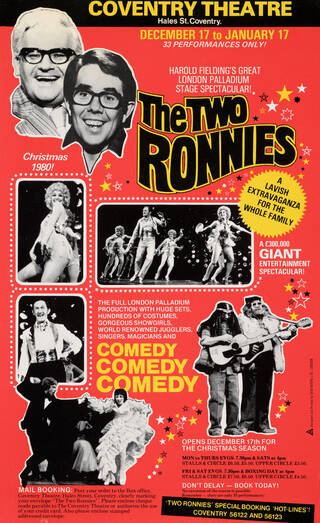
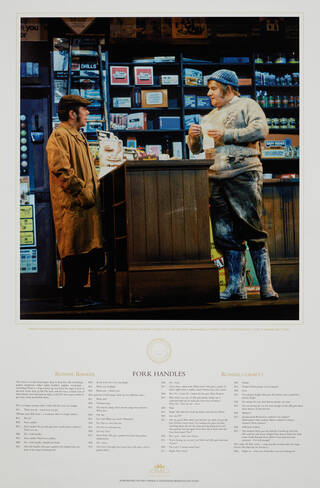
Ronnie Barker built an extensive collection of fake facial hair, worn to create his array of comedy characters. His moustaches, side-burns, eyebrows and beards shifting him from a bumbling buffoon to a suave gentleman.
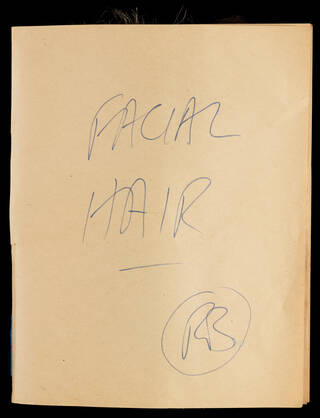
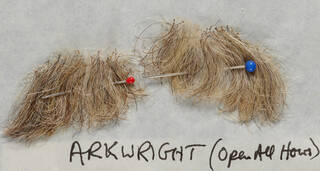
Identifying which comedy characters performed strongly with audiences lead to longer form storytelling. In sitcoms, comedians could deliver nuance and develop personality over the course of episodes and series. Ronnie Barker’s fondly remembered characters, Arkwright in Open All Hours (1973 – 76) and Norman Stanley Fletcher in Porridge (1974 – 77) were performed during the same period. Barker’s use of facial hair helps to distinguish the two very different characters, the clean shaven and outspoken Fletcher and the stuffy and old-fashioned Arkwright, with his signature greying moustache.
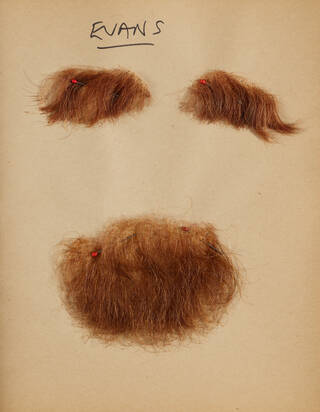
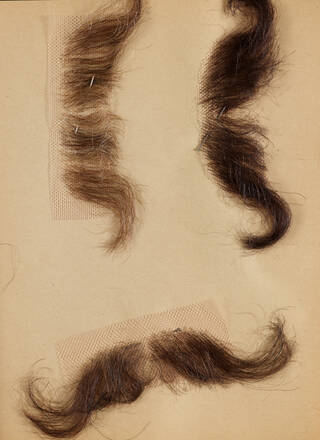
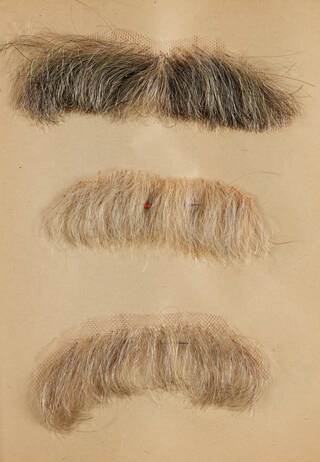
Whether deployed for fashion or comedy, facial hair is a prominent expression of identity. From the fashionable Victorian gent to the old-fashioned miser, memorable facial hair has helped bring characters to life, becoming as recognisable as the performers themselves.