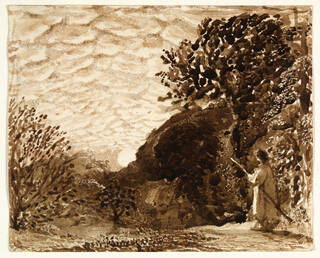
Palmer often created these scenes in stark monochrome, strongly outlined rather than the delicate watercolour technique of his contemporaries. This idiosyncratic style was unappreciated during his lifetime. However, an exhibition held at the V&A in 1926 reinvigorated interest in his work and he became an inspiration for artists interested in idyllic and visionary elements of landscape in the 20th century.
Early career and inspirations
Palmer showed early promise as an artist but did not attend formal art school, instead following his own individual artistic path. He dismissed the style of his contemporaries, such as John Constable (1776 – 1837), Thomas Girton (1775 – 1802) and David Cox (1783 – 1859), who were creating delicate watercolours in washes of colour, with careful naturalistic observation of the landscape, calling them "housepainters and sky sloppers and brush blotters" (letter to George Richmond, Shoreham, September 1828). Palmer cautioned himself to "carefully avoid getting into that style which is elegant and beautiful but too light and superficial" (from Palmer's pocket book dated 1823 – 24 and quoted in The Life and Letters of Samuel Palmer by A. H. Palmer, 1892).
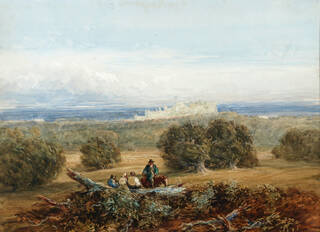
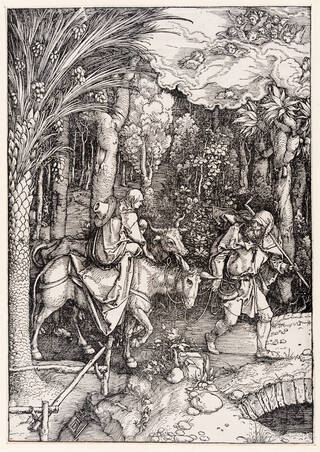
Instead, Palmer was inspired by earlier artists – "the fine pictures of the 13th, 14th, and two following centuries, which our modern addlepates [idiots] grin at for Gothic and barbarous…" (letter to John Linnell, 21 December 1828.) He was inspired by the spiritual focus and grand gestures of Michelangelo (1475 – 1564) and the bold outlines, intense detail and religious imagery of Albrecht Dűrer’s (1471 – 1528) woodcut prints.
"The past for poets: the present for pigs."
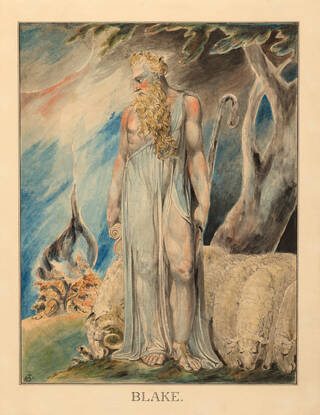
At this critical stage in his artistic evolution, Palmer came under the formative influence of the visionary poet and artist William Blake (1757 – 1827), who he met in 1824. Palmer became part of a group who called themselves 'The Ancients', who were captivated by Blake's unconventional art and beliefs. Blake's conviction that art should look beyond the merely physical and focus on conveying a spiritual truth appealed to Palmer's own strong faith and confirmed his desire to follow a similar path.
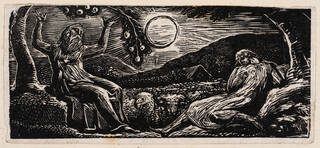
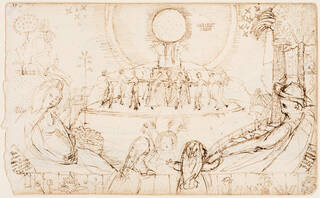
Palmer's 1824 sketchbook (several pages of which are in the V&A's collection and others in the British Museum) show him experimenting with his new style while exploring the countryside around London. He depicts the rural landscape, including huge suns and moons and simplified figures, in intense, exaggerated outlines. Palmer often rejected naturalism, choosing instead to depict symbolic representations of idealised landscapes.
Shoreham, Kent
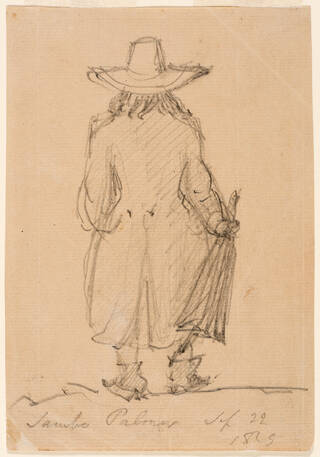
Encouraged by his desired artistic direction, Palmer left London – "the great national dustbowl" (letter to George Richmond, Shoreham, October 1834) – in 1826 and moved to the village of Shoreham in the Darent Valley in Kent, England. Palmer was seeking a rural idyll where he could be among the ancient agricultural rhythms of life. He signalled this shift by growing his hair and beard, which was extremely unfashionable in the 1820s. Wearing a large, oversized hat and coat with pockets full of sketchbooks and drawing materials, he tramped along the valley finding inspiration. Palmer's intense and detailed studies of hills, fields and especially trees were a form of meditation focussed on the wonder of creation.
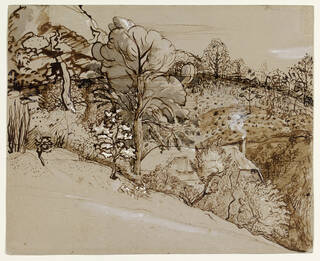
Palmer revelled in the landscape of Shoreham and the surrounding area, drawing extremely detailed studies of tree-covered hills and cottages and barns, which seemed to him characteristic of a peaceful rural life that had remained unchanged for centuries.
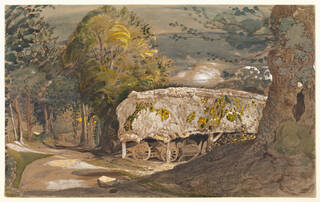
Palmer also reimagined the Kent landscape as an idealised realm of rural comfort and plenty with bountiful harvests and round woolly sheep guided by gentle shepherds. Palmer's landscapes are rarely realistic scenes, but rather allegories of how nature's bounty reveals God's benevolent provision of physical and spiritual sustenance.
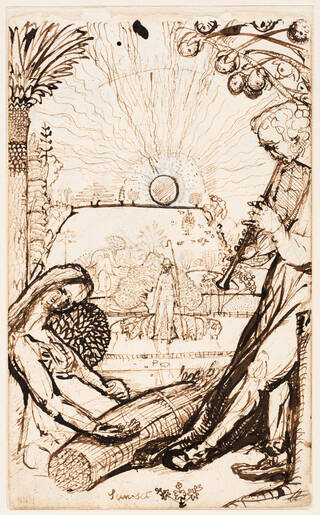
Churches were an important focal point in his works, nestled closely in the landscape but with prominent spires pointing skywards. These reflected Palmer's strong religious faith, believing that without the village churches "you have a frightful kind of paradise left – a paradise without a God" (letter to Hannah Palmer, London, 1856).
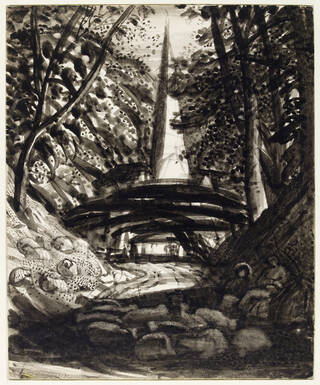
Palmer produced many twilight and nocturnal scenes, lit with magnified moons and stars. He loved walking and sketching under the light of a full moon. As London was beginning to be illuminated by the introduction of gas street lamps, the peaceful light of the moon harked back to simpler times. For Palmer the moonlight that allowed additional time for walking, reading or harvesting was another gift from God.
"Methinks the lingering, dying ray
Of twilight time, doth seem more fair,
And lights the soul up more than day."
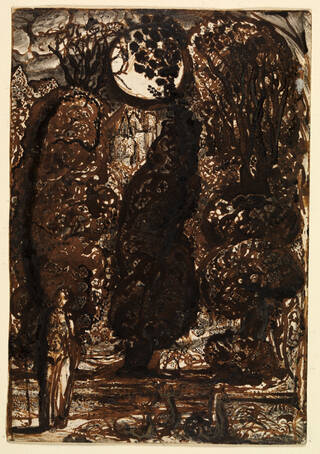
Palmer's romantic vision showed little of the hardship of rural life or the encroaching industrialisation. There were riots in Shoreham in 1830 after the introduction of threshing machines reduced work for labourers, but you would never know it looking at Palmer's idyllic scenes.
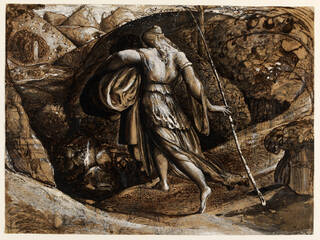
'Ruth returned from Gleaning' – A Blakean figure in a Shoreham landscape
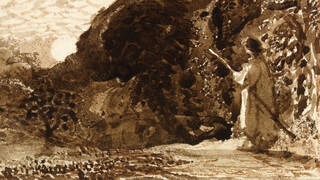
Ruth returned from Gleaning'was one of only a handful of Palmer's Shoreham works to be accepted for inclusion in the Royal Academy exhibition in 1829. Ruth, who appears in the Bible's Old Testament, carries a large bundle of barley while her mother-in-law Naomi awaits her, reading a book by candlelight. The background of round hills, dotted with sheep, and a winding river were influenced by the landscape of the Darent Valley. With a limited colour palette and strong outlines, and shading sketched in pen lines rather than washes of colour, this work demonstrates Palmer's Shoreham-period style. The figure of Ruth is unrealistically distorted, showing the artist's regard for the amplified muscular figures of Blake and Michelangelo.
'In a Shoreham garden' – Shoreham in colour
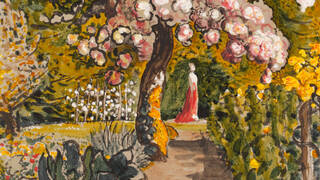
In contrast to much of his monochrome work, In a Shoreham garden is a riot of colour. A tree is in full and exaggerated bloom, typical of Palmer's love of fruitfulness. Palmer's son Herbert describes the work almost with embarrassment: "… when he entered in nature any instance of prodigal profusion, whether of foliage, blossom, or fruit, his delight took his imagination by the hand and led it far away from beaten tracks. The result is either impressive or ridiculous…" (The Life and Letters of Samuel Palmer by A. H. Palmer, 1892).
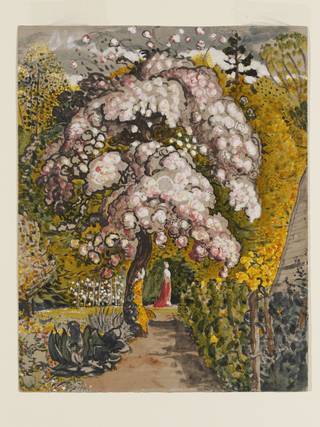
Herbert is often a harsh critic of his father's idiosyncratic approach and wrote in his biography of Palmer that his style during this period was "inexperience lashed on by an ill-controlled and powerful imagination…. If nature has been consulted, it has been consulted as it were in a distorting glass".
End of the dream
Palmer stubbornly kept to his rural retreat and unconventional style for seven years despite friends warning him that his professional career would suffer. He believed his approach was sanctified by God and that to revert to pretty, marketable landscape scenes would be a betrayal of this:
"By God’s help I will not sell away his gift of art for money no not for fame either… by making studies of the Shoreham scenery I could get a thousand a year directly. Thou…I will, God help me, never be a naturalist by profession…."
But the dream could not last. Unable to make money to buy materials, he resigned himself to returning to London and attempting to be a more commercial artist. He sighed that the "poetic vapours have subsided and the sad realities of life blot the field of vision" (letter to George Richmond, August 1835).
Most of Palmer's Shoreham works were never shown in his lifetime, but Palmer cherished them as memories of a happy time, keeping them in a special folder he called his 'curiosity portfolio'.
After Shoreham
In the later 1830s, Palmer travelled in England and across Europe hoping new locations would reinvigorate his artistic imagination. Abandoning his Shoreham style, he became more conventional, producing more colourful, naturalistic landscapes depicting reality rather than vision.
From his studies of Florence in Italy and Tintern Abbey in Wales, we can see that Palmer still loved to focus on a motif nestled within a valley. His attention to detail can be seen in the rendering of the architectural features of these two magnificent places. However, his bold lines and monochrome have been replaced with a soft wash of light colour.
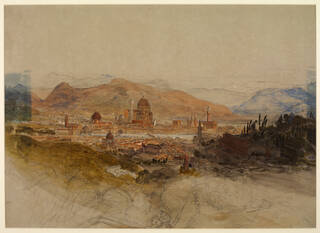
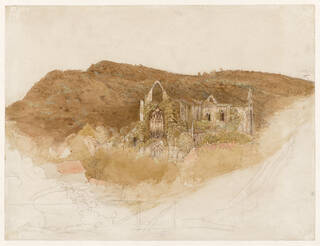
Unfortunately, the market for such views had dried up, leaving Palmer with no choice but to turn to private art tutoring to help bring in money.
In a nod to his previous love of exaggeration, but a stark departure from his preference for a subdued palette, Palmer’s paintings from the 1850s to his death in 1881 were characterised by intensely coloured skies.
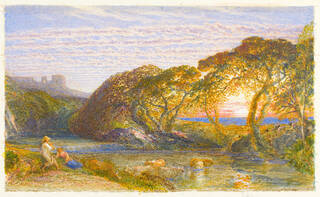
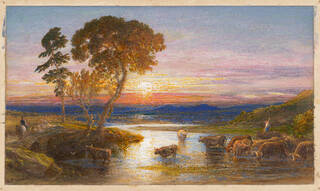
His restful rural figures make an appearance in these later works, but were felt dated when compared to the exhilarating art and subject matter of the pre-Raphaelite artists who were emerging from the 1850s.
Etching
In 1850, Palmer turned to etching and found a new vehicle for his visionary imagination, which gave him much joy in his later years. He returned to creating densely worked monochrome images, this time in print rather than drawing.
"Oh the joy! Colours and brushes pitched out of the window; plates the liber studiorum size got out of the dear, little etching-cupboard where they have long reposed; great needles sharpened three-corner-wise like bayonets; opodeldoc [a medicinal balm] rubbed into the forehead to wake the brain up; and a great gorge of old poetry to get up the dreaming."
Many of the motifs of his earlier Shoreham days reappear in his prints – lithe, graceful trees, flocks of docile sheep, blazing suns and moons.
Palmer loved the painstaking discipline of carefully scraping his designs into the metal plate, working and re-working it to achieve his desired tone and effects. To ensure the prints were exactly as he wanted them, Herbert installed a printing press in their home and worked with his father to perfect the finished print.
His perfectionism resulted in astonishingly meticulous images, but he was excruciatingly slow with the process. Palmer only created 13 plates, some unfinished, before his death in 1881.
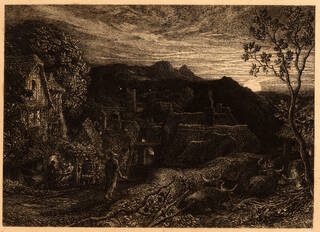
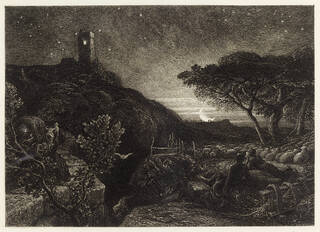
Despite a memorial show at the Fine Arts Society in 1881, and Herbert's memoir of his father's life in 1882 and The Life and Letters of Samuel Palmer, Painter and Etcher in 1892, Palmer remained a marginal figure. His works, especially his paintings, were mostly unknown to the wider public. It wasn't until the early 20th century that interest in Palmer's paintings began to accelerate, and his paintings started to enter major museums. Artist and printmaker Frederick Griggs (1876 – 1938) became fascinated with Palmer's atmospheric pastoral prints. He, along with printmaker and tutor Frank Short (1857 – 1945) and V&A Curator Martin Hardie, contacted Herbert and organised the reprinting and exhibiting of some of Palmer's prints, including a major retrospective of his work at the V&A in 1926.
Rediscovery in 20th century
The 1926 exhibition of Palmer's work was instrumental in the rediscovery of his art in the 20th century. This was the first time that work from all parts of Palmer's life, including much from his Shoreham period, was publicly shown. Herbert Palmer was integral to the success of this show, although his complex relationship with his father's legacy had led him to destroy many of his father's Shoreham works in a bonfire in 1910. Thankfully, enough of them had survived to enable Palmer's visions of idyllic rural scenes and his intricate and detailed style enthuse and inspire young artists of the day, such as Paul Drury (1903 – 87), John Piper (1903 – 92), Eric Ravilious (1903 – 92) and Graham Sutherland (1903 – 80). Their own work reflected a similar nostalgic desire for a pre-industrial paradise as the modernisation of the early 20th century invaded the countryside with busy roads and large-scale agricultural sites.
After feeling neglected and misunderstood during his lifetime, Palmer would no doubt be delighted that two centuries after his Shoreham sojourn, his vision for a spiritual, joyous and restorative relationship with nature still resonates.