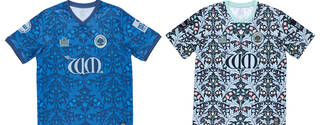
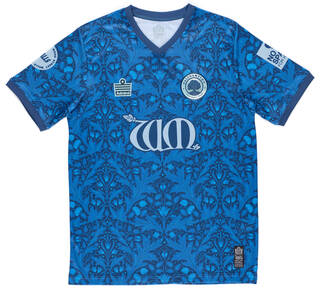
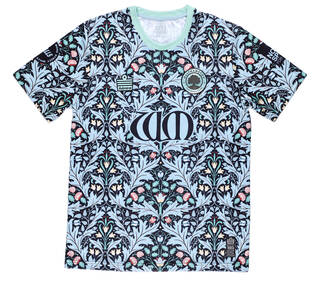
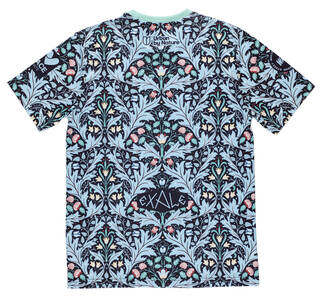
The pattern was created by John Henry Dearle (1859 – 1932) for Morris & Co. in about 1892. The shirts reimagine the pattern in two colourways – the ‘away’ shirt is closer in colour to the original design, while the ‘home’ shirt echoes Walthamstow FC’s traditional team branding, in blue.

The collection celebrates artist and polymath William Morris’ (1834 – 96) deep-rooted connection to Walthamstow in East London – his birthplace and childhood home – and speaks to the enduring legacy of his work in the local community.
The initial concept was conceived by Mark Clack, founder of Walthamstow-based design collective Wood Street Walls and was their first foray into textile and product design. Clack's approach evokes Morris’ own ethos of social enterprise and community-building:
I came up with the idea for the design because I wanted to find a creative way to generate funds for the team, to use the revenue from shirt sales to create a woman’s [sic] team.
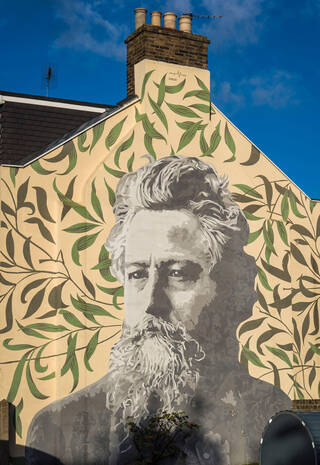
Wood Street Walls has developed numerous public art projects in the Waltham Forest borough and beyond, aiming to empower local artists and enrich the built environment with art relevant to contemporary issues. In 2016, they led a community project to create a mural of William Morris on Bedford Road in Walthamstow.
The spirit of William Morris is ever-present in Walthamstow today, and the reason why there is this huge community spirit is because people share a common love for beauty and for caring.
Based at Morris’s childhood home in Walthamstow, the William Morris Gallery played a key role as museum partner in the project, granting designers from Wood Street Walls access to their archive of Morris & Co. designs.
Born in Camden, London, John Henry Dearle became William Morris’ first apprentice at the age of 19, having worked as a shop assistant at the Oxford Street showroom. He was taught tapestry weaving by Morris himself at the Queen’s Square workshops before moving to the Merton Abbey Workshops in Surrey (now Greater London). Dearle went on to train apprentices himself. George Wardle, once business manager of Morris & Co., reflected:
It is however fair to add that in putting Dearle to the work in the first instance, Mr Morris was influenced by the evidence, intelligence and brightness of the boy. Dearle was the teacher of all who followed him…
Dearle would go on to produce some of Morris & Co’s most successful pattern designs, working across tapestry, stained glass, wallpaper and printed textiles. From 1890, Dearle was head designer of Morris & Co. and, following Morris’ death in 1896, he became Art Director of the company.

Once the 'Yare' pattern choice had been confirmed, Clack approached British sportswear brand Admiral to produce them. Founded in Leicester in 1914, Admiral was the first manufacturer of replica football kits in the world in the 1970s. Their first task with the Walthamstow kit was to digitally re-draw and adapt the colours from Dearle's original design, which would have originally been hand printed, to make it work with the sublimation printing technique (a process whereby patterns are transferred to fabric by applying heat and pressure). Admiral then advised on the placement of the collaborator and community partner logos and badges. The William Morris Museum logo (which happens to be Morris' initials), in an Arts & Crafts-style font, was placed prominently centre-front. The design was also adapted for a zipped 'walk out' jacket, a 'blackout' version of the shirts and shorts.

The legacy of Morris himself, the companies he led, and his talented daughter May Morris are represented in over 900 works across the V&A collections. Acquisitions that reflect on Morris’ enduring relevance – whether as comment, critique, or celebration – include prints and posters by David Mabb, Giles Deacon and Jeremy Deller’s ‘wearable art ensemble’, and Kehinde Wiley’s ‘Portrait of Melissa Thompson'.


