On 11th October 2025, I had the immense privilege to stand under the Torrijos Ceiling at V&A East Storehouse, and contribute, through a performance of five songs, to the event Focus On: Torrijos Ceiling. This multi-disciplinary event celebrated the art and craft of the Torrijos ceiling, through practical workshops, pop-up talks and performances, object encounters, and contemporary responses to the ceiling and the historical moment in which it was created. As a singer, I was granted the unique experience of performing under one of the magnificent wooden structures which once adorned the spaces of the Torrijos palace, designed and crafted to impress the gatherings of the most select members of Castilian aristocracy of the time. To honour this extraordinary legacy, and to explore the acoustic qualities of this exquisitely ornate structure, I curated a repertoire consisting of five Medieval and Early Modern songs, each selected to illustrate the cultural intersections and cross-pollination which so uniquely characterised late-15th century Iberia, a frontier territory suspended between the twilight of the Middle Ages and the dawn of Modernity.

The sources
Music was a very prominent element of entertainment culture at the courts of Castile and Aragón. As documented by chroniclers and abundantly studied by historians and musicologists, the Catholic Monarchs Isabel I of Castile and Ferdinand II of Aragón, whose joint reign spanned the period between 1476 and 1504, surrounded themselves with a vibrant collective of musical composers and poets, building on a long and rich peninsular tradition of royal patronage.1
Music and poetry at the courts of Castile and Aragón had been for centuries shaped by the confluence of Iberian artistic traditions, as well as by international influences, principally Catalan, Occitan, French, and Italian. Far from standing in isolation, we should imagine the royal courts of the time as multicultural and multilingual hubs, whose production reflected the interests of prestige-seeking royal dynasties connected by transnational marriage alliances and political ambitions.2
The refined taste of the Monarchs undoubtedly inspired entertainment practices at the courts of the high aristocracy, and the household of Gutierre de Cárdenas and Teresa Enríquez, lord and lady of the Palace of Torrijos, would have been no exception.
Among the authors that enjoyed greatest prestige at the royal court were Juan del Encina (c.1468-1529), playwright, poet and innovator of Castilian letters and music; Francisco de Peñalosa (1470-1528), one of the most celebrated composers of his time, and master of sacred and profane polyphony; and court chapel master and singer Juan de Anchieta (1462-1523). These authors, and many more, are represented in the most important musical document of the period, the Cancionero Musical de Palacio, or Palace Songbook.
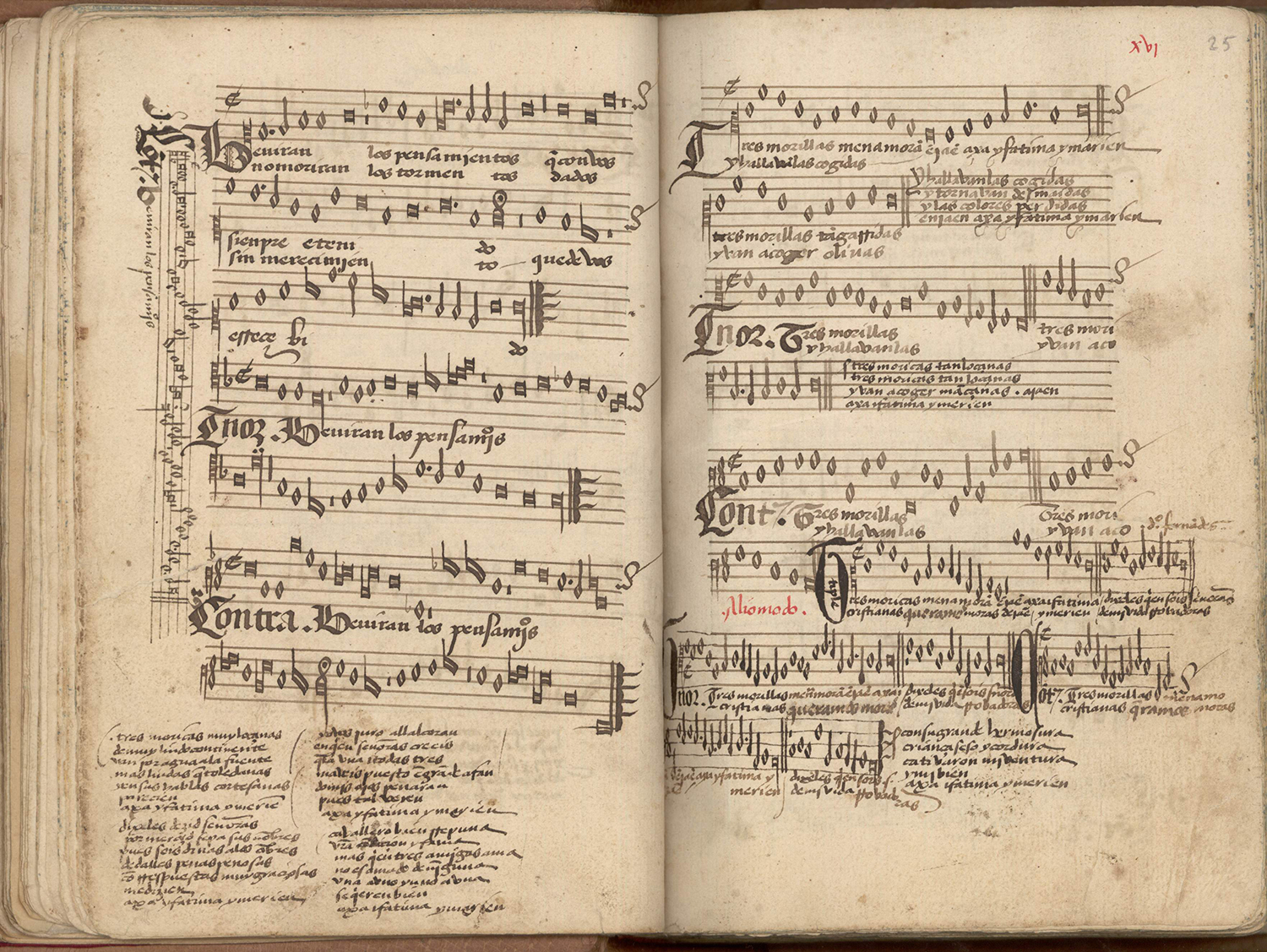
This Songbook was discovered in 1870 by musicologist Francisco Asenjo Barbieri in the library of the Royal Palace in Madrid. The manuscript is catalogued as MS II–1335, is available in fully digitised format. Since its discovery, it has fascinated academics and musical practitioners alike, as it represents the most complete anthology of Spanish court music in the Late Medieval period and early Renaissance. Compiled over a period which spans from the mid 1470s to the first two decades of the 16th century, the Cancionero Musical de Palacio tells us much about the tastes, influences and musical practices of the time.

The repertoire of the Cancionero consists of 458 musical pieces, both sacred and profane, mostly polyphonies for up to four voices, with or without instrumental accompaniment. While most compositions are in Castilian, there are other languages represented in the corpus, such as Italian, Catalan, Occitan, Latin, Portuguese, and even two compositions in Basque (the pieces listed as 174 and 461). The variety of song genres and languages suggests a vibrant, international courtly environment. The Cancionero repertoire is representative of the “high” music played at the courts of the aristocracy of the time, yet it reveals a distinct appreciation for popular musical forms and lyrical themes. The song forms most represented in the Cancionero are in fact the villancico (literally “song of peasants”) and the romance, or Hispanic ballad, both characteristic of Castilian orally-transmitted folk song. For my performance, I selected pieces from the Cancionero that are representative examples of these two genres. Furthermore, the romance acted as a bridging element to link the courtly musical culture of Castile with the Hispanic oral tradition, which develops in the Early Modern period and continues to the present day.
The first three pieces I performed therefore represented courtly musical culture, and the themes which captivated the interests of poets and composers associated with royal power, while the fourth and fifth pieces bring us to the Hispanic oral tradition which develops in parallel, and bears witness to the historical consequences of the political decisions taken by those in power.
Both these last two pieces belong to the orally-transmitted song tradition of the Sephardic Jews, who were expelled from the territories of the Crowns of Castile and Aragón in 1492, by a decree signed by the Catholic Monarchs in the immediate aftermath of the conquest of Granada and their establishment in the palaces of the Alhambra. In the heart of the communities of the Sephardic Diaspora, the romances of the Hispanic tradition continued to be sung and transmitted to each new generation, a cultural heirloom which came to represent the identity of the people who cherished them. At the same time, new songs (kantigas, komplas) were composed, based on inherited Hispanic musical and textual patterns, but bearing the distinct features of Sephardic diasporic culture.
In my performance, all five pieces were performed by solo voice. The three compositions from the Cancionero Musical de Palacio were annotated as polyphonies in the original source, while we know that the anonymous romance and kantiga were historically performed monophonically, for solo voice, at times accompanied by a choir of singers. For this occasion, potential accompaniment was replaced by a sustained chord produced on a shruti box. This instrument, while not historically consistent with the period at hand, was used nevertheless to replace, at least in part, the original polyphony or additional vocal accompaniment, and to anchor and amplify the vocal performance.

The repertoire
In the next part of this blog, I introduce the songs I performed, with additional comments and links to various styles of performance. All translations of lyrics are mine, unless otherwise stated.
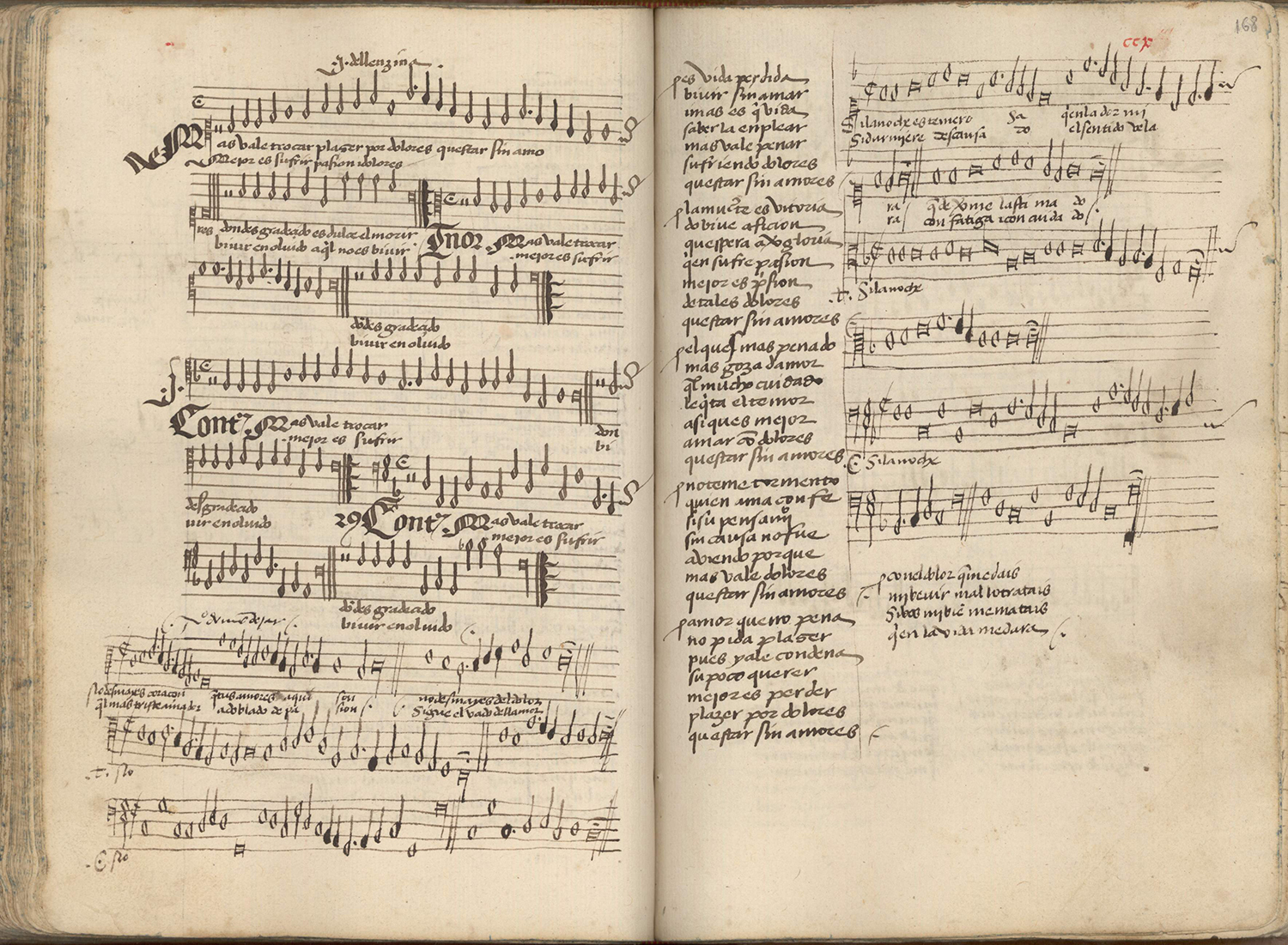
PIECE 1: Juan del Encina, Más vale trocar plazer por dolores [It is better to trade pleasure for torment], villancico (Cancionero Musical de Palacio, 201)
Más vale trocar is a piece authored by court composer, poet and playwright Juan del Encina (1468-1529), a foremost representative of early Castilian polyphony, and the most prolific author represented in the Cancionero. The song is composed in the traditional Iberian form of villancico (literally “song of peasants”), a strophic composition with refrain, particularly popular in the late Medieval and Early Modern periods. In this captivating piece for four voices, whose lyrical subject matter reflects the favoured themes of courtly culture of the time, Encina reflects on a timeless dilemma: whether it is preferable to lead a serene and contented, yet loveless, existence, or rather to succumb to the sweet and tempestuous passions of love, and suffer love’s inevitable torment.
For the full lyrics and English translation, click on the footnote.3
Click below for a short video of my performance of this song under the Torrijos ceiling. For examples of other performances of this song, you can look at this live performance of the Ensemble Cantoría in 2022, or this recording by Gaudia Musica from 2013.
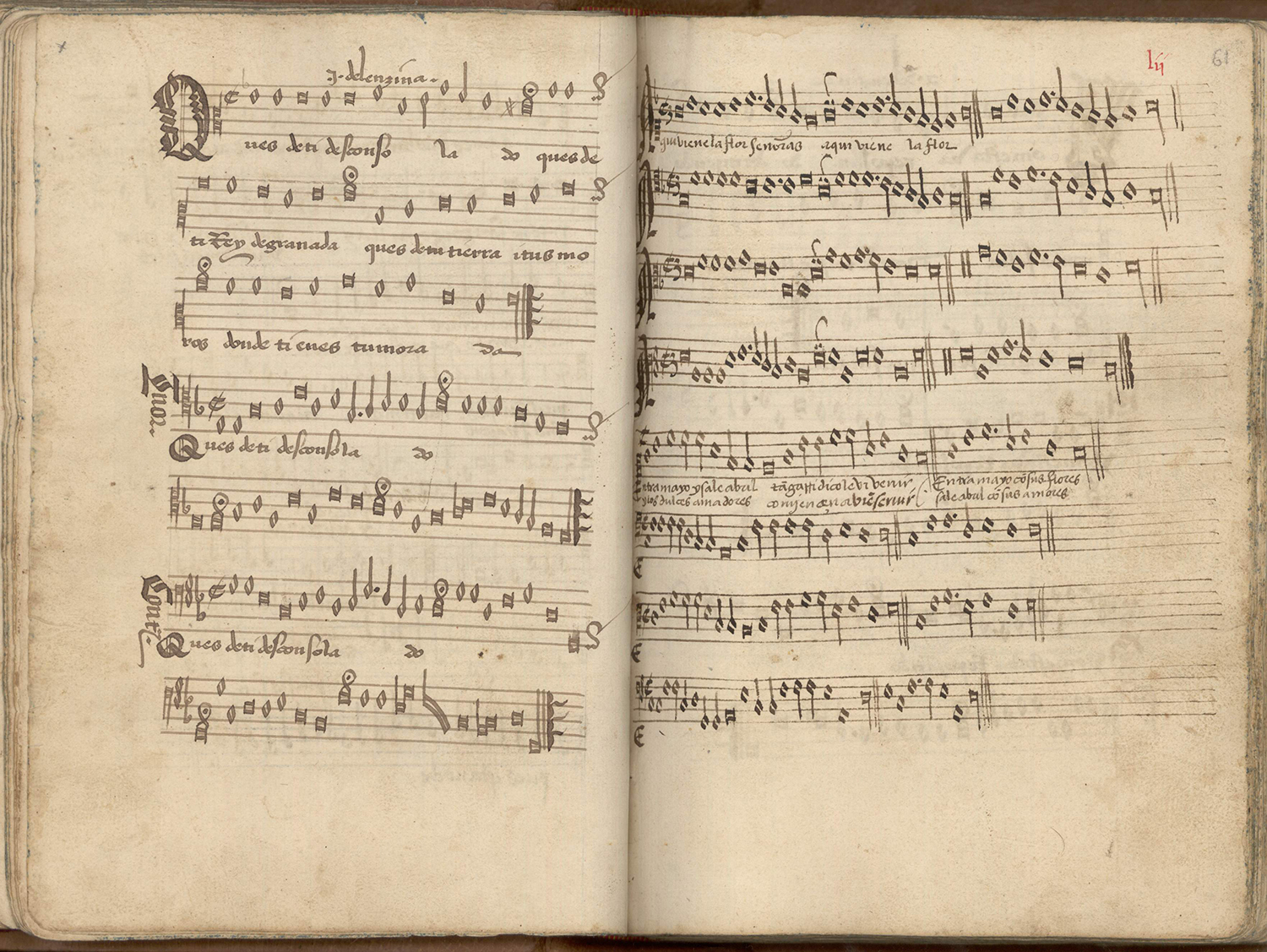
PIECE 2: Juan del Encina, Qu’es de ti, desconsolado? [What has become of you, bereaved one?], romance (Cancionero Musical de Palacio, 52)
Qu’es de ti desconsolado is a political romance composed by Juan del Encina to celebrate the capitulation of Granada, on 2nd January 1492, and its takeover by the Catholic Monarchs, whom he portrays as instruments of Divine Providence. In a direct address to the last Muslim King of Granada, Abu Abdallah Muhammad XI, known in Christian sources as Boabdil, the poet encourages the ill-fated Monarch, who has lost his kingdom, titles and earthly possessions, to embrace the Christian faith in order to redeem his soul. In this striking piece, Juan del Encina makes use of the devices typical of the Castilian popular romance to construct an intricate textual structure based on the use of anaphora and syntactic and semantic parallelisms. Despite having been composed as a polyphony for three voices, this romance is equally captivating when performed by a solo voice.
For the full lyrics and English singable translation, by Carol Anne Perry Lagemann, click on the footnote.4
For recordings of this song being performed, see Accentus Ensemble, Cancionero de Palacio: Music of the Spanish Court (1502-1520) (1996, Naxos), or this one by Joaquín Díaz and Javier Coble, Romances de la Reina Isabel (2004, Fundación Centro Etnográfico Joaquín Díaz, distr. by Altafonte).
PIECE 3: (Anonymous) Tres morillas m’enamoran en Jaén [Three Moorish maidens captivate me in Jaén], villancico zejelesco. (Cancionero Musical de Palacio, 24)
This anonymous villancico remains, five hundred years on, one of the most popular pieces from the Cancionero – so much so that renowned Granadan poet Federico García Lorca (1898-1936) adapted and harmonised its melody, combining the two extant textual variants, 24 (anonymous) and 25 (completed by Diego Fernández).
This particular example of villancico is modelled on the zajal, an Andalusi poetic form of strophic structure and composed in dialectal Andalusi Arabic, a genre which many scholars consider to have been inspired by contemporaneous Romance song traditions.5 The Castilian zéjel, of which Tres morillas is a beautiful example, features eight-syllable verse stanzas structured in triplets ending in a refrain, or turn (vuelta), with independent rhyme, following the pattern BBBAA CCCAA DDDA etc.
The theme of the song is also reminiscent of Christian-Muslim contacts on the Iberian frontier: the singer is captivated by three Moorish maidens, Aisha, Fatima and Mariam (Axa, Fátima y Marién) who travel to the Andalusi city of Jaén to pick olives and apples, only to find them already taken. The poem’s sensuality is highlighted by the metaphorical references to harvest, and the alliterative interplay of the words morillas (Moorish maidens) and m’enamoran (they entice me).
For the full lyrics and English translation, click on the footnote.6
Click below for a short video of my performance of this song under the Torrijos ceiling. For examples of other performances of this song, see Jordi Savall, Hespèrion XX, La Capella Reial de Catalunya, Cancioneros del Siglo de Oro (Colombina – Palacio – Medinaceli 1451-1595) (2012, Alia Vox); or this incredible historic recording with Federico García Lorca playing the piano and La Argentinita singing: “Las morillas de Jaén”. Colección de canciones populares españolas (1994, Sonifolk).
PIECE 4: Romance de Abenámar [The ballad of Abenámar], romance (from the Sephardic tradition of Morocco)
The form of the Hispanic ballad, the romance, which begins to appear in compilations and songbooks in the late 15th century, continues to enjoy great popularity throughout the Spanish Golden Age and well into the Modern era. As the voyages of discovery and conquest disseminated Hispanic culture across the globe, traditional Peninsular song material finds a home in new lands, and becomes transformed, absorbing new influences and reflecting new, hybrid identities. One such space is the Sephardic Jewish diaspora of North Africa and the Eastern Mediterranean, which emerges after the expulsion of the Jews from Spain in 1492, and is home to a unique tradition of balladry. Rooted in Castilian epic poetry (cantares de gesta) and late Medieval romances, and modified by centuries of oral transmission in numerous communities of the Mediterranean basin, the Sephardic romances represent a fascinating and unique repertoire within the rich tapestry of the Hispanic oral tradition.

The ballad of Abenámar, originally a Castilian frontier ballad first published by Pérez de Hita (1595), is based on a fictional account of a documented encounter between the Nasrid sultan of Granada, Yusuf IV ibn al-Mawl (1360s-1432), here referred to as Abenámar, and King Juan II of Castile (1405-1454). Chroniclers portray them as occasional political allies, though in 1431, Yusuf IV formally became Juan’s vassal, in exchange for support in the internecine wars which consumed the Nasrid sultanate at the time. In the song, the two rulers meet on a hill overlooking Granada’s fortified palace, the Alhambra. The Christian king asks Abenámar to describe the beautiful palaces they see, in a truthful manner. In the original, “Christian”, version of this song, and in accordance with a trope common in Medieval Castilian literature, the personified city of Granada appears as a captive of great beauty, whom the Christian king intends to conquer and liberate. The city however warns the monarch that this will be no easy feat: her husband, the Moor whom she belongs to, will defend her fiercely for he loves her dearly. This metaphor is entirely absent in the Sephardic variant, the focus shifting instead to the Moor’s emphasis on Truth as a virtue, and his description of the beauty of Granada.
For the full lyrics and English translation, click on the footnote.7 Textual variants of the Romance de Abenámar can be found in the Folk Literature of the Sephardic Jews digital archive (compiled between 1957-1993 by Samuel G. Armistead, Joseph H. Silverman and Israel J. Katz).
Click below for a short video of my performance of this song under the Torrijos ceiling. For other recordings of this song being performed, see Françoise Atlan, Romances séfardies. Entre la rose et le jasmin (2005, Buda Records); or Ensemble Sarband, Sepharad: Songs of the Spanish Jews in the Mediterranean and the Ottoman Empire (1996, Jaro).
PIECE 5: Morena me yaman [They call me the Dark One]. Sephardic wedding song (kantiga)
The last piece, a Sephardic wedding song or kantiga, closes the thematic arc of the performance, and brings us back to the opening theme of Love. Based on the figure of the Dark Maiden of the Song of Solomon (paraphrasing verses 1:5-6), this Sephardic wedding song contains, in its deceptive simplicity, a fascinating array of symbols and cultural references. Its textual roots are most likely found in an early Modern Castilian romance recorded in 1626 by Gonzalo Correas in his Arte grande de la Lengua Castellana.8 The last stanzas of the song refer to the traditional elements of the Sephardic wedding ceremony, for example, the ornate bridal dress, and the ceremony of kiddushin. Found in many textual and musical variants across the Sephardic diaspora, this is one of the most popular songs of the Sephardic repertory as a whole, and a remarkable example of Hispanic-Jewish intertextuality.
For the full lyrics and English translation, click on the footnote.9
For recordings of this song being performed, see Françoise Atlan at the Gibraltar World Music Festival (2012, live performance); or Isaac Levi, El Kante de una vida (2001, Hataklit).
As I mentioned above, the songs for the performance were curated to reflect both courtly and popular musical culture of the late 15th century. By so doing, my intention was to honour, as far as possible, the function of the Torrijos Ceiling, which was designed and crafted as a lavish backdrop to festive gatherings, mirroring cultural encounters and intersections. In the course of the performance, the splendid space under the ceiling’s dome came to life. The intricate carvings and latticework amplified the music emanating from underneath, and created a unique acoustic space, in which both performer and audience were transported to a different time and place.

- For a detailed account of musical practices at the court of the Catholic Monarchs, you can see, for instance, Higinio Anglés, La música en la Corte de los Reyes Católicos. Madrid: CSIC, 1941. ↩︎
- Vicenç Beltran, La corte de Babel: Lenguas, cultura y poética en la España del siglo XIII. Madrid: Gredos, 2005. ↩︎
- Más vale trocar (Juan del Encina)
Más vale trocar plazer por dolores
que estar sin amores.
Donde es gradecido es dulce el morir,
bivir en olvido aquel no es bivir.
Mejor es sufrir passión y dolores
que estar sin amores.
Es vida perdida bivir sin amar
y más es que vida saberla emplear.
Mejor es penar sufriendo dolores
que estar sin amores.
La muerte es vitoria do bive afición,
que espera aver gloria quiеn sufre passión;
Más vale presión dе tales dolores
que estar sin amores.
El qu’es más penado más goza d’amor,
qu’el mucho cuidado le quita el temor:
así qu’es mejor amar con dolores
que estar sin amores.
No teme tormento quien ama con fe
si su pensamiento sin causa no fue,
aviendo por qué más valen dolores
que estar sin amores.
Amor que no pena no pida placer
pues ya le condena su poco querer.
Mejor es perder plazer por dolores
que estar sin amores.
Translation:
‘Tis better to trade pleasure for sorrow
Than to live without love.
Where love is reciprocated, it is sweet to die,
To live in oblivion, this is not to live,
‘Tis better to endure great anguish and sorrow
Than to live without love.
A life without loving is a life wasted and lost,
And we must be sure to make good use of living
‘Tis better to endure torment and suffering
Than to live without love.
Death is salvation to an afflicted heart,
Yet those who suffer, aspire to glory
‘Tis better to endure the pain of such sorrow
Than to live without love.
The sharpest of aches brings the sweetest rewards
And love’s caring will free you of worry.
‘Tis better to love in pain and in sorrow,
Than to live without love.
The faith-guided lover bears no fear of pain,
When love’s signs reveal it is reciprocated,
With reason to hope, ‘tis better to suffer
Than to live without love.
A love that’s painless should not expect bliss
For such love indeed must truly be shallow
‘Tis better to lose all pleasure for sorrow
Than to live without love. ↩︎ - Qu’es de ti, desconsolado (Juan del Encina)
¿Qu’es de ti, desconsolado? ¿Qu’es de ti, rey de Granada?
¿Qu’es de tu tierra y tus moros? ¿Dónde tienes tu morada?
Reniega ya de Mahoma y de su seta malvada,
que bivir en tal locura es una burla burlada.
Torna, tórnate, buen rey, a nuestra ley consagrada,
porque si perdiste el reyno tengas el alma cobrada.
¡Oh Granada noblecida por todo el mundo nombrada,
hasta aquí fuiste cativa, y agora ya libertada!
Perdióte el rey Don Rodrigo por su dicha desdichada;
ganóte el rey Don Fernando con ventura prosperada;
la reyna Doña Ysabel, la más temida y amada,
ella con sus oraciones, y él con mucha gente armada.
Según Dios haze sus hechos, la defensa era excusada;
que donde Él pone su mano lo impossible quasi es nada.
Translation:
What’s become of you, bereaved one? What is Granada’s king fated?
What of your Moors, your dominions? Where is your home now located?
Forswear the prophet Muhammad; forfeit his sect vile and hated;
To believe his words is folly, by tricks to be captivated.
Turn your allegiance, good king, to Christian law God dictated.
Though you may have lost your kingdom, be with your soul compensated.
Noble city of Granada, in all the world celebrated,
Till today you were a captive, and now you are liberated!
He lost you, sad King Rodrigo; to that sorrow he was fated.
Retaken by King Fernando, now be joyful and elated!
Queen Isabella, through the land most loved and most venerated,
She for you fought hard by praying, he by warring unabated.
As God had planned for the city, its defences were frustrated.
We earn impossible triumphs when for us God has advocated. ↩︎ - For more information on the mutual influences between the Romance and Andalusi poetic traditions, see J. R. Gabaldón Vielma, “La poesía hispano andalusí y su impacto en la lírica Española”, Lemir 24 (2020), pp. 431-440. ↩︎
- Tres morillas m’enamoran en Jaén (Anonymous)
Tres morillas m’enamoran
en Jaén
Axa y Fátima y Marién
Tres morillas tan garridas
yvan a coger olivas
y hallávanlas cogidas
en Jaén
Axa y Fátima y Marién
Y hallávanlas cogidas
y tornavan desmaídas
y las colores perdidas
en Jaén
Axa y Fátima y Marién
Tres moricas tan loçanas
yvan a coger mançanas
y hallávanlas cogidas
en Jaén
Axa y Fátima y Marién
Translation:
Three Moorish girls entice me
In Jaen
Axa, Fatima and Marien
Three Moorish girls, so fair and lovely
Went to pick olives
And found them all picked
In Jaen
Axa, Fatima and Marien
And they found them all picked
And they came back disappointed
Their cheeks pale and faded
In Jaen
Axa, Fatima and Marien
Three Moorish girls, so fresh and lively
Went to pick apples
And they found them all picked
In Jaen
Axa, Fatima and Marien ↩︎ - Romance de Abenámar (Anonymous)
¡Abenámar, Abenámar,
moro de la morería,
el día que tú naciste,
grandes señales había!
Estaba la mar en calma,
la luna estaba crecida:
moro que en tal signo nace
no debe decir mentira.
Y no os la diré, señor,
aunque me cueste la vida,
Que de chico y de muchacho
mis padres me lo decían,
que mentiras no dijese,
que era grande villanía:
pregunta, pues, el buen rey,
que la verdad te diría.
¿qué palacios son aquellos?
¡altos son y relucían!
L’Alhambra era, señor,
palacio de gran valor
El moro que lo labraba
cien duros ganaba al día,
y el día que no los labra
otras tantas se perdía.
¡Abenámar, Abenámar,
moro de la morería,
el día que tú naciste,
grandes señales había!
Translation:
Abenámar, Abenámar,
Moor of the Moorish quarter,
The day you were born
Great signs foretold your fortune.
The sea was calm and smooth,
The Moon so full and radiant,
A Moor born under such signs
Should only ever be truthful.
I will only speak the truth, Sire,
Though my life I may have forsaken,
For thus I was taught, as a boy,
By my Father and my Mother:
To never tell a lie
For such thing is a great evil
Pray, ask me, O good King,
And I’ll give you a truthful answer.
What palaces are those,
So high and of such splendour?
The Alhambra it is, my Lord,
No palace was ever greater.
The Moor who crafted and built it
Was paid a hundred gold coins daily,
And on the days he didn’t work
He lost his pay, and rightly. ↩︎ - “Aunque soi Morena / yo blanca nazí / á guardar ganado / mi color perdí” [Although I am dark, I was born fair-skinned. It is by watching the cattle that I lost my complexion]. See Gonzalo Correas, Arte grande de la lengua castellana (1626). Ed. by Muñoz y Manzano, C. Madrid: Real Academia Española, 1903. p. 280. ↩︎
- Morena me yaman (traditional Sephardic)
Morena me yaman,
yo blanka nasí,
de pasear galana
mi kolor pedrí.
Morena me yama
el ijo del rey.
Si otra ves me yama
me vó yo kon él.
Morena me yaman
los marineros.
Si otra vez me yaman
me vó yo kon eyos.
Didzime galana
si kerésh venir.
Los velos tengo fuertes,
no puedo venir.
Vestido de vedre
i de altalí,
kinze días la novya
kon el tchelibí.
Eskalerika le izo
de oro i de marfil
para ke suba el novio
a dar kiddushin.
Translation:
They call me the Dark One, yet white I am.
From walking under the sun I became so.
Dark One he calls me, the King’s son
Should he call me again, with him I’d go
Dark One they call me, the sailors at sea
Should they call me again, with them I’d go
Tell, me o beauty, if you’d like to come
I hold on to my veils, I cannot come.
Dressed all in green and scarlet
In fifteen days the bride will join her betrothed.
They have built a staircase of ivory and gold
For the groom to climb, and give kiddushin. ↩︎