
We are delighted that the magnificent golden throne of Maharaja Ranjit Singh (1780 – 1839) of Punjab is the centrepiece of the exhibition Ranjit Singh: Sikh, Warrior, King at the Wallace Collection from 10 April – 20 October 2024.
The intricately designed and exquisitely decorated octagonal throne with rounded back and hourglass base elevated on eight small feet, was made in Lahore in the first quarter of the 19th century by the goldsmith Hafez Muhammad Multani. The throne has a wood frame, covered in sheets of gold, and other materials include lac, brass, silk, cotton, and metal-wrapped thread.

Taken from the Lahore treasury at the annexation of Punjab by the British East India Company in 1849, the throne was sent to Calcutta in 1853 and shipped to London for display in the India Museum in Leadenhall Street. Upon the closure of the India Museum in 1879, the throne was transferred to the Victoria and Albert Museum (formerly, the South Kensington Museum) where it has been on permanent display ever since.
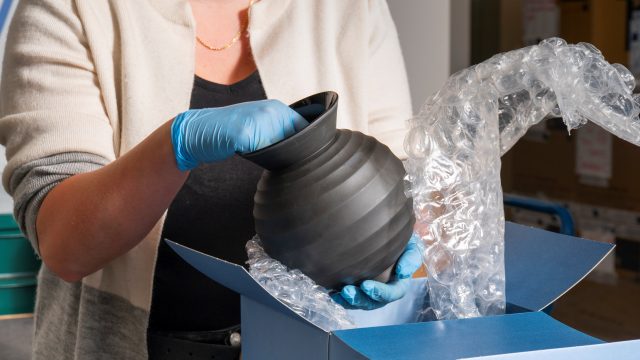
To prepare it for exhibition at the Wallace Collection, the throne was moved out of its display case in the South Asia Gallery and taken to the Furniture Conservation Studio, so that its condition could be properly assessed and documented by conservators with expertise in furniture, metalwork, and textiles conservation.
This sojourn in the conservation studio presented a rare opportunity to look at the object from several vantage points:
Since gold is so abundantly lavished on the throne it seemed like a natural place to begin my observations. A wonderful material for all sorts of reasons, in view of the outstanding crafting of the throne, one quality that stood out is the incredibly high malleability of gold, which makes it shapable and receptive to decoration.
The image of malleable gold propelled me on a flight of fancy to the 19th- century toshakhana (treasure house) of Maharaja Ranjit Singh in Lahore where I imagined goldsmith Hafez Muhammad Multani embossing and chasing beautiful designs into the gold, working on both sides of the sheets until the gold bloomed into shoots, leaves, and flowers. Far from being mere ornament, the vegetal designs enliven the throne by facilitating the play of light and shadow on its surface and by providing a myriad of winding paths for ocular travel around the circular form.
Letting my eyes glide over the surface illuminated numerous small gold pins, like punctuation marks trying to contain the efflorescence of design. These small pins securing the gold panels to the wood provided an inroad to the making process – whereas I have never worked patterns into gold, I have certainly hammered nails into wood.

Without the wooden frame, there would simply be no golden throne. Peeking into the underside revealed interesting information about the hollow structure. Further investigation would certainly increase our knowledge of the construction, but a cursory examination suggests that curvilinear panels are joined at strategic junctions to create the hourglass-shaped base. Four slender metal rods positioned vertically at the cardinal directions underpin the wood, which has a smooth appearance and is painted yellow to complement the gold.
The colour yellow or basanti (of spring) was a favourite of the Lahore Darbar.[1] The travelogue of Mohan Lal Kashmiri (1812 – 1877), (secretary to Sir Alexander Burnes during his mission to Central Asia in 1832 – 34) describes a visit to the celebration of basant (spring) in Lahore on 6 February 1832. Whilst at the fair (held near the tomb of Madhu Lal Husain) Mohan Lal ‘was surprised to view the Maharaja’s troops standing on both sides of the road, forming a regular street, with their uniform basanti dress (of yellow colour), to salute the King of Punjab, who was apparelled like-wise in a basanti dress, accompanied by his European guests; he proceeded to the tents, which were made of yellow silk and ornamented with pearls, where he was received with the most extravagant demonstrations of joy, – “Long live the good liege of the Fiver Rivers!” was the general cry.’[2]

Keeping with the colour scheme, the original upholstery of the backrest is made from yellow silk velvet (and other materials). Here in either corner are a pair of gold ‘elbow rests’ (actually, I suspect these are holding the upholstery in place) that have been made to look like cut sunflowers. These utilitarian shapes cleverly make the overarching colour and dominant motif of the throne converge in a single image.

It’s evident that floral motifs are plentiful and multidimensional on the object. At first the flowers on the wraparound back appear to be meandering in an arbitrary fashion, but following the scrolling stems to the back of the throne one is rewarded by a most remarkable sight showing that the flowers are organised into a bouquet overlaid onto the ‘spine’ and anchored into the ‘tailbone’ of the object.

Looking at the throne is akin to being inside[3] a sheesh mahal (palace of mirrors)[4]. Shapes, colours, motifs, and metaphors collide and proliferate, and forms beget forms. Like the velvet upholstery, the seat is original and woven from alternating bands of red and green silk cording. Among the geometrical patterns in the weave are four interlocked eight-point stars also known as octagrams, as they derive from the octagon. The inclusion of the octagram could be coincidental, as a typical motif of the milieu, or a deliberate nod to the octagonal footprint of the throne.
The eight-point star, the bouquet, and the sunflower are but a few of numerous games of mirrors to engage our intellect and enthral our senses.
[1] ‘The court colour of the Durbar is yellow or green; and the chiefs and officers were all clothed in yellow garments…’. Baron Charles Hugel, ‘Travels in Kashmir and the Panjab, containing a particular account of the government and character of the Sikhs, from the German of Baron Charles Hugel. With notes by Major T. B. Jervis, F.R.S.’. Published in London, 1845. Quoted from the travelogue entry for Monday 13 January 1836 on page 287
[2] Mohan Lal, Esq., ‘Travels in the Panjab, Afghanistan, and Herat; and a visit to Great Britain and Germany’. Published in London, 1846. Pages 17 and 18
[3] Or imagining myself inside one since I can’t correctly recall visiting the one in Amer Fort!
[4] Sheesh mahal is a palace whose interior is decorated with glass and mirrorwork. Such palaces found favour with Indian rulers from the 17th century onwards. Beautiful examples can be seen in Lahore, Agra and Amer forts.
A rare detailed account of the THE THRONE OF MAHARAJA RANJIT SINGH . Very beautiful account with reference to the colour history of colour yellow as witnessed by various visitors.Please add the details on the two roads on both sides on which silk cords are draped which were actually carrying golden globes on them and Maharaja rested his hands on those as if conveying to the beholder as conqueror of the world. I have been trying to get further details and reference if any to above.
A very well researched and well expressed article written by Revati Mann on the throne of Maharaja Ranjit Singh .Thanks Revati for bringing home to us The throne . You have done an in-depth study of the design and the materials used for the omaking of a remarkable throne . Your article is a tribute to the maker of the throne Hafez Mohammed .
Along with the throne the richness of the royal court is very well delineated. It brings home to the reader not only the authority of the throne and the grandeur and the refined culture of the court but also the greatness of the Maharaja who ruled it and of his times . Thank you
A very vivid description which transported me to Furniture Conservation Studio and thence to the Maharaja’s court; where l let my imagination run free to create the pomp and show of that era….Very beautifully described!
Clearly a dazzling object. Thank you for the description and sharing a glimpse of Lahore then.
Well researched and presented, thanks for highlighting aesthetics of craftsmanship.
Revati.. I am so proud of you! It is so well very written with such intricate details. Utterly marvellously read and huge well for for excellent hard work.
Best wishes,
Revati… I am so surprised and great thanksgiving to you for such a great information about throne of great king of sikh empire Maharaja Ranjit singh.i don’t have words to say the way you gave description just superb, majestic
I am thoroughly ashamed that this beautiful and ornate throne is still under the possession of the British establishment. It was illegally seized as a ‘spoil of war’ from an eight year old child. In my option it ought to be sent back to our friends in India from where is was so humiliatingly taken. As a Scotsman I can confirm that this is the true legacy of Anglo-Saxon hegemonic domination. I’m surprised how so many Indians don’t seem to care about this incredibly important issue.
Panjaab Nation aka Sikh Raaj made up by invitation by the erstwhile muslim ruler of Lahor comprise of over 70% muslim, around 20% hindus of a various sects and just around 10% of Sikhs, thus was a country not a vassal of the East India company. It never was a Princely State of the British Raaj under the Empress Victoria.
The subcontinent of the mughals was comprised of Vassals of the Mughals under hindu and muslim raajaas and later as Princely States of the East India company.
India on the other hand only became a country after the partitioning of the Nation of Panjaab in 1947 by the crooks of INC under British dominion.
This is a fact not brought forth by the Hindu regimes of India. The reasons are few and simply stated.
The corrupt and self serving Hindu regime came to power & have held the Indian society hostage through spurious methods ever since 1947.
The infamous manusmriti openly gives dominion over hindus to the brahminical order through an inhumane Caste System of Hinduism.
Guru Nanak Dev Ji tore into the farcical brahminical caste system since his childhood. He started very early in his childhood by denouncing the Brahmin thread ceremony as a ploy used by the brahmins as a street vendor’s show to gouge funds from fellowmen as one with no true merit.
Then he went on to create the order of a free human being, an order of Sikh, humans, as students freed from caste,creed, race and religion.
Equality of gender and respect for all life.
Respect for all working people.
Thus eliminated the need for brahmin priesthood and their ascribed rituals. Denounced ritualistic life as a yoke put on human beings by the brahmins on all man and placing their woman as inferior.
Guru Nanak freed the masses from labels of upper & lower castes.
That the creator of All as equals is ‘1’ in all.
There is no ritualistic differentiation and all are judged by their actions.
There is no room for hindu gods. That these are figments of imagination to keep humans in fear and in brahmin’s yoke.
These are the reasons why the hindu regimes of India don’t want the Sikhs to have autonomy. Guru Nanak added Dharm as the faith.
Honest work for livelihood.
Naam simran..keep faith with every breath in ‘1’ creator.
Share your worldly earnings with the needy.
All can see why the hindu regimes keep the masses deluded and continue to rip them off.
It is so as to continue to cheat and rob the Indians of any sense of humanity thereby ruling over them as if they were the emissaries of hindu gods.