
This post was written by Laura Feigen, Associate Lecturer, The Courtauld
Jewish Culture Month offers an opportunity to explore the V&A’s collections through the lens of ritual, movement, memory, and creativity. Across the museum, ritual objects, dress, photography, and performance reveal stories of Jewish communities at once personal and international. The tours, talks and screenings in May and June invite visitors to encounter Jewish cultural history not as a single narrative, but as a constellation of voices, traditions and artistic practices spanning time and geography.
Sacred splendour
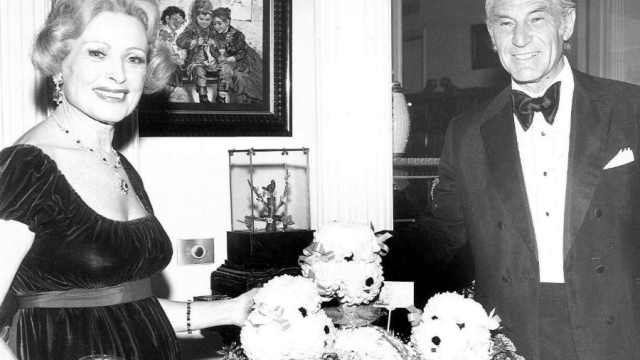
The newly re-opened Gilbert Galleries display over 500 works of art from the collection of Sir Arthur and Lady Rosalinde Gilbert. Though descended from Jewish families that emigrated to Britain from Poland in the 1890s, neither Arthur nor Rosalinde claimed to be religiously observant. They collected because, as Rosalinde said, ‘they loved beautiful things.’ That appreciation for craftsmanship is reflected in two exceptional examples of Jewish ceremonial art in Room 70b: a pair of silver-gilt Torah Finials (rimmonim) and a gold Torah crown (keter Torah).


Made in the Netherlands around 1780, the rimmonim are composed of hexagonal tiers encircled by bells whose rounded edges evoke the contour of pomegranates. This design recalls the robe worn by the High Priest in the Book of Exodus, which was trimmed with bells and pomegranates. Rimon (plural: rimmonim) is the Hebrew word for pomegranate. The rimmonim were first owned by Philip Salomons, who assembled the first major collection of Jewish ceremonial art in Britain, before entering the collection of Reuben Sassoon, a member of the prominent Baghdadi Sephardic Sassoon family.

The Torah crown is thought to have come from the court of Rabbi Israel Friedman (1797–1850), the Hasidic leader of Ruzhin in present-day Ukraine. Rabbi Friedman became known for conducting his court with extraordinary ceremony, which he described not as material excess but as a spiritual mode of leadership intended to reflect divine majesty. That sense of grandeur is embodied in the crown itself, adorned with jewels shaped into flowers, vines and birds from whose beaks hang floral bells.
Both objects were created to adorn Torah scrolls housed within the synagogue ark. This function is reflected in the Hebrew inscription on the rimmonim: כתר תורה (keter Torah), meaning “crown [of the] Torah”. The rimmonim topped the wooden rollers around which the scroll was wound, while the crown surmounted the scroll itself. Their rich decoration reflects the principle of hiddur mitzvah, the beautification of sacred ritual through craftsmanship and devotion.
These objects are particularly resonant during the festival of Shavuot, or the “Festival of Weeks,” which commemorates the giving of the Torah to the Jewish people at Mount Sinai and also marks the spring harvest. In this context, the Torah ornaments connect artistic splendour with revelation and learning across generations. The themes of Shavuot will be highlighted as part of the Gilbert Galleries Storytelling event.
Clothing tradition
The object viewing session Up Close: Jewish Material Culture from the Middle East and North Africa offers an opportunity to explore the history of dress and adornment in Jewish communities from Iran, Iraq, Morocco, Palestine, Yemen, and Algeria. Among the highlights is a pair of 19th-century embroidered leather slippers from Morocco.

Decorated with embroidered floral motifs, the slippers reflect the textile and leatherworking traditions of North Africa in the nineteenth century. Likely worn by a woman, their elongated pointed form, lush pompoms, and rich embroidery suggest they were intended for ceremonial or festive occasions, perhaps associated with marriage or important domestic celebrations.
Unlike the Torah ornaments in the Gilbert Galleries, these slippers speak not to public ritual but to the intimate sphere of everyday life. They simultaneously reveal how beauty and craftsmanship could express cultural identity and belonging. Combining Jewish, North African and Ottoman decorative influences, the slippers testify to the interconnected artistic cultures in which Jewish communities lived and worked in the wider Mediterranean.
Photography and Jewish identity
The tour Jewish Photographers in the Photography Centre focuses on the American Photograph display, highlighting the work of Jewish photographers while also questioning what it means to describe a photographer as “Jewish”.
A departure point for the tour is Alfred Stieglitz’s The Steerage (1907). Taken while Stieglitz travelled from the United States back to Europe, the image looks down onto the lower deck of the ship, where shawled passengers gather beneath a striking arrangement of gangways and railings. Stieglitz described the photograph as a modernist composition, fascinated by its graphic structure and layered geometry, yet the image also reveals stark social divisions between passengers above and below deck. Although The Steerage has often been interpreted through the lens of migration and Jewish diaspora, Stieglitz never explicitly framed it as a Jewish image.

This ambiguity frames the wider tour. Photographers such as Diane Arbus, Joel Meyerowitz, Lee Friedlander and Garry Winogrand played a central role in twentieth-century American photography, particularly within mid-century street photography and documentary practice, yet many did not foreground Jewish identity within their work. Rather than offering a singular “Jewish” photographic style, their work demonstrates how photography as a medium became connected to questions of movement, social observation, and urban experience. These themes will be further explored by Maya Benten in her Lunchtime Lecture: On Jewish Photography.
Stories from everyday life
The V&A screening of Danny Braverman’s recorded performance Wot? No Fish!!, offers an opportunity to experience a work that transforms family archive into theatrical storytelling. The performance is based on a collection of illustrations created by Braverman’s great-uncle Ab Solomon, a Jewish immigrant living in London’s East End. Between 1926 and 1986, Solomon sent weekly hand-drawn cards to his wife, documenting family life through caricatures, jokes and observations.

Together, these illustrations offer an extraordinary chronicle of twentieth-century Jewish experience in Britain. The title — Wot? No Fish!! — captures the cadence of East End Jewish culture, shaped by Yiddish inflections, local slang and the rhythms of immigrant life. Through humour, narration, and reflection, Braverman reveals how ordinary domestic moments can become powerful forms of historical and communal memory.
Overall, the collections highlighted for Jewish Culture Month also intersect with the museum’s own formation in the 1850s, shaped in part by Jewish collectors and dealers. Figures such as Ralph Bernal, Isidore Spielmann, Lionel de Rothschild, the Durlacher Brothers and Siegfried Bing rarely contributed Judaica, but instead helped build the V&A’s wider encyclopedic collections. Jewish Culture Month is therefore an opportunity to explore the extraordinary range of Jewish involvement and cultural expression embedded within the museum’s history, collections and contemporary programme.

What a lovely read — pairing the rimmonim with the Torah crown really brought the idea of hiddur mitzvah to life for me. I’d never made the connection between the pomegranate-shaped bells and the High Priest’s robe from Exodus. And Wot? No Fish!! sounds like a gem — those weekly cards from Ab Solomon must be an incredible archive of everyday life, and it makes me want to start properly organizing my own family photos. I’ve been digitizing my grandparents’ albums lately, and I use a picture converter to fit the scans into a shared family album layout without cropping anything. Hoping to catch the photography tour before it ends!