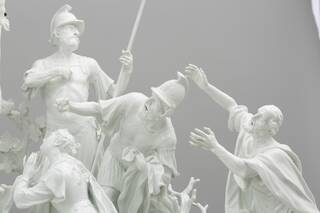
This conference explores the phenomenon of religious sculpture produced in European porcelain in the eighteenth century. Sculptures on religious subjects represent some of the most ambitious and complex productions in European porcelain of the period, yet they remain relatively understudied.
Meissen, Doccia Vienna, Höchst, Fulda, Nymphenburg – all these factories produced devotional images in porcelain. Even factories in mid eighteenth-century Protestant England – Chelsea and Derby – produced sculptures employing Catholic devotional imagery. In each instance, cultural-political motives for the creation of these images can be reconstructed.
The 1712 letter penned by the Jesuit Father François Xavier d'Entrecolles not only conveyed to Europe first-hand knowledge of Chinese porcelain production at Jingdezhen, but it also construed access to this knowledge as a triumph of the Jesuit global mission – the successes of the Jesuits in China made the secret of kaolinic porcelain available to the Catholic princes of Europe.
Porcelain’s alchemical heritage was also not without significance: success at the alchemical enterprise had always been deemed dependent on divine favour. These factors could lead to porcelain assuming a sacral character in Catholic court contexts. Devotional images in European porcelain exploited these cultural associations of the medium itself.
This international conference will explore the religious production of European ceramic factories and consider questions such as: Who were the artists and patrons involved in these sculptures’ creation? How did these sculptures function in private and public contexts? What significance lay in the use of porcelain to create devotional images?
Generously supported by the French Porcelain Society