Introduction
Elsa Schiaparelli (1890 – 1973) redefined fashionable taste and perceptions of beauty in the 20th century. Born in Rome into a family of academics and aristocrats, she fled their conservative expectations, leaving Italy at the age of 23 to live a life that was anything but conventional.
With no formal training, she launched her first fashion collection in 1927. Her bold, often audacious, haute couture creations soon made her the designer of choice for a confident clientele. Within five years, Maison Schiaparelli employed 400 staff who created over 7000 couture garments each year.
Often designing to confront and shock, Schiaparelli’s radical approach embraced the new and experimental, resulting in clothes that were resolutely modern. At the same time, her impact extended beyond fashion. Embedded within Europe’s creative avant‑garde, she positioned her work in direct dialogue with art, design and performance.
Elsa Schiaparelli closed her business and retired in 1954. The 2006 acquisition of the Schiaparelli name and archive paved the way for the House’s revival. Since taking the helm in 2019, Creative Director Daniel Roseberry has extended the House’s reputation as a fashion disruptor, reinterpreting its heritage and contributing to a new aesthetic vocabulary.
Tombstone label:
Elsa Schiaparelli at 21 Place Vendôme
François Kollar
1935 (digitally reinterpreted 2026)
© GrandPalaisRmn‑ Gestion droit d’auteur François Kollar. Photo: © Ministère de la Culture‑ Médiathèque du patrimoine et de la photographie, Dist. GrandPalaisRmn / François Kollar
AV label:
Hot off the press
Elsa Schiaparelli became the international fashion star of interwar Paris. Her daring design innovations were highly anticipated and eagerly reported in publications like Harper’s Bazaar and Women’s Wear Daily.
This compilation of press material comes from the leading research of the late Dilys Blum, Senior Curator of Costume and Textiles at the Philadelphia Museum of Art. The V&A acknowledges a debt to her scholarship.
Elsa Schiaparelli press coverage
Dilys Blum research files
About 1927–1939 (digitally reinterpreted 2026)
Object label:
Bare bones
This dress, one of the most remarkable of Elsa Schiaparelli’s career, is indicative of her multi‑faceted legacy. Her collaboration with Salvador Dalí reflects her deep connections with the leading artists of the time. The padded construction that shapes the dress’s deathly form exemplifies her predilection for employing unusual techniques to create designs that shocked.
Elsa Schiaparelli with Salvador Dalí
Summer 1938, Circus collection
Paris
Silk crêpe with plastic zips
V&A: T.394‑1974
Given by Ruth Ford
Object label:
Deep breath
Disembodied fragments of anatomy bring a deeper psychological dimension to Roseberry’s garments, accentuating and reversing form. In this dramatic gown, internal organs appear to rise to the surface with a rhinestone‑encrusted brass necklace in the shape of lungs. By playing a game of concealing and revealing a low‑cut neckline, the piece creates a surrealist statement.
Schiaparelli by Daniel Roseberry
Autumn/ Winter 2021
Paris
Wool (dress); brass, rhinestones (necklace)
Patrimoine Schiaparelli, Paris
Designing the Modern Wardrobe
Being thoroughly modern, she gives her clothes the essence of modern architecture, modern thought and modern movement.
When Elsa Schiaparelli opened her first premises in 1928 on rue de la Paix, Paris, the sign read, ‘ Schiaparelli Pour le Sport ’ (Schiaparelli For Sport). She soon became a source of haute couture for all occasions, providing made‑to‑measure clothes for the modern urban woman. She expanded her range to include stylish yet practical daywear ‘ Pour la Ville ’ (For the City) and arresting eveningwear ‘ Pour le Soir ’ (For Evening). Schiaparelli garnered a loyal and assured clientele of women who, like her, were fashionably adventurous.
Elegant jackets became a signature design, characterised by their embroidery and witty details. Hats, gloves, bags and shoes completed the Schiaparelli look and revealed her innovative and playful approach to accessories.
Since his appointment in 2019, Creative Director Daniel Roseberry has continued the founder’s tradition, experimenting with new and unconventional textiles and offering distinctive and daring ensembles for the contemporary wearer.
Pour le Sport
Elsa Schiaparelli first made her name designing clothes for sport and leisure activities. Knitted sweaters, simple tops and skirts as well as swimsuits, beachwear and ski attire were her focus. These early collections reflected new ideas about modern living, exercise and outdoor pursuits.
Schiaparelli’s first collections were practical and easy to wear yet undeniably stylish. Within two years of launching her business, Vogue declared, ‘ Schiaparelli has greatly contributed to transforming today’s style into a thing of extreme elegance ’.
Place Vendôme
In 1935, Elsa Schiaparelli moved her couture salon to 21 Place Vendôme, one of the grandest squares in Paris, which she termed, ‘ the world’s centre of elegance ’. Schiaparelli now had space for a capacious ground‑floor boutique where she sold accessories, perfumes and cosmetics. Its window displays, innovatively staged by long‑standing American staff member Bettina Bergery (born Jones), became a visitor attraction. These theatrical scenes often featured two articulated, wooden figures, known as Pascal and Pascaline.
Pascal and Pascaline
Unknown maker
Late 19th century
France
Wooden mannequins owned by Elsa Schiaparelli
Patrimoine Schiaparelli, Paris
Ashtray
Jean‑Michel Frank and Alberto Giacometti
1935
France
Painted wood
Patrimoine Schiaparelli, Paris
Shocking de Schiaparelli cosmetics and makeup
Parfums Schiaparelli, Inc.
1938–47
Made in New York; sold in Paris
Cardboard, printed paper, copper alloy, ceramic, mirror
Patrimoine Schiaparelli, Paris
Schiaparelli Shocking Eyelid Radiance for Sparkling Young Glam
Parfums Schiaparelli, Inc with illustration by Salvador Dalí
1947
Made in New York; sold in Paris
Glass, printed paper, wood, silk
Patrimoine Schiaparelli, Paris
Image: Looking through the shop window of Elsa Schiaparelli on Place Vendôme, Paris, 1951 Photograph by Regina Relang. Münchner Stadtmuseum, Sammlung Fotografie, Archiv Relang
Zig‑zags and bow‑knots
I wore it at a smart lunch and created a furore… soon the restaurant of the Paris Ritz was filled with women from all over the world in black and white sweaters.
It started with a sweater. Schiaparelli’s first solo collection, designed in January 1927, featured geometric patterned, black and white knitwear. A turning point came a few months later when she commissioned an Armenian maker, Aroosiag Mikaëlian, to knit a sweater with a jaunty bow‑knot motif. Part of Schiaparelli’s November 1927 collection, the sweater became an instant and much‑copied hit. The press remarked on its amusing trompe l ’oeil pattern and the complex two‑tone knitting technique which gave a tweed‑like appearance.
Black sweater with white bow‑knot
Elsa Schiaparelli
Designed 1927; made 1971
Paris
Wool
V&A: T.388‑1974
Given by Elsa Schiaparelli
Black and white sweater with geometric pattern
Elsa Schiaparelli
1927
Paris
Wool
Loan Courtesy of Western Reserve Historical Society, Cleveland, Ohio: 86.64.293
Black sweater with red bow‑knot
Elsa Schiaparelli
1927
Paris
Wool
Philadelphia Museum of Art: 1952‑9‑1
Gift of Vera White
Image: Elsa Schiaparelli wearing her bow‑knot sweater, 1928
Unknown photographer
Patrimoine Schiaparelli, Paris
Evening coat
Elsa Schiaparelli
Spring 1939, A Modern Comedy collection
Paris
Wool felt, fulled wool, silk thread embroidery
Philadelphia Museum of Art: 1969‑232‑3
Gift of Elsa Schiaparelli
Evening coat
Elsa Schiaparelli
Winter 1936 Paris
Wool tweed, cellophane
Philadelphia Museum of Art: 1969‑232‑2
Gift of Elsa Schiaparelli
Pour la Ville
Elsa Schiaparelli’s chic and functional daywear was the talk of the town. In an interview with The New York Times in 1936, she advised on the crucial components of modern daywear, saying, ‘ the ideal wardrobe should include one fur coat, one tweed suit, a dark tailored suit, a silk dress for afternoon wear ’.
Her stylish day suits stood out from city crowds, identifiable by Schiaparelli staples such as intriguing textiles, bold buttons and unusually placed pockets. Lively novelty prints showed the designer’s skills at self‑promotion, with Parisian landmarks and newspaper cuttings referencing her own career.
Trousers
Trousers became a Schiaparelli signature at a time when most women wore them for sport or for informal home wear. With typical daring, Schiaparelli embraced this garment as stylish attire for day and evening, even donning a pair of wide‑legged culottes on a work trip to London in 1931.
Suit
Elsa Schiaparelli
Winter 1939
Paris
Wool (suit); leather (buttons)
Metropolitan Museum of Art: 2009.300.1870a, b Brooklyn Museum Costume Collection at The Metropolitan Museum of Art, Gift of the Brooklyn Museum, 2009; Gift of Arturo and Paul Peralta‑Ramos, 1955
Image: Elsa Schiaparelli (right) with client and entrepreneur Dilkusha de Rohan in London, 1931
Unknown photographer
Getty Images
Breaking news
Schiaparelli made fashion headlines with this textile. She capitalised on the press attention her garments and personal life received, designing a print with news cuttings about herself. The pattern was part of her Stop, Look and Listen collection and was seen across her day dresses, parasols, hats and even on men’s ties.
Newsprint textile
Manufactured for Elsa Schiaparelli by Colcombet
1935
Paris
Printed cotton
Allentown Art Museum: 1978.026.352
Group label
Printed textiles
In 1936, Schiaparelli created novelty prints for the American market, selling them to manufacturers and the fabric sections of department stores. Fourteen of these were made exclusive to American textile manufacturer Drucker‑Wolf, Inc. Among the designs were disembodied hands with floating red hearts and a skyline of famous Parisian landmarks including the Eiffel Tower and the Arc de Triomphe. The latter celebrated the upcoming 1937 Exposition Internationale in Paris.
A Hand to Kiss
Manufactured for Elsa Schiaparelli by Drucker‑Wolf, Inc.
1936
Paris
Printed silk crêpe
Allentown Art Museum: 1978.026.354
Paris Exposition 1937
Manufactured for Elsa Schiaparelli by Drucker‑Wolf, Inc.
1936
Paris
Printed silk crêpe
Allentown Art Museum: 1978.026.379
Pamela Carme
Centre stage
This coat was worn by Pamela Carme, a British socialite turned star of the stage. As the wife of Henry Sherek, a leading director and producer in London’s West End, she spent much of her married life in theatres. This was reflected in her wardrobe choices, such as this elegant garment with buttons shaped like comedy and tragedy masks.
Elsa Schiaparelli
Spring 1939, A Modern Comedy collection
Paris
Wool, velvet, silver fox fur (coat); painted metal (buttons)
V&A: T.233‑1964 Given by the Honourable Pamela Sherek
Image: Pamela Carme, 1928
Photograph by Yvonne Gregory
Camera Press London
Suit
Schiaparelli emphasised the importance of day suits for her Winter 1936 collection, proclaiming ‘ Simple suits, mandated apparel ’. This two‑tone example, made in her Parisian salon but sold by Lord & Taylor in New York, combines contrasting textures of leather buttons, tweed and velveteen. Prominent pockets, as seen on the jacket, became a frequent feature of Schiaparelli’s daywear.
Elsa Schiaparelli, sold by Lord & Taylor
Winter 1936
Paris
Tweed, velveteen ( jacket, skirt); leather (buttons)
Lent by The Museum at the Fashion Institute of Technology: 78.125.1
Gift of Mrs. Steward McDonald
Suit
This vibrant day suit highlights two typical Schiaparelli design devices – unusual fabrics and unexpected fastenings. The trompe l ’oeil textile in a kaleidoscope of jewel tones is made to look like woven material but is actually printed rayon crêpe. The blue plastic beetles on the buttons echo the Pagan collection themes that draw on imagery of flora and fauna.
Elsa Schiaparelli
Autumn 1938, Pagan collection
Paris
Rayon (suit); plastic (buttons)
Metropolitan Museum of Art: 1974.338.5a, b
Gift of Mrs. J.R. Keagy, 1974
Suit
Schiaparelli continued designing seasonal collections for a short time after the start of the Second World War. Her Spring 1940 season was described as, ‘ a very small war collection essentially created for Parisians ’. Ever the promoter of novel solutions, Schiaparelli offered suits with large ‘cash and carry ’ pockets to replace the need for a handbag, practical during wartime.
Elsa Schiaparelli
Winter 1939,
Cash and Carry collection
Paris
Wool tweed
Lent by The Museum at the Fashion Institute of Technology: 68.151.4 Gift of Mr. Rodman A. Heeren
Suit
Elsa Schiaparelli
About 1948
Paris
Wool ( jacket and skirt); plastic (buttons)
Lent by The Museum at the Fashion Institute of Technology: 77.17.5
Gift of Despina Messinesi
Suit
Elsa Schiaparelli
About 1938
Paris
Wool ( jacket, skirt); metal, enamel, resin (buttons)
Fondation Azzedine Alaïa: FAA.SCH.0008.1 & 2
Pour le Soir – Part 1
Bold, dramatic, occasionally subversive, Elsa Schiaparelli’s gowns and evening suits made people look twice. From her beginnings as a designer of sportswear, she swiftly mastered the principles of formal attire. Clients adored the Schiaparelli look which could be seen at balls, theatres and restaurants in the world’s most cosmopolitan cities.
Perhaps more than any fashion designer of the era, Schiaparelli urged textile manufacturers to bring her their newest and best materials. In her hands, innovations such as crinkly tree‑bark textures, cellophane and even woven glass were transformed into startling and flattering eveningwear.
Crinkled and colourful
Schiaparelli was a daring colourist, relishing unexpected juxtapositions as seen in this dress’s beetroot tone complemented by salmon pink. The trim traces a sensuous line from the shoulder to the daringly‑deep back décolletage. The ribbon’s puckered texture was a Schiaparelli favourite. One newspaper headline declared this collection to be, ‘ Alive with interest, stressing crinkly effects ’.
Elsa Schiaparelli
Summer 1932
Paris
Silk crêpe (dress); silk (trim)
Robert and Penny Fox Historic Costume Collection at Drexel University: 55.33.12
Gift of Mrs. Rodolphe Meyer de Schaunensee
Evening dress
This dress belonged to Barbara ‘ Baba ’ Beaton, sister of photographer Cecil Beaton, a friend of Schiaparelli’s. The emphasis is on the sleeves. Prominent epaulettes decorate the shoulders. The sleeves’ multiple folds mimic the fashionable 16th‑century technique of textile slashing, then used for decorative effect.
Elsa Schiaparelli
1933
Paris
Silk satin
V&A: T.389‑1974
Given by Barbara Hambro
Image: Model wearing Schiaparelli evening dress, 1933
Photograph by Ilse Bing
© Estate of Ilse Bing
Emblematic elegance
When Schiaparelli began designing evening dresses, her early examples were simply constructed and sometimes finished with a jacket. Here, a dress of silk crêpe de chine is paired with a luxurious silk velvet cape accented with silk chiffon. It was worn by Australian‑born Molly Fink, later Rani of Pudukkottai, a prominent socialite and early Schiaparelli client.
Elsa Schiaparelli
About 1930
Paris
Silk crêpe de chine (dress); silk velvet, silk chiffon (cape)
Fashion Museum Bath: BATMC I.09.105&A
Given by Martanda Sydney Tondaiman
Evening dress
This gown's plunging back décolletage creates a dramatic effect. The train could either be worn long or as shown here, wrapped around the body and fastened to a clip hidden at the waist. This alternative styling transforms the dress into a slim, columnar silhouette.
Elsa Schiaparelli
Winter 1931
Paris
Riboulding rayon crêpe
Philadelphia Museum of Art: 1993‑39‑1
Gift of Anne Sayen in memory of Mrs Lucy B. Harvey
Collection in focus
Comedy of colours
From 1935, Elsa Schiaparelli designed around recognisable themes. She took inspiration from a range of unconventional sources and titled her collections accordingly. A central motif of her Spring 1939 collection, A Modern Comedy, was the diamond pattern of the Harlequin costume, seen in this multicoloured patchwork coat.
Evening coat
Elsa Schiaparelli
Spring 1939, A Modern Comedy collection
Paris
Wool felt, fulled wool, silk thread embroidery
Philadelphia Museum of Art: 1969‑232‑3
Gift of Elsa Schiaparelli
Evening coat
Elsa Schiaparelli
Winter 1936
Paris
Wool tweed, cellophane
Philadelphia Museum of Art: 1969‑232‑2
Gift of Elsa Schiaparelli
Fair Weather
Soon after Schiaparelli showed her Modern Comedy collection, her long‑time friend Man Ray painted this work which he considered the culmination of his surrealist career. It features a mannequin with a colourful diamond pattern similar to a Schiaparelli coat (displayed nearby), and other nods towards her work and his own. Despite its upbeat title, the damaged wall and fighting creatures anticipate the coming war.
Man Ray
1939
Paris
Oil on canvas
Philadelphia Museum of Art: 2014‑1‑1 125th Anniversary Acquisition. Gift of Sidney and Caroline Kimmel, 2014
All that glitters
Evening coats and capes helped to finish a Schiaparelli look. For the Winter 1933 collection, she offered military style, hip‑length cloaks with raised collars. This example features a distinctive, looped‑pile textile. Originally, the metal threads would have shone brightly. While they have tarnished over time, their dense tactility remains.
Elsa Schiaparelli
Winter 1933
Paris
Looped lamé (cloak); skirt (prop)
V&A: T.390‑1974
Given anonymously
Evening suit
Elsa Schiaparelli
Autumn 1936
Paris
Silk satin, lamé
Fondation Azzedine Alaïa: FAA.SCH.0010.1 & 2
Object label
Liquid gold
Sinuous and glistening, this ensemble stands out in a collection often remembered for embellished evening suits. It exemplifies Schiaparelli’s Winter 1937 embrace of shimmering textiles. Metal threads are woven into a subtle pattern of alternating diagonal gold and silver bands, punctuated by a joyful scattering of multicoloured stars. A fitted jacket ties at the waist and completes the look.
Elsa Schiaparelli
Winter 1937
Paris
Woven, printed lamé
Robert and Penny Fox Historical Costume Collection at Drexel University: 55.33.13 a,b
Gift of Mrs. Rodolphe Meyer de Schaunensee
Molly Fink
Evening dress with hood
Australian‑born Molly Fink was an early Schiaparelli client. Her marriage, in 1915, to Martanda Bhairava Tondaiman, Raja of the princely Indian state of Pudukkottai, was considered controversial by some. The couple travelled widely and lived lavishly. As this unusual ensemble suggests, Fink was a bold dresser. She revelled in public attention and her personal wardrobe reflected a cosmopolitan life.
Elsa Schiaparelli
Autumn 1935
Paris
Wool crêpe (dress); wool crêpe, metal (hood)
Fashion Museum Bath: BATMC I.09.110; BATMC I.09.110 A
Given by Martanda Sydney Tondaiman
Image: Rani Molly of Pudukkottai (Molly Fink) wearing Schiaparelli at the Deauville Races, France, 1937
Unknown photographer
© Fashion Museum Bath
Evening dress
Elsa Schiaparelli
Autumn 1940
Paris
Silk crêpe, pearls, sequins, metal strip
V&A: T.48‑1965
Given by Elsa Schiaparelli
Object label
Collection in focus
Evening dress
Schiaparelli’s Pagan collection celebrated nature and the classical past. This dress alludes to the ancient world. Fashioned like a doric column, its thick, padded folds create the illusion of carved fluting. A geometric collar, reminiscent of an abacus (column top), frames the wearer’s head which becomes the column’s capital. The dress transforms the wearer into an animate element of classical architecture.
Elsa Schiaparelli
Autumn 1938, Pagan collection
Paris
Silk satin
V&A: T.335‑1987
Bequeathed by Katherine Raine
Collection in focus
Evening dress
For Summer 1936, Schiaparelli took inspiration from a childhood memory of jumping from a window using an umbrella to slow her descent. Watching parachutists during a trip to Russia was another reference. The sheer textile of this dress, combined with a seamed panel construction, produces a parachute effect. The vibrant purple sash and skirt trim anchor the cloud‑like dress.
Elsa Schiaparelli
Summer 1936, Parachute collection
Paris
Silk organdie (dress); silk velvet (trim); silk satin (sash)
V&A: T. 42:1 to 3‑2010
Suit
Elsa Schiaparelli
Summer 1936, Parachute collection
Paris
Silk satin (skirt, jacket); net (blouse)
V&A: T.391, T.391A,B‑1974
Given anonymously
Pour le Soir: Daniel Roseberry
Daniel Roseberry, Creative Director of Maison Schiaparelli since 2019, continues to create spectacularly crafted garments that challenge perceptions and incorporate wit and the unexpected. Sparks of inspiration can range from a texture, a button, an accessory, a colour or more literal references that entirely reimagine an Elsa Schiaparelli silhouette to extreme exaggeration.
Innovation is a constant, channelling the founder’s daring experiments with textiles and techniques. In Roseberry’s words, it is about creating a tension, ‘the pebble in the boot, that thing that’s going to make it memorable… that thing that gets under your skin’.
Evening jacket and trousers
Schiaparelli by Daniel Roseberry
Spring/ Summer 2022
Paris
Cotton, lurex, metal thread, sequins, synthetic pearls, Swarovski rhinestones ( jacket); wool (trousers)
Patrimoine Schiaparelli, Paris
Saddle corset top and skirt
Schiaparelli by Daniel Roseberry
Autumn/ Winter 2025
Paris
Silk velvet, silk satin, lambskin, foam
Patrimoine Schiaparelli, Paris
Red evening dress
Schiaparelli by Daniel Roseberry
Autumn/ Winter 2025
Paris
Silk satin, silk mousseline
Patrimoine Schiaparelli, Paris
Group label (central plinth)
Suit with corset
Schiaparelli by Daniel Roseberry; hat by Stephen Jones Millinery
Autumn/ Winter 2022
Paris
Silk velvet ( jacket, trousers); silk satin, synthetic pearls, lurex (corset); straw, silk lace (hat)
Patrimoine Schiaparelli, Paris
Painted dress
Schiaparelli by Daniel Roseberry
Autumn/ Winter 2023
Paris
Cotton crochet, painted PVC, rhinestones
Patrimoine Schiaparelli, Paris
White wedding ensemble
Schiaparelli by Daniel Roseberry
Autumn/ Winter 2024
Paris
Silk crêpe, silk satin ( jacket); tulle, sequins, crystals (skirt)
Tia Fine Art Limited
Black dress dotted with gold
Schiaparelli by Daniel Roseberry
Autumn/ Winter 2024
Paris
Silk velvet, brass leaf
Patrimoine Schiaparelli, Paris
Group label (central plinth)
Dress with green bow
Schiaparelli by Daniel Roseberry
Autumn/ Winter 2024
Paris
Silk knit, lace, silk satin
Patrimoine Schiaparelli, Paris
Silver winged cape
Schiaparelli by Daniel Roseberry
Autumn/ Winter 2024
Paris
Silk velvet, leather
Patrimoine Schiaparelli, Paris
Versailles revisited
Roseberry expands the extravagance of Elsa Schiaparelli’s Winter 1938 Zodiac collection with this full‑length cape. Embroidered and sequined patterns of galloping horses and sparkling sunbursts replicate the original motif of the Apollo Fountain from the Park of Versailles. The reverse of the garment also references Schiaparelli’s legacy, with a tuxedo collar designed to look as if worn backwards.
Schiaparelli by Daniel Roseberry
Spring/ Summer 2022
Paris
Silk, metal thread, synthetic pearls, Swarovski crystals, wool
Patrimoine Schiaparelli, Paris
Image: Interior designer and actress Elsie de Wolfe wearing Elsa Schiaparelli’s Apollo of Versailles evening cape, 1939
Photograph by Cecil Beaton
Getty Images
Mille‑feuille
For his Autumn/Winter 2024 Phoenix collection, Roseberry celebrated ‘the range of what the ateliers can do’, showcasing exquisite haute couture craftsmanship. He was also inspired by silhouettes of the 1950s, emphasised by the hourglass structure of this gown and the swirling mille‑feuille circle trimmings.
Schiaparelli by Daniel Roseberry
Autumn/ Winter 2024
Paris
Silk satin, silk organza
Patrimoine Schiaparelli, Paris
Pour le Soir – Part 2
Bold, dramatic, occasionally subversive, Elsa Schiaparelli’s gowns and evening suits made people look twice. From her beginnings as a designer of sportswear, she swiftly mastered the principles of formal attire. Clients adored the Schiaparelli look which could be seen at balls, theatres and restaurants in the world’s most cosmopolitan cities.
Perhaps more than any fashion designer of the era, Schiaparelli urged textile manufacturers to bring her their newest and best materials. In her hands, innovations such as crinkly tree‑bark textures, cellophane and even woven glass were transformed into startling and flattering eveningwear.
AV label:
Shining personalities
Bettina Ballard, the Paris correspondent for American Vogue from 1935 to 1940, described the Schiaparelli client as a particular ‘type’ who was noticed ‘wherever she went and [was] protected by an armour of amusing conversation‑making smartness’. These women recognised the transformative power of distinctive clothing, worn with panache.
Running time: approximately 4 minutes
This AV has no sound
Credits
Peggy Guggenheim
Estate of Rogi André Photo: Bibliothèque nationale de France
Gala Dalí
Bettina Bergery Papers. General Collection, Beinecke Rare Book and Manuscript Library, Yale University
Lady Jane Clark
© 2025 Man Ray 2015 Trust/DACS, London. Photo: ©2025 Man Ray Trust/ADAGP, Paris and DACS Images, London
Maud Russell
Courtesy of the Maud Russell estate/Cecil Beaton Archive ©Condé Nast © Victoria and Albert Museum, London
Marie‑Laure de Noailles
© 2025 Man Ray 2015 Trust/DACS, London Photo: ©2025 Man Ray Trust/ADAGP, Paris and DACS Images, London ©2025 Salvador Dalí, Fundació Gala‑Salvador Dalí, DACS Photo courtesy Fundació Gala‑Salvador Dalí
Ruth Ford
Cecil Beaton Archive ©Condé Nast
Helena Rubinstein
© Studio Lipnitzki/BHVP/Roger‑Viollet
Diana Vreeland
Photograph by Louise Dahl‑Wolfe © Center for Creative Photography, Arizona Board of Regents Photo: Patrimoine Schiaparelli, Paris
Rani Molly of Pudukkottai
© Fashion Museum Bath
Rosalinde Gilbert
© Victoria and Albert Museum, London
Lady Alexandra Haig
Horst P. Horst/Condé Nast via Getty Images © Illustrated London News Ltd/Mary Evans
Frances Rodney
© Estate of John Everard.Courtesy of Harper’s Bazaar UK
Elsie de Wolfe
Cecil Beaton/Condé Nast via Getty Images
Daisy Fellowes
Cecil Beaton/Condé Nast via Getty Images
Wallis Simpson
Cecil Beaton/ © Victoria and Albert Museum, London
Millicent Rogers
Horst P. Horst/Condé Nast via Getty Images
Princess Jean Poniatowski
Horst P. Horst/Getty Images
Dilkusha de Rohan
Fox Photos/Getty Images
Lilí de Álvarez
Fox Photos/Getty Images
Amy Johnson
Sasha/Hulton Archive/Getty Images
Marlene Dietrich
RGR Collection/Alamy Stock PhotoDeutsche Kinemathek – Marlene Dietrich Collection Berlin (Inventory Number: 4.2‑199316‑1_0234)
Josephine Baker
Bettmann/Getty ImagesChronicle/Alamy Stock Photo
Arletty
George Hoyningen‑Huene Estate Archives
Joan Crawford
Photo by Edward Steichen/Condé Nast via Getty Images
Vivien Leigh
George Hoyningen‑Huene Estate Archives
Katharine Hepburn
Patrimoine Schiaparelli, Paris
Ina Claire
George Hoyningen‑Huene/Getty Images
Zip me up
Here, two evening dresses exemplify the designer’s enthusiasm for prominent zips, a Schiaparelli design signature at a time when this still novel fastening was usually reserved for utilitarian garments. In a gown from Winter 1935, a black zip cuts almost surgically across the body. In another from Spring 1939, a zip in bright, notice‑me blue plastic is a distinctive feature.
Elsa Schiaparelli
Spring 1939, A Modern Comedy collection
Paris
Silk crêpe with plastic zip
Courtesy of Fondation Azzedine Alaïa: AA.SCH.0056
Elsa Schiaparelli
Winter 1935, Crowns or Republics collection
Paris
Silk taffeta with plastic zip
Robert and Penny Fox Historic Costume Collection at Drexel University: 55.33.1a Gift of Mrs. Rodolphe Meyer de Schaunensee
Day and Night
Schiaparelli’s metamorphic designs inspired her friend and collaborator, the artist Salvador Dalí. The angular silhouette, prominent zips and transformable panels of the blue dress in this painting identify it as a Schiaparelli. Dalí’s double depiction of the dress framed in a dream‑like environment reveals body parts that are usually concealed.
Image: Day and Night Clothes, Salvador Dalí, 1936 Gouache on paper
© 2025 Salvador Dalí, Fundació Gala‑Salvador Dalí, DACS.
Photo: Private Collection/Bridgeman Images
Fashion in focus
Schiaparelli’s eveningwear gave photographers license to create adventurous fashion images, visually matching the artistic language of her garments. Cecil Beaton shifted towards a more surrealist aesthetic, with stark spaces cast in dramatic lighting. Horst P. Horst’s tightly cropped format echoes the strict tailoring of a collarless jacket from Schiaparelli’s Summer 1937 collection. The high camera angle accentuates the matching hat’s texture and the butterfly buttons.
Lyla Zelensky and Ruth Ford, Schiaparelli Evening Dresses
Cecil Beaton
1936
London
Gelatin silver print
V&A: 193‑1977
Collarless jacket and hat with butterfly trimmings, British Vogue, 15 March 1937
Horst P. Horst
1937
Paris
Gelatin silver print
Private Collection
Collection in focus
The circus comes to town
Schiaparelli announced the Summer 1938 Circus collection as a dazzling spectacle, ‘ A circus on Main Street with elephants, apples and toffee… and prints which challenge Barnum’s title [as] the greatest show on Earth ’. Showcasing the designer’s irrepressible creativity, the collection was popular with her fashionably adventurous clients and it received wide press coverage. The New York Times highlighted an ‘ elephant jacket, with small pachyderms appliquéd in silver on a Shocking Pink background ’.
Pink, plum suit with acrobat fastenings
Elsa Schiaparelli
Summer 1938, Circus collection
Paris
Silk twill ( jacket); metal (buttons); silk crêpe (dress)
V&A: T.395&A‑1974
Given by Ruth Ford
Plum suit with horse fastenings
Elsa Schiaparelli
Summer 1938, Circus collection
Paris
Wool, glass ( jacket); metal (buttons); silk (dress)
V&A: T.37‑1964, T.38‑1964
Given by Dorothy Otway Smithers
Pink suit with elephants
Elsa Schiaparelli
Summer 1938, Circus collection
Paris
Silk, rayon cord, metal floss, silk floss, rhinestones ( jacket); rayon (dress)
ASU FIDM Museum, Los Angeles: 2021.1796.1AB
Gift of Liz Forster in memory of Dorothy Rasmussen
Lamp
When Schiaparelli moved her couture house to 21 Place Vendôme, she hired Jean‑Michel Frank to design the interior. In turn, Frank invited sculptor Alberto Giacometti to help create the light fixtures. These shell‑like lamps perched atop simplified doric columns were dramatic focal points of a modernist scheme.
Jean‑Michel Frank and Alberto Giacometti
Wood, plaster
1935
Paris
Patrimoine Schiaparelli, Paris
Evening coat
In response to the looming threat of war, Schiaparelli’s Summer 1939 collection captured a retrograde mood. Her reprise of the 19th‑century bustle resulted in a focus on the back of garments, with the House announcing, ‘ Fullness appears cunningly in unexpected places ’. In this evening coat, volume is achieved with a train which can be fastened into bustle‑like gathers.
Elsa Schiaparelli
Summer 1939, Bustle collection
Paris
Silk grosgrain
V&A: T.52‑1965
Given by Elsa Schiaparelli
Screen
Schiaparelli favoured screens painted by her artist friends as part of her interior décor. This example by her long‑standing collaborator Marcel Vertès references the Italian theatrical tradition and its influence on ballet. It shows Harlequin, in diamond patterned tights, serenading Colombine, who wears a tutu. Vertès painted these Commedia dell’arte characters around the same time as Schiaparelli launched her Modern Comedy collection.
Marcel Vertès
About 1939
Paris
Gouache on paper, laid down on wood
Patrimoine Schiaparelli, Paris
The Harlequin figure’s black mask in the Commedia dell’arte theatre tradition has been interpreted as depicting a racist stereotype.
Evening dress
After returning to Paris from New York in July 1945, Schiaparelli designed collections for the next eight years. This dress of heavily ruched silk jersey probably dates from the Autumn 1949 collection, which featured form‑hugging silhouettes achieved through shirred and gathered fabric. An exposed zip fastening runs down the front.
Elsa Schiaparelli
About 1949
Paris
Silk jersey with metal zip
V&A: T.49‑1965
Given by Elsa Schiaparelli
Object label
Collection in focus
Looking back to fashion’s past
Schiaparelli’s Summer 1939 season is often posthumously referred to as the Bustle collection, suggestive of the 19th‑century padded undergarment by the same name. It included evening dresses like this, with a fullness at the small of the back. The collection’s nostalgic designs contrasted with the dark political undercurrents that were drawing Europe closer to war.
Elsa Schiaparelli
Summer 1939, Bustle collection
Paris
Silk satin, silk moiré
V&A: T.231‑1964
Given by the Honourable Pamela Sherek
Birds of a feather
Schiaparelli wore this dress to the Eiffel Tower 50th anniversary ball of June 1939. The textile print of swallows in flight suggests hope and renewal. The skirt’s cascading gathers offset a form‑fitting line. Many of the designer’s friends and clients attended the same event wearing Schiaparelli gowns, including socialite Patricia López‑Willshaw and Wallis Simpson, Duchess of Windsor.
Elsa Schiaparelli
Summer 1939, Bustle collection
Paris
Printed silk
Philadelphia Museum of Art: 1969‑232‑47a,b
Gift of Elsa Schiaparelli
A Schiaparelli ‘sari’
Schiaparelli’s Summer and Autumn 1935 collections included European‑style evening dresses worn with head scarves, inspired by the sari wardrobe of Princess Karam of Kapurthala who visited Paris that year. Confusion ensued. The House mislabelled these dresses as ‘ ihrams ’, garments worn by Muslims during the Hajj pilgrimage to Mecca. Harper’s Bazaar called them ‘ Hindu ’ dresses, while Vogue inaccurately used the term ‘ sari ’.
Elsa Schiaparelli
Summer 1935
Paris
Silk
Collection Mark Walsh Leslie Chin
Vintage Luxury N.Y.
Simply heaven
Mystical, spiritual and celestial motifs are common Schiaparelli details. This dress features delicately embroidered crossed keys, the Christian symbol of the Keys of Heaven. Perhaps in reference to pending war, the House declared of this garment, ‘Things can’t be so bad after all. Life is simply heaven!’
Elsa Schiaparelli
Summer 1939, Bustle collection
Paris
Rayon crêpe, metal thread, seed pearls, beads
Philadelphia Museum of Art: 1969‑232‑33
Gift of Elsa Schiaparelli
Object label
Collection in focus
Butterfly effect
A kaleidoscope of colourful butterflies, a surrealist symbol of metamorphosis, flutters across the surface of this dress. The garment embodies that season’s spirit, described by Schiaparelli as, ‘A song of birds, bees and butterflies woven on summer prints’. The shorter waltz‑length skirt, raised 15 centimetres above the floor, was a trend Schiaparelli promoted.
Elsa Schiaparelli
Summer 1937
Paris
Printed silk organza
Philadelphia Museum of Art: 1969‑232‑49
Gift of Elsa Schiaparelli
Evening dress
Schiaparelli’s designs for early 1950s eveningwear reflect an evolving fashionable silhouette. For this dress from her Spring 1952 collection, she explored asymmetric drapery, contributing volume to the otherwise slim skirt. Contrasting colours heighten the quintessential Schiaparelli drama.
Elsa Schiaparelli
Spring 1952
Paris
Silk satin
V&A: T.50‑1965
Given by Elsa Schiaparelli
A glittering future
Harper’s Bazaar described Schiaparelli’s Autumn 1934 collection as ‘going into dead, pure black’. This ink black evening dress is distinguished by an unusual, apron‑style over‑tunic, covered with round paillettes (sequins) radiating down to an undulating hem. Vogue, referencing this gown, declared that one could ‘look forward to a glittering future’.
Elsa Schiaparelli
Autumn 1934
Paris
Silk crêpe, silk tulle (dress); cellulose acetate (paillettes)
Courtesy Fondation Azzedine Alaïa: FAA.SCH.0054
Image: Model wearing Schiaparelli’s evening dress
French Vogue, August 1934
Photograph by Horst P. Horst
Condé Nast via Getty Images
Millicent Rogers
Camouflage couture
Heiress Millicent Rogers was among Schiaparelli’s most devoted American clients. An inimitable arbiter of style, she became a philanthropist and jewellery designer. The audacious pattern of this evening dress resembles camouflage, then uncommon in fashionable attire. Four contrasting‑coloured, oversized plastic zips ensure a snug fit.
Elsa Schiaparelli
Winter 1937
Paris
Silk woven with metal thread (dress); plastic (zips)
Metropolitan Museum of Art: 2009.300.1168a‑c
Brooklyn Museum Costume Collection at The Metropolitan Museum of Art,
Gift of the Brooklyn Museum, 2009;
Gift of Millicent Huttleston Rogers, 1951
Image: Millicent Rogers wearing a Schiaparelli jacket,
British Vogue, 1938
Photograph by Horst P. Horst
Condé Nast via Getty Images
Evening dress
Schiaparelli’s Winter 1935 collection was a study in contrasts. Some evening dresses featured dramatically sculptural, full‑skirted silhouettes. Other, slim‑skirted designs included this brown columnar dress with horizontal gold strips. It shows off one of the collection’s most startling details, embroidered and padded round panels which accentuate the breasts.
Elsa Schiaparelli
Winter 1935
Paris
Wool crêpe
V&A: T.36‑1964
Given by Dorothy Otway Smithers
Veil
Schiaparelli closed the presentation of her Circus collection with a wedding dress paired with this extraordinary veil. The net surface is embroidered with blue beads sewn to resemble snaking tendrils of hair. The motif suggests the serpent‑haired Medusa, lending a sinister tone to this spectacular design.
Elsa Schiaparelli
Summer 1938, Circus collection
Paris
Rayon net, glass beads
Philadelphia Museum of Art: 1969‑232‑26
Gift of Elsa Schiaparelli
The Schiaparelli Jacket
Dazzling and daring, Elsa Schiaparelli’s jackets completed her striking evening suits, combining lavish embroidery, sumptuous textiles and unusual fastenings. Often simple in silhouette but exceptional in their embellishment, these jackets offered a canvas on which to display exquisite haute couture skills. Her tailored jackets for daywear were equally distinctive, with bold buttons and oversized pockets.
Season after season, Schiaparelli entrusted her embroidery to Maison Lesage to realise her vision, taking her collections ’ themes to adventurous heights. Lesage’s use of flat metal strips as well as playful motifs of flowers, starbursts and musical instruments, made the pieces instantly identifiable as Schiaparelli designs.
A modern twist
Roseberry collages together artistic styles and Elsa Schiaparelli’s distinctive jacket designs in this colourful piece. Fractured anatomical elements appear, motifs seen in both surrealist and cubist canvasses and in Schiaparelli garments. Eyes, lips and noses float on the wide sleeves, while gold and tasselled breasts protruding from the bodice are accentuated by swirling baroque coils.
Schiaparelli by Daniel Roseberry
Autumn/ Winter 2021
Paris
Silk satin, silk faille, rhinestones, synthetic pearls, lurex, resin, metal thread
Patrimoine Schiaparelli, Paris
Evening jacket
Elsa Schiaparelli
Winter 1939
Paris
Silk satin, metal thread ( jacket); plastic, metal (buttons)
ASU FIDM Museum, Los Angeles: 2010.5.24
FIDM Museum Purchase: Funds generously donated by Barbara Bundy and Bloomingdale’s
Day jacket
Elsa Schiaparelli
Spring 1940
USA
Wool, velvet ( jacket); enamel (buttons)
Private Collection
Schiaparelli in America
For her 30 city lecture tour of the USA in 1940, Vogue described Schiaparelli as having arrived with ‘limited luggage, unlimited chic’. She paired jackets with both day and eveningwear, such as this one with ‘cash and carry’ pockets. The tour featured an ‘American Designed Wardrobe’ that selected US manufacturers could reproduce. The jacket with enamel globe buttons (right) represented a united world at a time of war.
Elsa Schiaparelli
Spring 1940
Paris
Rayon crinkle crêpe, silk crêpe, gilded metal thread embroidery
Philadelphia Museum of Art: 1969‑232‑71a
Gift of Elsa Schiaparelli
Evening jacket
Elsa Schiaparelli
Summer 1938, Circus collection
Paris
Wool, glass beads, mirrored paillettes ( jacket); painted metal (buttons)
V&A: T.392‑1974
Given by Ruth Ford
Evening jacket
Elsa Schiaparelli
1937
Paris
Wool, metal coil ( jacket); painted metal (buttons)
V&A: T.63‑1967
Given by Lady Glenconner
Evening jacket
Elsa Schiaparelli
Autumn 1939, Music collection
Paris
Silk chiffon, silk and metal thread, pearl beads ( jacket); silver (buttons)
Philadelphia Museum of Art: 1969‑232‑23
Gift of Elsa Schiaparelli
Hall of Mirrors
The rococo hand mirrors on this jacket were inspired by the Galerie des glaces (Hall of Mirrors) at the Palace of Versailles. They also evoke the surrealist preoccupation with mirrors as portals to a dreamworld. Schiaparelli often visited Versailles and the Villa Trianon, in its grounds, where her friend and client Elsie de Wolfe (Lady Mendl) lived and hosted grand events.
Elsa Schiaparelli
Designed Winter 1938; made Spring 1939
Paris
Silk velvet, silk crêpe, glass, faceted beads, mirror, plastic
Francesca Galloway collection, London
Home grown
Schiaparelli’s colourful pantry of carrots, cauliflowers and radishes offered a witty observation on the changing role of women during the war. Under the German occupation of France (1940–44), French women helped to contribute to their country’s economic recovery by growing fresh produce. This dinner jacket was from the last collection Schiaparelli designed before leaving Paris for the USA in May 1941.
Elsa Schiaparelli
Summer 1941
Paris
Rayon crêpe, cellulose acetate velvet, silk embroidery
Philadelphia Museum of Art: 1969‑232‑17
Gift of Elsa Schiaparelli
Evening jacket
Elsa Schiaparelli
Winter 1936
Paris
Fulled wool, metal thread, paillettes
Philadelphia Museum of Art: 1969‑232‑12
Gift of Elsa Schiaparelli
Evening jacket
Elsa Schiaparelli
Winter 1937
Paris
Silk velvet, metal strip
V&A: T.51‑1965
Gift of Elsa Schiaparelli
Evening jacket
Elsa Schiaparelli
Spring 1947
Paris
Silk crêpe, silk taffeta, paillettes, seed pearls ( jacket); jet (buttons)
Philadelphia Museum of Art: 1969‑232‑24
Gift of Elsa Schiaparelli
Evening jacket
Elsa Schiaparelli
Winter 1938, Zodiac collection
Paris
Silk crêpe, metal thread, metal strip, crystals
V&A: T.211‑2016
Given by Penny Mellor
Evening jacket
Elsa Schiaparelli
Winter 1938, Zodiac collection
Paris
Silk velvet, metal strip, metal thread, beads, crystals
Courtesy Fondation Azzedine Alaïa: FAA.SCH.0001
Finishing Touches
Elsa Schiaparelli’s fashion accessories were utterly unconventional. Whether hats shaped as plaited hair or sized for a doll, shoes featuring stripes or leopard fur, gloves like manicured hands or whimsical bags, they acted both as conversation starters and as finishing touches. Artists designed them and looked to them for inspiration.
Today, Daniel Roseberry continues this tradition of crafting unexpected and beguiling accessories to enhance the full ensemble. A gold wig forms a glistening millinery flourish. Bags are objects of surprise, fashioned like bejewelled faces or oversized padlocks. These fashion details are repositioned as ornaments upon which to project creative imaginings.
Stockings for Schiaparelli
For the surrealists, the lowly position of legs and feet invited elevation. Drawing on Finnish traditions, Schiaparelli dressed them in brightly coloured stockings, captured here by Gisèle Freund, an advocate for colour photography celebrated for her portraits of writers and intellectuals. The photograph was published in Life magazine, alongside an article about wartime fashion in Paris.
Gisèle Freund
1940
Paris
Chromogenic print facsimile from digital negative, 2026
© Imec, Fonds MCC, Dist. Rmn / Photo Gisèle Freund. AM 1992‑189
Object lessons
When surrealist artist Meret Oppenheim needed money, she offered ideas for accessories to couturiers. Schiaparelli bought her design for a fur bracelet. Wearing it to a café, accompanied by Pablo Picasso and Dora Maar, Oppenheim was inspired to cover a teacup in fur, which resulted in the artwork Object. Maar, who had also photographed Schiaparelli looks in her commercial work, captured Object in a surrealist exhibition at the Charles Ratton Gallery.
Object by Meret Oppenheim
Dora Maar
1936
Paris
Inkjet print facsimile from digital negative, 2026
© ADAGP, Paris © Centre Pompidou, MNAM‑CCI, Dist. GrandPalaisRmn / image Centre Pompidou, MNAM‑CCIAM2004‑0163 (975)
Meret Oppenheim
Man Ray
1933
Paris
Gelatin silver print
V&A: PH.68‑1984
Nusch Éluard
Model behaviour
Nusch Éluard modelled for Schiaparelli and wore her couture. As a central figure in the surrealist movement, she made photocollages, sat for Man Ray and Picasso, and inspired poetry by her husband Paul Éluard. Man Ray photographed her holding Schiaparelli’s gleaming egg‑shaped purse (displayed nearby) and a reflective fan, which he wired to Harper’s Bazaar for immediate publication.
Angel clips
Designed by Jean Schlumberger for Elsa Schiaparelli
1937
Paris
Gilt bronze
Collection of William Wain
Image: Nusch Éluard wearing Schiaparelli evening dress from the Summer 1935 collection, 1935
Photograph by Man Ray
Centre Pompidou: AM 1994‑393 (4994)
Hand in glove
Schiaparelli’s gloves often exploited their uncanny similarity to disembodied human hands. She made her first gloves with faux fingernails in 1928. After Man Ray photographed hands painted to resemble gloves by Pablo Picasso, Schiaparelli revisited the idea for her Winter 1936 collection. Hands also appear in her brooches. In an otherworldly portrait of fellow photographer Dora Maar, Man Ray superimposed a Schiaparelli brooch featuring two entwined hands, echoing the position of Maar’s own hand and disrupting the sense of scale.
Hands painted by Pablo Picasso
Man Ray
1935
Paris
Gelatin silver print
Centre Pompidou: AM 1994‑394 (2444)
Dora Maar
Man Ray
1936
Paris
Gelatin silver print
The Collection of Sir Elton John and David Furnish
Hand brooch
Possibly made by Jean Clément for Elsa Schiaparelli
1937
Paris
Bakelite, gilt metal
Collection of William Wain
Nusch Éluard
When Nusch Éluard arrived at Pablo Picasso’s studio wearing a Schiaparelli hat with a horseshoe motif and a pair of angelic clips on her lapels, Picasso immediately painted her portrait. He was fascinated by the hat’s angular form which he compared to an anvil. Schiaparelli admired Picasso’s work and owned his painting, Birds in a Cage, from the same year as the portrait of Éluard.
Pablo Picasso
1937
Paris
Oil on canvas
Musée national Picasso‑Paris: MP 1990‑19
1 Four stocking samples
Elsa Schiaparelli
About 1940
Paris
Nylon, card
ASU FIDM Museum, Los Angeles: 2023.1832.3A‑D
Gift of the Jimmy Raye Collection, Salem, MA
2 Pink striped gloves
Elsa Schiaparelli
About 1950
Paris
Silk
Philadelphia Museum of Art: 1969‑232‑59b,c
Gift of Elsa Schiaparelli
3 Pink and orange gloves
Elsa Schiaparelli
Autumn 1939, Music collection
Paris
Silk velvet
Philadelphia Museum of Art: 1969‑232‑70a,b
Gift of Elsa Schiaparelli
4 Pink gloves
Elsa Schiaparelli
Summer 1938, Circus collection
Paris
Silk crêpe
V&A: T.393:B,C‑1974
Given by Ruth Ford
5 Pair of hair combs
Elsa Schiaparelli
1935
Paris
Tortoiseshell, gilt metal
V&A: T.409&A‑1974
Given by Lady Frieda Valentine
6 Bag
Elsa Schiaparelli
Summer 1938, Circus collection
Paris
Rayon satin (bag); silk velvet (drawstrings); cotton, rayon, silk velvet (flowers and leaves)
Collection Mark Walsh Leslie Chin Vintage Luxury N.Y.
7 Egg‑shaped minaudière
Elsa Schiaparelli
1935
Paris
Hard enamel, chrome, silvered leather
Collection Mark Walsh Leslie Chin Vintage Luxury N.Y.
8 Dragonfly diadem
Elsa Schiaparelli
Autumn 1938, Pagan collection
Paris
Glass, horn, brass, bronze, cold enamel
Collection Mark Walsh Leslie Chin Vintage Luxury N.Y.
9 Pink and white boots
Elsa Schiaparelli
Winter 1939
Paris
Leather (boots); mother‑of‑pearl (buttons)
Philadelphia Museum of Art: 1969‑232‑58a,b
Gift of Elsa Schiaparelli
Image: Elsa Schiaparelli bowling in St. Moritz wearing her leopard fur boots, 1949
© Lee Miller Archives, England 2026
All rights reserved. leemiller.co.uk
10 Leopard fur boots
Elsa Schiaparelli
Winter 1939
Paris
Leopard fur, leather (boots); mother‑of‑pearl (buttons)
Philadelphia Museum of Art: 1969‑232‑56a,b
Gift of Elsa Schiaparelli
11 Mittens
Elsa Schiaparelli
Summer 1938, Circus collection
Paris
Silk, metal
V&A: T.412&A‑1974
Given by Ruth Ford
12 White gloves
Elsa Schiaparelli
Autumn 1939, Music collection
Paris
Silk georgette, metal and silk thread, stones, seed pearls, sequins, metal
Philadelphia Museum of Art: 1969‑232‑64a,b
Gift of Elsa Schiaparelli
13 Purple gloves
Elsa Schiaparelli
Autumn 1939, Music collection
Paris
Silk crêpe, metal and silk thread, pearls
Philadelphia Museum of Art: 1969‑232‑67a,b
Gift of Elsa Schiaparelli
14 Black gloves
Elsa Schiaparelli
Autumn 1939, Music collection
Paris
Silk georgette, metal thread, beads
Philadelphia Museum of Art: 1969‑232‑65a,b
Gift of Elsa Schiaparelli
1 Hat
Schiaparelli by Daniel Roseberry
Autumn/Winter 2025
Paris
Black wool felt, synthetic pearls
Patrimoine Schiaparelli, Paris
2 Bag
Schiaparelli by Daniel Roseberry
Spring/Summer 2022
Paris
Calf leather, lambskin, gold brass, enamel
Patrimoine Schiaparelli, Paris
3 Hat
Schiaparelli by Daniel Roseberry
Autumn/Winter 2025
Paris
Silk velvet, washed satin faille
Patrimoine Schiaparelli, Paris
4 Bag
Schiaparelli by Daniel Roseberry
Spring/Summer 2022
Paris
Gold brass, Swarovski rhinestones, lambskin
Patrimoine Schiaparelli, Paris
5 Bag
Schiaparelli by Daniel Roseberry
Autumn/Winter 2023
Paris
Golden brass, Swarovski rhinestones
Patrimoine Schiaparelli, Paris
6 Hat
Schiaparelli by Daniel Roseberry
Spring/Summer 2021
Paris
Painted resin
Patrimoine Schiaparelli, Paris
7 Bag
Schiaparelli by Daniel Roseberry
Spring/Summer 2023
Paris
Schima superba wood, golden brass, enamel
Patrimoine Schiaparelli, Paris
8 Gloves
Schiaparelli by Daniel Roseberry
Spring/Summer 2023
Paris
Calf leather, Swarovski rhinestones, resin
Patrimoine Schiaparelli, Paris
9 Mask
Schiaparelli by Daniel Roseberry
Spring/Summer 2021
Paris
Golden brass, resin, Swarovski crystals
Patrimoine Schiaparelli, Paris
10 Bag
Schiaparelli by Daniel Roseberry
Spring/Summer 2021
Paris
Golden brass, enamel
Patrimoine Schiaparelli, Paris
11 Hat
Schiaparelli by Daniel Roseberry
Autumn/Winter 2024
Paris
Silk velvet, goat hair
Patrimoine Schiaparelli, Paris
Hats
At a time when hats were required daytime wear for women, Elsa Schiaparelli offered provocative options. Schiaparelli hats were made from materials as varied as wool felt, plant fibre or fur. Some of her more surprising millinery designs included a birdcage, a circus tent and even a lambchop. Referencing such flourishes, she once said, ‘ The spirit of infectious good humour can be created even through women’s hats. I like to amuse myself through some of my creations. If I didn’t, I should die.’
Black doll‑sized hat with lace
Elsa Schiaparelli
Autumn 1938, Pagan collection
Paris
Wool felt, lace
V&A: T.411‑1974
Given by Ruth Ford
White large‑brimmed hat with insects
Elsa Schiaparelli
Autumn 1938, Pagan collection
Paris
Polyvinyl acetate fibre, metal
V&A: T.427‑1974
Given by Lady Alexandra Trevor‑Roper
Burgundy hat
Elsa Schiaparelli
Summer 1940
Paris
Silk taffeta, silk velvet
ASU FIDM Museum, Los Angeles: 2017.5.22 FIDM Museum Purchase: Funds raised by the FIDM Museum Fashion Council, 2017
Red plait‑shaped hat
Elsa Schiaparelli
1951
Paris
Wool
Courtesy Fondation Azzedine Alaïa: FAA.SCH.0089
Black folded hat
Elsa Schiaparelli
About 1935
Paris
Waxed satin
Courtesy Fondation Azzedine Alaïa: FAA.SCH.0093
Plaited straw hat with flowers
Elsa Schiaparelli
1939
Paris
Straw, cotton
ASU FIDM Museum, Los Angeles: 2014.5.5 FIDM Museum Purchase in honor of Ken Weber
Brown plant fibre hat
Elsa Schiaparelli
1930
Paris
Woven plant fibre
V&A: T.271‑1975
Given by Lady Moorea Black
Hat with yellow, pink and blue feathers
Elsa Schiaparelli
Summer 1945
Paris
Silk satin, feathers
Philadelphia Museum of Art: 1969‑232‑62
Gift of Elsa Schiaparelli
Black straw hat
Elsa Schiaparelli
1938
Paris
Straw
V&A: T.415‑1974
Given by Lady Frieda Valentine
Hats
At a time when hats were required daytime wear for women, Elsa Schiaparelli offered provocative options. Schiaparelli hats were made from materials as varied as wool felt, plant fibre or fur. Some of her more surprising millinery designs included a birdcage, a circus tent and even a lambchop. Referencing such flourishes, she once said, ‘The spirit of infectious good humour can be created even through women’s hats. I like to amuse myself through some of my creations. If I didn’t, I should die.’
Black doll‑sized hat with lace
Elsa Schiaparelli
Autumn 1938, Pagan collection
Paris
Wool felt, lace
V&A: T.411‑1974
Given by Ruth Ford
Pink striped hat
Elsa Schiaparelli
About 1950
Paris
Silk
Philadelphia Museum of Art: 1969‑232‑59a
Gift of Elsa Schiaparelli
Black hat with fur trim
Elsa Schiaparelli
1930s
Paris
Wool felt, mink fur
V&A: T.44‑2000
Given by the Right Honourable Mrs Drummond, in memory of her mother Frances Farquarson
Blue plaited straw hat
Elsa Schiaparelli
About 1951
Paris
Straw
Courtesy Fondation Azzedine Alaïa: FAA.SCH.0094
Black hat with feathers
Elsa Schiaparelli
About 1935
Paris
Black felt, corded silk, cockerel feathers
Fashion Museum Bath: BATMC 1.12.209
Given by Lady Moorea Black
Green hat with pleated brim
Elsa Schiaparelli
About 1935
Paris
Wool
Courtesy Fondation Azzedine Alaïa: FAA.SCH.0090
Black and orange hat
Elsa Schiaparelli
About 1935
Paris
Wool
Courtesy Fondation Azzedine Alaïa: FAA.SCH.0060
Pink and green hat
Elsa Schiaparelli
About 1955
Paris
Silk
V&A: T.284‑1991
Given by Ruth Walton
Fur‑trimmed hat with blue and yellow feathers
Elsa Schiaparelli
About 1948
Paris
Wool felt, mink fur, net, kingfisher and gull feathers
Philadelphia Museum of Art: 1969‑232‑60
Gift of Elsa Schiaparelli
Head over heels
Surrealism turned the world on its head. Allowing the subconscious mind to express itself, surrealism explored the erotic potential of clothing from head to toe. The Shoe hat was inspired by Gala Dalí placing a shoe on her husband, Salvador’s, head. Gala owned this version of the hat with a Shocking Pink heel, while others are completely black. She posed for a photograph in the Shoe hat alongside Dalí’s mannequin‑like sculpture, Retrospective Bust of a Woman.
Shoe hat
Elsa Schiaparelli with Salvador Dalí
1937–38
Paris
Wool felt, silk velvet
V&A: T.2‑2009
Image: Gala Dalí wearing the Shoe hat, with Salvador Dalí's sculpture titled Retrospective Bust of a Woman, 1938
Photograph by André Caillet
Photo: André Caillet.
Provided by the archive of Fundació Gala‑Salvador Dalí
Creative Constellations
The presentation of fashion was a work of art.
Art fascinated Elsa Schiaparelli and shaped her social circle and design philosophy. She worked at the centre of a constellation of painters, sculptors, photographers, writers and artisans. In Paris in the late 1920s and 1930s, she found affinity with the surrealists who embraced the absurd, erotic and subversive – qualities they often found in clothing. Both at her invitation and on their own initiative, artists created designs for Schiaparelli garments, accessories, perfume bottles and jewellery. Skilled artisans realised their visions through techniques from embroidery and silkscreen printing to glassblowing and metalsmithing.
Schiaparelli also commissioned artists to design her advertising and boutiques. Her taste was eclectic, as reflected in numerous portraits of her in a range of styles, made by her artist friends.
Schiaparelli’s collaborations enhanced her reputation. While rival designer Gabrielle ‘ Coco ’ Chanel dismissed Schiaparelli as ‘ that Italian artist who’s making clothes ’, her work with other creatives resulted in some of her most memorable designs.
Artist Collaborations
Two artists stand out for their fantastical collaborations with Elsa Schiaparelli over multiple seasons. Spaniard Salvador Dalí was a leading proponent of Surrealism, known for precisely painted dreamlike images, and Jean Cocteau was a French avant‑garde writer, artist and intellectual who blurred modernity and classicism, fantasy and reality.
Both were interested in metamorphosis and they recognised the transformative power of Schiaparelli’s work. While Dalí lauded her premises on Place Vendôme as the beating heart of surrealist Paris, Cocteau characterised it as an otherworldly laboratory.
Artist’s model
Schiaparelli made herself the face of her fashion house and worked with artists to shape its visual identity. She favoured photographers like long‑time friend Man Ray who used uncanny props and darkroom techniques such as solarisation which reverses tones to create halo effects. In one photograph, Schiaparelli wears a dress from her Autumn 1931 collection with trompe l’oeil pleats painted by Art Deco designer Jean Dunand. In others, she sports a fanciful wig by hairdresser Antoine de Paris. Man Ray superimposed a plaster torso onto the portrait he published in the surrealist magazine Minotaure.
1 Elsa Schiaparelli, New York
Irving Penn
1948
New York
Gelatin silver print
The Irving Penn Foundation
2 Elsa Schiaparelli
Man Ray
1931– 33
Paris
Gelatin silver print
Patrimoine Schiaparelli, Paris
3 Elsa Schiaparelli
Teddy Piaz
1940
Paris
Gelatin silver print
Musée Jean Cocteau Collection Séverin Wunderman: 2005.1.1006
4 Elsa Schiaparelli
Horst P. Horst
1937
Paris
Gelatin silver print
Private Collection
5 Elsa Schiaparelli with a torso
Man Ray
1933
Paris
Gelatin silver print
Collection SFMOMA The Helen Crocker Russell and William H. and Ethel W. Crocker Family Funds purchase: 80.348
6 Elsa Schiaparelli with a wig
Man Ray
About 1934
Paris
Gelatin silver print
Musée Cantini de la Ville de Marseille
7 Elsa Schiaparelli
Man Ray
1938
Paris
Gelatin silver print
Centre Pompidou: AM 1994‑394 (3839)
8 Elsa Schiaparelli
Cecil Beaton
1944
New York
Gelatin silver print
Private Collection
Elsa Schiaparelli
Schiaparelli wore her own designs for portraits by artist friends. Art Deco designer Jean Dunand painted her in an evening gown made of Rayesca, a crêpe fabric with a distinctive herringbone pattern, favoured by Schiaparelli and ideally suited to Dunand’s crisp, modernist style. The dress was one of her most popular designs from the Autumn 1933 collection.
Jean Dunand
1933
Paris
Lacquer on wood
Patrimoine Schiaparelli, Paris
Torn apart
The trompe l'oeil print on this dress gives the impression of torn fabric, perhaps even flesh. The disquieting design becomes three‑dimensional on the accompanying tent veil. It is connected to a series of unsettling paintings by Dalí featuring women in dresses torn to varying degrees. One of these (shown opposite) was in Schiaparelli’s own art collection. The head of flowers may reference Schiaparelli’s claim that, as a child, she planted flower seeds in her nose and mouth in order to grow more beautiful.
Torn dress and veil
Elsa Schiaparelli with Salvador Dalí
Summer 1938, Circus collection
Paris
Viscose rayon, silk
V&A: T.393&A‑1974
Given by Ruth Ford
Necrophiliac Spring
Salvador Dalí
1936
Paris
Oil on canvas
Private Collection
Direct dial
Dalí and Schiaparelli’s collaborations started small. In typically surrealist style, they exploited the tactile intimacy of a rotary telephone dial by transforming it into a pressed‑powder compact. This was one of the attention‑grabbing accessories Schiaparelli added to her first themed collection — Stop, Look and Listen — which marked the opening of her new premises on Place Vendôme. The compact could be personalised with an engraved monogram. The design proved so popular that it was long reproduced.
Black compact
Elsa Schiaparelli with Salvador Dalí
1935
Paris
Lacquer, glass, golden brass
Patrimoine Schiaparelli, Paris
Tortoiseshell compact Elsa Schiaparelli with Salvador Dalí
1935
Paris
Lacquer, paper, glass, golden brass
Patrimoine Schiaparelli, Paris
Blue compact
Elsa Schiaparelli with Salvador Dalí
About 1950
Paris
Metal, paper and plastic
ASU FIDM Museum, Los Angeles: 2016.1250.2A‑C
Gift of Joan Beer Damask & Donald Damask
Wallis Simpson
Wedding feast
American socialite Wallis Simpson gained international fame in 1936 when King Edward VIII abdicated the British throne to marry her. A Schiaparelli client, in 1937 she ordered an avant‑garde wedding trousseau which included a version of the Lobster dress. She was photographed wearing the dress — with the provocatively placed lobster — by official royal photographer Cecil Beaton.
Lobster dinner dress
Elsa Schiaparelli with Salvador Dalí
Summer 1937
Paris
Printed silk organza, synthetic horsehair
Philadelphia Museum of Art: 1969‑232‑52
Gift of Elsa Schiaparelli
Image: Wallis Simpson wearing the Lobster dress, 1937
Photograph by Cecil Beaton
V&A: PH.2843‑1987
Bequeathed by Eileen Hose, secretary to the photographer, 1987
Shellfish desire
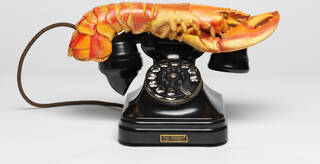
Lobsters were a prevailing motif for Salvador Dalí, who considered them sexually charged. For Schiaparelli beachwear, he drew a lobster among parsley, which was transferred to silk by designer Paul Sache (shown opposite). Dalí then proposed applying the design to a simple high‑waisted dinner dress, suggestively positioning the creature on the skirt. He also planned to add real mayonnaise. When poet Edward James commissioned Dalí to make the Lobster Telephone, it reflected the free flow of ideas between artist, designer and writer.
Lobster Telephone
Salvador Dalí
1938
Europe
Steel, plaster, rubber, resin, paper
Tate: Purchased 1981. T03257
Lobster print textile
Elsa Schiaparelli with Salvador Dalí; silk printing by Paul Sache
Spring 1937
Paris
Printed silk organza
Philadelphia Museum of Art: 1969‑232‑52
Gift of Elsa Schiaparelli
Lobster print textile
Elsa Schiaparelli with Salvador Dalí; silk printing by Paul Sache
Spring 1937
Paris
Printed silk organza
Philadelphia Museum of Art: 1969‑232‑52
Gift of Elsa Schiaparelli
Group label
Exquisite corpse
The macabre beauty of skeletons fascinated the surrealists. Schiaparelli collaborated with Dalí on this dress, bringing a skeleton to life using the trapunto quilting technique, stitching the outline through two layers of fabric with wadding. The sheer material, combined with the padded spine, ribcage, collarbones and hip joints, suggests we are seeing the wearer’s own flesh and bones. This is the only known original of the Skeleton dress. In Dalí’s drawing (displayed nearby) skeletons pose like fashion models.
Skeleton dress
Elsa Schiaparelli with Salvador Dalí
Summer 1938, Circus collection
Paris
Silk crêpe with plastic zips
V&A: T.394&A‑1974
Given by Ruth Ford
Skeleton Woman
Salvador Dalí
About 1938
Paris
Ink and pencil on paper
Patrimoine Schiaparelli, Paris
Desk job
Schiaparelli’s navy‑blue and black velvet Bureau suit for Winter 1936 featured drawer‑shaped pockets with hard plastic pulls. The soft sculpture transformed the wearer into an animate item of furniture. It was inspired by this drawing by Salvador Dalí who, in this period, added drawers to figures in paintings, sculptures and this cover for the surrealist magazine Minotaure. Cecil Beaton photographed models wearing the Bureau suit against a Dalí‑inspired backdrop for Vogue, with one model holding a copy of Minotaure.
Anthropomorphic Cabinet
Salvador Dalí
1936
Paris
Ink and pencil on paper
Patrimoine Schiaparelli, Paris
Minotaure
Cover designed by Salvador Dalí
June 1936
Paris
Colour halftone print on paper
Chelsea College of Arts Library, University of the Arts London
Schiaparelli Bureau suit
Cecil Beaton
1936
Paris
Inkjet print facsimile, 2026
Condé Nast via Getty Images
Ruth Ford
Top billing
American actress and model Ruth Ford wore some of Schiaparelli's most theatrical designs. Surrealist patron and poet Edward James paid for many of them, amassing this astronomical bill for 86,237 French francs in about 6 months. He bought neckties featuring small zebras for himself while everything else was for friends, including the Torn dress and the Skeleton dress (displayed nearby) for Ford. Her later donation of Schiaparelli garments to the V&A was the largest from a single client.
Schiaparelli invoice
Maison Schiaparelli
1938
Paris
Ink on paper
On loan from West Dean
(The Edward James Foundation): EJA/1/82/1
Image: Ruth Ford wearing an evening cape by Elsa Schiaparelli, about 1935
Photograph by Cecil Beaton
Cecil Beaton Archive © Condé Nast
Object label
Elsa Schiaparelli
Artist, playwright and filmmaker Jean Cocteau appreciated the theatricality of Schiaparelli’s dramatic capes and coats. These were often embellished with eye‑catching details like the silk roses stitched onto an evening coat (shown nearby). Cocteau’s simple outline drawing shows a cape with a hand protruding from the garment. For surrealists, disembodied hands held symbolic, often sexual, meaning.
Jean Cocteau
1937
Paris
Pencil on paper
Musée Jean Cocteau, Collection Séverin Wunderman: 1.514
Harper’s Bazaar
Illustrations by Jean Cocteau
July 1937
Drawn in Paris; printed in New York
Colour halftone print on paper
V&A: NCOL.419‑2025
Drawings
Jean Cocteau
About 1936
Paris
Pencil and coloured pencil on cardboard
On loan from West Dean (The Edward James Foundation): EJA/ 1/ 22/ 8a; EJA/ 1/ 22/ 9a
Mirror, mirror
Schiaparelli launched her Spring 1937 collection to mark the Exposition Internationale in Paris, where she exhibited alongside other artists and designers, many reviving an aesthetic inspired by ancient Greece and Rome. Jean Cocteau blended classical motifs and surrealist techniques in his drawings of mirrored, kissing faces which, in profile, trace an urn of roses and a draped cloth (shown nearby). The image was embroidered onto the reverse of this coat, with stitched golden lines creating an illusionistic fluted column below.
Evening coat
Elsa Schiaparelli with Jean Cocteau
Spring 1937
Designed in Paris; made in London
Silk jersey, gilded metal and silk thread, appliquéed silk
V&A: T.59‑2005
Given by the American Friends of the V&A
Drawings
Jean Cocteau
About 1936
Paris
Pencil and coloured pencil on cardboard
On loan from West Dean (The Edward James Foundation): EJA/ 1/ 22/ 8a; EJA/ 1/ 22/ 9a
Hand crafted
Cocteau’s whimsical, linear drawing style complemented Schiaparelli’s clean tailoring. Following his design, Maison Lesage embroidered this jacket with a figure in profile, its face appearing on the shoulder with hair flowing down one sleeve in a cascade of golden bugle beads. The floating hand uncannily holds a sequinned handkerchief around the waist. Cocteau drew an illustration of this look for Harper’s Bazaar (shown nearby) in which the figure’s profile mirrors that shown on the jacket, its hand clutching a scarf.
Dinner jacket
Elsa Schiaparelli with Jean Cocteau
Spring 1937
Paris
Linen, gilded metal and silk thread, beads, paillettes
Philadelphia Museum of Art: 1969‑232‑22
Gift of Elsa Schiaparelli
Harper’s Bazaar
Illustrations by Jean Cocteau
July 1937
Drawn in Paris; printed in New York
Colour halftone print on paper
V&A: NCOL.419 ‑2025
Fashion illustrations
As eccentric as he was talented, Christian Bérard drew fashion illustrations for the leading magazines. His lyrical style animated the figure‑hugging ‘cigarette’ silhouette of these evening dresses from Schiaparelli's Winter 1939 collection. Affectionally known as Bébé, Schiaparelli said of him, ‘To be approved and admired – and sometimes befriended – by Bébé was a consecration in the artistic, social and intellectual world of Paris’.
Christian Bérard
1939
Gouache on paper
Paris
Patrimoine Schiaparelli, Paris
Object label
21 Place Vendôme
The column at the centre of Place Vendôme, erected by Emperor Napoleon I, has become a distinctive landmark associated with Schiaparelli. In this collage of Elsa Schiaparelli’s greatest moments, created by her long‑standing collaborator Marcel Vertès, fashion models rather than soldiers twist up the monument. These are interspersed with other recognisable motifs, including eyes, lips and a measuring tape.
Marcel Vertès
1953
Paris
Paper and watercolour on wood
Patrimoine Schiaparelli, Paris
Dress and hat
Schiaparelli by Daniel Roseberry; hat by Stephen Jones Millinery
Autumn/ Winter 2021
Paris
Wool, silk, velvet (dress); felt, vinyl (hat)
Patrimoine Schiaparelli, Paris
Perfume
Elsa Schiaparelli launched her first perfume, S, in 1928, shortly after establishing her fashion collections. This unisex fragrance marked the beginning of a series of successful scents, driven by an entrepreneurial spirit and described by the press as sharing ‘ the same tangy, unexpected quality of Schiaparelli clothes ’.
At the premises on Place Vendôme, a large golden birdcage, conceived by interior designer Jean‑Michel Frank, enclosed the perfume section of the ground‑floor boutique. Frank was one of many skilled specialists among Schiaparelli’s network of creative perfume partners who, along with Salvador Dalí, Leonor Fini and Marcel Vertès, produced striking bottles and advertisements.
Advertisement for Salut de Schiaparelli
Schiaparelli hired avant‑garde photographer Ilse Bing to create advertisements for her new trio of fragrances – Schiap for daytime, Soucis for late afternoon and Salut for evening. This solarised image depicts Bettina Bergery, Schiaparelli’s right hand at Place Vendôme. She poses surrounded by lilies to evoke the perfume’s floral scent.
Ilse Bing
1934
Paris
Gelatin silver print from solarised negative, 1988
V&A: E.3073‑2004
Bequest of Ilse Bing Wolff
Salut
For Salut, Schiaparelli turned to Jean‑Michel Frank who designed a bottle with clean lines and contrasting cork packaging. The fragrance was a success with one journalist commenting, ‘ This is what Salut does for a girl… A drop behind each ear and you feel you ’ve had good news. A spray around your neck and Marlene Dietrich had better look out ’.
Jean‑Michel Frank for Elsa Schiaparelli
1934
Paris
Glass (bottle); cork (packaging)
Patrimoine Schiaparelli, Paris
Schiap
Designed for Elsa Schiaparelli
1934
Paris
Glass (bottle); card (packaging)
Patrimoine Schiaparelli, Paris
Object label
Snuff
Snuff was Schiaparelli’s only perfume for men. The bottle, shaped like a pipe and sold in a tobacco box, references artist René Magritte’s 1929 painting The Treachery of Images, which depicts a pipe with the contradictory phrase, ‘ This is not a pipe ’. By alluding to this artwork, Schiaparelli reflects its playful approach to perceptions of reality.
Designed for Elsa Schiaparelli
1939
Paris
Glass (bottle); paper (box); celluloid (filling)
Patrimoine Schiaparelli, Paris
Image: La Trahison des images, René Magritte, 1929
Oil on canvas
Los Angeles County Museum of Art
Le Roy Soleil
This fragrance was an homage to Louis XIV, the Sun King. It was produced in a limited edition of 2,000 crystal bottles created by historic French glassmaker Baccarat and packaged in oversized, gilded metal seashells. Salvador Dalí, who designed the bottle, created an illusionistic effect on the flacon’s stopper where sun, sky and birds converge to form a face.
Salvador Dalí for Elsa Schiaparelli; manufactured by Baccarat
1947
Paris
Baccarat crystal (bottle); enamel gold lacquer (stopper); silk satin, velvet, card, metal (shell)
Patrimoine Schiaparelli, Paris
Advertisement for Le Roy Soleil de Schiaparelli
Marcel Vertès
About 1947
Paris
Off‑set lithograph
Patrimoine Schiaparelli, Paris
Shocking
Schiaparelli commissioned her friend, artist Leonor Fini, to design the bottle of her most famous perfume, Shocking. Its shape was modelled on the dress form of actress Mae West, then in Schiaparelli’s atelier (workshop), and featured a measuring tape around the shoulders. Fini, whose surrealist artworks often referenced clothing, was disappointed by the addition of small flowers to her design by Schiaparelli’s commercial director. Schiaparelli called on illustrator and costume designer Marcel Vertès to create the advertisements for Shocking. He breathed humour onto the magazine page, often animating the bottles by depicting them in unusual locations such as a painter’s studio or a horseracing track.
Shocking de Schiaparelli, window display bottle
Leonor Fini for Elsa Schiaparelli
1937
Paris
Glass, cardboard, paper, cotton
Patrimoine Schiaparelli, Paris
Shocking de Schiaparelli
Leonor Fini for Elsa Schiaparelli
1937
Paris
Glass
Patrimoine Schiaparelli, Paris
Shocking, artist’s studio
Marcel Vertès
About 1937
Paris
Off‑set lithograph
Patrimoine Schiaparelli, Paris
Shocking, horseracing track
Marcel Vertès
About 1937
Paris
Off‑set lithograph
Patrimoine Schiaparelli, Paris
Sleeping
Sleeping debuted in Schiaparelli’s collection of Summer 1940 with a bottle and packaging designed to look like a lit candle and a snuffer. Marketed as a nighttime scent to be spritzed on before bed, the perfume alluded to the surrealist fascination with dreams and the unconscious. The turquoise cone also announced the new Schiaparelli colour for that season, Sleeping Blue.
Designed for Elsa Schiaparelli
1940
Paris
Glass (bottle); paper, card, metal (packaging)
Patrimoine Schiaparelli, Paris
Advertisement for Sleeping de Schiaparelli
Marcel Vertès
About 1940
Paris
Off‑set lithograph
Patrimoine Schiaparelli, Paris
Succès Fou
Designed for Elsa Schiaparelli
1952
Paris
Glass, enamel, gold leaf (bottle); card (packaging)
V&A: C.86:1 to 4‑2025
Given by Susan Marks in Memory of Diana June Simons née Davies
Sport
Schiaparelli’s entrepreneurial flair extended to her perfume business. In addition to commissioning artists to create the packaging and advertisements, she also initiated partnerships with high profile companies. For the eau de toilette edition of her Sport scent, Schiaparelli and champagne house G.H. Mumm imagined this festive miniature replica bottle design.
Designed for Elsa Schiaparelli
1952
Paris
Glass, aluminium (bottle); card (packaging)
Patrimoine Schiaparelli, Paris
Zut
Fernand Guéry‑Colas for Elsa Schiaparelli; manufactured by Verreries Brosse
1937
Paris
Glass (bottle); silk (ribbon); card (packaging)
Patrimoine Schiaparelli, Paris
Bijoux
Like her fashion accessories, Schiaparelli’s buttons and jewellery were designed to be noticed. They often expressed, in miniature, the essence of each collection. Acrobats and bears complemented the Circus collection, while leaves and insects accompanied Pagan.
To produce these pieces, Schiaparelli collaborated with many talented specialists, including Jean Clément, François Hugo and Jean Schlumberger.
Working with artists gave Schiaparelli ‘ a sense of exhilaration ’. Jean Cocteau, Alberto Giacometti and Elsa Triolet were also among those who made imaginative proposals.
Daniel Roseberry continues to embrace the absurd and amusing. His jewellery can reference doves in flight, golden padlocks and bejewelled anatomy such as hearts, eyes and ears.
Buttons (side 1)
Cat
Elena Izcue for Elsa Schiaparelli
1929
France
Ceramic
Patrimoine Schiaparelli, Paris
Mother‑of‑pearl rim
François Hugo for Elsa Schiaparelli
1939–45
France
Mother-of-pearl, silver, metal
V&A: T.127‑1965
Given by Dr L.V. Beck
Coiled chain
François Hugo for Elsa Schiaparelli
1939–45
France
Gilt silver, enamel
V&A: T.123‑1965
Given by Dr L.V. Beck
Black and Gold star
Jean Clément for Elsa Schiaparelli
1942
France
Ceramic
Patrimoine Schiaparelli, Paris
Gold swirl
François Hugo for Elsa Schiaparelli
1939–45
France
Gilt silver
V&A: T.126‑1965
Given by Dr L.V. Beck
Red and white profile
Jean Clément for Elsa Schiaparelli
1930s
France
Ceramic
Patrimoine Schiaparelli, Paris
Red, white and blue enamel
François Hugo for Elsa Schiaparelli
1939–45
France
Metal, enamel
V&A: T.132‑1965
Given by Dr L.V. Beck
Adam and Eve
Jean Clément for Elsa Schiaparelli
Late 1930s
France
Ceramic, brass, enamel
Patrimoine Schiaparelli, Paris
Profile with hand
Jean Clément for Elsa Schiaparelli
1930s
France
Ceramic
Patrimoine Schiaparelli, Paris
Twisted wire and blue enamel
François Hugo for Elsa Schiaparelli
1939–45
France
Metal, enamel
V&A: T.134‑1965
Given by Dr L.V. Beck
Dog’s head
François Hugo for Elsa Schiaparelli
About 1950
France
Leather, brass
Patrimoine Schiaparelli, Paris
Horn and metal
François Hugo for Elsa Schiaparelli
1939–45
France
Horn, gilt silver
V&A: T.136‑1965
Given by Dr L.V. Beck
Padlock
Designed for Elsa Schiaparelli
1940
France
Wood, brass
Patrimoine Schiaparelli, Paris
Stag’s head
François Hugo for Elsa Schiaparelli
About 1950
France
Leather, brass
Patrimoine Schiaparelli, Paris
Marbled blue enamel
François Hugo for Elsa Schiaparelli
1939–45
France
Copper, enamel
V&A: T.138‑1965
Given by Dr L.V. Beck
Door knocker
Possibly made by Line Vautrin for Elsa Schiaparelli
1930
France
Gilt bronze
Patrimoine Schiaparelli, Paris
Diamanté flower
François Hugo for Elsa Schiaparelli
1939–45
Paris
Metal, celluloid, diamanté, paste
V&A: T.149‑1965
Given by Dr L.V. Beck
Plumed hat
Jean Clément for Elsa Schiaparelli
About 1937–38
France
Plaster
V&A: T.428‑1974
Given by Lady Alexandra Trevor‑Roper
Hazelnut
François Hugo for Elsa Schiaparelli
1930s
France
Wood, brass
Patrimoine Schiaparelli, Paris
Blue and purple enamel
François Hugo for Elsa Schiaparelli
1939–45
France
Silver-gilt, enamel
V&A: T.149A‑1965
Given by Dr L.V. Beck
Peanut
Jean Clément for Elsa Schiaparelli
1930s
France
Ceramic
Patrimoine Schiaparelli, Paris
White, red and blue circle
François Hugo for Elsa Schiaparelli
1939–45
France
Silver-gilt, enamel
V&A: T.105‑1965
Given by Dr L.V. Beck
Butterfly
Jean Clément for Elsa Schiaparelli
1937
Paris
Resin, metal
Patrimoine Schiaparelli, Paris
Yellow S
Gisèle Favre for Elsa Schiaparelli
1940
France
Ceramic
Patrimoine Schiaparelli, Paris
Enamelled with concentric rings François Hugo for Elsa Schiaparelli
1939–45
France
Gilt silver, enamel
V&A: T.148‑1965
Given by Dr L.V. Beck
Woman’s head
Possibly made by Jean Schlumberger for Elsa Schiaparelli
Early 1930s
France
Painted resin
Patrimoine Schiaparelli, Paris
Turquoise and gold flower
François Hugo for Elsa Schiaparelli
1939–45
France
Gilt silver, enamel
V&A: T.104‑1965
Given by Dr L.V. Beck
Looped wire
François Hugo for Elsa Schiaparelli
1939–45
France
Gilt silver, wire
V&A: T.122‑1965
Given by Dr L.V. Beck
Black head
François Hugo for Elsa Schiaparelli
1940–49
France
Ceramic
Patrimoine Schiaparelli, Paris
Three‑leafed clover
François Hugo for Elsa Schiaparelli
1939–45
France
Gilt silver
V&A: T.117‑1965
Given by Dr L.V. Beck
White head
François Hugo for Elsa Schiaparelli
1940–49
France
Ceramic
Patrimoine Schiaparelli, Paris
Black star
Jean Clément for Elsa Schiaparelli
1930s
Paris
Ceramic
Patrimoine Schiaparelli, Paris
Green spiral
Elsa Triolet for Elsa Schiaparelli
About 1928–32
Paris
Glass
Patrimoine Schiaparelli, Paris
Bee on a flower
Jean Clément for Elsa Schiaparelli
1930s
France
Ceramic
Patrimoine Schiaparelli, Paris
Yellow leather
Ardor Atelier for Elsa Schiaparelli
Early 1930s
France
Leather
Patrimoine Schiaparelli, Paris
Cat eye
Designed for Elsa Schiaparelli
Late 1940s
France
Glass, metal
Patrimoine Schiaparelli, Paris
Red leather
Ardor Atelier for Elsa Schiaparelli
Early 1930s
France
Leather
Patrimoine Schiaparelli, Paris
The Hunter (Figure with raised arms)
Alberto Giacometti for Elsa Schiaparelli
1935–39
Paris
Bronze
Greens of Cheltenham Ltd
Ram’s head
Jean Clément for Elsa Schiaparelli
1930s
France
Ceramic
Patrimoine Schiaparelli, Paris
Pink leather
Ardor Atelier for Elsa Schiaparelli
Early 1930s
France
Leather
Patrimoine Schiaparelli, Paris
Blue eye
François Hugo for Elsa Schiaparelli
Late 1940s
France
Brass, enamel
Patrimoine Schiaparelli, Paris
Buttons (side 2)
Lizard
François Hugo for Elsa Schiaparelli
1939–45
France
Metal, enamel
V&A: T.146‑1965
Given by Dr L.V. Beck
Daisy
François Hugo for Elsa Schiaparelli
1939–45
France
Metal, enamel, plaster, silver foil
V&A: T.142-1965
Given by Dr L.V. Beck
Black petals
François Hugo for Elsa Schiaparelli
1939–45
France
Glazed ceramic
V&A: T.125‑1965
Given by Dr L.V. Beck
The Hunter (Figure with raised arms)
Alberto Giacometti for Elsa Schiaparelli
1935–39
Paris
Bronze
Greens of Cheltenham Ltd
Snake and apple
Jean Clément for Elsa Schiaparelli
Late 1930s
France
Ceramic
Patrimoine Schiaparelli, Paris
Femme aux Bras Levés (Woman with raised arms)
Alberto Giacometti for Elsa Schiaparelli
About 1938
France
Bronze
Patrimoine Schiaparelli, Paris
Stone
François Hugo for Elsa Schiaparelli
1941
France
Granite, metal
Patrimoine Schiaparelli, Paris
Green leaf
François Hugo for Elsa Schiaparelli
1939–45
France
Metal, enamel
V&A: T.143‑1965
Given by Dr L.V. Beck
Gold cherub
Jean Schlumberger for Elsa Schiaparelli
1937–38
France
Leather, velvet, brass
Patrimoine Schiaparelli, Paris
Honeycomb
François Hugo for Elsa Schiaparelli
1943
France
Ceramic
Patrimoine Schiaparelli, Paris
Gold swirls
François Hugo for Elsa Schiaparelli
1939–45
Gilt silver
France
V&A: T.120‑1965
Given by Dr L.V. Beck
Grey and red flower
François Hugo for Elsa Schiaparelli
1939–45
France
Glazed earthenware, silver, enamel
V&A: T.137-1965
Given by Dr L.V. Beck
Blue and gold
François Hugo for Elsa Schiaparelli
1939–45
France
Gilt silver, enamel
V&A: T.141‑1965
Given by Dr L.V. Beck
Green bird
François Hugo for Elsa Schiaparelli
1939–45
France
Glazed earthenware
V&A: T.116‑1965
Given by Dr L.V. Beck
Dragon
François Hugo for Elsa Schiaparelli
1939–45
France
Glazed earthenware
V&A: T.145-1965
Given by Dr L.V. Beck
Gold lattice
François Hugo for Elsa Schiaparelli
1939–45
France
Gilt silver
V&A: T.121‑1965
Given by Dr L.V. Beck
Spotted blue motif
François Hugo for Elsa Schiaparelli
1939–45
France
Gilt silver, enamel
V&A: T.144-1965
Given by Dr L.V. Beck
Leaf
François Hugo for Elsa Schiaparelli
1939–45
France
Gilt silver
V&A: T.113‑1965
Given by Dr L.V. Beck
S shape
Jean Clément for Elsa Schiaparelli
1942
France
Enamelled ceramic
Patrimoine Schiaparelli, Paris
Turquoise dragon
Jean Clément for Elsa Schiaparelli
Late 1930s
France
Ceramic
Patrimoine Schiaparelli, Paris
Gold and red pattern
François Hugo for Elsa Schiaparelli
1939–45
France
Gilt silver, felt
V&A: T.129‑1965
Given by Dr L.V. Beck
Red petals
François Hugo for Elsa Schiaparelli
1939–45
France
Glazed earthenware, silver
V&A: T.111-1965
Given by Dr L.V. Beck
Round turquoise
François Hugo for Elsa Schiaparelli
1939–45
France
Foil, metal, enamel
V&A: T.140‑1965
Given by Dr L.V. Beck
Braided border
François Hugo for Elsa Schiaparelli
1939–45
France
Gilt silver, wire, enamel
V&A: T.109‑1965
Given by Dr L.V. Beck
Black and blue pricked motif
François Hugo for Schiaparelli
1939–45
France
Glazed earthenware, enamel
V&A: T.147-1965
Given by Dr L.V. Beck
Enamel cream
François Hugo for Elsa Schiaparelli
1939–45
France
Metal, enamel
V&A: T.114‑1965
Given by Dr L.V. Beck
Duck
François Hugo for Elsa Schiaparelli
1939–45
France
Gilt silver, enamel
V&A: T.107-1965
Given by Dr L.V. Beck
Golden flower
François Hugo for Elsa Schiaparelli
1939–45
France
Gilt silver, metal
V&A: T.131‑1965
Given by Dr L.V. Beck
Drums
Jean Clément for Elsa Schiaparelli
Autumn 1939, Music collection
France
Plaster
V&A: T.429&A,B-1974
Given by Lady Alexandra Trevor‑Roper
Duckling
François Hugo for Elsa Schiaparelli
1939–45
France
Gilt silver, enamel
V&A: T.103-1965
Given by Dr L.V. Beck
Concave gold
François Hugo for Elsa Schiaparelli
1939–45
France
Gilt silver
V&A: T.118‑1965
Given by Dr L.V. Beck
Translucent with foliage
Jean Clément for Elsa Schiaparelli
Paris
Glass, resin, brass
Patrimoine Schiaparelli, Paris
Turquoise with twisted wires
François Hugo for Elsa Schiaparelli
1939–45
France
Gilt metal, enamel
V&A: T.139‑1965
Given by Dr L.V. Beck
Pelican and fish
François Hugo for Elsa Schiaparelli
1939–45
France
Glazed clay
V&A: T.112‑1965
Given by Dr L.V. Beck
Translucent with bird motif
François Hugo for Elsa Schiaparelli
1930s
Paris
Glass, resin, brass
Patrimoine Schiaparelli, Paris
Fossil
François Hugo for Elsa Schiaparelli
1939–45
France
Glazed clay
V&A: T.110‑1965
Given by Dr L.V. Beck
Colourful S
Designed for Elsa Schiaparelli
1940
France
Brass, enamel
Patrimoine Schiaparelli, Paris
Grey with ridges
François Hugo for Elsa Schiaparelli
1939–45
France
Metal, enamel
V&A: T.133‑1965
Given by Dr L.V. Beck
Turquoise with diamanté
François Hugo for Schiaparelli
1939–45
France
Metal, foil, diamanté
V&A: T.130-1965
Given by Dr L.V. Beck
Jewellery
1 White necklace
Elsa Triolet for Elsa Schiaparelli
About 1930
France
Glass, chrome, cotton
Collection Mark Walsh Leslie Chin
Vintage Luxury N.Y.
2 Rabbit brooch and clips
Jean Schlumberger for Elsa Schiaparelli
Summer 1938, Circus collection
France
Brass, bronze, cold enamel
Collection Mark Walsh Leslie Chin
Vintage Luxury N.Y.
3 Elephant clip
Designed for Elsa Schiaparelli
Summer 1938, Circus collection
France
Gilt metal, Bakelite, imitation pearls
William Wain Collection
4 Bear brooch
Jean Schlumberger for Schiaparelli
Summer 1938, Circus collection
Paris
Brass, glass, imitation pearls
Patrimoine Schiaparelli, Paris
5 Leopard paw brooch
Jean Schlumberger for Elsa Schiaparelli
About 1939
France
Metal, enamel
Collection Mark Walsh Leslie Chin
Vintage Luxury N.Y.
6 Bat brooch
Designed for Elsa Schiaparelli
1938
France
Brass, bronze, cold enamel, glass
Collection Mark Walsh Leslie Chin
Vintage Luxury N.Y.
7 Dog and donkey brooches
Lucien Neuquelman for Elsa Schiaparelli
About 1938
France
Glazed ceramic, metal
Collection of Jennifer Anne Gibson
8 Squirrel brooch
Jean Schlumberger for Elsa Schiaparelli
Autumn 1938, Pagan collection
France
Gilt bronze, enamel
William Wain Collection
9 Royalists and Republicans necklace
Designed for Elsa Schiaparelli
Winter 1935, Crowns or Republics collection
France
Brass, bronze, cold enamel
Collection Mark Walsh Leslie Chin
Vintage Luxury N.Y.
10 Acrobat necklace with matching brooch
Attributed Roger Jean Pierre for Elsa Schiaparelli
Spring 1939, A Modern Comedy collection
France
Gilt metal, coloured pastes, enamel
William Wain Collection
11 Necklace with bows
Jean Schlumberger for Elsa Schiaparelli
Autumn 1938, Pagan collection
Paris
Gilt metal, enamel
William Wain Collection
12 Miniature hand clip
Jean Schlumberger for Elsa Schiaparelli
About 1936-37
Enamel and metal
Paris
Collection Mark Walsh Leslie Chin
Vintage Luxury N.Y.
13 Mirror brooch
Designed for Elsa Schiaparelli
1935
France
Gilt metal, mirror
William Wain Collection
14 Green hat brooch
Designed for Elsa Schiaparelli
Winter 1935, Crowns or Republics collection
France
Leather, gilt metal, glass
William Wain Collection
15 Ostrich hair pins
Jean Schlumberger for Elsa Schiaparelli
Summer 1938, Circus collection
Paris
Brass, bronze, cold enamel, glass
Collection Mark Walsh Leslie Chin
Vintage Luxury N.Y.
16 Blue bird brooch
Designed for Elsa Schiaparelli
Summer 1939, Bustle collection
France
Brass, bronze, cold enamel, glass
Collection Mark Walsh Leslie Chin
Vintage Luxury N.Y.
17 Parrot brooch
Designed for Elsa Schiaparelli
Summer 1939, Bustle collection
France
Brass, bronze, cold enamel, glass
William Wain Collection
18 Gallic rooster brooch
Possibly made by Jean Schlumberger or Jean Clément for Elsa Schiaparelli
Winter 1935, Crowns or Republics collection
France
Gilt metal, enamel, glass, paste pearls
William Wain Collection
19 Duck hat pins
Lina Baretti for Elsa Schiaparelli
Autumn 1938, Pagan collection
Paris
Gilded metal, suede, paste, imitation pearls, wire
William Wain Collection
20 Parachute brooch
Designed for Elsa Schiaparelli
Summer 1936, Parachute collection
Possibly France
Brass, bronze, cold enamel
Collection Mark Walsh Leslie Chin
Vintage Luxury N.Y.
21 Hot air balloon brooch
Designed for Elsa Schiaparelli
About 1940
France
Metal, enamel, rhinestones
Lent by The Museum at the Fashion Institute of Technology: 84.173.3
Gift of Simeon Braguin
22 Harlequin head clip
Jean Schlumberger for Elsa Schiaparelli
Spring 1939, A Modern Comedy collection
Paris
Gilt metal, coloured pastes, enamel
William Wain Collection
The Harlequin figure’s black mask in the Commedia dell’arte theatre tradition has been interpreted as depicting a racist stereotype.
23 Clown brooch
Possibly made by Jean Schlumberger for Elsa Schiaparelli
Spring 1939, A Modern Comedy collection
Paris
Gilt metal, enamel
William Wain Collection
24 Drummer brooch
Jean Schlumberger for Elsa Schiaparelli
Summer 1938, Circus collection
France
Gilt metal, enamel, glass
William Wain Collection
25 Harlequin brooch
Jean Schlumberger for Elsa Schiaparelli
Spring 1939, A Modern Comedy collection
France
Gilt metal, enamel
William Wain Collection
The Harlequin figure’s black mask in the Commedia dell’arte theatre tradition has been interpreted as depicting a racist stereotype.
26 Jester clip
Possibly made by Max Boinet for Elsa Schiaparelli
Summer 1938, Circus collection
France
Gilt metal, clear paste
William Wain Collection
27 Leaf necklace
Jean Clément for Elsa Schiaparelli
Autumn 1938, Pagan collection
Paris
Gilt metal on fabric mount
William Wain Collection
28 Choker
Designed for Elsa Schiaparelli
Autumn 1938, Pagan collection
Paris
Silk and velvet ribbons with gilt pine cones
Given by Ruth Ford
Museum no. T.413‑1974
29 Succès Fou perfume brooch
Unknown designer for Elsa Schiaparelli
About 1953
France
Brass, glass (bottle); imitation stone
William Wain Collection
30 Leaf bracelet
Jean Clément for Elsa Schiaparelli
Autumn 1938, Pagan collection
France
Gilt metal, enamel
William Wain Collection
31 Leaf brooch
Jean Clément for Elsa Schiaparelli
Autumn 1938, Pagan collection
France
Gilt metal, enamel
William Wain Collection
32 Flower brooches
Maison Gripoix for Elsa Schiaparelli
About 1938
France
Gilt metal, glass paste
Lent by The Museum at the Fashion Institute of Technology: 74.135.222
Gift of Janet Chatfield-Taylor
33 Acorns and leaves clip
Jean Clément for Elsa Schiaparelli
Autumn 1938, Pagan collection
France
Gilt metal, Bakelite
William Wain Collection
34 Blue stars brooch
Jean Schlumberger for Elsa Schiaparelli; made by Maison Gripoix
Winter 1938, Zodiac collection
France
Gilt metal, glass
William Wain Collection
35 Star cascade brooch
Degorce Frères
Winter 1938, Zodiac collection
France
Gilt metal, enamel
William Wain Collection
36 Roi soleil clips
Jean Schlumberger for Elsa Schiaparelli
Winter 1938, Zodiac collection
France
Brass, bronze, gold plate, glass
Collection Mark Walsh Leslie Chin
Vintage Luxury N.Y.
37 Flower basket brooch
Possibly made by Max Boinet for Elsa Schiaparelli
Autumn 1938, Pagan collection
France
Gilt metal, enamel, tourmaline paste
William Wain Collection
38 Pansy brooch and cuff worn by fashion editor Diana Vreeland
Designed for Elsa Schiaparelli
Autumn 1938, Pagan collection
France
Brass, bronze, cold enamel
Collection Mark Walsh Leslie Chin
Vintage Luxury N.Y.
39 Beehive brooch
Designed for Elsa Schiaparelli
Autumn 1938, Pagan collection
Possibly France
Brass, bronze, straw raffia
Collection Mark Walsh Leslie Chin
Vintage Luxury N.Y.
40 Camelia clip
Attributed to Jean Schlumberger for Elsa Schiaparelli
Autumn 1938, Pagan collection
Paris
Enamel, imitation pearls, rhinestones, metal
William Wain Collection
41 Ladybird brooch
Degorce Frères for Elsa Schiaparelli
Autumn 1938, Pagan collection
France
Gilt metal, enamel, resin, rhinestones
William Wain Collection
42 Grasshopper brooch
Attributed to Degorce Frères for Elsa Schiaparelli
Autumn 1938, Pagan collection
Possibly France
Lucite, metal, rhinestones
William Wain Collection
43 Snail brooch
Designed for Elsa Schiaparelli
Autumn 1938, Pagan collection
France
Gilt metal, shell
William Wain Collection
44 Dove pendant
Alberto Giacometti for Elsa Schiaparelli
1935–39
Paris
Gilt bronze
Greens of Cheltenham Ltd
45 Winged bird
Alberto Giacometti for Elsa Schiaparelli
1935–39
Paris
Gilt bronze
Greens of Cheltenham Ltd
46 Eye with a teardrop brooch
Jean Cocteau for Elsa Schiaparelli
1937
Paris, France
Enamelled metal, melted glass, mother-of-pearl coated resin
Musée Jean Cocteau Collection Séverin Wunderman:
2005.1.1119
47 Angel of the Annunciation brooch
Alberto Giacometti for Schiaparelli
About 1935–39
Paris
Gilt bronze
Patrimoine Schiaparelli, Paris
48 Aspirin necklace
Elsa Triolet for Schiaparelli
1929
France
Glass (beads); metal (clasp); cotton (thread)
Département des Médiathèques-Ludothèque, Saint Etienne du Rouvray
Writer Elsa Triolet’s trompe l’oeil necklace represents an early example of Schiaparelli’s collaborations and exploration of surrealist themes. It is made from glass beads that resemble the common aspirin tablet. Between 1928 and 1930, Triolet and her partner, poet Louis Aragon, created jewellery to sell within the boutique of Schiaparelli’s Paris headquarters.
49 La Langouste (lobster) brooch
Ralph de Rosa Company for Elsa Schiaparelli
About 1954
Designed in Paris; made in USA
Cabochon glass, crystal glass, metal
William Wain collection
50 Hand-shaped leaf brooch
Possibly made by Salvador Dalí for Elsa Schiaparelli
1951
Made in USA
Gilt metal, paste, ruby cabochon
William Wain collection
Jewellery
1 Necklace
Schiaparelli by Daniel Roseberry
Autumn/Winter 2023
Paris
Silver plated brass, Swarovski crystals, synthetic pearl
Patrimoine Schiaparelli, Paris
2 Bracelet
Schiaparelli by Daniel Roseberry
Spring/Summer 2024
Paris
Golden brass, Swarovski crystals, resin
Patrimoine Schiaparelli, Paris
3 Cuffed bracelet and disc-shaped bracelet
Schiaparelli by Daniel Roseberry
Autumn/Winter 2023
Paris
Silver plated brass, Swarovski crystals
Patrimoine Schiaparelli, Paris
4 Earring
Schiaparelli by Daniel Roseberry
Spring/Summer 2025
Paris
Silver plated brass, synthetic pearl
Patrimoine Schiaparelli, Paris
5 Necklace
Schiaparelli by Daniel Roseberry
Spring/Summer 2024
Paris
Silver plated brass, Swarovski crystals
Patrimoine Schiaparelli, Paris
6 Ring
Schiaparelli by Daniel Roseberry
Spring/Summer 2024
Paris
Golden brass, glass, Swarovski crystals
Patrimoine Schiaparelli, Paris
7 Earrings
Schiaparelli by Daniel Roseberry
Spring/Summer 2024
Paris
Silver plated brass, Swarovski crystals, electronic chips
Patrimoine Schiaparelli, Paris
8 Earrings
Schiaparelli by Daniel Roseberry
Spring/Summer 2024
Paris
Silver plated brass, Swarovski crystals
Patrimoine Schiaparelli, Paris
9 Necklace
Schiaparelli by Daniel Roseberry
Autumn/Winter 2025
Paris
Silver metal, synthetic pearls, Swarovski crystals
Patrimoine Schiaparelli, Paris
10 Earring headdress
Schiaparelli by Daniel Roseberry
Autumn/Winter 2022
Paris
Golden brass, Swarovski crystals, resin
Patrimoine Schiaparelli, Paris
11 Earring
Schiaparelli by Daniel Roseberry
Spring/Summer 2025
Paris
Silver plated brass, tainted resin
Patrimoine Schiaparelli, Paris
12 Earring
Schiaparelli by Daniel Roseberry
Spring/Summer 2025
Paris
Golden brass, tainted resin
Patrimoine Schiaparelli, Paris
13 Earrings
Schiaparelli by Daniel Roseberry
Spring/Summer 2023
Paris
Calf leather, glass
Patrimoine Schiaparelli, Paris
14 Earrings
Schiaparelli by Daniel Roseberry
Aumtum/Winter 2021
Paris
Gold brass, Swarovski crystals, white resin, synthetic pearls
Patrimoine Schiaparelli, Paris
15 Necklace
Schiaparelli by Daniel Roseberry
Aumtum/Winter 2022
Paris
Silk velvet, golden brass, Swarovski crystals
Patrimoine Schiaparelli, Paris
16 Earrings
Schiaparelli by Daniel Roseberry
Spring/Summer 2021
Paris
Resin, golden brass, Swarovski crystals
Patrimoine Schiaparelli, Paris
17 Earrings
Schiaparelli by Daniel Roseberry
Spring/Summer 2022
Paris
Golden brass, Swarovski crystals, vintage crystals
Patrimoine Schiaparelli, Paris
18 Necklace
Schiaparelli by Daniel Roseberry
Autum/Winter 2025
Paris
Treated silver
Patrimoine Schiaparelli, Paris
19 Earrings
Schiaparelli by Daniel Roseberry
Spring/Summer 2022
Paris
Golden brass, resin, glass
Patrimoine Schiaparelli, Paris
20 Brooch
Schiaparelli by Daniel Roseberry
Autum/Winter 2023
Paris
Golden brass, crystals
Patrimoine Schiaparelli, Paris
21 Ring
Schiaparelli by Daniel Roseberry
Autum/Winter 2021
Paris
Golden brass, enamel, synthetic pearls
Patrimoine Schiaparelli, Paris
22 Earrings
Schiaparelli by Daniel Roseberry
Spring/Summer 2023
Paris
Golden brass, glass, foam, calf leather, enamel, Swarovski crystals
Patrimoine Schiaparelli, Paris
23 Earrings
Schiaparelli by Daniel Roseberry
Spring/Summer 2021
Paris
Golden brass, resin, enamel
Patrimoine Schiaparelli, Paris
24–29 Schiaparelli vous invite…
Each season, invitations to Schiaparelli fashion shows are accompanied by these bijoux‑like souvenirs. Now a Schiaparelli signature, some pieces, such as the spiral seashell, can even be worn as jewellery. These keepsakes reflect design motifs the guests will see at the presentations. A shimmering apple from the Autumn/Winter 2023 invitation appeared on the runway as a small bag, while a golden feather evoked the Icarus‑themed collection of Spring/Summer 2025.
24 Feather invitation
Schiaparelli by Daniel Roseberry
Spring/Summer 2025
Paris
Pleated gold
Patrimoine Schiaparelli, Paris
25 Key invitation
Schiaparelli by Daniel Roseberry
Autumn/Winter 2024
Paris
Pleated gold
Patrimoine Schiaparelli, Paris
26 Shell invitation
Schiaparelli by Daniel Roseberry
Autumn/Winter 2025
Paris
Pleated gold
Patrimoine Schiaparelli, Paris
27 Apple invitation
Schiaparelli by Daniel Roseberry
Autumn/Winter 2023
Paris
Pleated gold
Patrimoine Schiaparelli, Paris
28 Disc invitation
Schiaparelli by Daniel Roseberry
Spring/Summer 2024
Paris
Pleated gold
Patrimoine Schiaparelli, Paris
29 Triangular face invitation
Schiaparelli by Daniel Roseberry
Spring/Summer 2023
Paris
Pleated gold
Patrimoine Schiaparelli, Paris
Beyond Paris
The names of the famous people who flocked to Upper Grosvenor Street [in London] would make a small Who’s Who.
From her headquarters in Paris, Elsa Schiaparelli’s reputation and style extended across Europe, the United States and beyond. A high‑profile public figure with a flair for self‑promotion, she attended the many glittering events in her busy social calendar wearing her own latest designs. Wherever she went, what she wore made headlines.
The 1933 opening of Schiaparelli’s London salon in Mayfair gave her a presence in one of the world’s most elegant shopping districts. Nearby commercial galleries made tentative steps in showing surrealist art and, in 1936, the sensational London International Surrealist Exhibition stopped traffic.
Throughout the 1930s and into the 1950s, Schiaparelli gained further recognition by costuming British, French and American films and plays, the latter reaching a theatre audience of more than three million people. In parallel, Schiaparelli was the preferred designer for the personal wardrobes of the most notable performers of the day.
Stage and Screen
Between 1931 and 1953, Elsa Schiaparelli costumed more than 60 theatre and film productions in London, Paris and New York. In 1934 alone, her designs featured in seven shows in London’s West End, with one production, Vintage Wine, drawing an audience of 235,000 people. In Hollywood, Schiaparelli dressed the leading ladies of award‑winning films, notably Zsa Zsa Gabor in Moulin Rouge (1952).
Schiaparelli capitalised on the celebrity power of her famous followers. In her autobiography, Shocking Life, she described her couture salon as a meeting place where ‘ all the stars came ’, including Greta Garbo, Josephine Baker, Arletty and Marlene Dietrich.
Metamorphosis
Filmmakers often chose Schiaparelli costume designs for their characters involved in narratives of masquerade, disguise and transformation. Her garments played a key role in a film’s plot. In Every Day’s a Holiday, Mae West’s character, Peaches O’Day, hides tools in the folds of her Schiaparelli gown. In Pygmalion, Wendy Hiller’s costume changes, from simple day dresses to dramatic eveningwear, convey Eliza Doolittle’s move from a working‑class to a high‑society woman. For Schiaparelli’s last film Moulin Rouge, she created six historic costumes for Zsa Zsa Gabor as performer Jane Avril. At director John Huston’s request, the designs were inspired by Henri de Toulouse-Lautrec’s advertisements for the Parisian cabaret and showcased Schiaparelli’s daring colour palette in brilliant technicolour film.
Couture for cinema
The inclusion of a Schiaparelli design acted as a marker of luxury and fashionable taste in a film. In Artists and Models Abroad, a parade of haute couture includes a sumptuous, ruffled Schiaparelli gown, emphasising its designer’s title as a leading couturier of interwar Paris. For Le Vagabond Bien Aimé or The Beloved Vagabond, the designer showcased looks made in her Parisian and London salons for the French and English versions of the film. Schiaparelli’s headquarters became the backdrop for films too. In one scene from Aventures à Paris, two characters pay a visit to Place Vendôme, now recognised as the epicentre of style in the French capital, and stand beside a van advertising the designer’s garments Pour le Sport, Pour la Ville and Pour le Soir.
Running time: approximately 3 minutes This AV has no sound
Artists and Models Abroad (1937)
Mitchell Leisen
Paramount Pictures
Le Vagabond Bien-Aimé (1936)
Curtis Bernhardt
Toeplitz Productions Ltd.
Aventures à Paris (1936)
Marc Allégret
Productions André Daven
Moulin Rouge (1952)
John Huston
Studio Canal
Pygmalion (1938)
Anthony Asquith, Leslie Howard
Janus Films, ITV Global Entertainment
Un Certain Monsieur (1950)
Yves Ciampi
Eclectiques-Films
Every Day’s a Holiday (1937)
Edward Sutherland
Paramount Pictures/Universal Studios
Marlene Dietrich
Femme fatale
Marlene Dietrich was among Schiaparelli's preeminent celebrity clients who purchased garments from the Paris and London salons. Her wardrobe conveyed her public persona and challenged conventional ideas of glamour and femininity. Dietrich embraced a more masculine look by wearing trousers both on and off screen, prompting Schiaparelli to recall her ‘ famous legs ’. The sharply tailored silhouette of these two suits, one with buttons by sculptor Alberto Giacometti, became synonymous with Dietrich’s style.
Image: Marlene Dietrich wearing Schiaparelli for the film Angel, Paramount Pictures, 1937
Unknown photographer
RGR Collection / Alamy Stock Photo
Suit
Elsa Schiaparelli with buttons by Alberto Giacometti
1938
Paris
Wool, silk, velvet ( jacket); bronze (buttons); wool (skirt)
Deutsche Kinemathek – Marlene Dietrich Collection Berlin: TX‑70624
Suit
Elsa Schiaparelli
1937
Paris
Silk, velvet, glass, sequins ( jacket); velvet (trousers)
Deutsche Kinemathek – Marlene Dietrich Collection Berlin: TX‑70330; TX‑70125
Every Day’s a Holiday
For the film Every Day’s a Holiday, the lead actress and co‑writer Mae West requested that Schiaparelli design the look for her role as beguiling con artist, Peaches O ’Day. These extravagant garments took centre stage as O ’Day changed her look at almost every scene and adopted an alter ego in an attempt to evade police capture.
Elsa Schiaparelli
1937
Paris
Wool
Collection of John H. Davey
Image: Film still from Every Day's a Holiday, 1937
Moviestore Collection Ltd / Alamy Stock Photo
Schiaparelli London Ltd
When Schiaparelli opened her London premises at 6 Upper Grosvenor Street, Mayfair, it became the capital’s first surrealist space, ushering the art movement into the city. There she employed around 80 workroom staff, hosted fashion presentations and sold pieces from her Paris collections. The interior included ice‑blue panelled walls, blue and white striped curtains and glass accessory cabinets.
Schiaparelli was familiar with the UK from regular textile scouting trips and through her relationship with English businessman and theatre‑backer Henry Spence Horne. Despite a loyal clientele, with war fast approaching, Schiaparelli closed her London premises in July 1939.
Frances Rodney
Working wardrobe
These chic ensembles and hats exemplify the working wardrobe of American‑born editor of British Harper’s Bazaar Frances Rodney (later Farquharson) who purchased them at Schiaparelli London. Their colour may indicate mourning for her husband, James, who died in 1933. As a trusted friend, Rodney chaperoned Schiaparelli’s daughter, Gogo, during her 1938 debutante season. When Rodney remarried, she moved to her new husband’s Scottish ancestral home, embracing the local tartans.
Coat
Elsa Schiaparelli
About 1935
Designed in Paris; made in London
Wool
On loan courtesy of National Museums Scotland: A.1994.1023
Suit
Elsa Schiaparelli
Summer 1938, Circus collection Designed in Paris; made in London
Wool
Aberdeen City Council (Aberdeen Archives, Gallery & Museums collections): ABDMS024946.1+.2
Evening dress
Possibly Elsa Schiaparelli
About 1939
Designed in Paris; made in London
Satin‑backed silk crêpe
On loan courtesy of National Museums Scotland: A.1994.1020
Straw hat with ribbon
Elsa Schiaparelli
About 1939
Designed in Paris; made in London
Straw (hat); silk (ribbon)
On loan courtesy of National Museums Scotland: A.1994.1010
Hat with curled brim
Elsa Schiaparelli
Spring 1937
Designed in Paris; made in London
Wool
On loan courtesy of National Museums Scotland: A.1994.111
Hat with feathers
Elsa Schiaparelli
Late 1930s
Designed in Paris; made in London
Wool, feathers
On loan courtesy of National Museums Scotland: A.1994.1015
Image: Frances Rodney, British Harper’s Bazaar, September 1941 Photograph by John Everard
Tartan skirt
Schiaparelli was a career‑long proponent of British textiles. The pattern of this skirt’s French silk taffeta reflects her enthusiasm for Scottish tartans. She incorporated them into a range of garments, including coats, sports clothes and hats.
Elsa Schiaparelli
1949
Paris
Silk taffeta (skirt); blouse (prop)
Musée des arts Décoratifs: UF 73‑21‑2
Evening coat
Although the textile of this vivid Schiaparelli London evening coat was made by French manufacturer Ducharne, its dense weave and deep red hue resemble the heavy wool twill used for the tunics of the Life Guards, part of the British Army’s Household Cavalry. The gold buttons underline the military reference, their curlicue shape adding a touch of Schiaparelli humour.
Elsa Schiaparelli
Winter 1935
Designed in Paris; made in London
Wool (coat); metal (buttons)
V&A: T.35‑1964 Given by Dorothy Otway Smithers
Lady Mount Temple
British aristocrat Molly Mount Temple strikes a formidable pose in this portrait. A keen follower of modern art and design, Temple chose to wear Schiaparelli and be portrayed by British painter Gluck. The artist, who rejected gender norms of the day, understood the power of dressing and picked out sartorial details, like the undulating white collar and bright red fingernails.
Gluck
1936
London
Oil on canvas
Collection of Mr. Cary Stevens and Allen Green, M.D.
Sheila Legge as Surrealist Phantom
To mark the opening of the London International Surrealist Exhibition, artist Sheila Legge staged an innovative performance. She stood in London’s Trafalgar Square in a white silk dress with long black gloves and a mask of paper roses. The performance, and photographs taken by Claude Cahun, reference Dalí’s painting Necrophiliac Spring (displayed in Artist Collaborations) with Schiaparelli as the artwork’s inspirator and owner.
Claude Cahun
1936
Inkjet print facsimile from original negative, 2026
London
Jersey Heritage Collections
Discussing Dress
John Banting shared a fascination with mannequins and clothing with the surrealists he met in Paris in 1930. He explored their metamorphic potential in this work which blends surrealist techniques with a fashionable pink and blue palette. Banting, who participated in the London International Surrealist Exhibition of 1936, briefly worked as a window dresser and often wore bold clothing and dyed‑green hair.
John Banting
1937
London
Paper, gouache, pencil on paper
V&A: P.16‑1971
Gala and Salvador Dalí
Gala Dalí wears a Schiaparelli London dress with a glittering bodice, likely a gift from poet and surrealist patron, Edward James. The photograph was taken on the occasion of Salvador Dalí’s first UK solo exhibition, where James bought the painting seen here. Exploiting the accompanying publicity, the Schiaparelli London Winter 1936 collection was shown alongside drawings by Dalí.
Cecil Beaton
1936
London
Gelatin silver print from original negative, 1971
Collection of Anthony Leigh
Glove hat
Artist Eileen Agar wore gloves with scarlet nails to René Magritte’s 1938 exhibition opening in London. They imitated a Schiaparelli design from Winter 1936. Agar later pinned them to this hat to create an artwork. She recalled that surrealist women juxtaposed ‘ a Schiaparelli dress with outrageous behaviour or conversation… simply carrying the beliefs of Surrealism into public existence ’.
Eileen Agar
About 1938
Straw, leather
London
V&A: T.169‑1993
Given by Jenny Fraser
Eileen Agar at Brighton Pavilion
Lee Miller’s photograph of her friend’s shadow may be the only visual evidence of Agar wearing Schiaparelli. The distinctive elongated hat, typical of Schiaparelli headwear, had caught the attention of the French surrealists when it appeared in the magazine Minotaure in 1933. In Britain, surrealists wore noteworthy hats to exhibition launches at the London Gallery, which opened in 1937.
Lee Miller
1937
London
Chromogenic print facsimile from original negative, 2026
Lee Miller Archives, East Sussex, England
Gold leaf
Lady Alexandra Haig wore Schiaparelli designs to attend the whirlwind of social events enjoyed by London’s smart set. For a Christmas carolling party at the residence of the Marquess of Londonderry, she chose this evening suit from the Pagan collection. The golden leaves winding round the lapels soften the jacket’s neatly tailored line.
Evening suit
Elsa Schiaparelli
Autumn 1938, Pagan collection
Designed in Paris; made in London
Rayon marocain, metal strip, beads, crystals ( jacket); painted resin (buttons); rayon marocain (dress)
V&A: T.399&A‑1974
Given by Lady Alexandra Trevor‑Roper
Evening suit
British art collector and patron Jane Clark wore this suit, one of Schiaparelli’s more extravagantly embellished examples. The embroidery’s placement and meandering, stylised floral pattern are reminiscent of an 18th‑century man’s habit à la française or court suit. Such elaborate garments illustrate the readiness of British clients to embrace Schiaparelli’s most spectacular designs.
Elsa Schiaparelli
Spring 1938
Designed in Paris; made in London
Silk velvet, metal strip, crystals ( jacket); resin (buttons); silk velvet (dress)
Fashion Museum Bath: BATMC: I.109.298
Given by Lady Jane Clark
Lady Alexandra Haig
High society
Lady Alexandra Haig (later Trevor‑Roper) was a prominent British Schiaparelli client who shopped for several seasons at the designer’s London premises. Haig favoured Schiaparelli’s evening suits. She chose this burgundy velvet ensemble from the Autumn 1937 collection to wear for her portrait, published in society magazine, The Tatler, in January 1938.
Evening suit
Elsa Schiaparelli
Autumn 1937
Designed in Paris; made in London
Silk velvet, metal strip, silver‑gilt thread, crystals, sequins ( jacket); metal (buttons); silk velvet (skirt)
V&A: T.398&A–1974
Given by Lady Alexandra Trevor‑Roper
Image: Lady Alexandra Haig wearing her Schiaparelli burgundy velvet evening suit, 1938 Photograph by Canons of Hollywood
Mary Evans Picture Library
Evening ensemble
Elsa Schiaparelli
About 1939
Designed in Paris; made in London
Printed silk ( jacket); silk crêpe (skirt)
V&A: T.232&A‑1964
Given by the Honourable Pamela Sherek
Maud Russell
In bloom
These two dresses, with patterns reminiscent of lush summer gardens, are from the wardrobe of art collector Maud Russell (born Nelke). She defied convention both through her avant‑garde taste and secret wartime work for the British Naval Intelligence Division. Her friends included photographer Cecil Beaton, art critic Clive Bell, art historian Kenneth Clark and V&A curator, and later director, John Pope‑Hennessy.
Elsa Schiaparelli
About 1938
Designed in Paris; made in London
Silk
V&A: T.148–1969
Given by Maud Russell
Elsa Schiaparelli
About 1938
Designed in Paris; made in London
Silk
V&A: T.149 ‑1969 Given by Maud Russell
Image: Maud Russell, 1935
Photograph by Cecil Beaton
Cecil Beaton Archive © Condé Nast
Evening dress and coat
The coronation of King George VI was the most high‑profile British event of 1937. Many female guests favoured British couture for this important national occasion. In contrast, Jane Clark, married to art historian Kenneth Clark, chose a look by Elsa Schiaparelli. Her ensemble was elegantly understated except for one subversive detail, a mermaid button with naked, nipple accented breasts.
Elsa Schiaparelli
1937
Designed in Paris; made in London
Silk (dress); silk velvet (coat); ceramic (button)
Fashion Museum Bath: BATMC I.06.105, BATMC I.09.291
Gift of Lady Jane Clark
Rosalinde Gilbert
And the bride wore…
For her north London wedding at Golders Green Synagogue, Rosalinde Gilbert purchased this wedding dress at Schiaparelli London. The textile’s crinkled texture was a favourite of the designer’s. Removable sleeves (now lost) allowed the bride to also wear the gown as an evening dress. Gilbert probably altered the train herself. She ran a wholesale fashion house and, with her husband Arthur, amassed a renowned art collection, now held at the V&A.
Wedding dress
Elsa Schiaparelli
1934
Designed in Paris; made in London,
Rayon with metal thread (dress); silk (veil); wax, metallic fabric, metal (circlet)
The Rosalinde and Arthur Gilbert Collection on loan to the Victoria and Albert Museum, London
LOAN: GILBERT.18:1 to 3‑2025
Given by Sir Colin Gilbert
Image: Rosalinde and Arthur Gilbert on their wedding day, London, 1934
Unknown photographer
© Victoria and Albert Museum, London
Finale
A Golden Thread
Nobody has been able to pronounce [my name] properly… but everybody knows what it means.
In 1954, Elsa Schiaparelli officially retired and closed the doors of her couture salon at 21 Place Vendôme. She left an enduring mark on the world of fashion and a creative legacy that combines fearless imagination, surrealist sensibilities and an intuitive design rigour.
Since 2019, Daniel Roseberry has furthered the design heritage of the House by crafting garments that embrace innovation and the unpredictable. Maison Schiaparelli continues to celebrate the talents and techniques of Parisian haute couture, featuring skilful draping, intricate embroidery and lavish embellishment. On today’s red carpet, it remains one of the leading choices for prominent personalities and daring tastemakers.
The House’s heritage and its founder’s subversive spirit are powerful sources of inspiration, a golden thread connecting past and present. Roseberry’s unique design signatures include sculptural silhouettes and references to American western wear and cowboy styling. For him, this reinterpretation and reinvention is ‘ a story that only Schiaparelli can tell ’.
The next step
Nominated Best Supporting Actress for her role in the musical Wicked, Ariana Grande took centre stage in this glittering gown at the 2025 Oscars. The heel at the back pays homage to Dorothy’s ruby slippers from the original film, The Wizard of Oz (1939). It also alludes to Elsa Schiaparelli’s Shoe hat created in collaboration with Salvador Dalí (displayed in Artist Collaborations).
Custom couture gown worn by Ariana Grande
Schiaparelli by Daniel Roseberry
2025
Paris
Silk, tulle, sequins, beads
Courtesy of Ariana Grande
Image: Ariana Grande performing at the Oscars, 2025
Photograph by Frank Micelotta
Disney via Getty Images
Back to the future
Microchips, motherboards and mirrors. For this collection, Roseberry fused inspiration from retro technology and science fiction films such as Alien (1979). Wearing a simple vest and cargo trousers, model Maggie Maurer walked the catwalk cradling this bedazzled baby on her hip, causing a media sensation. For Roseberry, this melange of cultural references is ‘a handwriting that feels unique to the house’.
Schiaparelli by Daniel Roseberry
Spring/Summer 2024
Paris
Cotton jersey (vest); silk faille, horsehair (trousers); calf leather, plastic, golden brass, silver brass, Swarovski crystals (boots); foam, Swarovski crystals, electronic chips (doll)
Patrimoine Schiaparelli, Paris
Americana
Roseberry’s designs pay homage to his Texan roots by offering a contemporary twist on American western wear. Silver‑tipped belt buckles flank these voluminous trousers paired with a structured biker jacket, subverting a typically masculine cut. Denim too has become a surprising staple in his collections, elevating a more casual style to luxurious couture. The jacket and jeans are a patchwork of sources, made from vintage denim and embroidered with rich, evocative patterns.
Black jacket and trousers with belt buckles
Schiaparelli by Daniel Roseberry
Spring/ Summer 2024
Paris
Vinyl ( jacket); wool twill, silver plated brass (trousers); acrylic resin, Swarovski crystals, silver brass (necklace)
Patrimoine Schiaparelli, Paris
Embroidered denim jacket and trousers
Schiaparelli by Daniel Roseberry
Autumn/ Winter 2021
Paris
Cotton denim, metal thread, resin, enamel, calf leather ( jacket); cotton denim, metal thread, resin (trousers)
Patrimoine Schiaparelli, Paris
Body bijoux
Glittering galaxies and astronomical symbols orbit around this intricate ensemble. Shaped like radiating sunrays, the dress and headpiece from Spring/ Summer 2022 are made of leather and gold leaf with Schiaparelli emblems – a dove, padlock and lobster – encrusted with cabochon stones from the 1930s. Displaced anatomical elements feature too with sparkling eyes, lips and pierced nipples across the bodice.
Schiaparelli by Daniel Roseberry
Spring/Summer 2022
Paris
Moulded calf leather, resin, golden leaf, Swarovski crystals, vintage crystals
Patrimoine Schiaparelli, Paris
Scorpion sister
For this collection, Roseberry crafted garments that were ‘explosive in silhouette’. Their structural shapes took inspiration from Elsa Schiaparelli’s fascination with animal life and the natural world. Here, a scorpion tail protrudes from a sheer bustier. The blooming flowers suspended across the bodice are also reminiscent of Schiaparelli’s claim that, as a child, she planted seeds in her nose and mouth to grow more beautiful.
Schiaparelli by Daniel Roseberry
Spring/Summer 2026
Paris
Synthetic crinoline, polyamide tulle, cotton, synthetic beads, synthetic crystals, silk, steel, virgin sheep wool
Patrimoine Schiaparelli, Paris
Group label (left-hand plinth)
Sculpting the body
For his Icarus collection, Roseberry soared to new heights and sought inspiration in the ‘ great chapters of great couturiers ’. He embraced past designers – including Elsa Schiaparelli, Paul Poiret and Madame Grès – to create sculptural silhouettes. Here, nipped‑in waists are emphasised by corseted bodices and padded hips. Further inspiration came from the original Schiaparelli couture salon interior, where Alberto Giacometti’s shell‑like lamps suggested the undulating waist of this gown’s scalloped bustier.
Embroidered corset dress
Schiaparelli by Daniel Roseberry
Spring/ Summer 2025
Paris
Silk duchesse satin, silk mesh
Patrimoine Schiaparelli, Paris
Scalloped corset dress
Schiaparelli by Daniel Roseberry
Spring/ Summer 2025
Paris
Silk satin, silk tulle
Patrimoine Schiaparelli, Paris
Through the keyhole
Keyhole shapes, a Schiaparelli feature, can be found across jewellery, accessories and eye‑catching gowns such as this. A cut out reveals the wearer’s skin, perhaps evoking the surrealist preoccupation with doors as thresholds to a dreamworld or as portals to another state of consciousness. Roseberry adds another uncanny element with the trompe l ’oeil feather fabric and matching mask.
Schiaparelli by Daniel Roseberry
Spring/ Summer 2024
Paris
Polymer clay, rhinestones, resin
Patrimoine Schiaparelli, Paris
Black and gold
Elsa Schiaparelli’s Autumn 1938 press release announced designs in ‘ black sprinkled with purest gold ’. This colour combination remains a signature, aptly revealed in this take on the Skeleton dress (displayed in Artist Collaborations). Here, the protruding padded ridges of the original gown glitter in three‑dimensional embroidery against a dark bodice. This custom piece was made for singer Dua Lipa for the 2024 Golden Globes.
Custom couture gown worn by Dua Lipa
Schiaparelli by Daniel Roseberry
2024
Paris
Silk velvet, silk taffeta, golden brass
Courtesy of Dua Lipa
Image: Dua Lipa at the Golden Globes, 2024
Photograph by Jon Kopaloff
Getty Images
Padlocks
This embroidery sample by Maison Lesage shows the decadent gold thread passementerie (decorative trimmings) that would have adorned Schiaparelli eveningwear. The padlock motif first appeared in Elsa Schiaparelli’s 1935 Stop, Look and Listen collection as a striking suit fastener. A design feature across her garments and accessories, it remains an inspiration for Daniel Roseberry today.
Maison Lesage for Elsa Schiaparelli
1938
Paris
Satin appliqué, thread, metal strip, wire, cabochons
Lesage Heritage: Ref.26914
Porcelain pockets
As well as astrology, Elsa Schiaparelli’s Zodiac collection took inspiration from the Palace of Versailles and the reigns of Louis XIV and his successor in the 18th‑century Louis XV. The porcelain flowers on this coat’s pastel pockets reference the rococo ornaments of the Sèvres ceramics factory. Sèvres ’ signature pale pink was admired among Versailles courtiers, including Madame de Pompadour, an influential confidante of Louis XV.
Elsa Schiaparelli
Winter 1938, Zodiac collection
Paris
Wool, velvet, porcelain, metal thread, paillettes, beads
Philadelphia Museum of Art: 1969‑232‑6
Gift of Elsa Schiaparelli
Colourful contrasts
Elsa Schiaparelli demonstrated a fearless use of colour. Exciting new tones with amusing titles – such as Pirate Red, Pierrot Blue or Ocean Green – became seasonal signatures. This ensemble, made in Schiaparelli’s London salon, contrasts both colour and texture with its emerald cock‑feather cape and shimmering brown gown. The bright lining traces a daring split up the skirt.
Elsa Schiaparelli
1936
Designed in Paris; made in London
Silk satin (dress); cock feather (cape)
Collection Mark Walsh Leslie Chin Vintage Luxury N.Y.
Golden glow
Dramatic, sculptural, vibrant, Elsa Schiaparelli combined shimmering gilt braid with large, bulbous sleeves to create this theatrical evening coat and stole. Strips of this golden plaiting are reminiscent of the soutache (decorative trimming) applied to military uniforms. By using a material typically reserved for ornamental accents to create an entire garment, Schiaparelli broke with tradition.
Elsa Schiaparelli
About 1937
Paris
Gilt braid
V&A: T.235 & A‑1976
Given by Brenda Gurschner
Shots of style
Roseberry’s theatricality and playfulness fire the imagination of fashion photographers. Just as Cecil Beaton, Man Ray and Horst P. Horst drew inspiration from Schiaparelli’s eveningwear, today’s image‑makers stage striking scenes to interpret contemporary looks. Tim Walker and Nick Knight conjure dreamlike worlds, expanding the surrealist themes of the garments, combining romantic backdrops and distorting lenses. Steven Meisel, Jack Davison and Nick Thompson capture dynamic portraits of Schiaparelli’s celebrity wearers, including Lady Gaga, Zendaya and Gillian Anderson.
1 Hunter Schafer for W Magazine, Haute Couture Autumn/Winter 2024
Tim Walker
2024
2 White Over Real, British Vogue, Haute Couture Autumn/Winter 2019
Tim Walker
2020
3 Gillian Anderson, London
Nick Thompson
2022
4 Zendaya for W Magazine, Haute Couture Spring/Summer 2022
Jack Davison
2022
5 Emma Corrin for W Magazine, Haute Couture Autumn/Winter 2021
Tim Walker
2021
6 Ariana Grande, Haute Couture Spring/ Summer 2024
AB+DM (Ahmad Barber and Donté Maurice)
2024
7 Lady Gaga for Vogue Italia, Haute Couture Autumn/Winter 2021
Steven Meisel
2021
8 Model Lulu Tenney for Harper’s Bazaar Italy, Haute Couture Spring/Summer 2025
Nick Knight
2025
9 Model Sora Choi for V Magazine, Haute Couture Spring/Summer 2025
Nick Knight
2025
10 Nadia Lee Cohen, Ready to Wear Spring/ Summer 2022
Nadia Lee Cohen
2022
11 Victoria Fawole, Isle of Sheppey
Charlotte Wales
2024
12 Model Ajah Angau Jok for Vogue Italia, Schiaparelli Ready to Wear Spring/Summer 2023
Gabriel Moses
2023
Shots of style
The theatricality and playfulness of Roseberry’s collections have continued to fire the imagination of fashion photographers. Nadine Ijewere and Campbell Addy emphasise the sculptural silhouettes of Roseberry’s work with tightly cropped compositions and a dramatic play of shadow. Oli Kearon references the neoclassical themes of 1930s photography by Cecil Beaton and Horst P. Horst, surrounding the studio setting with props of busts and columns. Light and texture converge in Louie Banks’ portrait of Daphne Guinness, her Schiaparelli corset and skirt contrasting with the gritty background.
1 Zoë Kravitz
Campbell Addy
2022
2 Liminal, Primrose Archer for Tatler
Oli Kearon
2024
3 Daphne Guinness, Interview Magazine
Louie Banks
2023
4 Haute Couture Spring/Summer 2023, styled by Nell Kalonji and modelled by Divine Mugisha for Luncheon Magazine issue 15
Nadine Ijewere
2023
All photographs are inkjet prints and have been supplied courtesy of the artist.