Today, carnival is celebrated around the world as vibrant festivals that showcase unique cultural traditions and identities through music, dance, costume and food.
Here we present a selection of carnival-flavoured highlights from our collection.
Costume
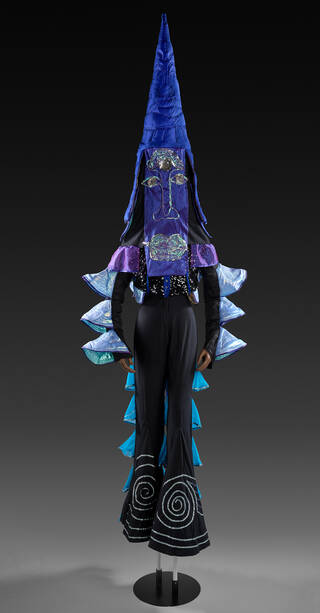
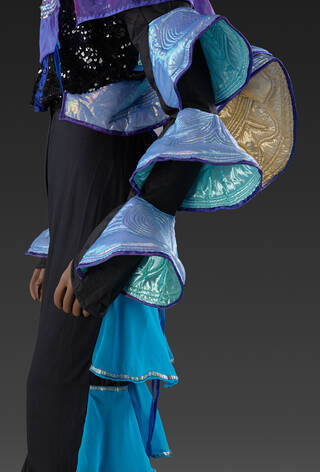
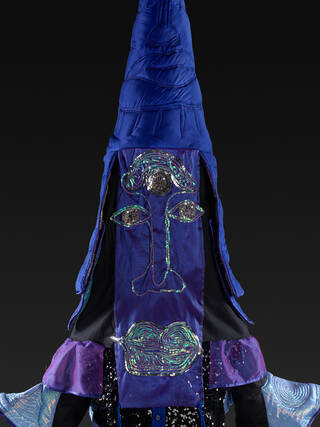
This incredible stilt walker costume was designed by the multi-disciplinary artist Keith Khan and worn by him at the Preston Carnival in 1988. It is based on the 'Jab Jab', a devil-like character central to Caribbean carnival celebrations, particularly in Grenada and Trinidad and Tobago.
The 'Jab Jab' is a form of 'Mas' or masquerade that dates back to the 18th century, where enslaved Africans were denied access to masquerade balls held by the French plantation owners. They instead staged their own mini carnivals, incorporating their own rituals and folklore as a way to mock and resist their colonial oppressors. Today, it serves as a powerful symbol of cultural pride and remembrance.
Resistance
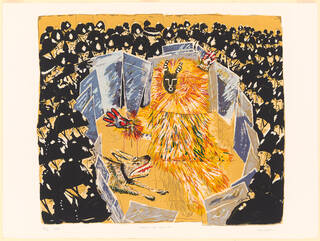
Resistance is a key theme in Tam Joseph's spectacular print Spirit of the Carnival (1988). It features a solo masquerader being kettled by the police at London's Notting Hill Carnival. Despite being enclosed by a wall of riot shields and confronted by a snarling dog, the masked performer continues their dance.
It is an image of Black cultural and political resistance and resilience in the face of an ever-increasing police presence at the Notting Hill Carnival during the 1970s and 80s. It can also be read as a commentary on negative portrayals of carnival – and by extension the Black community – in mainstream media.
Notting Hill Carnival
The Notting Hill Carnival is an annual celebration of Caribbean and Black diasporic cultures in West London. It is the world's second-largest street carnival after the famous Rio de Janeiro Carnival in Brazil, attracting around two million people who enjoy three days of parades, music, dancing and food over the August Bank Holiday weekend.
Its origins can be found in the late 1950s when Caribbean immigrants to London were faced with discrimination and racist abuse. Activists fought back, organising events to unite people, including an outdoor festival in 1966 – a street party which would evolve into the Notting Hill Carnival we know and love today.
Inspiration
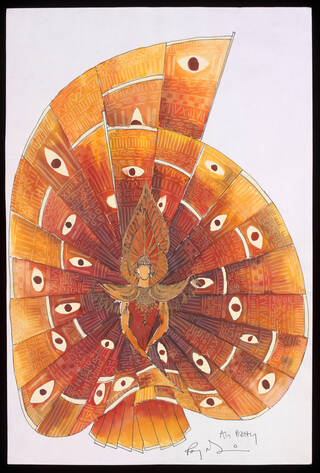
This spectacular and award-winning costume design by Ali Pretty and Ray Mahabir was for Radiance, the Queen in the 'Call the Rain' Carnival band in 1998. The costume design for the band was inspired by a quote from the English author Jeanette Winterson:
Call The Rain – drops of mercy that revive the burnt earth. Forgiveness that refills the droughted stream. The rain in opaque sheets falls at right angles to the sea. It is giddy this fluid geometry, the points, the solids, surfaces and lines that must undergo change. I will not be what I was. The rain transforms the water.
The costume for Radiance is a celebration of the fertile earth coming back to life after drought.
At the Notting Hill Carnival that year, 'Call the Rain' won first prize in the event's design competition with Ali Pretty and Ray Mahabir also awarded Best Designer of the Year.
Al Vandenberg
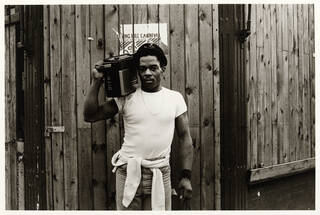
Al Vandenberg was an American photographer who had studied photography in New York alongside Alexey Brodovitch, Richard Avedon and Bruce Davidson. He abandoned his successful commercial career in the 1970s to take street photographs.
This image is part of his series On a Good Day, which brings together his London street portraits from the 1970 – 80s. The portraits perfectly capture the style and mood of the era, as well as the events taking place in the city, such as the Notting Hill Carnival advertised in the background of this photograph.
The V&A acquired 15 photographs from Al Vandenberg's On a Good Day series as part of the Staying Power project.
Anarchic energy
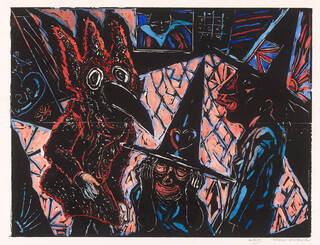
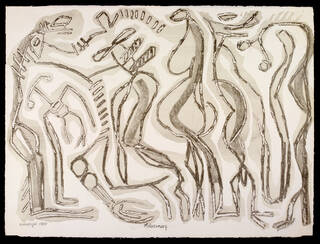
Mobocracy by artist and printmaker Timo Lehtonen perfectly captures the anarchic energy of carnival – the powerful and pulsating sounds of steelpans, soca (a genre of music from Trinidad and Tobago), and sound systems offering a space for raucous, joyous solidarity and cultural defiance.
Cultural identity is a recurrent theme in Lehtonen's abstract designs, describing his work as an "attempt to illuminate the relationship between creativity and a sense of belonging".
John Lyons
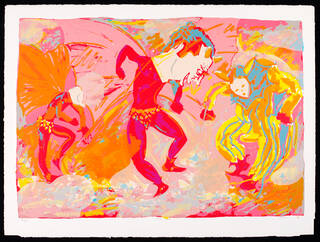
The Trinidadian poet and painter John Lyons has been producing vibrant and dramatic compositions that capture the spirit and vitality of Caribbean culture for over six decades.
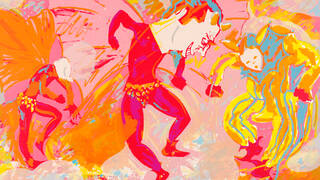
An enduring theme in his work is the masquerade. In this screen print we can see three masqueraders energetically dancing – the central figure 'Jab Jab', the devil disguised as a clown.
In this film, we take an intimate look inside Lyon's studio, writing shed, and kitchen, and experience his unique creative process that blends painting, poetry, cooking – and most importantly – love. Learn why mistakes are essential, why stepping away can spark inspiration, and how collecting objects can fuel new ideas.