It feels strange to imagine something so familiar to us as YouTube on public display in a museum. Strange, maybe because it isn't considered old (by museum standards) or even a physical object – two things traditionally associated with museum collecting – but also because it's been removed from its everyday environment: us accessing and interacting with its content on our own devices. In this new context, the object has gained a different set of values. Here, it is less about the individual stories uploaded, viewed, liked, commented on and shared, and more about its own story and the important role it has played in transforming the ways in which individuals and communities come together around content.
The V&A is no stranger to the challenges of collecting and displaying digital objects, having previously acquired examples such as the reproductive health app Euki in 2019 and the social media platform WeChat in 2017. The acquisition of the earliest available YouTube watch page featuring ‘Me at the zoo’, dated 8 December 2006, captures a significant moment in the history of the internet and web design – the shift from a read-only internet to one centred on user-generated multimedia content, social interaction and collaboration, otherwise known as Web 2.0.
YouTube emerged at a time when increasingly reliable and fast broadband access of the 2000s replaced the slow dial-up internet of the 1990s. With the rise of access to web and digital cameras, this period also saw more people starting to record and share videos documenting their daily lives and other significant events. YouTube was registered as a company on 14 February 2005 and launched its first website in May that year. Founded by Jawed Karim, Chad Hurley and Steve Chen, who were among the first team of developers and designers at the financial technology company PayPal, it was initially intended to provide a more user-friendly interface to upload and watch videos. First in the form of a dating website, it very quickly evolved into a repository for all types of videos. Insights into how users were interacting with the platform soon led to a redesign and the implementation of an embedded video player and interactive features, such as share buttons, ratings, a comments section and a related videos section. YouTube wasn’t the first and only video sharing platform available in the mid-2000s (see also Myspace), but its early efforts to champion community building and participation created interaction design patterns for social media and other platforms still in use today.
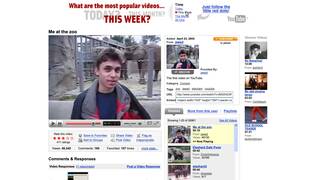
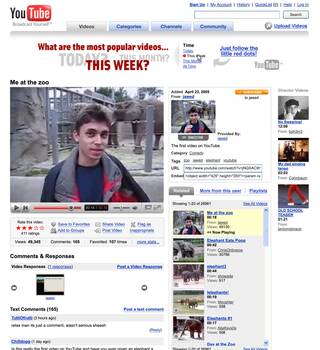
Despite a significant transformation of the underlying technologies, elements of the early YouTube watch page remain at the centre of the platform’s design and function today. The 2006 page shows the logo top left, followed by two rows of navigation menus, a banner ad and one large column on the left of the page containing the video player. Comments sat below the video player in the same column, and to the right there were two columns for related and suggested videos. This simple, functional and lightweight interface was characteristic of the aesthetic of web design of the era. At the same time, a growing focus and understanding of usability principles enabled users to easily interact with platforms which increasingly depended on their participation and content creation.
YouTube grew rapidly and soon attracted the attention of other tech companies interested in the growing world of online video. Less than two years later in October 2006, Google acquired the company for $1.6 billion. Today, YouTube is the largest repository of videos and second most visited website globally.
But what exactly has entered the V&A collection?
YouTube in the collection is made up of three separate objects, and a complex process of reconstruction was needed to make the watch page work as it would have done in 2006. The three parts are:
1. The original front-end code as captured by the Internet Archive on 8 December 2006
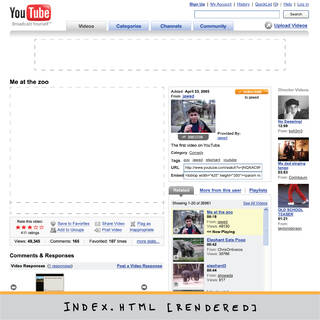
...and the video player built to run on Adobe Flash Player

2. The video file for ‘Me at the zoo’

3. YouTube adverts from December 2006 and January 2007

The art of reconstruction
Reconstructing the early watch page was a joint effort between V&A curators and conservators, YouTube’s User Experience team and interaction design studio oio.
A YouTube watch page is a dynamic object that changes on every visit, and it was vitally important that this was taken into account when considering what was to be brought into the collection. Code found in YouTube’s informal design archive was initially considered as a possible source for the reconstruction. However, lacking evidence of its deployment on YouTube servers, the decision was made to retrieve code from the Internet Archive’s Wayback Machine – an archive of the internet’s web pages from 1996 onwards. The chosen code was served on 8 December 2006, giving the museum certainty of the metadata it would present in the object.
The main challenge of the reconstruction process was working through the technological obsolesce of the underlying technologies that sustained YouTube at the time. This included YouTube’s custom video player, designed by Ches Wajda, that was built to run on Adobe Flash Player. To bring its functionality back, despite Adobe Flash Player no longer being supported by modern browsers, the team used the Flash emulator Ruffle. The benefit of this open-source project is that it’s built collaboratively and continuously maintained, which makes it less vulnerable to software obsolesce and, to some degree, helps futureproof an object the museum aspires to keep running in perpetuity.
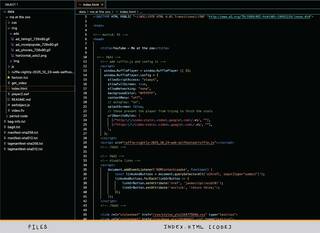
This and other interventions into the code required establishing a rigorous method for documenting modifications of the source code. Labelled comments in HTML code enable future researchers, conservators and curators to understand the work undertaken and the logic behind it so that, if needed, it can be reversed or updated. This is a key tenet of conservation that the V&A seeks to apply across its collections, including the digital.
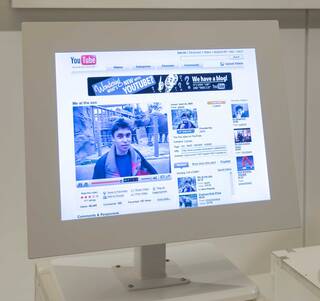
A separate set of challenges arose when working though the contexts in which the object is to be displayed and made accessible. Contemporary browsers use minimal user interface (UI) elements for scroll bars and buttons, while the pixel density of contemporary screens allow for extremely sharp rendering of text and image. The first of these issues was solved by a browser extension that replicates UI elements common at the time. The second was addressed directly in gallery by using display technology of lower resolution than what is standard today. This attention to detail is part of the museum's commitment to documenting how the experience of the internet has changed over the last 20 years.
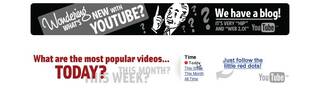
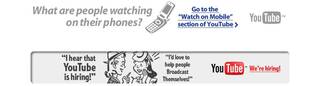
When looking through YouTube’s informal design archive, a serendipitous discovery meant that adverts promoting YouTube’s own features and blog, dated December 2006 and January 2007, could be used to fill the otherwise empty ad banner in the reconstructed page. The playful tone of the adverts is reflective of YouTube’s early years and the informality that characterised the corporate culture of the internet in the mid 2000s. Distinguishing the historical value of these files was an important part of the collaboration between YouTube and the V&A. The adverts have been added to the V&A collection, joining already extensive holdings of advertising and graphic design.
On completion of the reconstruction and to comply with the formalities of the museum’s cyber security and data compliance standards, all object files were delivered via a PIN authenticated encrypted hard drive.

As a cultural and social phenomenon, the YouTube watch page is not only emblematic of Web 2.0 and the rise of user-generated content, but also a prescient sign of what would become the creator economy and platform capitalism. It reveals the ways in which early design decisions would become central to broader economic and cultural systems that define contemporary life.
The tech industry’s focus on growth and innovation gives it a pace that makes looking back and holding on to its history uncommon. This acquisition is an exciting opportunity to understand the rise of digital platforms and the history and design of the web. As technology continues to develop ever faster, the V&A aims to be a place for the understanding of how our designed world transforms our everyday and shapes the society of tomorrow.
See the object on display
The YouTube watch page is on display at V&A South Kensington as part of the Design 1900–Now gallery and V&A East Storehouse.
Find out more about digital art and design the V&A