James was born in 1907 into a wealthy family who lived at an enormous estate at West Dean in Sussex. His mother, Evelyn Forbes, was a Scottish socialite. His father, William James, had inherited a fortune from American railways and metals. Rumours of royal parentage abounded but were unproved. In 1912 William James died, leaving his infant son, Edward, a vast fortune which Edward inherited when he came of age.
Attending university in Oxford, England, James was a contemporary of writers Evelyn Waugh (1903 – 66) and John Betjeman (1906 – 84). While studying he wrote a book of poems, and after graduating established a publishing house, James Press, and published his friend Betjeman’s first books of poems.
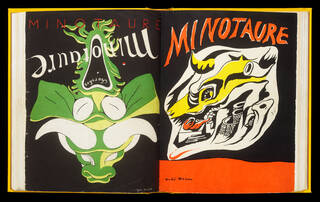
Poetry led James towards surrealism, a literary and artistic movement founded in Paris in 1924 inspired by the psychoanalysis of Sigmund Freud (1856 – 1939) and the politics of Karl Marx (1818 – 83), which explored the liberating possibilities of dreams, the irrational, and the unconscious. These topics were explored by writers and artists in the surrealist magazine Minotaure, to which James contributed poetry and articles, as well as providing financial support.
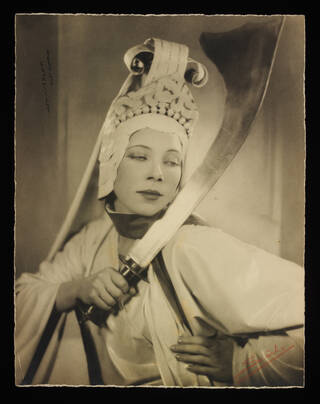
James’ entry to surrealist circles came through his involvement in the theatre. In 1931, James married the Austrian-born ballerina and actor Tilly Losch (1903 – 75). The marriage was a fiasco and would end in acrimony and accusations, and ultimately the divorce courts, in 1934. The previous year, in a bid to try and please his wife, James became the patron of Les Ballets 1933, an avant-garde ballet company founded by Boris Kochno (1904 – 90) and George Balanchine (1904 – 83). Following in the footsteps of the renowned Ballets Russes, Les Ballets 1933 worked with modern artists on their sets and costumes.
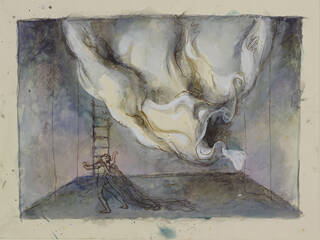
For the fantastical ballet L’Errante, in which Losch played the central role in a long green dress, the surrealist artist Pavel Tchelitchew (1898 – 1957) created an innovative set featuring projections onto gauzy fabrics. His design shows the final dream-like moment of the ballet, when a male dancer climbs a rope ladder into the sky while a falling curtain of white silk obscures the woman.
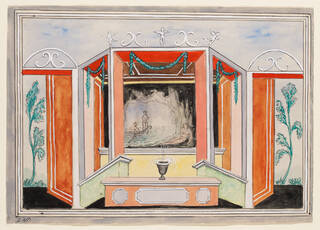
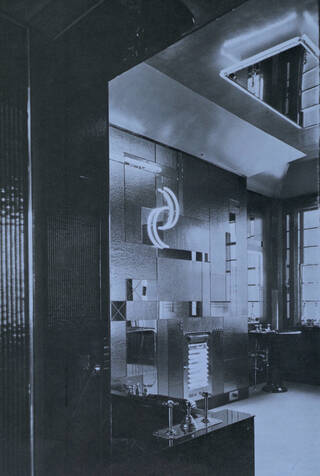
James brought home this fascination with surrealist design. His London townhouse at 35 Wimpole Street, and Monkton House on the grounds of West Dean, became canvases for the avant-garde. Wimpole Street was notorious for the bathrooms, one for James himself and the other for Losch. For his own, James hired the fashionable mural painter Geoffrey Houghton Brown (1903 – 93) to paint the walls in the style of those found in the ruins of the ancient city of Pompeii. In contrast, Losch’s bathroom was designed by the modern artist Paul Nash (1889 – 1946), and was all sharp lines, mirrored surfaces and neon lights.
When artist Salvador Dalí stayed at James’ London home in 1936, the pair dreamed up a number of items of surrealist furniture, including the iconic Lobster Telephone. Their ideas were realised when James renovated Monkton House, originally designed by architect Edwin Lutyens in 1902, where he wished to create ‘a complete surrealist house’ with the help of Dalí, alongside architects Christopher ‘Kit’ Nicholson and Hugh Casson, and decorator Norris Wakefield.
For the dining room, Dalí and James realised an idea from one of the painter’s artworks, Mae West’s Face which may be used as a surrealist apartment (1934 – 35, Art Institute of Chicago), which at its centre featured a sofa based on the performer’s lips. James commissioned a total of five Mae West Lips sofas, with those destined to sit either side of the fireplace at Monkton upholstered in bright red with black fringing across the green base, complemented by a matching green carpet and red pelmets fringed in black.


Each sofa was accompanied by a standard lamp formed of a stack of ten oversized golden champagne coupes. These cleverly conceal removable ashtrays, and feature bases decorated with ivy, berries and leaves.
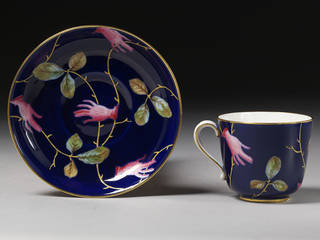
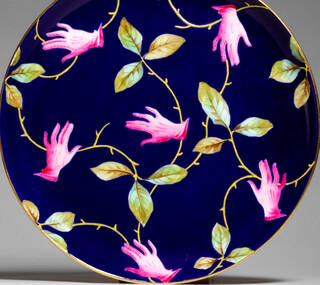
The pair also commissioned a dinner service from Royal Crown Derby in bone china, with trailing foliage and pink gloves. Disembodied hands and gloves were favoured motifs amongst the surrealists who enjoyed their uncanny appearance and gestural qualities.
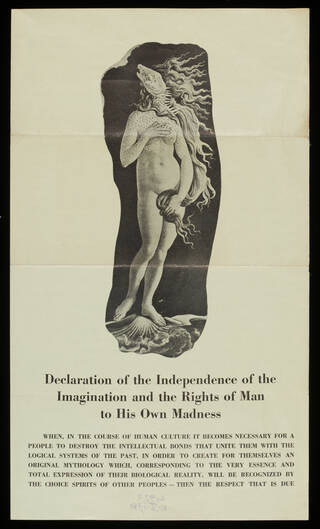
As Dalí’s primary patron, James paid the artist a salary in exchange for paintings and helped Dalí realise other projects. In the United States, James financed Dalí’s Dream of Venus pavilion at the 1939 World’s Fair in New York City. The installation was a surrealist reimagining of Botticelli’s famous Renaissance painting The Birth of Venus. When the Fair’s organisers denied Dalí his original vision of having a woman with a head of a fish at the pavilion’s entrance, he made a pamphlet denouncing this censorship.
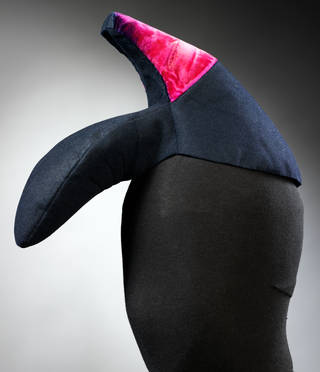
James was also a frequent shopper at Schiaparelli, the couture house in Paris’ Place Vendôme, complete with a shocking pink version of the Mae West Lips Sofa. In fact, part of James’ arrangement with the Dalís saw him buying Gala Dalí (1894 – 1982) – Salvador’s wife and business partner – haute couture clothing and accessories from Schiaparelli. This included the Shoe Hat, which was a collaboration between Salvador Dalí and designer Elsa Schiaparelli, inspired by Gala. James bought dresses designed by Dalí and Schiaparelli, including the Skeleton dress and the Tears dress for the Hollywood actor and model Ruth Ford (1911 – 2009). As Schiaparelli did not make menswear, James himself was limited to purchasing ties embellished with little zebras.
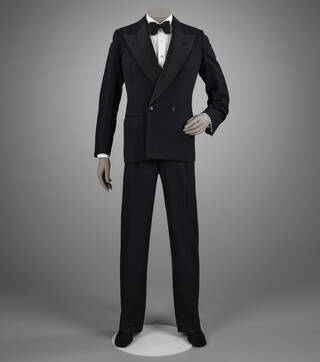
Portraits of James by his friend the surrealist artist René Magritte confirm that he was a snappy dresser. His surviving suits from the 1930s and 40s, bought from London tailors including Radford & Jones as well as from Saks Fifth Avenue on his visits to New York, range from country tweeds to black tie reflecting his varied, affluent lifestyle. Yet his wardrobe also contains garments which speak to his shifting sense of style in the post-war period, including waistcoats from the Balkan peninsula and ponchos from Mexico.
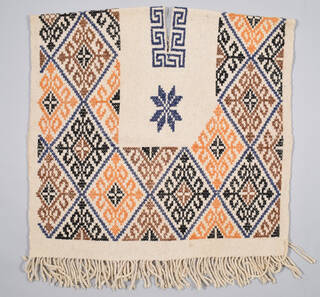
James had spent the war years in the United States and Mexico, from 1941 to 1945 splitting his time between Los Angeles and Mexico City and meeting many artists associated with surrealism living in the region. In 1945, he purchased a former coffee plantation on the edge of a rainforest in Mexico. Here he created La Pozas (The Pools) a fantastical garden, landscaped into a surrealist dreamscape and filled with extraordinary sculptures. Away from the sartorial expectations of British society, James incorporated garments and accessories of different styles, cultures and periods into his attire. Back home at West Dean, James created an educational institution providing training in conservation and in the visual and applied arts.
Edward James considered himself to have been born a surrealist and dedicated his life to not only dreaming, but realising the fantastic.