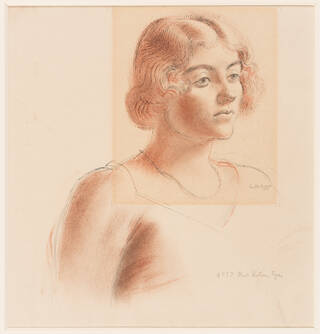
Agar was born to a Scottish father and American mother near Buenos Aires in Argentina. Moving to London at the age of seven for her education, her artistic talents were soon recognised and encouraged. Rather than taking the path expected by her wealthy family, Agar studied with the sculptor Leon Underwood. His chalk drawing of Agar portrays a thoroughly modern and self-assured young woman with a fashionable bobbed hairstyle. Agar then attended the influential Slade School of Art in the early 1920s, expanding her circle to include many major figures in British modern art, including photographer Cecil Beaton, and painter Paul Nash, with whom she later had a relationship.
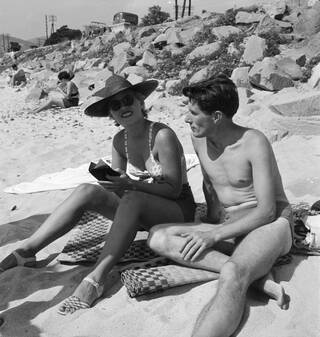
Agar completed her artistic education in Paris where she met Spanish painter Pablo Picasso, Romanian sculptor Constantin Brâncuși and French writer André Breton. The latter was the self-appointed leader of Surrealism, a literary and artistic movement that rejected rationalism and embraced the unconscious. Agar and her partner, the Hungarian writer Joseph Bard (whom she married in 1940), continued their cosmopolitan friendships after they returned to live in London. They spent time on holiday with Dora Maar and Picasso, Lee Miller and Roland Penrose, Ady Fideline and Man Ray, Nusch and Paul Éluard.
In the early 1930s Agar exhibited with the secessionist London Group and had her first solo exhibition in 1933. Despite her closeness with surrealist friends, she was something of a reluctant participant in the movement. Agar claims to have been rather surprised when in 1936 the organisers of the London International Surrealist exhibition, Penrose and Herbert Read, came to visit her studio. In her autobiography she recalled, ‘One day I was an artist exploring highly personal combinations of form and content, and the next I was calmly informed I was a Surrealist!’ She showed three paintings and five ‘objects’ alongside British artists selected by Read and Penrose, and established surrealists from mainland Europe including Salvador Dalí and René Magritte. The exhibition was a sensation, and on its opening day stopped traffic on Piccadilly in central London.
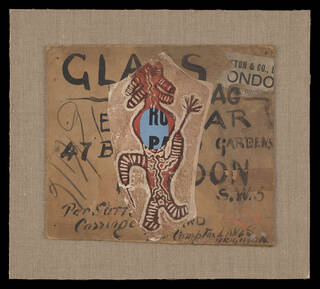
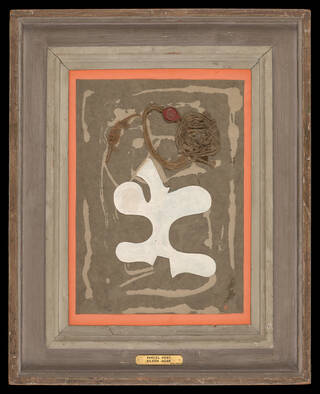
Agar painted throughout her life but relished bringing together previously unconnected found objects through collage and its sculptural sister assemblage. In her collages, she would use images and texts torn from magazines and other publications, alongside packing materials and wastepaper. One collage, evocatively titled Artist Rampant, even features her own address. Another, Parcel Post, made during the Second World War, features a piece of string with a fixture labelled ‘CERTIFIED SEED’. This element might suggest the ‘germination’ of a new idea produced by the unexpected meeting of everyday objects.
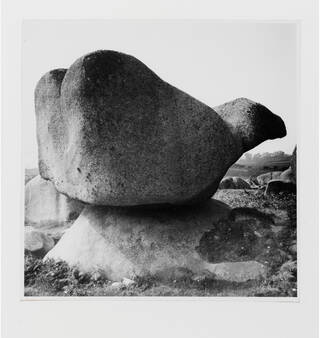
Much of Agar’s art was inspired by the natural world. As she outlined in her autobiography, ‘Surrealism for me draws its inspiration from Nature...you see the shape of a tree, the way a pebble falls or is framed, and you are astounded to discover that dumb nature makes an effort to speak to you, to give you a sign, to warn you, to symbolise your innermost thoughts.’ In her photography, she sought out natural forms with uncanny appearances, such as the Bum-Thumb Rock she photographed at Ploumanach in Brittany in northern France in 1936.
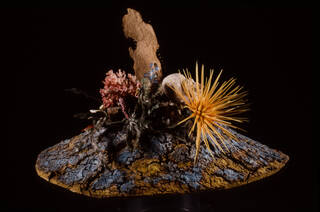
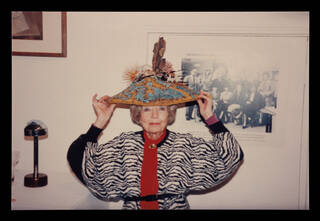
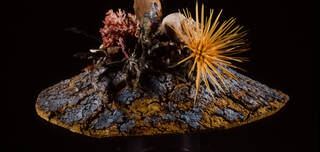
Agar was particularly fascinated by the sea and loved to beachcomb in Cornwall and on holiday with friends in the south of France. In 1936, she made a Ceremonial Hat for Eating Bouillabaisse, a traditional Provençal fish stew originating from the French port city of Marseille. To create it, Agar used a cork bowl that she picked up in St Tropez, which she covered with various marine objects including coral, seashells, fishbone, even a spiky sea-urchin. In an earlier iteration it even had a lobster tail, a motif favoured both by fellow surrealists Salvador Dalí and Elsa Schiaparelli. Agar wore this hat on television in 1948, walking through the streets of London and turning heads. In a time before performance art, this was a radical gesture.
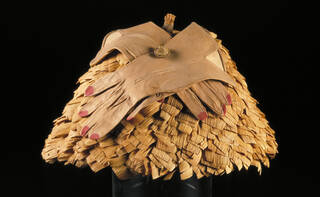
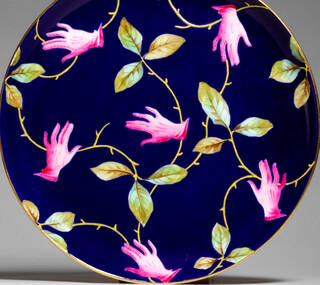
Fashion was a means through which Agar could blur the boundary between life and art. She wrote in her autobiography, ‘The Surrealist women, whether painters or not, were […] elegant and dressed with panache, caring about clothes and their surroundings, however strange the interiors. […]. The juxtaposition by us of a Schiaparelli dress with outrageous behaviour or conversation was simply carrying the beliefs of Surrealism into public existence.’ Agar was evidently inspired by Schiaparelli as in 1938 she wore tan gloves with scarlet nails – imitations of Schiaparelli’s iconic design from Winter 1936 – to the opening of a Magritte exhibition in London. Given Magritte’s fondness for using accessories like hats and shoes in his paintings in exchange with body parts this was an appropriate choice, and even drew comment in a newspaper. Agar later attached the gloves to a straw hat, fastened with a fossil brooch, to create the Glove Hat.
Later in life, Agar would produce an outfit for herself with textile designer Susannah Cartwright. The pair looked through Agar's portfolios for inspiration for the textile design, which was finalised by Cartwright. Agar wore the ensemble for the launch of her 1988 autobiography A Look at My Life, and also when interviewed about the book by presenter Jonathan Ross on The Last Resort on Channel 4.
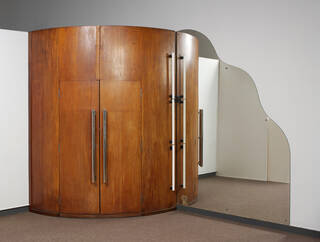
Agar also brought her surrealist eye into her own interiors at her home and studio in Bramham Gardens, Earl’s Court, not far from V&A South Kensington. The interior was a kind of enormous assemblage, bringing together her own artworks with furniture designed for her by the architect Rodney Thomas. Her extraordinarily chic art deco furniture, including a curvilinear wardrobe with a scallop-edge mirror, is part of the V&A collection. As commented in an illustrated article about Agar printed in The Bystander in 1940, ‘In any case she is a confirmed picker-up of junk-shop trifles and has a considerable talent for combining irrelevant objects [which] bring to her terracotta-and-blue studio an atmosphere of bright fantasy into which her white cat with its odd eyes fits perfectly.’