Its use of everyday materials connects to Marcel Duchamp's concept of the 'readymade', elevating ordinary objects to the status of high art and challenging expectations about what art should be, what it should look like, how it should be made and by whom. Collage is at once simple and complex, and full of contradictions: it can reveal and hide, construct and dismantle, and be both violent and reparative.
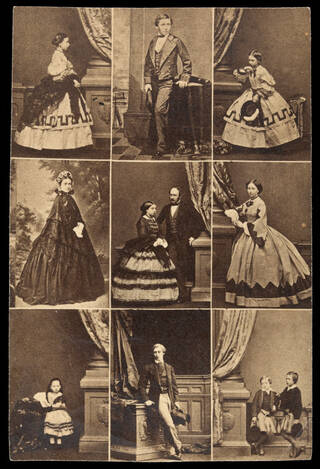
Collage defies convention and eludes easy definition. It relates to the development of 'material culture', a concept which emerged alongside 19th-century mechanical and industrial innovations in Europe, including mass paper production, advancements to the printing press and the invention of photography. The 1850s represented a golden age of commercial photographic inventions, leading to the 'carte-de-visite' (a small portrait photograph mounted on a piece of cardboard) in 1854. This was a revolutionary print medium that would democratise photography and become a key material in 1860s crafting. In many ways, photography was and still is collage's perfect partner.
However, collage's inherent nature as a democratic and accessible medium has presented historians with a conundrum. Before the Modernists began experimenting with "stuff stuck to other stuff" (to quote art historian Freya Gowrley), makers were doing the same all over the world – but these individuals, mostly women, folk and Indigenous artists, have historically been relegated to the margins of art practice. Art history suggests a habitual, gendered separation of collage techniques: the conceptual 'high' art form developed by Picasso and Georges Braque in 1912, and the 'low' craft or hobby version practised mostly by women.
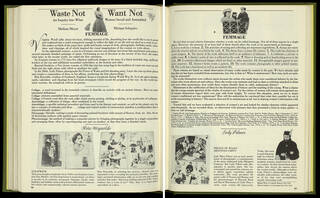
Against the backdrop of rising activism and feminism, two American artists came together to challenge this marginalisation. Assemblage artist Miriam Schapiro and painter Melissa Meyer collaborated in 1977 to write the manifesto Waste Not Want Not: An Inquiry into What Women Saved and Assembled – FEMMAGE. Political and provocative, it argued that a woman's artistic relationship to collaging predated that of the Modernists and was profoundly linked to lived experience – a transformational form of making born from resistance, survival and obligation.
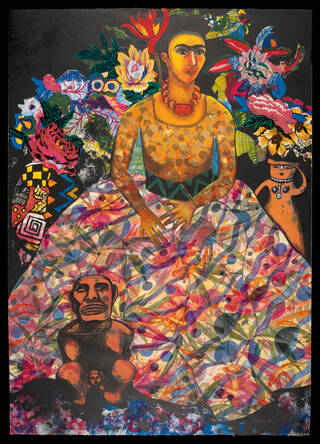
Their rationale emerged at the pinnacle of America's second-wave feminist art movement, which had developed in the late 1960s amid the fervour of the Civil Rights Movement, anti-war demonstrations and queer rights protests. Both practitioners were part of a significant group seeking to challenge the exclusionary art industry, write their own history, and reclaim femmage techniques as a defiantly feminist, rather than feminine, art experience.
Frustrated by the lack of adequate terminology, Schapiro and Meyer used the term 'femmage' – a fusion of feminism and collage. They identified femmage materials, often found, collected and repurposed, as fundamental to women's lives, emphasizing how women saved and assembled "because leftovers yielded nourishment in new forms". They defined femmage as "activities as they were practiced by women using traditional women's techniques – sewing, piecing, hooking, cutting, appliquéing, cooking and the like – activities also engaged in by men but assigned in history to women". Their examples included an Iroquois woman applying quillwork to a buckskin bag in 1775, 18th-century German nuns who cut and pasted delicate lace onto paintings of saints, and Lady Filmer, a 19th-century British socialite who was arguably one of the first to create a photomontage.
The manifesto was first published in the 1977 – 78 edition of Heresies, a New York-based journal examining art and politics from a feminist perspective. Alongside their essay sat relevant articles about Indigenous textile art and Lucy Lippard's Making Something from Nothing, which similarly argued the significance of saving and assembling within women's artistic and lived experiences.
Schapiro and Meyer argued that the materiality of collage was crucial. Salvaged materials were accessible, convenient and symbolic: "Each cherished scrap was a reminder of its place in a woman's life." These objects held tangible connections to emotion and history; embedded in women's lives and often sourced from domestic settings. Being confined to raising families, lacking independent income, or living in poverty provided bittersweet inspiration. Schapiro and Meyer suggest the act of saving and reimagining signifies a woman's "pride, desperation and necessity", and that a woman's circumstance – social, familial, economic, geographical – were key influences within femmage techniques.
Photography and Femmage
While collage's best-known origin story dates to 1912, its fundamental process of layering appeared centuries earlier – around 1112 AD, the Japanese poet Ise produced prose on collaged papers for an anthology of poems. European experiments with paper and chemistry later produced various print processes, and the rise of photomechanical printing in the 1880s made mass reproduction possible.
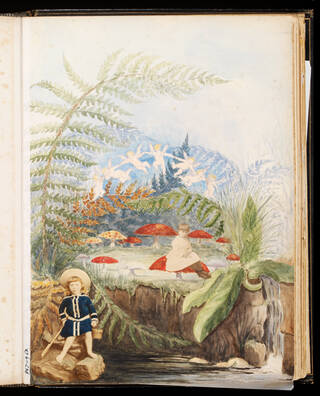
Photographic collage emerged alongside these innovations. Early adopters like Henry Peach Robinson and Oscar Gustav Rejlander created 'combination prints' from multiple negatives. In the 1860s, wealthy Victorian women began using photographs in elaborately illustrated albums as an extension of their 'feminine accomplishments'. For 19th-century British women such as Kate Gough, Lady Filmer and Edith Paget, the photo album became a significant site for self-expression and memory-making.
These early composites developed critical artistic roots after the First World War, through the Berlin Dada and Russian Constructivist movements. The Dadaists rejected bourgeois forms of artistic practice, choosing instead to call this technique 'photomontage', from the German monteur, meaning 'assembler'. These artists took photography's origins in documentation and subverted its capacity for 'truth telling' into an abstracted visual language. For artists such as Hannah Hoch, Valentina Kulagina and Vavara Stepanova, photomontage became ideological as well as technical – an intervention that could conflate, confuse and disrupt.
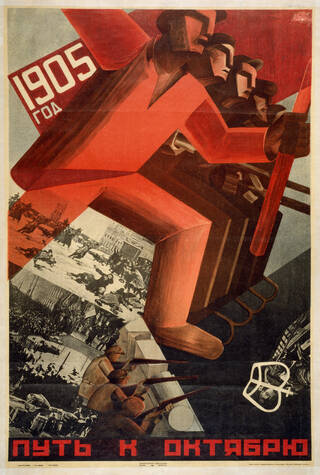
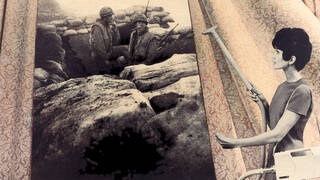
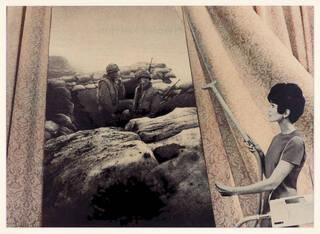
Artists associated with the Women's Liberation Movement, including Martha Rosler and Penny Slinger, also embraced photography's subversive and transformative nature to probe questions of identity and femininity.
"I started making photomontages that addressed the images of women, which of course is political, and then I realized I could make photomontages addressing the question of war."
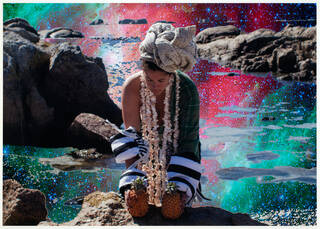
For artists of colour, such as Alberta Whittle and Frida Orupabo, photomontage techniques can be read as a tool for reclamation and emancipation – a way to free the Black and Indigenous female body from histories of subjugation. Orupabo describes collage as important "because it makes possible alternative ways of seeing and imagining". The act of cutting may be violent, yet the process leads to new and reparative ways of existing.
This is an edited extract from the V&A/Thamses & Hudson publication Cut Out by Fiona Rogers, Parasol Foundation Curator of Women in Photography